





New York
Custom Millwork NYC: Costs, Ideas & Expert Advice
10.20.2026
10.20.2026


In This Article
New York City homes have architectural personalities that are difficult to replicate. The carved pocket doors of a Brooklyn brownstone, the decorative molding of a prewar Manhattan apartment, and the restrained woodwork of a contemporary loft each call for a different approach to custom millwork. Done well, new woodwork can look as though it has always belonged in the space, even when the original details disappeared decades ago.
But getting that result takes more than choosing the right molding profile or wood species. Proportions, craftsmanship, and careful planning determine whether custom millwork complements your home's architecture or feels like an expensive addition that doesn't quite fit.
In many historic NYC brownstones, large wooden pocket doors originally separated the front and rear parlors, allowing the rooms to function independently or open into one continuous space.
Original doors are often worth restoring. Worn rollers, damaged tracks, and shifted framing can interfere with their operation even when the wooden panels remain in good condition.
Where the doors have disappeared, custom fabrication offers an opportunity to recreate them. Matching the panel profiles, casing thickness, and opening dimensions matters more than elaborate carving.
In a brownstone parlor, raised-panel wainscoting can restore architectural detail removed during an earlier renovation. Simpler recessed panels are often a better match for prewar apartments with restrained trim.
Panel heights should respond to the ceiling, windows, and existing baseboards. Standardizing the height without studying those relationships can produce awkwardly narrow panels around openings.
Full-height wood paneling is another option for a study, dining room, or library. Contemporary apartments can benefit from restrained flat panels, while stained wood installations demand careful grain matching. Adjacent panels with poorly matched veneer can disrupt an otherwise thoughtful design.
In NYC prewar apartments, surviving molding provides the best reference for new work. A millwork specialist can measure an original profile and reproduce it using custom milling knives or other fabrication methods.
Historic profiles can be surprisingly complex. What appears to be one large piece of crown molding may actually consist of several smaller pieces assembled into a continuous design.
Picture rails are another feature worth considering. Besides contributing to a room's period character, a properly installed rail system can accommodate hanging artwork without repeatedly fastening into plaster walls.
Design a Home That’s Uniquely Yours
Block can help you achieve your renovation goals and bring your dream remodel to life with price assurance and expert support.
Get Started
Carved newel posts, turned balusters, hardwood handrails, and decorative stair trim are among the most distinctive features of historic NYC brownstones.
Restoration might involve repairing damaged treads, reproducing missing balusters, refinishing the handrail, or fabricating replacement trim to match surviving details.
Staircase work also carries structural and safety requirements. Handrail heights, guard openings, and stair geometry must be evaluated against applicable code requirements. Reproducing a historic railing involves more than copying its appearance.
For larger townhouse renovations, read our guide to Brooklyn brownstone renovations for insights into how original architectural details fit into structural work and modernization.
In a brownstone parlor, bookcases can flank a fireplace, with their cornices and baseboards aligned to existing architectural trim. In a prewar apartment, shallow cabinets can make use of an alcove without reducing circulation space.
Contemporary apartments offer different possibilities. Full-height cabinetry with flush doors, concealed storage, and carefully aligned panel joints can introduce architectural structure to an otherwise plain room.
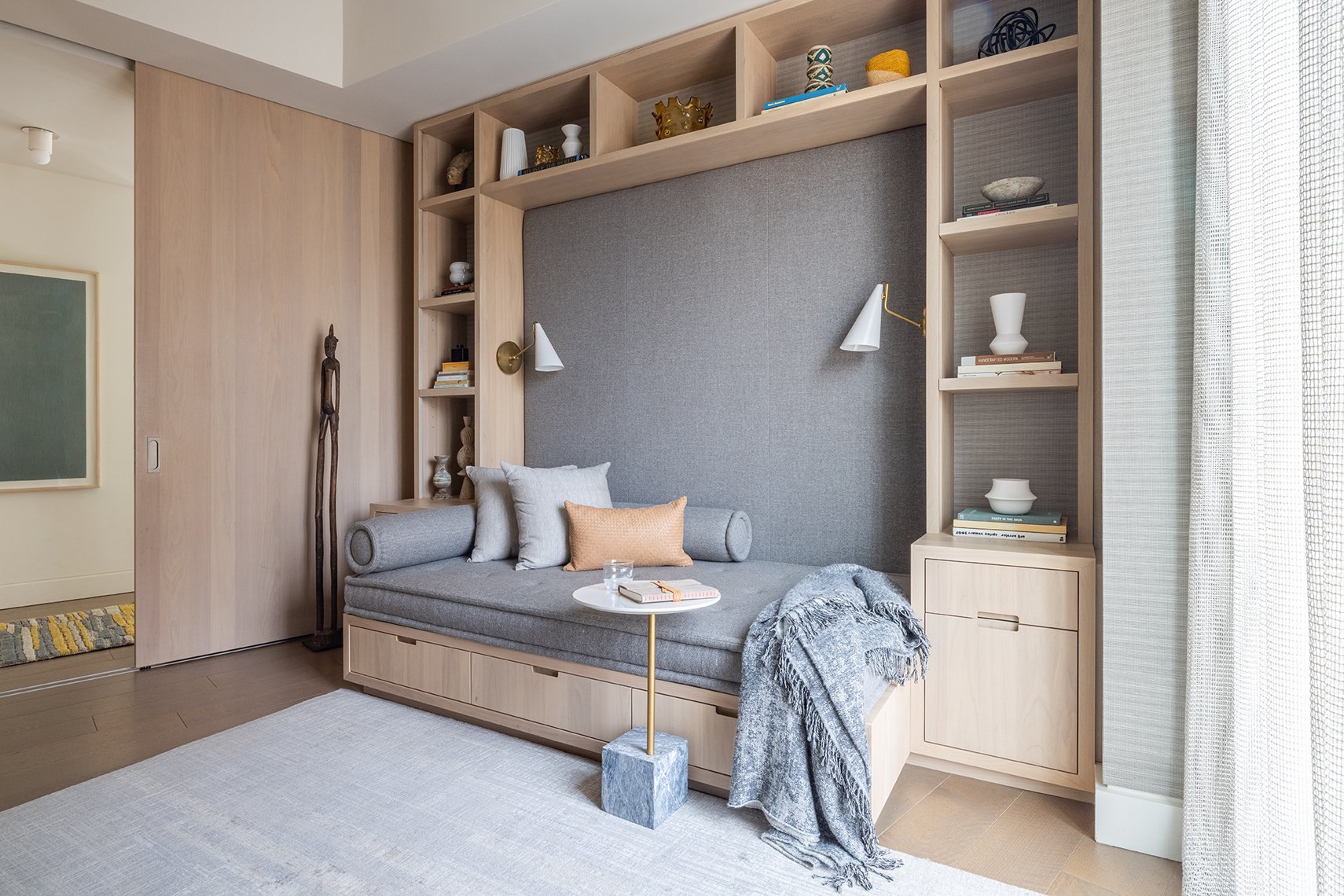
A New York renovation by KS Renovation Group offers an example of architectural built-ins with a contemporary aesthetic. Light-wood shelving frames a recessed daybed, with storage drawers underneath and matching cabinetry beside it. The aligned shelving and consistent finish give the entire installation a cohesive appearance.
A bookcase that stops just below the ceiling can look unfinished when a full-height design would have been more appropriate. Shelving placed too close to a decorative mantel can also crowd an attractive focal point.
For a more detailed breakdown of installation methods and costs, explore the cost of installing built-in bookshelves.
Custom millwork costs depend on the complexity of the design, materials, fabrication requirements, and existing site conditions. A straightforward run of painted trim and a fully paneled brownstone parlor belong in entirely different budget categories.
The following ranges offer preliminary budgeting guidance for common NYC architectural millwork projects.
| Millwork project | Estimated cost | Major pricing factors |
|---|---|---|
| Crown molding | $80 to $200 per linear foot for simpler installed profiles | Profile complexity, preparation, finishing |
| Wainscoting | $300 to $800 per linear foot for simpler custom paneling | Panel height, materials, detailing |
| Full-height wall paneling | $400 to $1,200 per linear foot for relatively straightforward designs | Ceiling height, panel design, finish |
| Built-in bookshelves and cabinetry | $3,500 to $10,000+ per substantial installation | Size, construction, doors, hardware |
| Historic pocket doors and casings | Custom estimate per opening | Fabrication, restoration, tracks, matching trim |
| Staircase millwork | Custom estimate by scope | Balusters, carving, handrails, repairs |
The per-linear-foot figures are preliminary published pricing benchmarks, not standardized rates. For paneling, confirm the assumed height and whether installation and finishing are included. Historic restoration is harder to estimate because repairing a pocket-door track bears little resemblance to recreating carved hardwood doors.
For a real-world cost reference, this NYC residential millwork project has a published project price of $18,500 and a reported build time of two weeks. The figure represents the listed project total, not a per-linear-foot rate or a general benchmark for similar installations.
Reproducing historic molding profiles, cutting complex joinery, or matching new woodwork to existing materials requires specialized labor. Intricate carving, curved components, and hardwood finishes increase costs further.
NYC buildings introduce additional expenses. Installers may need to fit panels around bowed plaster walls or sloping floors, while elevator reservations, loading restrictions, and limited construction hours complicate delivery.
Request itemized estimates separating materials, fabrication, finishing, installation, and repairs to surrounding surfaces. That makes it easier to understand differences between contractors' prices.
Don't demolish original brownstone woodwork until you've established what can be repaired or reproduced. Many NYC homes retain doors, trim, paneling, and staircase details that would be expensive to recreate.
Extensive water damage, severe deterioration, or major layout changes can still make replacement the more practical choice.
For homeowners undertaking larger renovations, our article on prewar condo renovations in NYC discusses the complications of working with original architectural features.
Renovate with confidence every step of the way
Step 1: Personalize Your Renovation Plan
Step 2: Receive Quotes from Trusted Contractors
Step 3: Let Us Handle the Project Details

A $20,000 wall of custom cabinetry can still look poorly designed if the proportions are wrong. Oversized crown molding, awkward panel divisions, and trim that doesn't align with existing doorways are mistakes that expensive hardwood and beautiful finishes can't disguise.
This is particularly noticeable in older NYC homes. A Victorian brownstone parlor might have tall doors with substantial casings and deep baseboards. Introducing a narrow modern casing on one doorway creates an obvious inconsistency. Excessively ornate molding can be equally distracting in a simpler prewar apartment.
Use surviving architectural details to establish dimensions for new work, paying attention to where horizontal lines meet and how trim transitions around openings.
And resist adding decoration simply because you're paying for custom fabrication. A room with carved door casings, an elaborate mantel, and substantial crown molding may benefit more from restrained built-ins than another heavily ornamented feature.
A custom price tag is no guarantee of quality. Poor joinery, cheap hardware, and inadequate finishing can leave you with cabinetry that performs worse than a well-made standard product.
Solid hardwood is an excellent choice for doors, handrails, and molding, but humidity-related movement makes it less suitable for some large cabinet panels. Quality plywood provides dimensional stability for cabinet construction, while MDF offers a smooth surface for painted details. Hardwood veneers can deliver the appearance of natural wood over stable engineered substrates.
Paying for solid wood everywhere can increase expense without improving performance.
When reviewing a millwork proposal, focus on three details:
Once fabrication begins, correcting a measurement error can mean rebuilding an entire cabinet or remaking a run of panels. The contractor who takes measurements and prepares the shop drawings has as much influence on the finished result as the person producing the woodwork.
Prewar NYC apartments are rarely perfectly square. Plaster walls bow, floors slope, and ceilings change height across a room.
A large built-in requires measurements at multiple points. Narrow filler pieces or scribed trim can accommodate some irregularities, but substantial variations must be addressed during fabrication.
Final measurements also need to reflect the construction schedule. Leveling floors, replacing drywall, or changing baseboards can alter dimensions after an initial survey.
Shop drawings establish the dimensions, panel divisions, door swings, materials, and attachment methods that fabrication will follow.
For substantial millwork, review:
The contractor installing electrical wiring needs to know where cabinetry will go before the finished pieces arrive.
The Architectural Woodwork Institute's standards describe professional shop-drawing expectations, including construction and coordination requirements.
Locally fabricated millwork offers practical advantages when pieces need adjustments or replacement components. A nearby shop can often respond faster than a distant manufacturer with extended shipping schedules.
Ilya Suleymanov, co-owner of I & N Builders, a New York City renovation contractor, cautions homeowners about delays involving overseas cabinetry.

Something I tell people to avoid is cabinets that are made overseas. It'll take forever to come in, and when something does go wrong, it takes forever again to get anything back. So I usually say, 'Make sure that you're able to get them either locally or as a stock item.'
The same concern applies to specialty millwork components. Confirm where pieces are fabricated, how replacements are handled, and who takes responsibility for damaged or incorrectly sized materials.
Ordering too early can be as disruptive as ordering too late.
Co-op and condo approvals: Building management may require alteration agreements, contractor insurance, common-area protection, and service elevator reservations. These requirements are separate from city permitting. The NYC Department of Buildings identifies cabinet installation as work that generally doesn't require a permit, although structural, plumbing, and electrical changes can trigger additional requirements.
Radiators and building systems: Older apartments frequently have radiators, heating risers, and plumbing access points that affect millwork placement. Custom enclosures need adequate airflow and access for servicing. Concealing equipment permanently behind cabinetry creates maintenance problems.
Building access: A ten-foot panel is useless if it can't clear the building's elevator, stairwell turns, or apartment doorway. Large installations often need to be fabricated in transportable sections and assembled on-site, with joints incorporated discreetly into the design.
Reproducing historic molding, restoring pocket doors, or fabricating paneling for an irregular prewar room demands experience beyond ordinary cabinetry installation. Ask to see comparable projects, especially when commissioning detailed architectural reproduction work.
Three questions deserve particular attention:
Compare proposals based on actual specifications. The lowest number is difficult to evaluate when one contractor includes detailed drawings and installation while another provides only a fabrication allowance.
Block Renovation helps homeowners connect with vetted contractors for apartment remodels, brownstone renovations, and projects involving custom carpentry and architectural detailing. With detailed scopes and competitive contractor bids, New Yorkers can compare approaches and understand what's included before construction begins.
Remodel with confidence through Block

Connect to vetted local contractors
We only work with top-tier, thoroughly vetted contractors

Get expert guidance
Our project planners offer expert advice, scope review, and ongoing support as needed
Enjoy peace of mind throughout your renovation
Secure payment system puts you in control and protects your remodel

Renovate confidently with Block
Easily compare quotes from top quality contractors, and get peace of mind with warranty & price protections.
New York
Custom Millwork NYC: Costs, Ideas & Expert Advice
10.20.2026

New York
Brooklyn Basement Remodeling Costs: What to Budget
10.10.2026
New York
Prewar Condo Renovations: NYC Costs and Contractors
10.09.2026
New York
Apartment Gut Renovation NYC: A Unit Owner's Guide
10.06.2026
New York
Queens Kitchen Remodeling: Costs & Contractors
10.03.2026