





Countertops
Slate Countertops vs. Granite, Quartz and Soapstone
09.20.2026
09.20.2026


In This Article
You can walk through a countertop showroom and see dozens of granite and quartz slabs before anyone mentions slate. That can make slate appealing if you want something you don’t see in every kitchen, but it also means you may have fewer local examples to look at, fewer fabricators who work with it regularly, and more questions about how the stone will behave once it becomes a working kitchen surface.
Slate can be an excellent countertop material. It handles heat and household chemicals well, comes in distinctive muted colors, and has a matte character that is difficult to reproduce with engineered stone. But choosing it takes more homework than choosing granite or quartz because the quality of the particular slate matters, and its natural layered structure affects everything from scratching and edge damage to slab dimensions.
| Material | What distinguishes it | Typical installed cost |
|---|---|---|
| Slate | Matte natural stone with subtle color variation and a relatively quiet surface | About $50 to $100 per sq. ft. |
| Granite | Hard natural stone available in a very wide range of colors and patterns | About $40 to $140 per sq. ft. |
| Quartz | Engineered surface with consistent patterns and no sealing requirement | About $50 to $150 per sq. ft. |
| Soapstone | Soft, nonporous natural stone that develops a visible patina | About $70 to $120 per sq. ft. |
Those ranges are useful for early budgeting, but slab availability can change the equation quickly. A relatively inexpensive stone that requires an extra slab, additional seams, or a specialized fabricator can end up costing more than the square-foot price suggests, so the material quote only tells part of the story.
Granite has had decades to become a routine countertop material. Fabricators know it, suppliers stock an enormous range of it, and large slabs are readily available. Quartz goes even further toward predictability because manufacturers intentionally produce consistent slabs. With slate, you need to pay closer attention to the actual slab in front of you.
Slate is a metamorphic rock with a naturally layered structure. That layering allows it to split into thin, strong sheets, the same characteristic that made slate useful historically for roofing and blackboards. In countertop applications, however, the quality and structure of the particular stone determine how prone it is to scratching, cleaving, flaking, or chipping. The Natural Stone Institute's guidance on slate notes that slate and soapstone are both softer than many other dimension stones and are not known for especially high abrasion resistance.
So remember: two slabs both sold as slate can behave differently. Higher-quality slate that has undergone greater metamorphism tends to hold together more reliably than softer material that readily separates along its layers. Before ordering, look at the slab edges for signs of flaking and ask the supplier where the slate was quarried and whether that particular material has been used successfully for countertops.
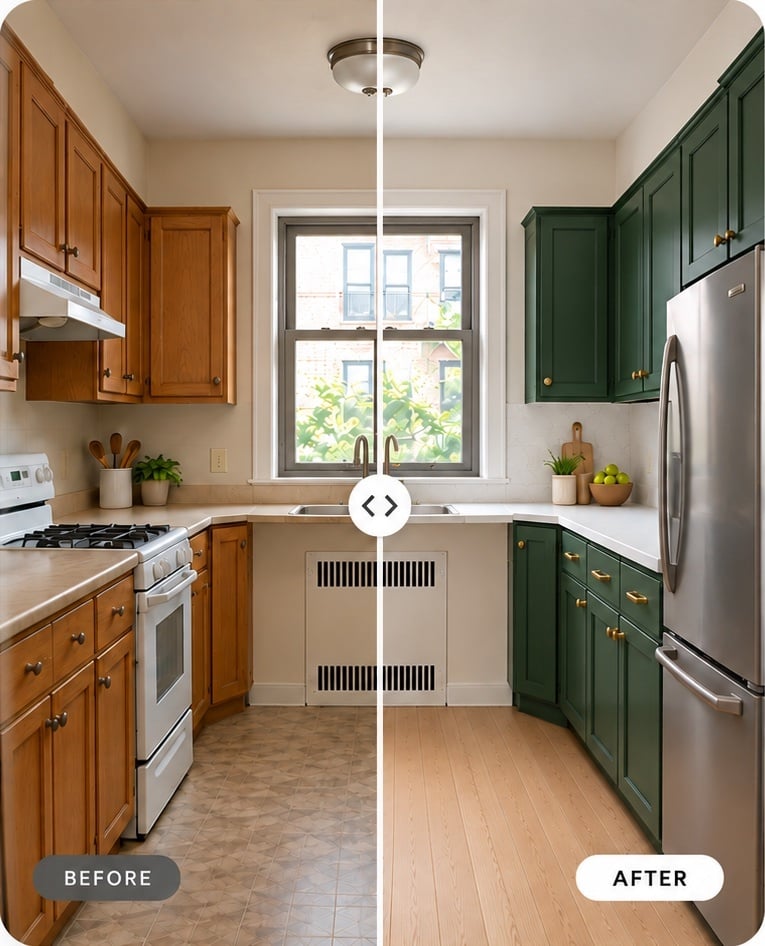
Both slate and granite are quarried stone, can tolerate the demands of a working kitchen, and can last for decades with reasonable care. Both also handle heat well, while slate has particularly strong resistance to household chemicals and acids.
Granite tends to have more visible mineral movement, speckling, veining, and color variation. Slate is usually more monochromatic and subtle. Blacks, charcoal grays, greens, purples, and muted reds are common, and the surface often has a soft matte quality rather than granite's familiar polish. One option isn't immediately better than the other, aesthetically.
Granite is hardest dimension stones commonly used for countertops, with excellent scratch resistance and strong resistance to normal kitchen heat. It is also produced in a huge range of slab sizes and patterns.
Slate is softer and more vulnerable to abrasion, while sharp impacts along an exposed edge can also reveal the layered structure of the stone. On scratch resistance, slab availability, and tolerance for rough treatment, granite has the advantage.
Think about a busy kitchen where someone slides a ceramic serving dish across the island, drops a heavy mug near the edge, then puts down a hot Dutch oven while dinner is being served. Granite is unusually forgiving of that treatment. Slate handles heat well too, but scratching and edge damage deserve more attention.
If everyone already uses cutting boards and trivets and you're comfortable with signs of wear developing over time, slate's softer surface may be manageable. In a kitchen that gets knocked around all day, granite is simply the safer choice.
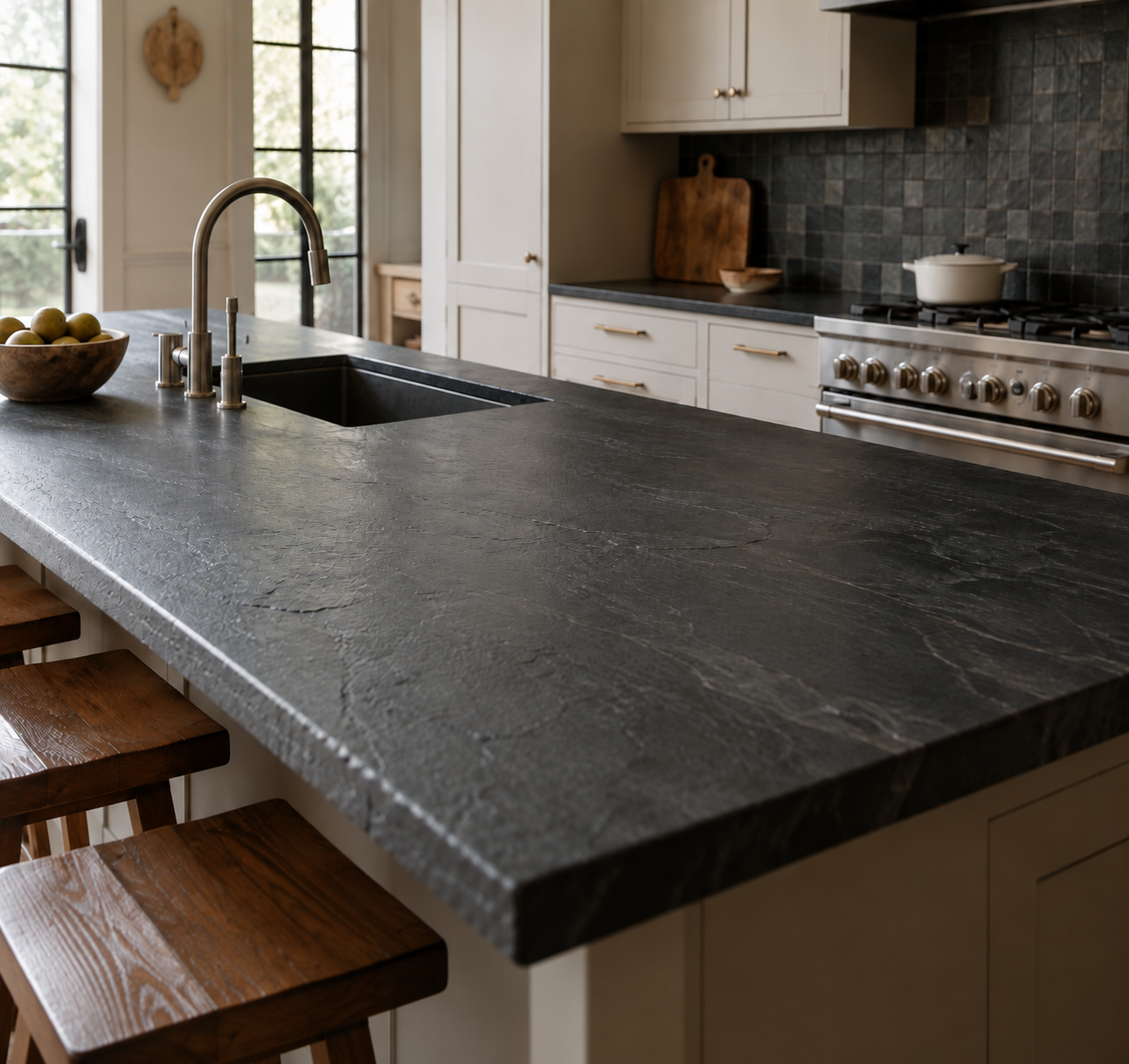
Quartz solves several of the uncertainties that come with natural stone. Because engineered quartz is manufactured rather than quarried as an intact slab, manufacturers can control the color and pattern much more closely. The surface is also low-porosity and does not need the periodic penetrating sealer commonly associated with many natural stones.
Slate is less predictable, and for some homeowners, that variation is part of the appeal. Put 3 slate slabs from the same general color family next to one another and you may see shifts in tone, texture, mineral character, or cleavage. If you want the countertop to look unmistakably like natural stone, those shifts can be a plus.
Quartz's resin content creates one of its clearest limitations. Engineered quartz should be protected from hot cookware because excessive heat can damage or discolor the resin binder, whereas natural stone does not contain that resin. Granite handles heat extremely well, and slate has a long history of use in applications where heat and chemical resistance matter.
You still should not make a habit of putting extremely hot pans directly onto any countertop because sudden concentrated temperature changes can stress natural stone too. For a kitchen where heat exposure is a frequent concern, though, slate and granite have an advantage over engineered quartz.
Design a Home That’s Uniquely Yours
Block can help you achieve your renovation goals and bring your dream remodel to life with price assurance and expert support.
Get Started
Slate and soapstone are easy to group together. Both are usually dark, matte natural stones, both have strong chemical resistance, and neither gives you the glossy, crystalline appearance associated with many granites. Once you live with them, though, they age differently.
Soapstone is considerably softer and scratches readily. Those scratches can often be sanded or blended into the developing patina, and mineral oil is frequently used to darken soapstone and make that changing surface more uniform.
Slate generally resists scratching better than soapstone, although it remains softer than granite. Its layered construction creates a different vulnerability because a hard impact can chip an edge or cause a thin layer to separate.
If these are the 2 materials you've narrowed your search to, Block's full comparison of slate vs. soapstone countertops gets further into how each surface wears over time.
A countertop sample tells you what a material looks like, but it tells you almost nothing about whether that material works with your kitchen layout. Slate slabs are often smaller than granite slabs, and some slate quarries produce material suitable primarily for tile because large intact sections are harder to obtain. That becomes important in a kitchen with a long perimeter counter or oversized island.
Consider an island planned at 10 feet long; a granite supplier may have several slabs large enough to fabricate the surface with minimal interruption, while the slate you love might only be available in dimensions that require a seam. That does not necessarily kill the idea, but it does mean you need the conversation with the fabricator before the cabinetry and island dimensions become fixed.
Ask for the answers to these questions before ordering:
A dramatic slab can make you forget that countertops are fabricated objects, so it helps to bring the conversation back to sink cutouts, corners, edge profiles, overhangs, seams, and transport into the house. Those details are where a material choice starts interacting with the rest of the renovation.
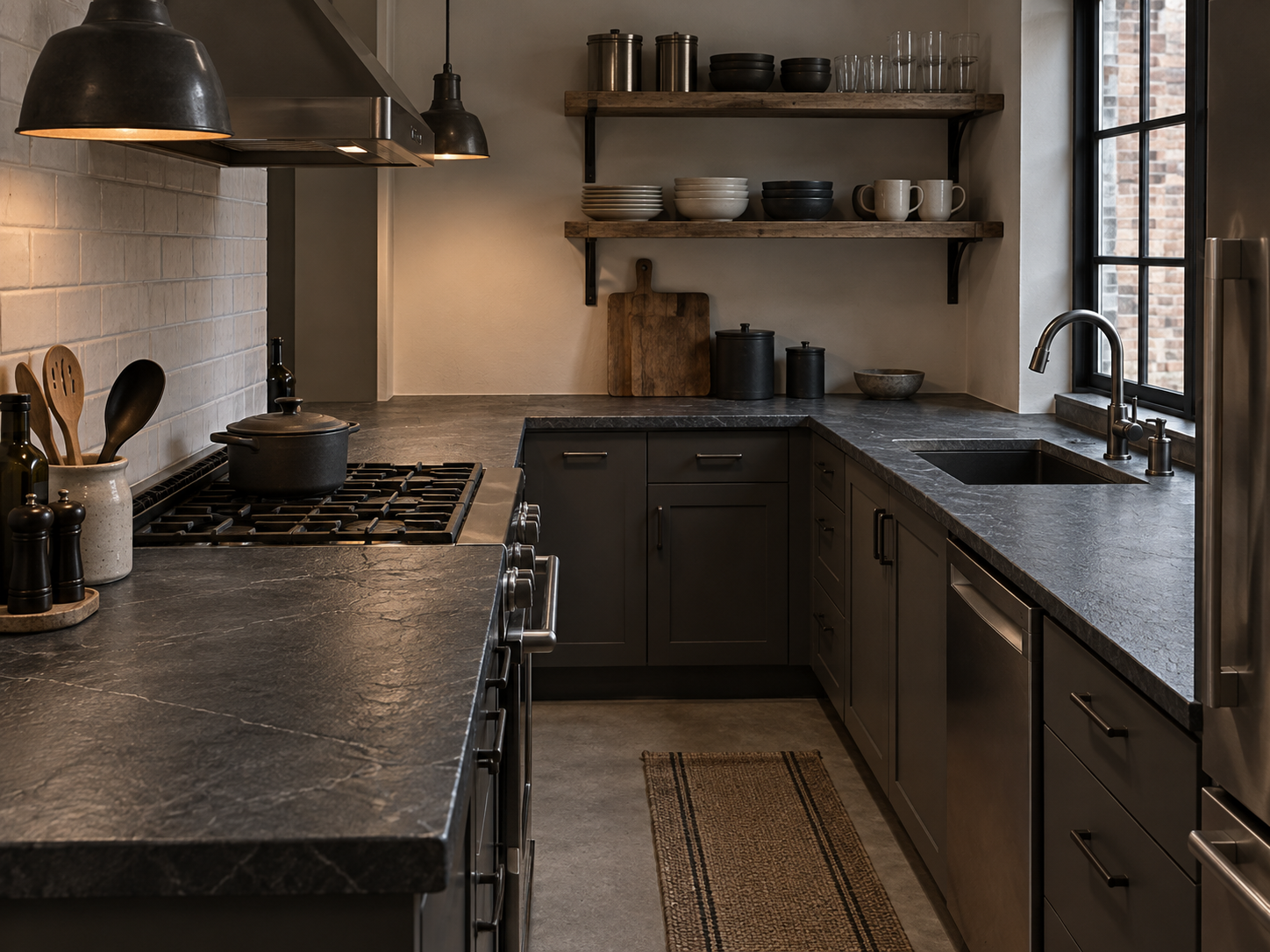
Slate naturally cleaves along planes, so an unfinished or cleft piece can have noticeable surface texture. Trust us, this could make it harder to clean if not finished.
Flour catches differently when you're wiping down after baking. Crumbs can collect in subtle low points. A cutting board may rock if the surface is particularly uneven. For most countertops, ask to see honed material rather than assuming the slate you've seen on floors is representative of the finished counter.
Chemicals: Slate performs particularly well against household chemicals and acids compared with more reactive stones such as marble, and historically its chemical resistance helped make slate useful for laboratory work surfaces.
Scratching: With slate, scratches are the enemy. Using a cutting board should already be standard practice because cutting directly on stone damages knives, but dragging rough ceramic, cast iron, or appliances across slate can leave marks.
Chipping: A chipped corner on granite can happen, especially around sinks and dishwashers, while slate's layered structure creates another possible failure point. If the particular stone cleaves easily, thin pieces along an edge can break away, so ask the fabricator about edge profiles with that in mind. A very crisp, thin edge exposes the corner differently than a slightly eased profile.
Slate can fall into an attractive middle ground for natural stone, commonly around $50 to $100 per square foot installed. But a quote should tell you more than the cost of the material, especially if slab size or local availability is limited.
Suppose your kitchen needs 42 square feet of countertop. At $80 per square foot, the simple arithmetic suggests $3,360. That number can change once the fabricator accounts for full-slab purchasing, unused material, sink and cooktop cutouts, edge work, seams, delivery, and the difficulty of moving a heavy slab into the house. Smaller slate slabs can make that waste calculation especially relevant.
Granite has an enormous supply chain, so common varieties can be remarkably economical. Quartz pricing is also fairly predictable until you move into premium patterns, jumbo slabs, or elaborate edge details. Soapstone often starts higher because the material itself is less widely distributed.
Block's broader guide to kitchen countertop materials compares installed price ranges across the major countertop categories if slate is only one of several materials you're still considering.
Transparent Pricing You Can Trust

Slate deserves serious consideration when you want a natural surface with restrained movement and you're willing to spend more time evaluating the actual stone before ordering it.
It works especially well when:
That last point matters because a surface can remain structurally sound for decades without looking untouched for decades. If you want every mark to disappear into a uniform surface, quartz may feel easier to live with. Slate makes more sense when some natural variation and wear are acceptable parts of the material.
Granite deserves a closer look when your highest priorities are scratch resistance, large slab availability, natural stone, and broad color choice. Quartz makes sense when you want consistent appearance, minimal maintenance, and a large catalog of predictable patterns.
Soapstone belongs in the conversation when you like slate's quiet, dark appearance but actively want a surface that develops patina and can be renewed as it scratches.
None of those comparisons can tell you whether the particular slate sitting at your stone yard is a good countertop. See the entire slab, check the edges, ask how large the usable section is, run your hand over the finish, and have the fabricator show you exactly where the seams will land.
A countertop decision reaches beyond the slab itself. Cabinet dimensions, sink placement, plumbing, appliance clearances, backsplash thickness, seam locations, and installation sequencing all affect the finished result, so the material has to work with the kitchen around it.
Block Renovation can match you with vetted contractors and help you compare detailed project scopes before construction begins. That gives you a clearer view of how the countertop fits into the rest of the kitchen renovation instead of pricing the surface as an isolated purchase.
Remodel with confidence through Block

Connect to vetted local contractors
We only work with top-tier, thoroughly vetted contractors

Get expert guidance
Our project planners offer expert advice, scope review, and ongoing support as needed

Enjoy peace of mind throughout your renovation
Secure payment system puts you in control and protects your remodel


Renovate confidently with Block
Easily compare quotes from top quality contractors, and get peace of mind with warranty & price protections.
Countertops
Slate Countertops vs. Granite, Quartz and Soapstone
09.20.2026
Countertops
Laminate Countertops vs. Quartz: How to Choose
09.15.2026
Countertops
Kitchen Counter Overlay: Cost, Durability and More
09.13.2026
Countertops
What Color Countertops Go With Oak Cabinets?
09.01.2026
Countertops
Walnut Cabinets With White Countertops
08.24.2026