



Ceiling
Ceiling Medallion Installation: Costs and Modern Ideas
09.04.2026
08.01.2026



In This Article
Look up in most rooms and there's nothing to see. Flat white paint, a fixture in the middle, and that's the whole story. Wallpaper on the ceiling changes a room's character without you moving a stick of furniture. A deep botanical print overhead pulls a bedroom in close around the bed, a little like a canopy without the frame. Stars over a crib give a baby something to look at during the 20 minutes they're supposed to be falling asleep. In a powder room with no window, a metallic ground picks up whatever light the sconces throw. The space stops feeling like a closet with a toilet in it.
Ceilings are unforgiving, though. You look at one straight on, lying in bed or leaning back at the table. Nothing breaks up the field, no art and no furniture, and a seam that drifts a quarter inch becomes the thing you notice every night. Scale is the other place people go wrong. A print that looked balanced at eye level in a showroom can sit low and heavy over 8 foot ceilings and one window, and a busy pattern above a patterned sofa just makes a room feel loud. Smooth drywall is the easy version of this job. Texture, old plaster, or a vaulted angle means prep before anything goes up.
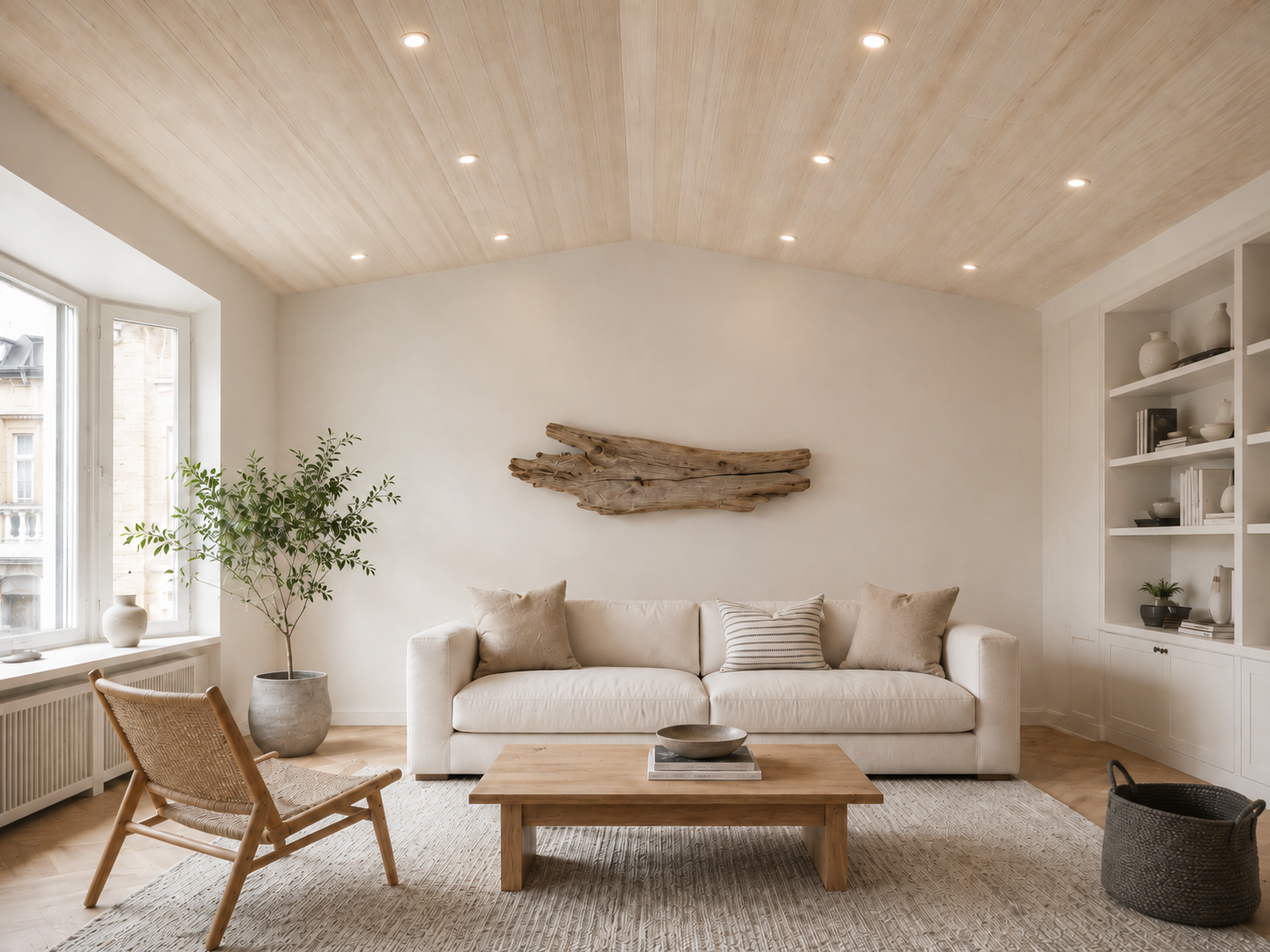
Ceiling wallpaper that mimics a material costs a fraction of the real thing and skips the trade you'd need to install it. One idea we particularly love: plank and wood-grain papers that stand in for tongue and groove.
Another idea? Pressed-tin patterns give you a period kitchen or bar ceiling without hunting down panels, and plaster, concrete, and grasscloth papers cover the texture you'd otherwise pay a specialty finisher for.
Keep the finish matte on any of them. Gloss looks printed the second light hits it at an angle, and recessed cans do exactly that. With plank patterns, run the lines along the room's longest dimension to carry the eye down the space.
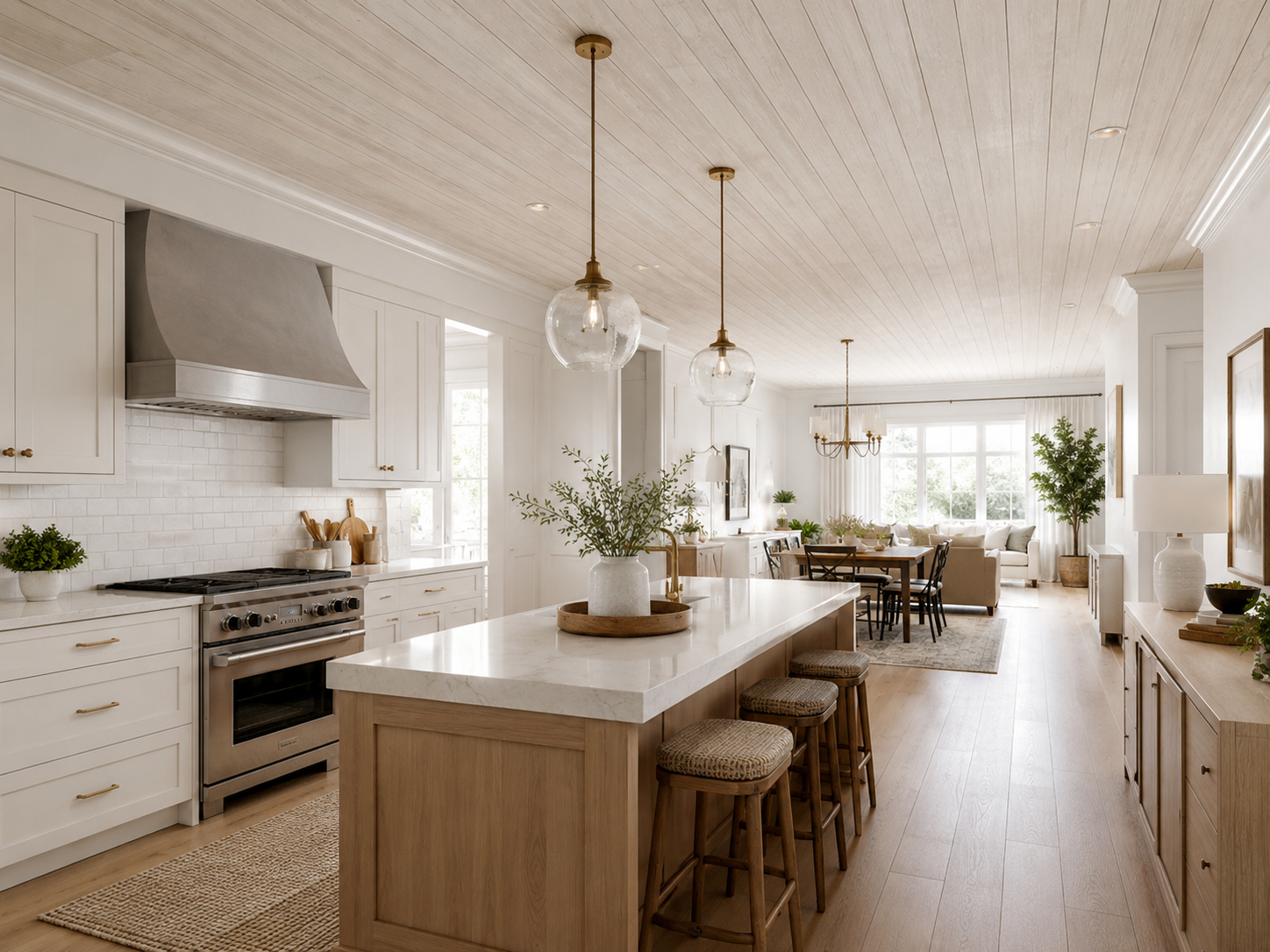
A whitewashed plank paper is the version that works for an open kitchen's ceiling, since it warms the ceiling without darkening a room lit from one side. Specify a scrubbable vinyl within a few feet of the range, because airborne grease settles overhead and uncoated papers can't be wiped.

In attic rooms, dormers, and knee walls, the ceiling is already the biggest surface in the room. Small-scale wall paper prints work best on those ceiling angles, because the repeat keeps its proportions as the plane tilts.
Paint the vertical walls one color pulled from the paper, usually its background tone. That keeps your eye moving across the slope instead of stopping at every corner where two planes meet.
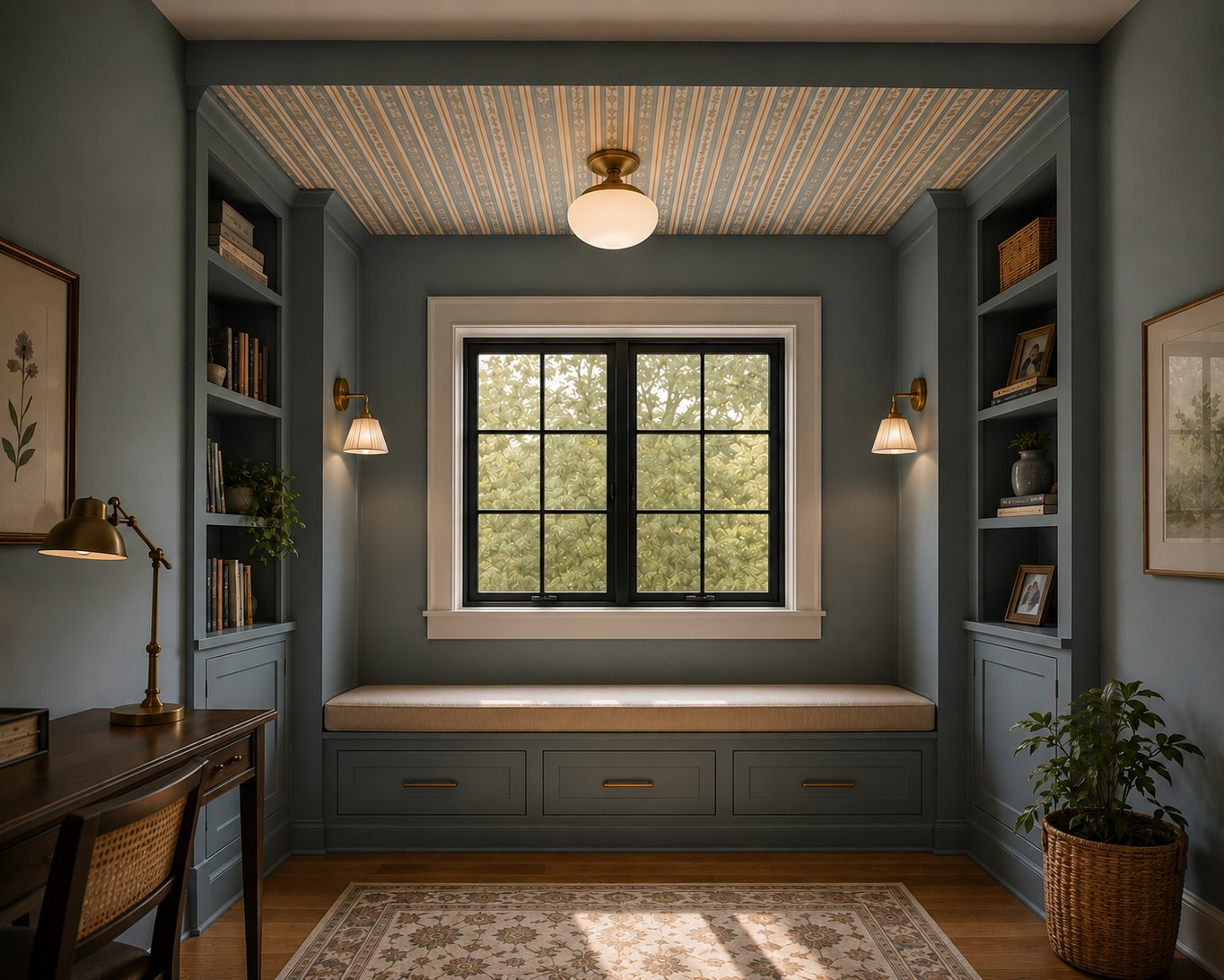
Papering the ceiling over one part of a room separates a nook or a desk without framing a wall, and this idea helps you keep the floor area minimalist.

White walls under a busy ceiling can leave the paper floating with nothing to anchor it. A saturated wall color pulled from the print ties the two together.
Take that color from the paper's second or third most present tone. The brightest accent in a print is there in small doses, and it rarely survives being spread across a whole wall. It's a smart idea to test the paint in the room itself, at night, under the lights you own, since ceiling paper bounces light down and shifts how the color looks.

A repeat that feels dramatic on a 6 foot sample board can look busy across 200 square feet, and a tight small print over that same span turns into visual static. A 300 square foot living room ceiling can take motifs a foot or two across.
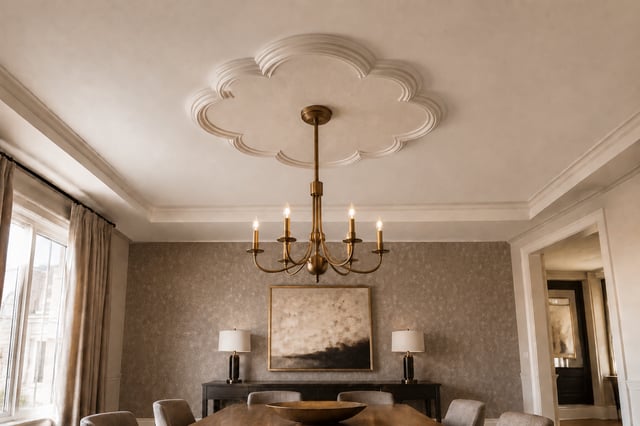
Plan the layout around the light fixture before the first strip goes up. A good installer centers the pattern to put the medallion where the repeat can absorb it, instead of cutting a flower in half directly above the bed.
Take this full condo remodel done by KS Renovation Group; the ceiling's colors perfecty echo the tones of the walls and curtains. In turn, the space feels much more purposeful than if the ceiling had been a singular hue.


Dark colors work overhead in ways they rarely do on four walls. A dark ceiling suggests depth instead of a low lid. Leave the walls light to keep the contrast crisp, and put warmer bulbs in the fixture, since cool white light over a dark ceiling flattens the color to gray.
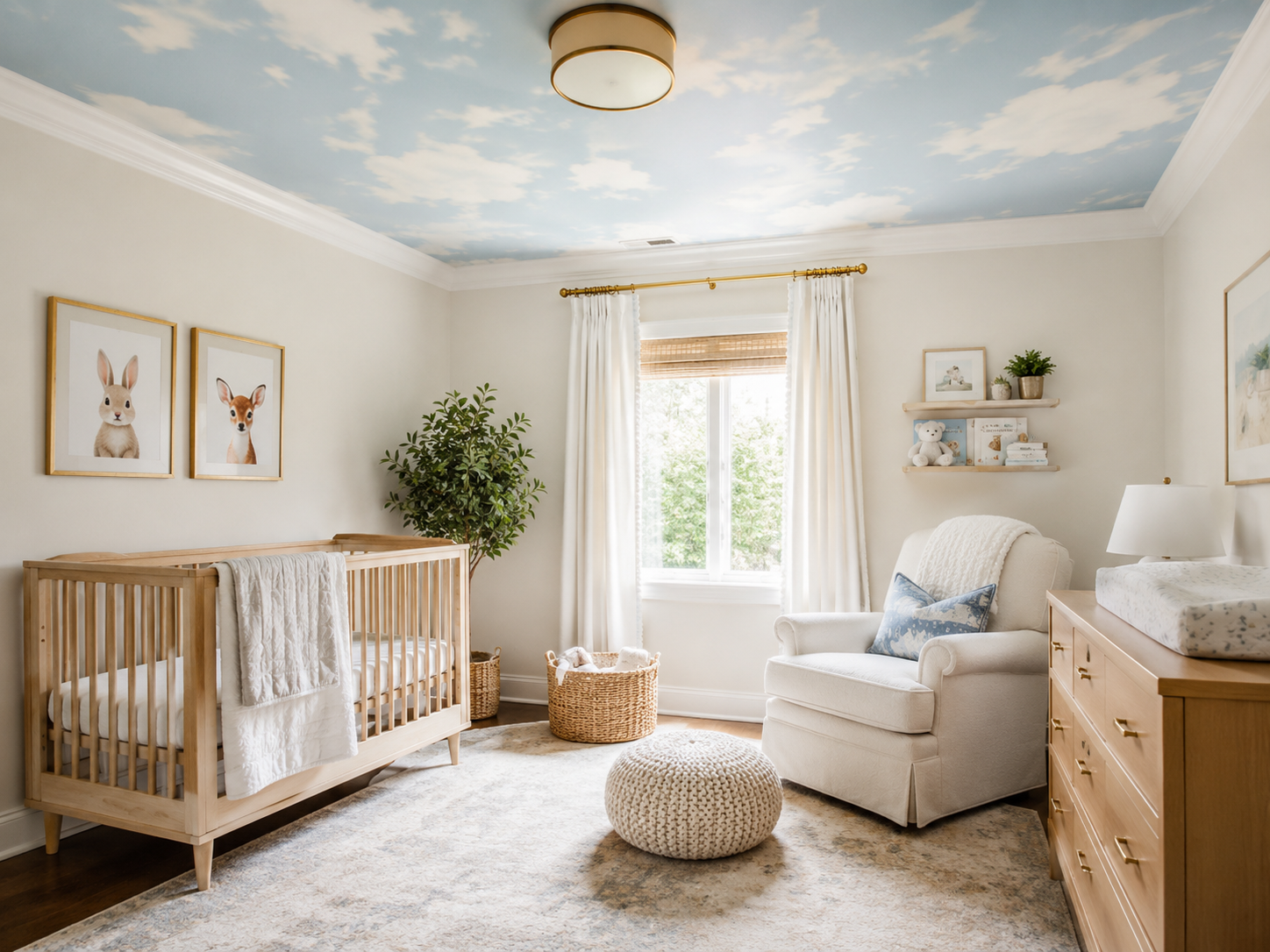
A baby on their back in a crib spends a good part of the day looking at the ceiling. A sky, star, or cloud pattern up there is decoration they'll actually see. Another reason this idea works so well? The ceiling is also the surface no child can reach. Nothing overhead gets colored on, picked at, or scuffed by a dresser shoved into a new corner.

A powder room is 30 square feet with no furniture and no daylight to fight, and guests are in there for two minutes. That makes it the safest place for a high-contrast geometric or a period pattern that would exhaust you in a bedroom.
Dark wainscot or a painted lower wall grounds a busy ceiling, and a mirror placed opposite catches a slice of it at eye level for anyone standing at the sink.
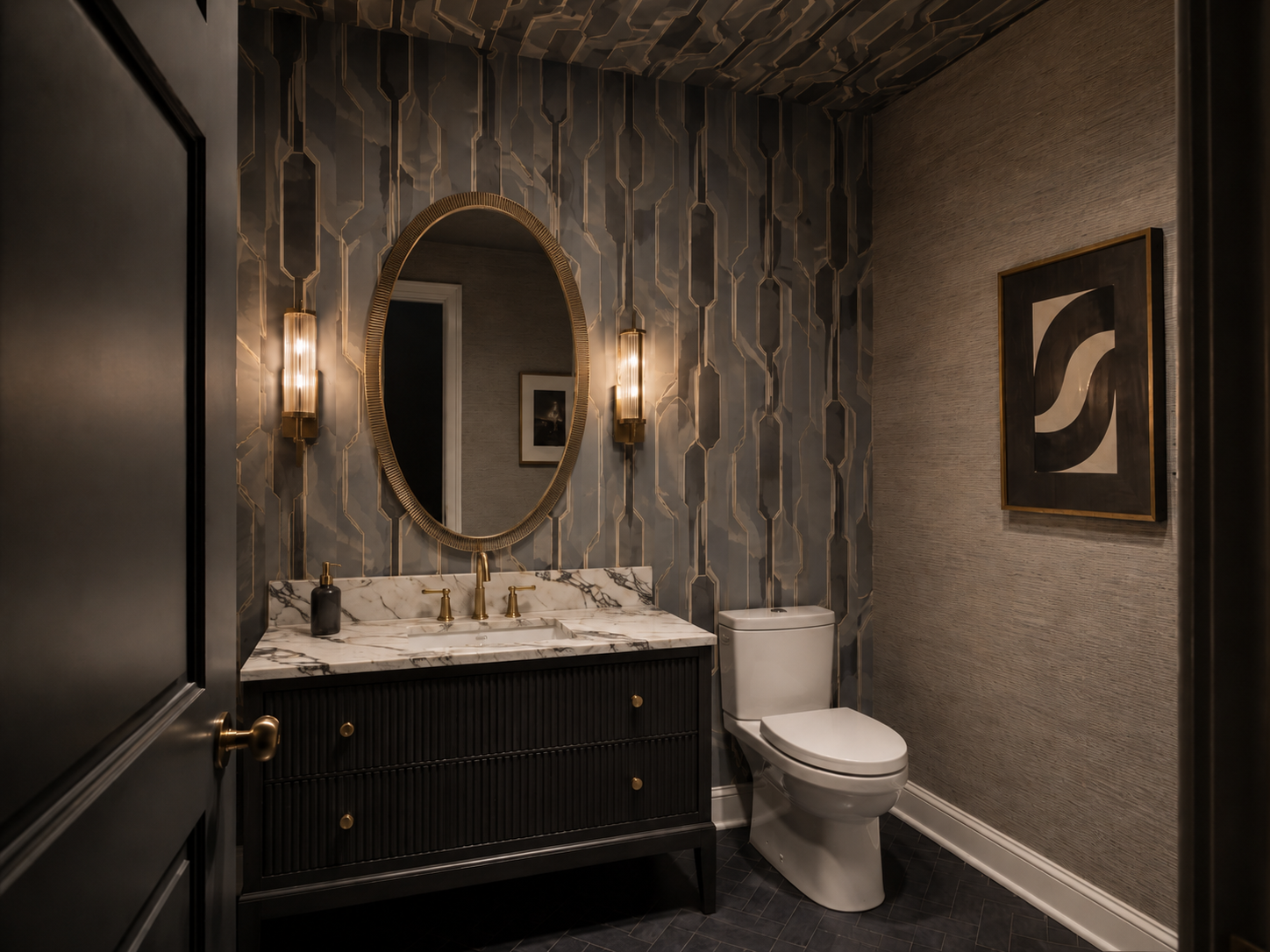
Pairing a papered ceiling with a papered accent wall is the middle option, and a powder room is the natural place for it. Put the pattern on the wall behind the vanity and the ceiling above it, then keep the remaining walls in a plain texture like a grasscloth or a linen-look paper in the same family.
Two papers in one small room only work if the palette is tight. Run the same paper from the accent wall onto the ceiling, or choose a second print built from the same three or four colors, and skip anything that introduces a new one.

Wrapping every surface is the bolder version of this iea, and it depends almost entirely on which print you pick. Loose, non-directional patterns with plenty of visible background are the ones that survive it, because there's white space between the motifs and no repeat trying to line up across the corner where wall meets ceiling. Pattern cannot match there. A print with a clear grid or an obvious vertical shows the break, while a scattered brushstroke or confetti pattern hides it completely.
Renovate with confidence every step of the way
Step 1: Personalize Your Renovation Plan
Step 2: Receive Quotes from Trusted Contractors
Step 3: Let Us Handle the Project Details

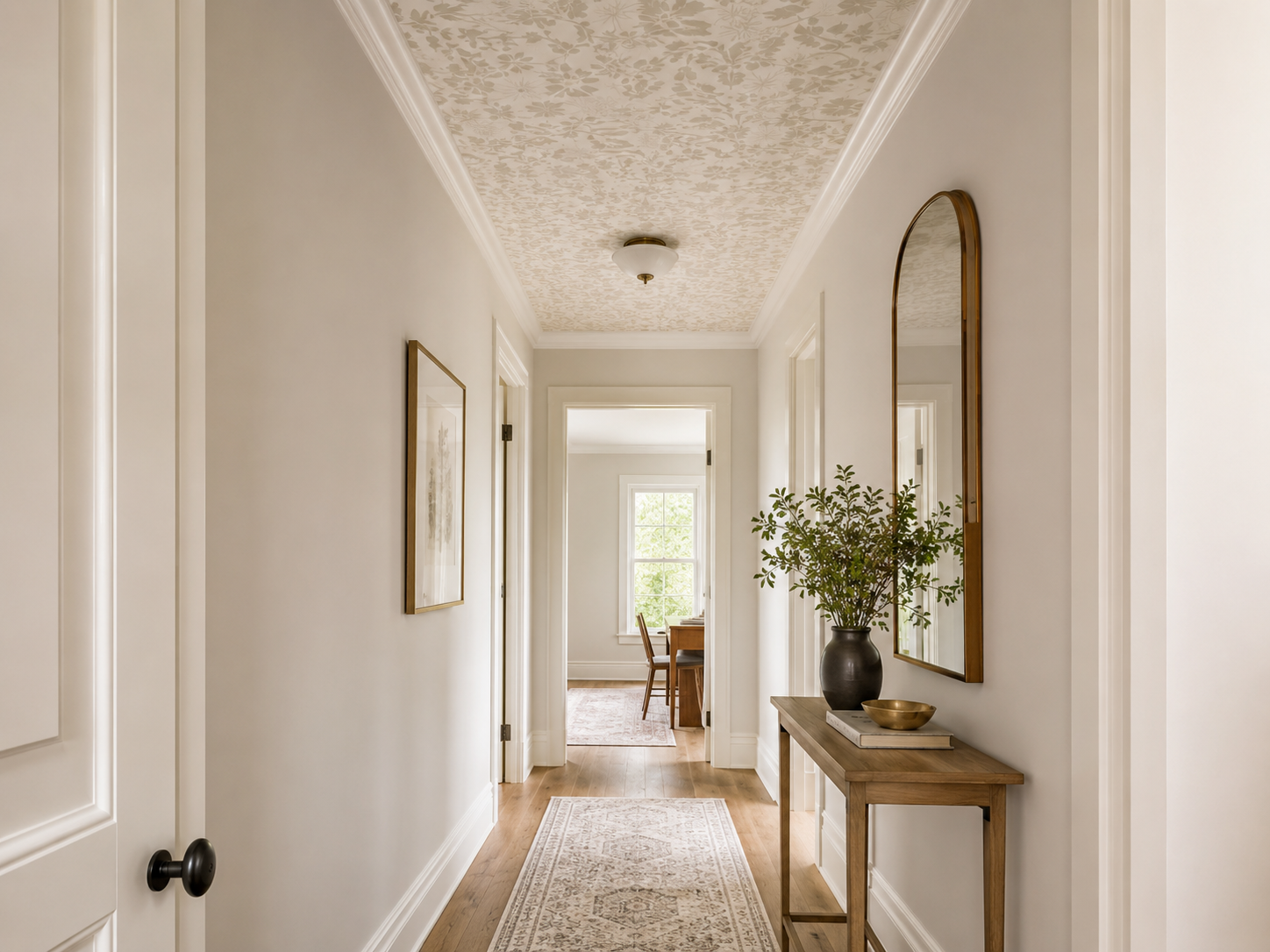
Hallways, entries, and mudrooms have almost no wall left to decorate. Doors, coat hooks, cabinets, and light switches eat the vertical surfaces, and the ceiling is what's left. Papering it gives a utility space some character without stealing an inch of the floor or the storage. The bill stays small too. These rooms rarely break 40 square feet, and a paper priced out of reach for a bedroom is affordable across one.
A tonal print, worked in two close shades of the same color, gives you texture without a full commitment. Tonal patterns also help in a long hallway lit by a single fixture, where high contrast would chop the ceiling into segments.
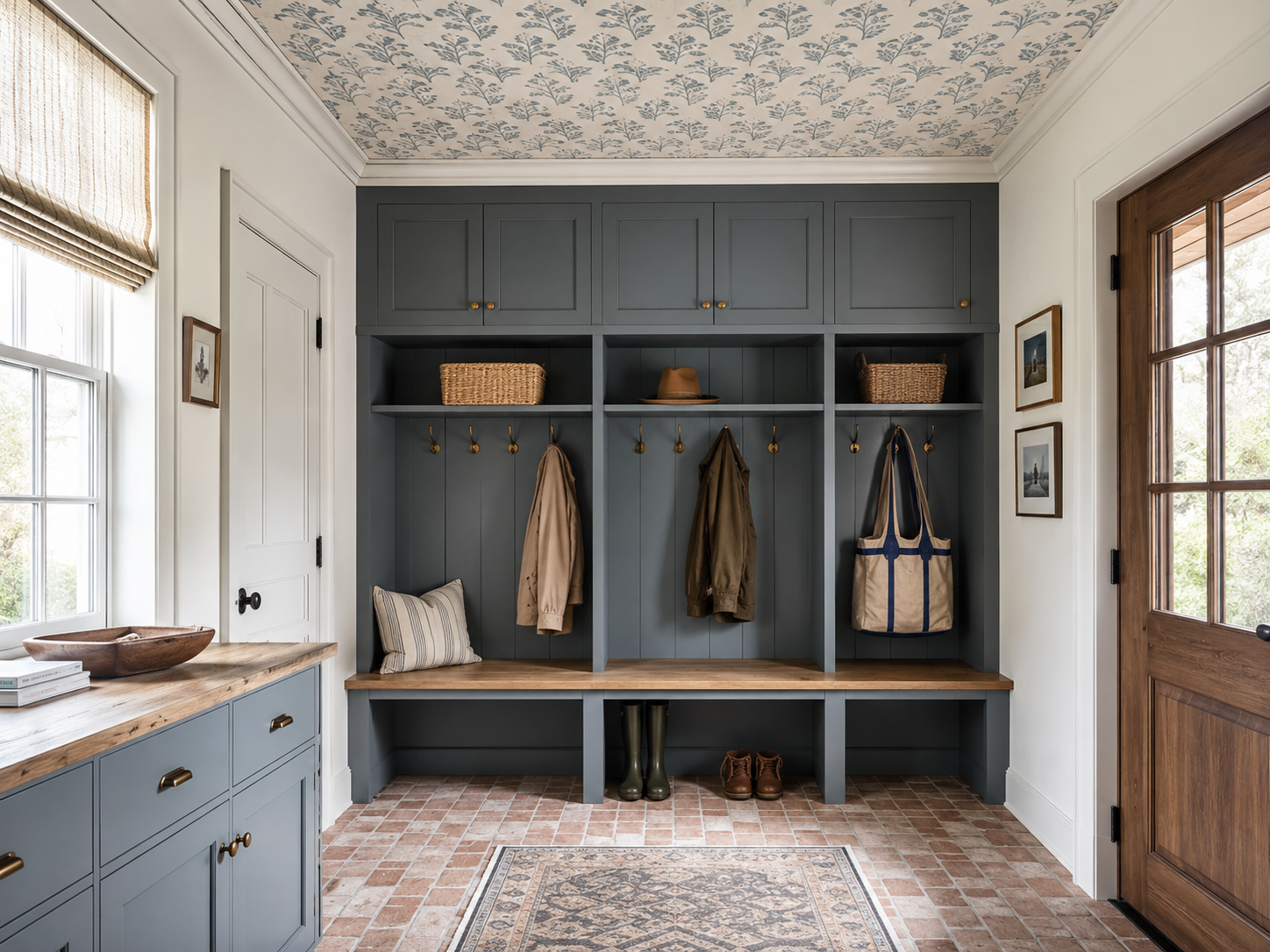
A mudroom asks a bit more of the paper. It takes wet coats, tracked-in snow, and door swings that pull humid air through several times a day. Specify a vinyl or vinyl-coated product for a room like that. Choosing a print that picks up the cabinet color is what keeps the two from competing, especially when the built-ins are dark and the ceiling pattern is light.

A recessed panel comes with a built-in frame, and papering only the inset is easier than covering a full flat ceiling. Every cut ends at existing trim. There's no delicate edge where paper meets crown molding, and minor errors disappear in the shadow line.
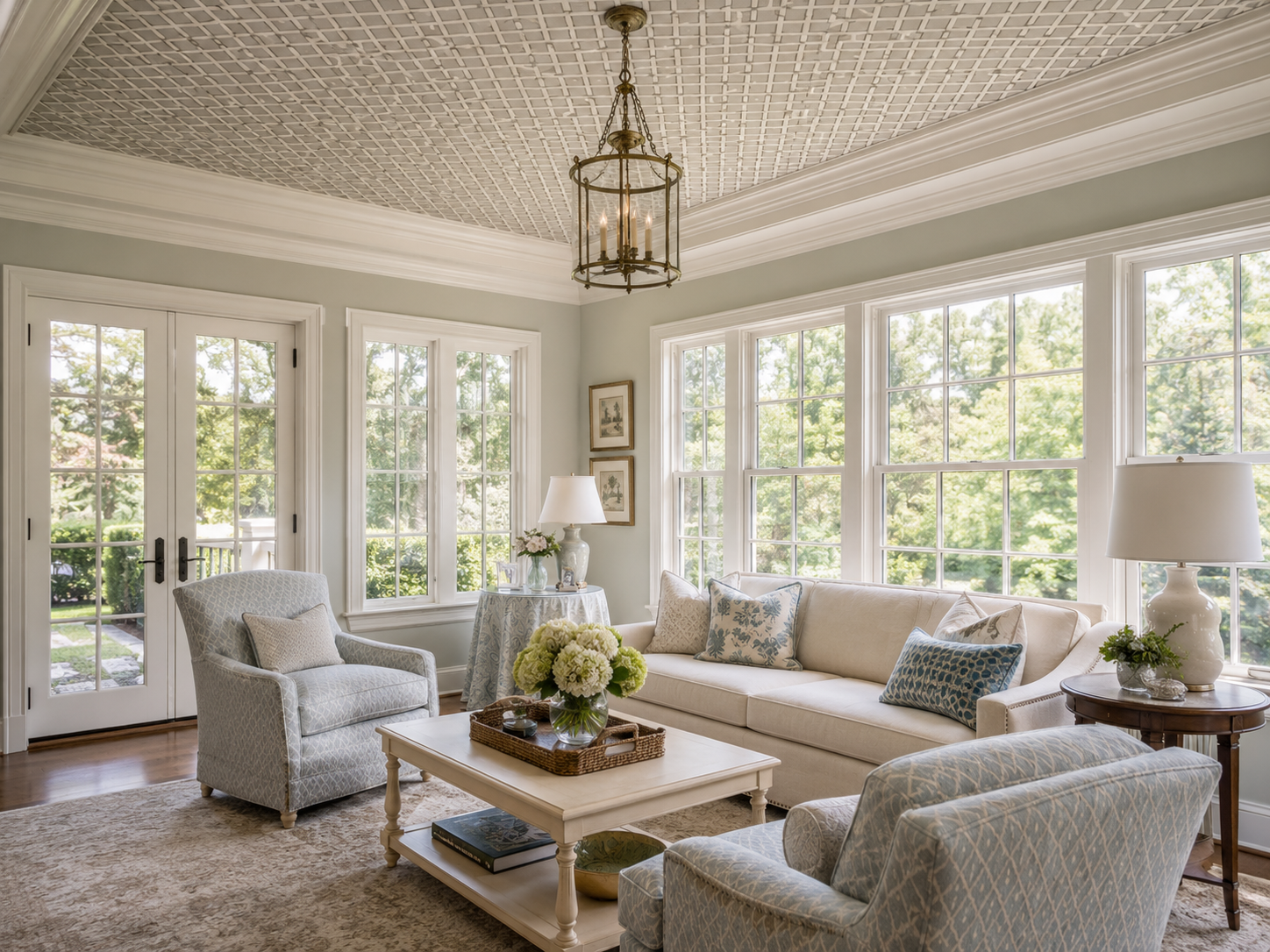
Crown molding gives every strip a finished place to end. The installer trims into the top edge of the profile instead of butting paper against a wall corner that's rarely square. Rooms with substantial trim can also handle a small-scale geometric or lattice pattern that would feel restless in a plainer room, since the molding already frames it.
Keep the crown painted, usually white or a shade off the wall color, and the pattern stops at a clean band. On a coved or trayed ceiling, paper the flat field and leave the sloped or stepped portion painted. That keeps the paper on one plane and the seams straight.
The cost to wallpaper a ceiling runs about $6 to $14 per square foot installed, materials and labor together. The same paper on walls comes in closer to $4 to $10, and the gap is all labor. Working overhead is slow, wet paper is heavy and pulls away from the surface, and a seam that would vanish at eye level sits in plain view from every seat in the room. On a room-sized ceiling the premium usually lands in the hundreds.
| Space | Ceiling area | Installed cost |
|---|---|---|
| Powder room | 20 to 40 sq ft | $300 to $600 |
| Bedroom | 120 to 180 sq ft | $700 to $2,500 |
| Dining room | 150 to 220 sq ft | $900 to $3,100 |
| Living room | 250 to 400 sq ft | $1,500 to $5,600 |
Turn your renovation vision into reality
Get matched with trusted contractors and start your renovation today!
Find a Contractor
Hanging paper on a ceiling is a different skill from hanging it on a wall, and the money you'd save rarely covers what goes wrong. A pasted strip 10 feet long weighs several pounds and starts sagging the moment one end goes slack. Installers work in pairs for that reason, with a support brush and a plan for every strip before it leaves the table. Get the first strip out of square by half an inch and the error compounds, with every seam after it drifting further out.
The material is what makes that expensive. Ruining three double rolls of a $150 paper wipes out most of the labor savings on a bedroom ceiling, and specialty papers usually come from a single dye lot, so a replacement roll ordered later may not match what's already up. Anything that needs prep raises the bar further, since skim coating a textured ceiling flat enough for paper is finish drywall work, and popcorn from before 1980 has to be tested for asbestos before it's touched at all.
Peel-and-stick is more forgiving, and it still takes two people and a flat ceiling. A mudroom at 30 square feet is a reasonable Saturday project. Anything at bedroom scale is worth quoting out.
Ask any installer you're considering how many overhead jobs they've done, whether liner paper is priced separately, and how they plan to handle pattern matching around the light fixture. Block matches you with vetted local contractors who bid from an expert-reviewed scope, with prep work and material allowances written down before anyone starts.
Remodel with confidence through Block

Connect to vetted local contractors
We only work with top-tier, thoroughly vetted contractors

Get expert guidance
Our project planners offer expert advice, scope review, and ongoing support as needed
Enjoy peace of mind throughout your renovation
Secure payment system puts you in control and protects your remodel

Renovate confidently with Block
Easily compare quotes from top quality contractors, and get peace of mind with warranty & price protections.
Ceiling
Ceiling Medallion Installation: Costs and Modern Ideas
09.04.2026
Ceiling
Cathedral Ceiling Ideas - Trim, Molding, Beams & Lighting
08.28.2026
Ceiling
Concrete Ceiling Repair and Replacement
08.22.2026
Ceiling
Wallpaper on Ceiling: Ideas and Cost Ranges
08.01.2026
Ceiling
Drop Ceiling Makeover: Before and After Ideas
06.19.2026