




Cost
20x20 Room Addition Cost: What to Budget in 2026
07.28.2026
01.14.2025



In This Article
When your remodel starts, the homeowner's policy you already pay for covers less than you'd expect. Standard policies are built for a finished, lived-in house, and most narrow their coverage once the walls are open and a crew is on site every day. Some go further and suspend coverage altogether if you move out during the work.
Renovation insurance, also called home renovation insurance or remodel insurance, fills that gap while construction is underway. Line it up before the first wall comes down, and a burst pipe or a job-site injury won't land on you.
What you need depends on the size of the job and who does the work, so a weekend backsplash and a full addition rarely call for the same policy. The sections below cover the coverage, the cost, and whether your project actually needs it.
Renovation insurance is the set of coverages that protect the structure, the materials, and you during active construction. Most homeowners build it from three pieces: builder's risk insurance, liability coverage, and sometimes an extension of an existing homeowner's policy. Which pieces you need scales with the project, from a homeowner's endorsement on a small job to a full builder's risk and liability policy on a structural remodel.
Not sure how to begin your renovation?
Get free, expert guidance from a dedicated Block Project Planner who can help you navigate proposals, timelines, contractor selection, and more.
Book A Free Consultation
The first thing to check is what your current homeowner's policy stops covering the moment construction starts. Standard policies are built for a finished home, and most limit or exclude damage tied to active construction, which is the coverage you most need once the work begins.
Vacancy is the trap people miss, and it starts with the homeowner's policy you already carry. Many of these policies reduce or suspend coverage once a home sits unoccupied for a set period, often 30 to 60 days, which is easy to hit during a gut renovation when you move out. A claim filed during that window can be denied on the vacancy clause alone. Read your policy before you assume you're covered, and ask your insurer in writing how a remodel and a move-out change your terms.
The coverage you need tracks the scope of the work. This maps common projects to the coverage that fits and a representative cost range for the policy term:
|
Project type |
Coverage you'll likely need |
Representative cost |
|
Cosmetic refresh (paint, backsplash, fixtures) |
Homeowner's policy extension |
Often the carrier minimum, roughly $400 to $500 |
|
Single-room remodel (kitchen or bath) |
Builder's risk plus liability |
Roughly 1 to 3% of project value |
|
Structural remodel or addition |
Builder's risk covering the existing structure, plus liability |
Roughly 2 to 4% of project value |
|
Whole-home or gut renovation with a move-out |
Builder's risk with existing-structure coverage, liability, and a vacancy check on your homeowner's policy |
Higher end of 2 to 4%, subject to carrier minimums |
The last piece is your contractor's own insurance. Before you sign anything, confirm the contractor carries general liability and workers' compensation coverage, and ask to be named on the certificate. A contractor without workers' comp can leave you responsible for an on-site injury.
Not every project needs a dedicated policy. A short cosmetic job where you stay in the home and hire a contractor who carries full builder's risk and liability coverage is often protected without buying anything extra. Structural work, a move-out, a long timeline, or a contractor who can't show proof of coverage all raise the cost of going without.
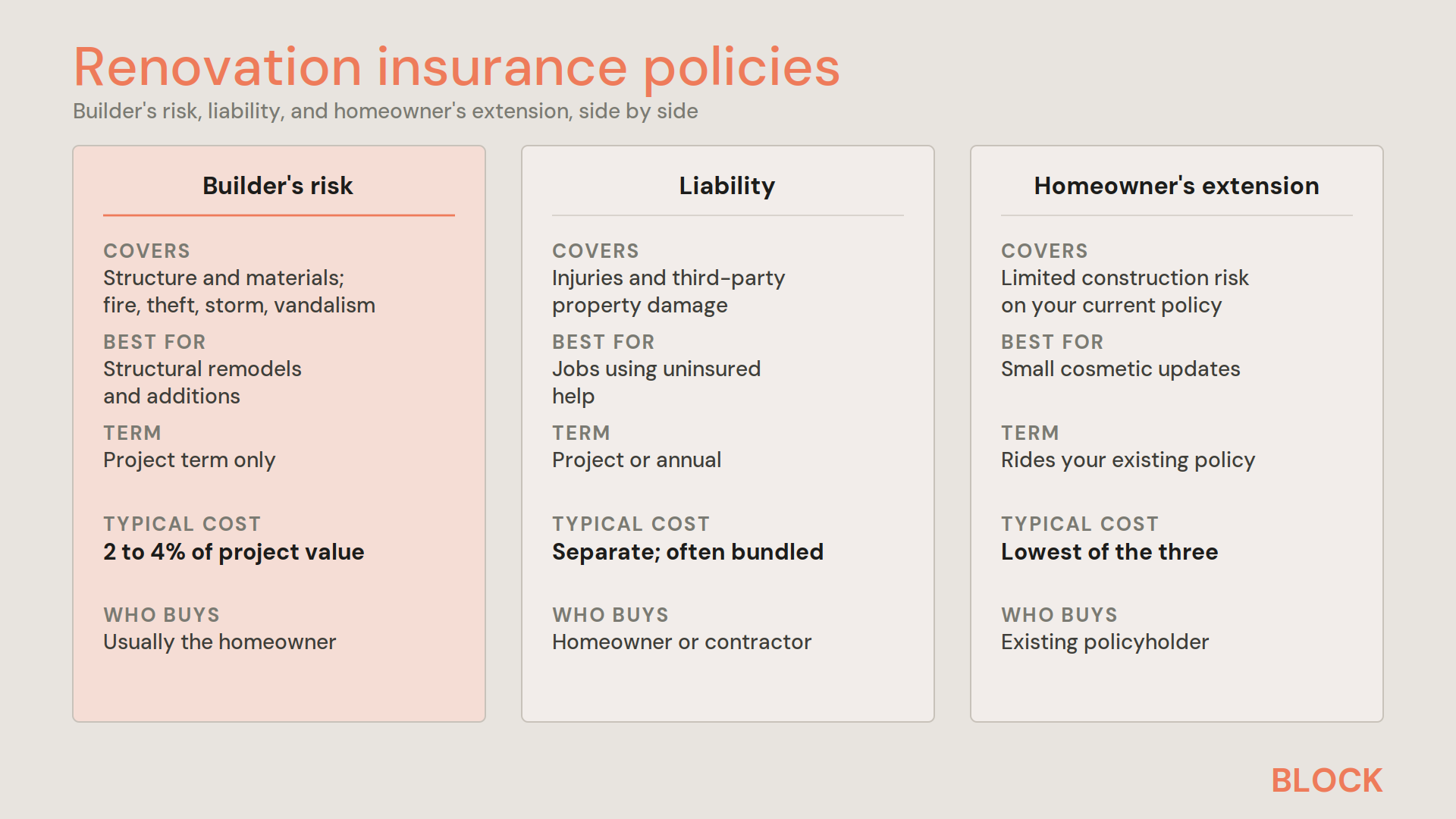
Builder's risk is the backbone of most renovation coverage. It insures the structure and the materials during construction against physical loss, and it typically extends to theft and vandalism, which matter when lumber, appliances, and copper are sitting on an open site.
Two details shape the policy. First, coverage runs only for the project term and ends when the work is finished, at which point you move protection back to a standard homeowner's policy. Second, on a renovation you have to decide whether to insure only the new work or to also cover the existing structure. Insuring only the new work is the cheaper option and the wrong one for most structural jobs, because the day a contractor punctures a water line and floods a finished floor, a new-work-only policy leaves the existing house uncovered. Add existing-structure coverage up to an agreed sublimit, and settle that number with your contractor in writing before work begins.
National carriers write builder's risk for renovation projects, not just ground-up builds. Nationwide offers a customizable policy with endorsements for extras like debris removal and ordinance or law coverage, and The Hartford writes builder's risk as inland marine coverage that applies to renovation and repair work. Get quotes from more than one, since rates on the same project vary widely between insurers.
Liability coverage handles bodily injury and third-party property damage connected to the project. It steps in for medical and legal costs if someone is hurt on site or if the work damages an adjacent property.
This coverage matters most when you hire independent help that doesn't carry its own policy. Even a skilled contractor can have an accident, and without liability coverage the homeowner absorbs the medical and legal costs. Carriers that write builder's risk, including Nationwide and The Hartford, often bundle general liability alongside it, which keeps both coverages with one insurer.
For smaller projects, an endorsement on your existing homeowner's policy can add construction-related coverage without a separate builder's risk policy. A major carrier like State Farm can add or adjust coverage for a remodel, so start with the insurer that already holds your policy. These add-ons suit limited work like a vanity replacement or a backsplash update.
Extensions are narrow by design, so they're a poor fit for major structural work, where builder's risk and standalone liability do more. A short call to your insurer is worth making either way, since bundling coverage can lower your total cost.
Renovation insurance cost is driven mostly by builder's risk, which is priced as a share of your total completed project value rather than as a flat monthly premium. As a representative planning range, builder's risk for a remodel usually runs about 1 to 4% of total project value for the policy term, and renovations tend to sit at the higher end, roughly 2 to 4%, because an existing structure carries more unknowns than a clean build.
A few concrete reference points help set expectations:
Beyond project value, a handful of factors move the number. Location is one of the largest: coastal and high-wind regions carry higher rates. Construction type matters too, since wood-frame structures cost more to insure than masonry or concrete. Longer project timelines raise the premium because there's more time for something to go wrong, and higher deductibles or added endorsements like flood coverage shift the price in either direction. Whether your contractor carries their own insurance also factors in, since gaps in their coverage push more risk onto your policy.
Set against the cost of a renovation itself, insurance is a small line item. For context on where the rest of your budget goes, see Block's guides to kitchen remodel cost and home addition costs.
Start with the insurer you already have. Sometimes a policy extension covers a smaller project, and if it doesn't, you shop for a standalone builder's risk policy. Be ready to share your project details, including scope, budget, timeline, and contractor information, since carriers price the policy on those specifics. Confirm your contractor's own coverage before you sign, and ask to insure the project to its full completed value to avoid a coverage shortfall if a claim comes in.
If something goes wrong during the work, the process is straightforward. Document the damage with photos, notify your insurer promptly, and file a claim with the details of what happened. The insurer reviews the loss and pays based on your policy terms and limits.
Knowing what a policy excludes matters as much as knowing what it covers. Most renovation insurance responds to sudden, accidental events like fire, storm damage, theft, and on-site injuries. It generally does not cover pre-existing problems, faulty workmanship, or ordinary wear, so a repair the crew should have done correctly stays your responsibility rather than the insurer's.
Before you commit to a policy, get specific about what it does and doesn't do. Ask what perils are covered and whether theft and vandalism are included. Ask whether the policy covers only the new work or also the existing structure, and at what sublimit. Confirm how long the coverage lasts and whether you can extend it if the project runs long, which many do. Then walk through the claims process so you know what filing actually looks like before you need it.
Rates and terms vary widely between carriers, so gather quotes from more than one provider before you decide. On the same renovation, a second-choice quote often comes in well above the best one, which makes shopping around one of the few reliable ways to lower the price.
Look past the number to coverage limits, exclusions, and the insurer's claims reputation. A bare-bones policy that saves a few hundred dollars can leave a real gap if a load-bearing mistake turns into a large claim. Match the policy to the project, with enough coverage for a major job and no extras you don't need on a minor one.
Your contractor's coverage and yours have to fit together without gaps. Confirm the contractor carries general liability and workers' compensation before hiring, and get proof rather than a verbal assurance. If they don't carry it, you take on injury and damage risk that should sit with them.
Even with a fully insured contractor, you may still need your own builder's risk policy, since that coverage usually falls to the homeowner rather than the contractor. Naming both parties where appropriate keeps responsibility clear and avoids the finger-pointing that follows an uninsured loss.
Renovation insurance handles the financial fallout when something goes wrong on a project. Working with a vetted contractor lowers the odds you ever need it. Block Renovation matches you with local contractors who carry their own coverage, reviews every scope to catch missing line items and red flags early, and releases payment only as the work gets done. Every project also carries a one-year workmanship warranty, so you get peace of mind throughout your renovation, with or without a separate policy. Compare quotes from reliable contractors and see how Block's approach to renovating protects your budget from the first bid.
Remodel with confidence through Block

Connect to vetted local contractors
We only work with top-tier, thoroughly vetted contractors

Get expert guidance
Our project planners offer expert advice, scope review, and ongoing support as needed

Enjoy peace of mind throughout your renovation
Secure payment system puts you in control and protects your remodel


Renovate confidently with Block
Easily compare quotes from top quality contractors, and get peace of mind with warranty & price protections.
Cost
20x20 Room Addition Cost: What to Budget in 2026
07.28.2026
Remodeling
Cinder Block Garage Cost: Prices by Size & Material
07.23.2026

Cost
2026 Bedroom Remodel Cost Guide: Average Price, Tips & ROI
07.22.2026

Cost
Attic Renovation Costs in 2026: Finish or Convert an Attic
07.20.2026
Timelines
Home Renovation Timeline: All 15 Phases Explained
07.19.2026