



.png?width=640&name=u5821215421_a_compact_basement_home_gym_with_wall-mounted_equ_92aa99da-8318-4192-83cd-69ec9f78a9dc_3%20(1).png)
Illinois
Glenview Basement Renovation Costs, Options & Tips
03.27.2026

02.27.2026


In This Article
Chicago has long attracted homeowners who want more than a cookie-cutter house. The city's deep architectural heritage, thriving cultural scene, and strong neighborhood identities make it one of the most compelling places in the Midwest to build from the ground up. Whether you're drawn to a tree-lined lot in the western suburbs or an infill parcel on the North Side, the opportunity to design a home that fits both your life and its surroundings is real. Few metro areas offer such a wide range of building contexts — from dense urban blocks to estate-sized suburban parcels — within a single region.
That said, building custom in Chicago comes with its own friction. The city maintains its own building code, separate from the International Building Code, and navigating permits across various municipalities adds layers of complexity. Material and labor costs have climbed steadily, and Chicago's clay-heavy soil and harsh winters demand careful planning from the start.
Design a Home That’s Uniquely Yours
Block can help you achieve your renovation goals and bring your dream remodel to life with price assurance and expert support.
Get Started
An experienced builder can evaluate prospective lots in ways most homeowners cannot — identifying drainage problems, flagging zoning constraints, and estimating site preparation costs before you commit to a purchase. The right lot isn't just about location; it's about what that specific piece of ground will demand from your budget and your design.
Key considerations include:
Desirable building locations in Chicago often come down to school district quality, commute times, and neighborhood character. Families consistently gravitate toward the western suburbs — Naperville (Districts 203 and 204), Hinsdale, and Wheaton — for their top-rated schools. Within the city, neighborhoods like North Center and Lincoln Park offer strong public school options alongside urban convenience.
Understanding what drives building costs and realistic timeframes in this market is the difference between a smooth project and an expensive surprise. Chicago's construction landscape has its own pricing dynamics, and costs can shift meaningfully depending on where and how you choose to build.
For standard-grade custom construction in the Chicago metro, expect to pay roughly $200–$275 per square foot. Mid-range builds with upgraded finishes typically land between $275–$400 per square foot, while true luxury custom homes — with bespoke cabinetry, high-end stone, and complex architectural detailing — can push past $500 per square foot. Downtown and near-north locations tend to skew higher, while south and southwest suburbs offer more moderate pricing.
Several factors push costs in either direction. Labor accounts for 30–40% of total construction spend, and union labor in Chicago runs 10–30% more than non-union rates. Skilled trades — particularly electrical, plumbing, and finish carpentry — command premium wages due to ongoing shortages. On the materials side, Chicago's tradition of brick and limestone construction adds cost compared to wood-frame-dominant markets. Market demand in the western suburbs (Naperville, Hinsdale, Burr Ridge) remains especially strong, which keeps both land values and builder pricing elevated.
Lot choice plays a decisive role in your total investment. A standard Chicago city lot measures just 25 by 125 feet, which constrains design options and often requires creative site plans to maximize light and livability. Infill parcels in established neighborhoods carry higher land costs but save on infrastructure, while undeveloped suburban lots may require significant site work. In areas zoned for multi-unit development (RT-4 or RM-5), land values jump considerably because of the added density potential.
Foundation work is a major expense category in Chicago, largely because of the region's clay-dominant soil. Roughly 85% of the metro sits on glacial clay, which expands when wet and contracts when dry — meaning deep foundations, proper drainage systems, and sometimes steel pile underpinning are non-negotiable. Framing and structural work typically represent the next largest line item, followed by mechanical systems (HVAC, electrical, plumbing). Chicago's 2022 Energy Transformation Code imposes rigorous insulation, window, and HVAC efficiency standards that exceed many other markets, adding cost but improving long-term performance. Interior finishes — cabinetry, countertops, flooring, and fixtures — can range from 15% to 30% of total cost depending on your selections. Finally, site work, including grading, utilities connections, and landscaping, can add 10–15% on top of the base construction budget, particularly on infill lots that require demolition of an existing structure.
Custom homes offer the chance to build exactly what you want, but certain choices carry outsized cost implications:
A realistic timeline for a custom home in Chicago runs 12–20 months from the start of construction to move-in, depending on the size and complexity of the project. Homes under 2,500 square feet with straightforward designs may finish closer to 10–12 months, while luxury builds exceeding 4,000 square feet often stretch past 16 months. Add 3–4 months of pre-construction for design development, permitting, and material selections, and the full process from first meeting to housewarming typically spans 15–24 months.
Weather is the single largest variable. Chicago winters can halt foundation pours, framing, roofing, and exterior masonry for weeks at a stretch — concrete curing slows dramatically below 40°F, and frozen ground complicates excavation. Builders who start site work in early spring gain the longest possible window of favorable conditions before the next winter. Permit timelines through the City of Chicago's Department of Buildings vary by project type, but standard plan review can add several weeks, and any required variances extend that further.
Chicago's architectural legacy gives custom builders an unusually rich palette to draw from, and today's homeowners are blending historic references with modern performance standards.
Building in Chicago demands respect for conditions you won't encounter in most other markets, and your builder's familiarity with these issues will directly affect your home's long-term performance.
Roughly 85% of the Chicago area sits on glacial clay, which behaves more like a sponge than solid ground. When saturated, clay expands and exerts hydrostatic pressure on foundation walls, leading to cracking, bowing, and water intrusion. During dry spells, it contracts and creates voids beneath footings. Builders here routinely specify deep foundations anchored to the hardpan layer below the active clay zone, and exterior waterproofing membranes paired with interior drainage systems are standard practice. Skipping a geotechnical survey to save a few thousand dollars is one of the costliest mistakes a Chicago homeowner can make.
Chicago winters are not a minor inconvenience for builders — they fundamentally alter what work can happen and when. Concrete cannot be poured reliably below 40°F without heated enclosures, insulated blankets, and chemical additives that accelerate curing, all of which add cost. Frozen ground complicates excavation and can delay foundation work by weeks. Experienced local builders plan their schedules to complete exterior-dependent work before November and shift to interior trades during the coldest months, keeping the project moving without compromising quality.
Chicago's combined sewer system handles both stormwater and wastewater in many neighborhoods, and during heavy rain events, the system can be overwhelmed — sending sewage back into basements. The city's Tunnel and Reservoir Plan (Deep Tunnel) has helped, but it cannot handle the most extreme storms, particularly as rainfall intensity increases. Builders who understand this risk design homes with overhead sewer connections, backflow prevention valves, and sump systems with battery backup, providing multiple layers of protection against the city's most common flood scenario.
Unlike most American cities that adopt the International Building Code, Chicago maintains its own construction code with stricter fire safety provisions rooted in the aftermath of the Great Chicago Fire. Contractors who have only worked in suburban municipalities or other states will need to adjust specifications and drawings significantly. The 2022 Chicago Energy Transformation Code adds another layer, requiring higher-efficiency HVAC systems, continuous insulation or thermal breaks on exterior assemblies, and compliance with at least two of five additional efficiency measures. Working with a builder who already holds Chicago permits and knows the Department of Buildings review process eliminates a major source of delays and costly revisions.
Compare Proposals with Ease
Choosing a builder is as much about communication and trust as it is about credentials and portfolios. The right builder will welcome tough questions and answer them with specifics, not generalities.

“Unplanned change orders derail budgets. The best contractors identify risks early instead of surprising you mid‑build.”
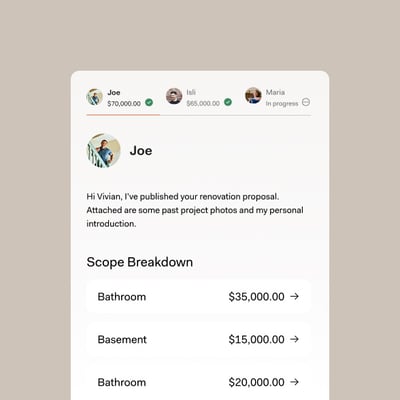
Block matches you with up to three vetted contractors who submit personalized proposals tailored to your project — taking the guesswork out of finding qualified builders in the Chicago market. Every contractor in Block's network undergoes insurance verification and reference reviews before they can bid on your project. Instead of cold-calling builders and hoping for the best, you get curated matches based on your scope, budget, and location.
Block Protections give you a structured framework that keeps your project on track financially. Expert-reviewed proposals are designed to minimize surprise costs and reduce change orders, so your budget reflects reality rather than optimistic estimates. Payments are released on a progress-based schedule as work is completed, giving you visibility and control through Block's dashboard at every stage.
Remodel with confidence through Block

Connect to vetted local contractors
We only work with top-tier, thoroughly vetted contractors

Get expert guidance
Our project planners offer expert advice, scope review, and ongoing support as needed
Enjoy peace of mind throughout your renovation
Secure payment system puts you in control and protects your remodel

Renovate confidently with Block
Easily compare quotes from top quality contractors, and get peace of mind with warranty & price protections.
Illinois
Glenview Basement Renovation Costs, Options & Tips
03.27.2026
.png?width=640&name=u5821215421_A_modest_basement_hangout_room_with_a_daybed_or_s_09da2214-8eab-4a7a-98c8-7379915539c6_2%20(1).png)
Illinois
Lake Forest IL Basement Renovation Costs & Tips
03.24.2026

Illinois
Kitchen Remodel in Glenview, IL: Costs & Local Tips
03.16.2026
.png?width=640&name=u5821215421_a_tidy_basement_storage_room_with_metal_shelves_c_366d5f94-acad-4603-b2f9-cc8dff5b20cd_2%20(1).png)
Illinois
Naperville Basement Renovation Costs, Options & Tips
03.12.2026

Illinois
Kitchen Remodel in Naperville, IL: Costs, Permits & Tips
03.09.2026