



.png?width=640&name=u5821215421_A_bright_coastal_living_room_with_a_half_wall_rai_f928a036-9b29-41b7-9710-603210dbd9a4_3%20(1).png)
Georgia
Planning a Brookhaven Custom Home? Start Here
06.11.2026

04.14.2026


In This Article
Atlanta has something most Sun Belt cities don't: shade. The city's mature tree canopy, one of the densest urban canopies in the country, means that many backyards start with a natural advantage. A deck or patio built beneath a hundred-year-old oak or a stand of tall pines is a fundamentally different experience from one built on an exposed slab in Phoenix or Dallas. The light is filtered. The temperature is manageable. The atmosphere is already set before you place a single piece of furniture.
That canopy, combined with Atlanta's rolling topography, its deep porch tradition, and its distinct architectural neighborhoods, produces outdoor spaces that don't look or feel like anywhere else. An elevated deck stepping down a wooded hillside in Virginia-Highland. A wraparound screened porch on a Craftsman bungalow in Candler Park. A flagstone patio tucked beneath dogwoods in Druid Hills. These spaces aren't just functional; they're part of what makes a home feel like it belongs in Atlanta.
Building them well means working with the terrain, respecting the trees, managing Georgia's clay soil and rainfall, and understanding that in Atlanta, a porch isn't just a platform. It's architecture.
Design a Home That’s Uniquely Yours
Block can help you achieve your renovation goals and bring your dream remodel to life with price assurance and expert support.
Get Started
Atlanta falls in the mid-range for outdoor construction costs, more affordable than Denver or San Diego but slightly higher than Tampa.
A basic concrete patio (400 to 600 square feet) typically costs $3,000 to $8,000. Pavers run $10 to $25 per square foot installed, with natural flagstone and bluestone at the higher end. Stamped concrete, which is popular for its ability to mimic stone at a lower price, costs $8 to $18 per square foot.
Wood decks are more common in Atlanta than in most Sun Belt cities (the rolling terrain often calls for elevated structures), and a pressure-treated pine deck runs $15 to $35 per square foot. Composite decking costs $25 to $50 per square foot. Ipe and other tropical hardwoods, favored for their durability and appearance, range from $30 to $60 per square foot.
A screened porch, one of Atlanta's most popular outdoor structures, typically costs $15,000 to $50,000 depending on size, materials, and whether it includes a finished ceiling, fans, and electrical. A basic covered porch or patio cover runs $10,000 to $30,000.
In Atlanta's most character-rich neighborhoods, the front porch is part of the home's architectural identity, not a detachable accessory. The deep, columned porch on a Craftsman bungalow in Inman Park. The wraparound porch on a Victorian in Grant Park. The formal portico on a colonial in Buckhead. These structures define how the house meets the street, and replacing, repairing, or expanding them requires matching the home's design vocabulary precisely.
If your porch needs rebuilding or expansion, pay close attention to column style (tapered Craftsman columns are different from turned Victorian spindles, which are different from classical round columns), railing profiles, ceiling material (beadboard is traditional in most Atlanta styles), and the porch floor material (tongue-and-groove wood is historically accurate; composite is more practical).
The color of the porch ceiling matters too. Haint blue, the pale blue-green traditionally painted on porch ceilings across the South, remains a popular choice in Atlanta's historic neighborhoods. The tradition may have superstitious origins, but the practical effect is pleasant: it reflects light softly and creates a sky-like feeling overhead.
Atlanta's spring and summer bring beautiful weather and aggressive mosquitoes. From April through October, an unscreened porch or deck loses a significant portion of its usability during the evening hours when outdoor living is most appealing.
Screened porches solve this problem entirely, and they're one of the most popular outdoor additions in the metro. The screened porch functions as a three-season room (April through November in Atlanta's climate) that's protected from insects, filtered from UV, and sheltered from light rain.
A typical Atlanta screened porch is 150 to 300 square feet, with a solid roof, screen panels on three sides, a ceiling fan, and a finished floor (often stained concrete, tile, or composite decking). Total cost ranges from $15,000 to $40,000 for a well-finished space, with higher-end versions ($40,000 to $60,000+) featuring beadboard ceilings, recessed lighting, a fireplace, and integrated audio.
The best screened porches in Atlanta treat the screen walls as picture frames for the yard and trees beyond, rather than as barriers. Using minimal framing (thinner mullions, fewer horizontal rails) maximizes the view and makes the space feel more open. Dark-colored screens are less visible than light-colored ones, further reducing the sense of enclosure.
Atlanta's terrain is hilly. The city sits on the Piedmont Plateau, and residential lots frequently have grade changes of five to fifteen feet or more from front to back. This topography makes ground-level patios impractical in many backyards, because building at grade behind the house would put you well below the living level of the home.
Elevated decks solve this by extending the home's floor level out into the yard, creating a platform at the same height as the interior rooms. The result is a living space that flows naturally from the house while the terrain drops away beneath it. In neighborhoods like Virginia-Highland, Morningside, and East Atlanta, multi-level decks that step down a hillside are a defining feature of the residential landscape.
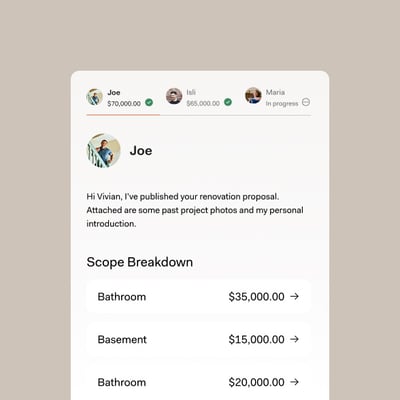
Compare Proposals with Ease

“Designers help prevent expensive mistakes by resolving details before construction starts.”
Atlanta's trees are an asset, but they require consideration during deck and patio planning.
Georgia's red clay soil is beautiful in a brick wall and problematic in a backyard. Clay absorbs water slowly, drains poorly, and expands when saturated, which creates three issues for outdoor construction:
Atlanta's outdoor season is longer than many homeowners realize. March through November is comfortable for most people, and even December through February brings enough mild days (highs in the 50s are common) that a patio with a fire pit or a screened porch with a space heater remains usable.
Features that extend the season: gas fire pits or outdoor fireplaces (providing warmth and a gathering point for cool evenings), ceiling-mounted infrared heaters under covered porches (adding 15 to 20 degrees of warmth), and retractable screen systems that can enclose an open porch during cooler months while opening fully in warm weather.
Atlanta's shoulder seasons, March through May and September through November, are when outdoor living is at its best. The temperatures are moderate, the bugs are less aggressive, and the foliage is either in full bloom or putting on a fall color display. Designing your space to be most inviting during these months, rather than optimizing solely for July, is a smart approach.
In the City of Atlanta, a ground-level patio (concrete or pavers, no roof structure) generally doesn't require a building permit. Elevated decks, covered porches, and any structure with electrical or gas connections do require permits. The City of Atlanta charges a $300 flat fee for single-family building permits, among the lowest in major U.S. metros.
Tree removal permits, if applicable, are a separate process and can take several weeks to process. If your project involves removing a protected tree, initiate the permit request early so it doesn't hold up the overall timeline.
Atlanta's best outdoor spaces feel like they grew naturally from the home and the landscape, because the contractor understood both. Block Renovation connects homeowners with vetted, licensed contractors who know how to work with Atlanta's terrain, tree canopy, and architectural traditions. You can compare detailed proposals side by side and build with protections like progress-based payments and a one-year workmanship warranty.
Remodel with confidence through Block
Connect to vetted local contractors
We only work with top-tier, thoroughly vetted contractors

Get expert guidance
Our project planners offer expert advice, scope review, and ongoing support as needed
Enjoy peace of mind throughout your renovation
Secure payment system puts you in control and protects your remodel

Renovate confidently with Block
Easily compare quotes from top quality contractors, and get peace of mind with warranty & price protections.
Georgia
Planning a Brookhaven Custom Home? Start Here
06.11.2026
.png?width=640&name=u5821215421_A_bright_coastal_living_room_with_a_half_wall_rai_f928a036-9b29-41b7-9710-603210dbd9a4_0%20(1).png)
Georgia
Custom Home Building in Augusta, Georgia: Local Guide
04.23.2026
.png?width=640&name=u5821215421_Apartment_Therapy_style_simple_upgraded_garage_in_d4af6dfc-e05b-4eb3-8a40-1969bb173efb_2%20(1).png)
Georgia
How to Upgrade Your Atlanta Garage Without Overspending
04.23.2026

Georgia
Atlanta Condo Renovations: Smart Upgrades That Protect Your Investment
04.22.2026

Georgia
Home Renovation ROI in Atlanta: Preserving Character While Meeting Modern Expectations
04.15.2026