





Cost
How Much Does It Cost to Finish a Basement in 2026?
06.30.2026
04.22.2026


In This Article
A basement egress door is the exit you hope you never use. It's also the feature that determines whether your finished basement is a legal bedroom or a very nice room you can't call a bedroom. Those are different things, and a lot of renovations get halfway through framing before anyone realizes which one they're actually building.
If you're adding a sleeping room downstairs, converting a basement into an in-law suite, or finishing the space to add real square footage, you need a code-compliant emergency escape and rescue opening. A window can work, but a door often works better.
The International Residential Code, which most jurisdictions follow in some form, is specific about what qualifies. Section R310 requires every basement and every basement sleeping room to have at least one operable emergency escape and rescue opening. A door can serve that role. It has to meet real criteria.
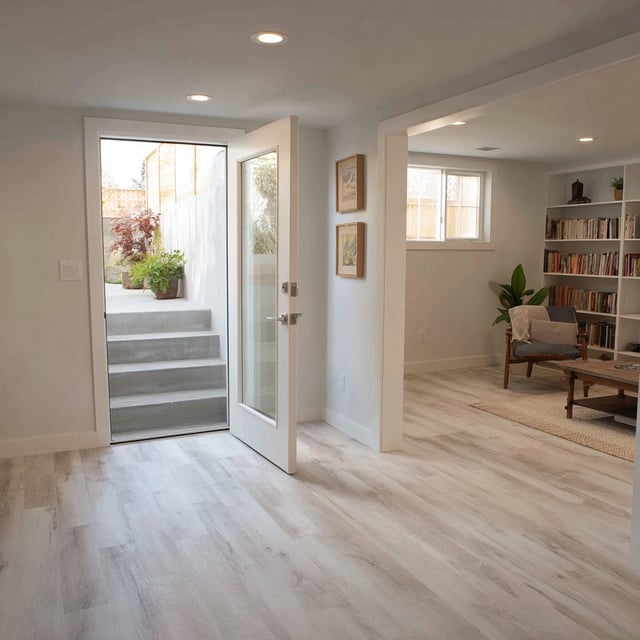
If you're using a side-hinged or sliding door as your egress, and the threshold sits below the surrounding ground level, you need a bulkhead enclosure or an area well outside it. The area well has to be at least 9 square feet, with a horizontal projection and width of no less than 36 inches. If the well is more than 44 inches deep, a permanently affixed ladder or steps are required. The well has to drain, usually by tying into the foundation drainage system.
A few points that trip people up. The door has to operate from the inside without keys or tools. Storm doors and screen doors can swing over exterior stairs and landings, but they don't substitute for the egress door itself. If your basement contains more than one sleeping room, each sleeping room needs its own egress opening. A single door serving the whole basement doesn't work.
Code versions matter too. Your jurisdiction may be on the 2018, 2021, or 2024 IRC, or something local layered on top. Denver rolled over to the 2024 I-Codes at the end of 2025. North Carolina delayed its 2024 adoption until sometime after April 2026. Confirm what your permit will be reviewed under before you order anything.
Homeowners usually land on one of three approaches. The right one depends on your lot, your foundation, and what you're trying to accomplish.
A bulkhead door: Often called a Bilco after the dominant manufacturer, is a slanted set of steel or fiberglass doors covering an exterior stairwell down to an areaway. Replacing an existing bulkhead typically runs $1,000 to $2,500 installed, sometimes up to $3,000 for premium materials or complex site prep. Adding one where none existed before is a bigger job because it requires excavation and a new concrete areaway.
An egress window with a window well: though it is not technically a door, it's worth covering here because it's often the best fit. Installed cost runs $6,000 to $8,000, including cutting the foundation, the window, the well, and drainage. For most basement bedroom conversions, this is the faster and cheaper path to compliance.
A full walkout conversion: You cut a new door-sized opening through the foundation, excavate down to grade, install a stairwell with retaining walls, add a full-height exterior door, and tie everything into drainage. Costs vary dramatically. On a sloped lot where part of the basement wall is near grade, $5,000 to $15,000 is realistic. On a flat lot with a fully buried basement wall, expect $25,000 to $40,000 once excavation, structural work, and finish work are in.
Here's the conversation that comes up more than any other. "We already have a Bilco door. That's our egress, right?"
Usually, no.
The egress opening has to serve the sleeping room. If your bulkhead is on the north side of the house and the new bedroom is on the south side, code isn't satisfied. An emergency exit that requires running through other rooms during a fire doesn't qualify. Inspectors still require a dedicated egress window in that bedroom.
So you spend $1,500 to $2,500 on a bulkhead, then another $6,000 to $8,000 on the egress window anyway. The bulkhead still has value for moving furniture and general basement access. It just isn't your code compliance unless it's positioned and sized for the specific room it serves.
This is the kind of detail that should get caught during scope review, not during framing. A good scope spells out exactly which opening serves which room and confirms it meets the IRC dimensions for that specific use. If your quote just says "egress" without naming the room and the opening, push back before you sign.
Transparent Pricing You Can Trust

Online cost guides love to cite $2,500 to $10,000 for adding a walkout door. That range exists. It assumes cooperative conditions: a sloped lot where the basement wall is already near grade, a foundation that can be cut without major reinforcement, and soil that drains well.
On a flat lot with a fully buried basement wall, the real budget is different. A structural engineer runs $500 to $2,000 for evaluation and stamped drawings. Permits are another $500 to $2,000. Excavation, including trucking dirt offsite, can be anywhere from $2,500 to $20,000 depending on how much you're moving and where it goes. Foundation cutting and a steel header run $2,000 to $5,000. Retaining walls for the stairwell are usually $3,000 to $9,000. The exterior door itself is $500 for a solid steel slab, up to $7,000 for sliding glass or french doors. Then you need stairs, a landing, railings, drainage, and finish work, which stack another $3,000 to $8,000 on top.
Totals in the $25,000 to $40,000 range are common. One Utah design-build firm reports an average of roughly $37,000 for a walkout on an 8-foot basement. The door itself is often the cheapest line item on the invoice.
This isn't an argument against doing it. It's an argument for budgeting off accurate numbers instead of the low end of a search result.
This one catches people. The IRC requires the sill of an egress opening to be no more than 44 inches above the finished floor. During rough framing, most basement egress windows are installed based on the slab height.
Then the finish work starts. A subfloor system adds an inch. Finished flooring adds another half inch to an inch on top of that. The window that was compliant at 43 inches above slab is now 45 inches above the finished floor. Fail inspection. Tear it out.
The fix is free if you plan for it. Measure your proposed finish floor assembly before your contractor sets the sill height on the egress window or door. This is the kind of thing Block's expert scope review catches early, when it's a note on a drawing instead of a torn-out window at final inspection.
Most basement egress installations that fail don't fail because of the door. They fail because water collects where it shouldn't.
An area well catches rain and snowmelt. Without proper drainage, water pools at the threshold, seeps into the foundation, freezes in winter, and eventually damages the door frame, the sill, or the foundation itself. In a finished basement, that can also mean water coming through the wall into the living space.
Code addresses this directly. Area wells have to drain, typically by connecting to the building's foundation drainage system, unless the soil is well-draining enough (certain sand-gravel mixtures) to be exempt. In practice, that means a gravel base, a pipe tied into the perimeter drain, and sometimes a sump pump on the interior side.
For walkout conversions, grading matters just as much. Rule of thumb: the ground should slope away from the threshold at a minimum of 6 inches over the first 10 feet. A landing drain at the base of the stairwell, connected to the same foundation drainage, handles what the grading doesn't. Budget 10 to 20% of your total project cost as contingency for drainage and waterproofing surprises that appear once excavation starts. For a $25,000 walkout, that's $2,500 to $5,000 in reserve.
Cutting a door-sized opening in a poured concrete or block foundation wall is a structural modification. The wall above the new opening has to span a new gap. That means a header sized to carry the load of everything above it, which is to say, the house.
Most jurisdictions require a structural engineer's stamp for any basement wall modification over 48 inches tall. Every walkout conversion clears that threshold. Engineering adds a few hundred to a couple thousand dollars to the project, but it's what keeps the rest of the house from settling in ways you don't want.
Homeowners sometimes try to skip this step, usually because a contractor says they've done it a hundred times and don't need drawings. That's the moment to find a different contractor. The stamp protects you at permit, at inspection, and when a future buyer's inspector asks for documentation of the structural work.
Once the code and structural pieces are sorted, there's real room for design, and it's worth spending time on. The default Bilco bulkhead ships in primer white, and it reads as utilitarian from the yard. A powder coat in deep green, charcoal, or matte black makes the same door disappear into the architecture. The Ultra Series, which looks like driftwood, also accepts interchangeable side panel inserts that add light and ventilation, which changes the feel of the basement on a summer afternoon.
For walkout conversions, the door you choose sets the whole tone of the lower level. A sliding glass door onto a small patio changes a buried basement into a daylit room, particularly on a south-facing wall. French doors with sidelights are more expensive (often two or three times the cost of a single steel door) and more architectural. They work when the walkout faces a garden or a thoughtful side yard, less so when it opens onto the driveway. A solid steel exterior door with a transom window is the practical middle path: light from above, security at eye level, weather sealing throughout.
The design choice should follow the code choice, not the other way around. A beautiful french door that doesn't meet egress requirements is still not a legal bedroom exit.
Three quotes is the floor, not the ceiling. Compare them line by line. If one contractor's number is $10,000 lower than the others, find out what's missing, not why they're cheaper. Usually it's engineering or drainage.
Every quote should specify the exact code section the work is being built to and the adopted code year in your jurisdiction. It should say whether structural engineering is included or billed separately. It should cover excavation and soil disposal (leaving dirt onsite versus trucking it out), the drainage approach and how the area well or landing drain ties into the foundation system, the door model and finish, railings if required (any wall over 32 inches usually needs a guardrail), and permits and inspections.
Block Renovation collaborates with basement contractors across the US, from St. Louis to Baltimore and Philadelphia. Our team can help match you with vetted local contractors and reviews each scope for the gaps that cause change orders later, which on a project like this usually means a missing drainage line item or an engineering assumption that won't pass permit. Start there, not with a contractor search.
Remodel with confidence through Block

Connect to vetted local contractors
We only work with top-tier, thoroughly vetted contractors

Get expert guidance
Our project planners offer expert advice, scope review, and ongoing support as needed

Enjoy peace of mind throughout your renovation
Secure payment system puts you in control and protects your remodel


Renovate confidently with Block
Easily compare quotes from top quality contractors, and get peace of mind with warranty & price protections.
Cost
How Much Does It Cost to Finish a Basement in 2026?
06.30.2026
Basement
1,000 Square Foot Basement Floor Plans: 4 Layouts
06.11.2026

Basement
How to Convert a Basement Into a Legal Apartment (2026)
06.08.2026
Bathroom
Building a Basement Bathroom: Cost & Planning
06.01.2026
Basement
Daylight vs. Walkout Basement: Which Is Better?
05.18.2026