Lot selection can make or break a custom home build. One consideration: whether the land is sloped. It doesn't have to be a dealbreaker, and in hilly cities like San Francisco, Seattle, Knoxville, or Rochester, it's almost unavoidable.
But it's important to know what you're up against.
Know your grade before anything else
Slope is measured as a percentage. For every 100 feet of horizontal distance, the elevation changes by some number of feet. That number changes everything about your project.
- Under 10%: slight. Builds much like flat ground.
- 11 to 20%: moderate. Requires planning, but very workable.
- Above 20%: steep. Costs and engineering rise sharply.
- 30 degrees and up: typically requires deeper foundations, retaining walls, and subsurface drainage to stabilize the site.
- 40 degrees and up: expect significant remediation and possibly six-figure site work before the house even starts.
Orientation matters too. A 28 by 60 foot home placed with the long side running down a 15% slope will have lower corners sitting nine feet below the upper corners. Turn the house 90 degrees and that drop shrinks to about four feet. Same lot, dramatically different excavation.
There's also the upslope versus downslope question. Upslope lots, where the land rises behind the house, often need cutting into the hill, hauling out soil, and sometimes blasting rock. Downslope lots, where the land falls away from the street, tend to be friendlier to walkout designs and existing drainage patterns.
Upsides to building a house on a slope
Believe it or not, there's actually some advantages to building on a slope. All of the below are made easier by the slant:
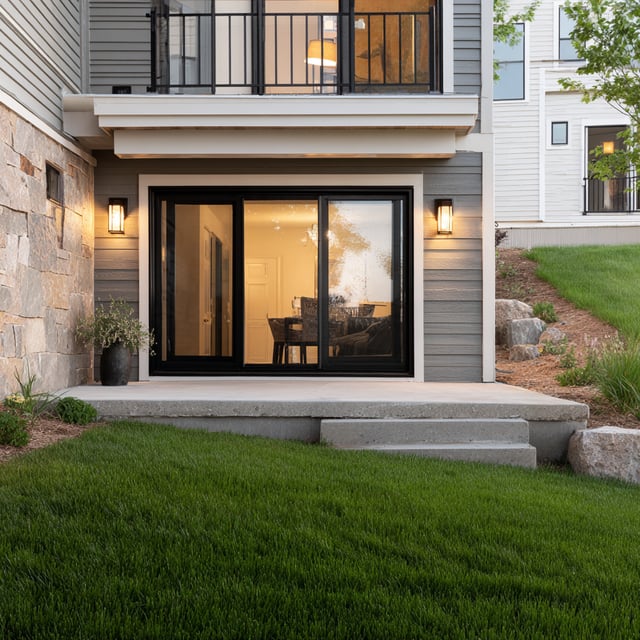
- A walkout or daylight basement that adds an entire level of bright, livable space without expanding the footprint. Because the lower level is partially exposed, you get full-size windows and a real exterior door, not the dim, half-buried feeling of a traditional basement. Many homeowners turn that space into a guest suite, rental unit, or home office that pays the slope back.
- Drive-under garages that free up the main floor for living areas. The slope does the work a tall foundation would otherwise have to do, so you get covered parking without giving up first-floor square footage.
- Views. Real views, the kind that make people stop talking when they walk in.
- Natural light from multiple elevations. A single home can pull light from windows that sit at three or four different heights along the slope, which is hard to replicate on a flat lot.
- Energy efficiency from soil-side insulation. Five feet below grade, the ground stays around 52 degrees year round, which cuts heating and cooling loads.
- Privacy. Steeper lots tend to be less developed, with neighbors farther away and often out of sight entirely.
- Lower land cost. Sloped lots usually sell for less than comparable flat ones, sometimes by a meaningful margin. That gap can offset a real chunk of the higher build cost.
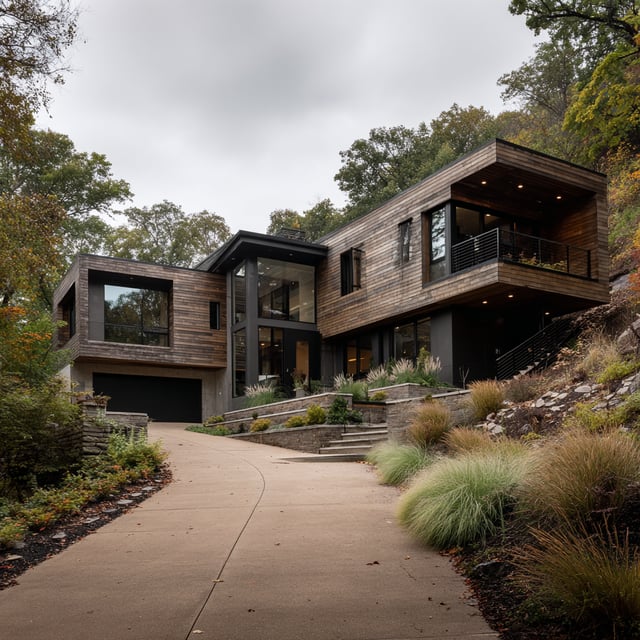
Sloped lots also produce homes that don't look like every other house on the block. Multi-level layouts, cantilevers, split-levels, and tiered decks aren't decorative choices on a hillside. They're the natural response to the terrain.
Foundation options, matched to the slope
Foundation choice comes down to your grade and your soil. Climate and budget shape it from there.
- Concrete slab. Cheapest option, only viable on slight to moderate slopes. Requires careful grading and often a stem wall plus compacted fill on the downhill side.
- Stepped foundation. Built like wide stairs that follow the natural contour. Each section steps down with the slope, knitted into one continuous base. On moderate slopes, this usually means less digging and a smaller footprint of disturbed land.
- Walkout or daylight basement. Partially exposed on the downhill side, with a real ground-level entrance and full-size windows. Adds livable square footage and tends to drain better than a fully buried basement.
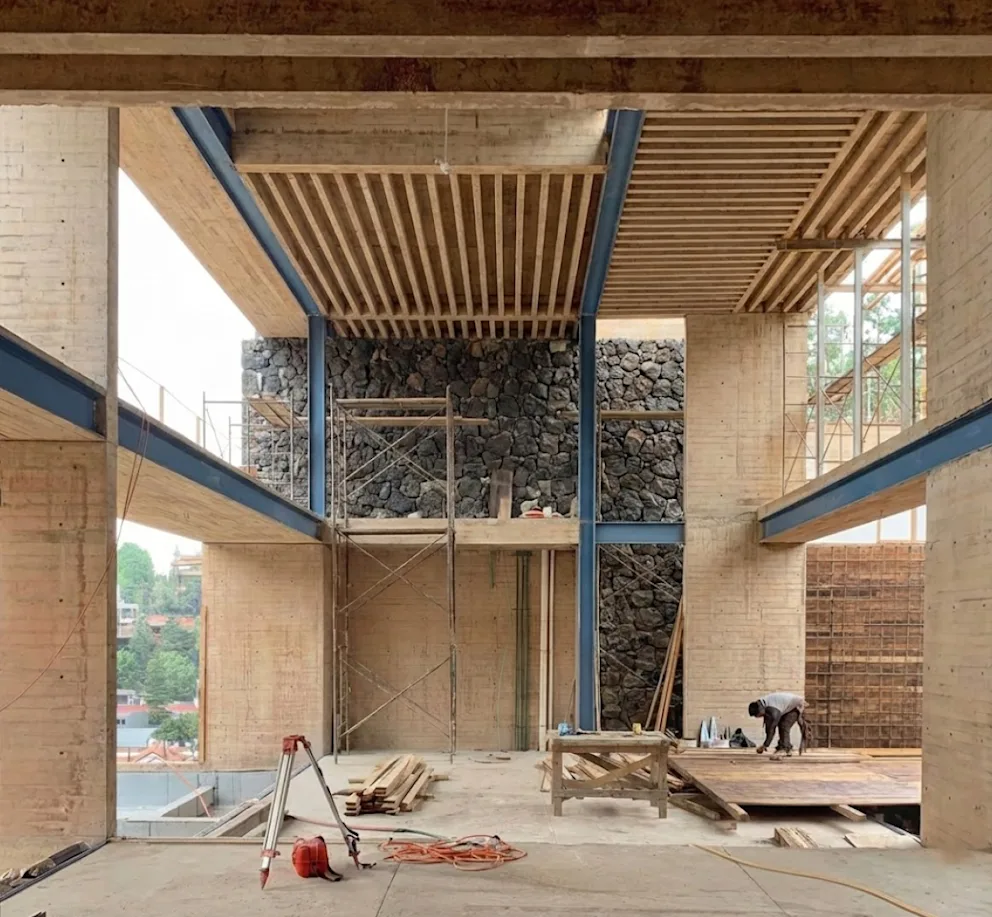
- Pier and beam. Concrete piers placed at strategic points support beams that the structure rests on. The house conforms to the slope instead of forcing the slope to conform to it. Strong choice for steeper lots.
- Caissons or piles. For very steep or unstable sites, deep holes (sometimes 20 to 40 feet) are drilled past loose soil to bedrock or dense earth, then filled with reinforced concrete. The house rides on these deep stilts. Expensive, but sometimes the only option that works.
- Hybrid foundations. Many slope projects combine approaches: shallow foundations on the stable lower section, deep piers on the higher or weaker section, retaining walls creating level zones in between.
Cut and fill, or build on stilts
Cut and fill levels the building area by removing soil from the high side and adding it to the low side. It produces a flat building pad, which is familiar territory for most contractors. It can also multiply your costs compared to a flat-site equivalent. And if the fill isn't compacted properly, a slab placed on top of it can crack and settle.
The alternative is to leave the slope alone and build above it on piers, posts, or pilings. A crane sets the structure on its supports, the slope stays mostly intact, and the home gains the ability to extend out over terrain that couldn't otherwise be built on. Often cheaper than aggressive cut and fill, and lighter on the site environmentally.
The cheapest path of all is to find a building zone that's already relatively level and let the rest of the lot stay sloped.
Drainage is not optional
Skimp on drainage and a slope will find out. Mudslides, foundation damage, retaining wall failure, basement flooding: most of these trace back to water that wasn't directed somewhere it could safely go.
The basics of slope drainage:
- Grade the soil immediately around the foundation to slope away from the house. Building codes require it for a reason.
- Use French drains, swales, and culverts to channel runoff to stormwater systems or soakaways.
- Tank (waterproof) any retaining wall and add drainage behind it. Hydrostatic pressure from trapped water is a common cause of wall failure.
- Account for downstream impact. Your runoff cannot flood the neighbor's yard or back up into a public road.
- A foundation drain that exits to daylight is more reliable than one that depends on a sump pump.
Codes typically require non-masonry building materials to sit at least eight inches above soil. On a slope with snow and rain coming down toward the house, doubling that clearance is a smart hedge.
Retaining walls, the unsung structural element
Retaining walls on a hillside hold back thousands of pounds of soil. Treat one like a landscape feature and it will eventually prove you wrong.
Common materials:
- Poured concrete. Strong, durable, around $30 to $50 per square face foot installed. Can be veneered for appearance.
- Stone or masonry. Long-lasting, attractive, generally more expensive. Costs vary widely depending on whether you're using cut stone, fieldstone, or block veneer, and skilled masons in your area aren't always easy to find. Done right, the wall outlives the house.
- Timber. Cheaper, around $15 to $30 per square face foot, but shorter lifespan.
- Gabion (wire baskets filled with rock). Rustic look, excellent natural drainage.
Walls over four feet typically require an engineer. Drainage behind the wall, usually a perforated drainpipe wrapped in landscape fabric and gravel, runs another $10 to $30 per linear foot. Permits range from $50 to $450 depending on jurisdiction, and engineering itself can add $100 to $220 per hour.
What it actually costs to build on a slope
Slope builds run 10 to 20% more than the same house on flat ground. Steeper sites cost more.
The cost drivers, in roughly the order they hit:
- Geotechnical reports and additional permits, often required before purchase.
- Site clearing, grading, excavation, and possibly blasting. Rock ledges near the surface are common on slopes and can be expensive to remove, since blasting carries liability risk to neighboring foundations.
- More extensive foundation work and concrete.
- Retaining walls and erosion control.
- Specialized drainage systems.
- Equipment access and staging, especially on sites that can't be worked when soil is wet.
- Higher long-term landscaping and maintenance costs.
A real example from a steep cliff-side lot: the geogrid soil stabilization system alone was estimated at $300,000, before the house, before the retaining wall required at the cliff edge. The buyer had been told they'd save $300,000 on the land. The land was effectively the same price as the flat lot down the road, just paid in a different column of the budget.
Get the geotechnical report before you sign, not after. Soil borings tell you whether bearing soil sits 8 feet down or 30 feet down, and that single number can swing the project's feasibility by hundreds of thousands of dollars.
How to plan a slope build
- Get a geotechnical report. Ideally before buying. Soil composition, bearing depth, groundwater, and stability all live in this document.
- Survey the topography precisely. Contour lines, not estimates.
- Bring in slope-experienced professionals early. A structural engineer, a geotechnical engineer, and an architect who has worked with hillsides. Flat-lot plans don't simply translate.
- Pre-meet with local building authorities. Many jurisdictions have specific slope regulations, fire access requirements, and stormwater rules. Sewer easements and hydrant distances can reshape the project.
- Choose a house plan designed for slopes. Most are 2 to 2.5 stories, with stepped foundations, walkout basements, or split-level layouts that match how the slope cuts through the floor plan.
- Plan access carefully. Driveway gradient, turnaround space, material delivery, and crane access all need attention before construction starts.
- Set a contingency. Even on flat land, 10 to 20% of the budget should sit in reserve. On a slope, lean toward the higher end. Hidden ledge, unexpected groundwater, and access problems are the kinds of surprises slopes specialize in.
Design moves that work on a hillside
What works on a hillside, based on the homes that don't fight the terrain:
- Multi-level layouts that cascade down the slope rather than fighting it.
- Split-level designs when the slope cuts through the home's middle.
- Large windows and outdoor decks oriented toward the view and the sun.
- Walkout lower levels used as rec rooms, guest suites, or rental units.
- Building into the uphill side for thermal mass and insulation.
- Compact, vertical footprints that minimize site disturbance and impermeable surface.
- Custom roof shapes (butterfly, shed) that play with the natural lines of the terrain.
- Wood, stone, and other natural materials that read as part of the landscape.
- Tiered landscaping with retaining walls, terraces, and rock gardens.
- Deep-rooted ground covers like English ivy, creeping phlox, and thyme to lock down soil and resist erosion.
Where to start
A sloped lot is worth it. The difference between a great hillside home and a stressful one is who plans it. Get the geotech, hire the experienced architect and structural engineer, and budget for the slope as it actually is, not as you hope it might be.
If you're sizing up a sloped lot or already own one and aren't sure where to begin, Block Renovation can match you with vetted contractors who've worked with hillside foundations, drainage systems, and retaining walls before. Tell us about the project and Block will handle the matching, the scope review, and the protections that keep a complex build from turning into a complex problem.

Written by
Victoria Mansa
Victoria Mansa
Victoria Mansa is a sales leader at Block Renovation, where she partners with homeowners and contractors to improve how renovation projects are planned and delivered. With years of experience managing large renovation pipelines and advising on six-figure projects, she focuses on bridging the gap between homeowner expectations and real-world construction outcomes.












.png?width=640&name=u5821215421_A_stylishly_renovated_A-frame_living_room_with_pi_bf06e9f9-ecb5-47c7-8242-2bc77e83ce8e_0%20(1).png)