



Cost
Attic Renovation Costs in 2026: Finish or Convert an Attic
07.20.2026
04.21.2026


In This Article
Denver’s fast growth, strong real estate market, and culture of outdoor living have created a population that knows how to make the most of what they have. And what a lot of Denver homeowners have—sitting above their heads, largely unused—is an attic with genuinely good bones.
This means adequate headroom, a conventional rafter-and-ridge roof structure (rather than engineered trusses), solid floor joists, and no significant structural or moisture damage. Many of Denver’s most popular housing types—the Tudor revivals and brick bungalows of Wash Park and South Pearl, and the Craftsman foursquares in Berkeley and Highlands—were built with conventional framing that converts well.
If your attic has good bones, the conversation shifts from “can we do this?” to “how do we make this as livable as possible?” That’s a much more interesting question, and this guide is dedicated to answering it.
Turn your renovation vision into reality
Get matched with trusted contractors and start your renovation today!
Find a Contractor
Denver’s renovation market has become increasingly competitive in recent years, with labor costs rising alongside the broader housing market. Here are realistic cost ranges for a Denver attic conversion with good structural bones:
Always set aside a bit more than the contractor initially quotes you; Denver’s older homes can surface surprises in the form of knob-and-tube wiring, undersized service panels, or plaster-and-lath ceilings below the attic floor that complicate the staircase opening.
Before getting into design and livability, it’s worth being specific about what good bones means in the Denver context—both because it sets realistic expectations and because knowing what you have shapes every decision that follows.
The single biggest design decision in an attic conversion is how you get there. The access solution you choose affects the floor plan below, the usable footprint above, and how the finished attic feels to use on a daily basis.
Pull-down stairs
A pull-down ladder may already exist in your attic. If it does, it’s not code-compliant access for a finished living space—it’s fine for storage, but a room intended for regular occupancy requires a permanent staircase. Pull-downs also create a significant thermal bypass, letting conditioned air escape and unconditioned air in, which matters in Denver’s wide temperature range.
Straight staircase
The most straightforward solution when there’s a linear run of space to work with—a wide hallway, a large closet, or a bedroom corner that can be reconfigured. A standard staircase requires roughly 35–40 square feet of footprint on the floor below and about the same opening in the attic floor. In many Denver foursquares, where the upper floor has generous hallways and landing areas, this works naturally.
L-shaped or U-shaped staircases
When a straight run isn’t available, an L-shape or U-shape fits into a tighter footprint by changing direction. These are common in Denver’s bungalows and smaller Craftsmans where hallway width is limited. They require more careful planning but are achievable in most floor plans.
Alternating tread stairs
A code-accepted alternative for steep or space-constrained access situations, alternating tread stairs (also called ship’s ladders) are steeper than a conventional staircase but more compact. They work well for attics used as offices, studios, or secondary bedrooms where daily foot traffic is moderate. Not ideal for small children or anyone with mobility considerations.
Once access is resolved, the floor plan takes shape around the roof geometry. Denver attic conversions typically work with a central zone of full headroom flanked by lower-ceiling knee wall areas that, while not standing height, are enormously useful.
The center zone
This is where the primary activity of the room lives—desk if it’s a home office, seating area if it’s a lounge or reading room, bed if it’s a bedroom. In a well-pitched Denver bungalow, the center zone might run 10–14 feet wide and the full length of the house, giving you a surprisingly generous footprint for the main function of the space.
Knee wall areas
The sloped ceiling areas along the perimeter of an attic are the most commonly wasted space in a conversion—and the most rewarding to use well. Some ideas that work particularly well in Denver homes:

“Cabinets aren’t just about looks. Storage inserts, pullouts, and organization inside the cabinets determine how functional a kitchen truly is.”
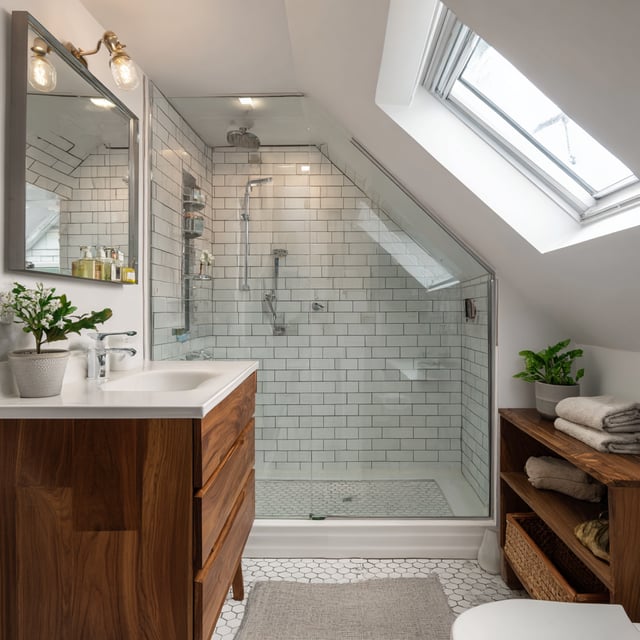
Denver’s 300-plus days of sunshine per year are one of the city’s defining qualities, and a finished attic that takes advantage of that light is a dramatically better space than one that doesn’t. Standard vertical windows on gable ends are a start, but they’re limited by the gable area available.
Skylight options worth knowing:
Denver’s climate is a study in extremes: hot summer afternoons (regularly above 90°F in July and August), cold winters (with stretches below zero°F), and the wide diurnal temperature swings that come with mile-high elevation and low humidity. An attic at the top of the house experiences all of this more acutely than any other room.
Insulation is the foundation. Colorado’s energy code requires R-49 at the ceiling plane for new construction—an attic conversion needs to meet this standard. Spray foam at the roof deck (unvented assembly) is common in Colorado conversions because it performs well in both heating and cooling seasons and handles the dry climate’s tendency toward air infiltration.
For mechanical systems, a mini-split heat pump is the most practical choice for a Denver attic addition. It provides both heating and cooling independently of the main system, handles Denver’s wide temperature range effectively, and avoids the complexity of extending ductwork through a finished attic. A single-zone unit is typically sufficient for a space up to 500–600 square feet.
One Denver-specific detail: the city’s low humidity means that the moisture issues that dominate Seattle attic conversions are less critical here. You still want adequate vapor management, but the risk profile is different. What Denver does share with other high-altitude climates is elevated UV exposure—southern-facing skylights should use laminated glass with UV protection to prevent premature fading of flooring and furnishings.
Turning a structurally sound Denver attic into a room you actually want to spend time in is a project that rewards careful planning and skilled execution. Block Renovation connects Denver homeowners with vetted, licensed contractors who know the city’s housing stock—from the brick foursquares of the Highlands to the post-war ranches of Lakewood—and can navigate the permits, structural work, and finish details that make an attic conversion genuinely livable. With transparent pricing, expert scope review, and progress-based payments, Block takes the uncertainty out of a project that has a lot of moving parts.
Remodel with confidence through Block

Connect to vetted local contractors
We only work with top-tier, thoroughly vetted contractors

Get expert guidance
Our project planners offer expert advice, scope review, and ongoing support as needed
Enjoy peace of mind throughout your renovation
Secure payment system puts you in control and protects your remodel

Renovate confidently with Block
Easily compare quotes from top quality contractors, and get peace of mind with warranty & price protections.
Cost
Attic Renovation Costs in 2026: Finish or Convert an Attic
07.20.2026
.webp?width=640&name=bathroom%20custom%20shower%20remodeled%20small%20attic%20(1).webp)
Attic
Convert Attic to Living Space: Costs and Code
06.18.2026
Attic
Denver Attic Renovation: Making Your Attic Actually Livable
04.21.2026

Colorado
Denver Home Additions—Costs, Architecture, and What to Know
04.20.2026
Colorado
Home Renovation ROI in Denver: Projects That Help Your Home Stand Out
04.16.2026