



Home Addition
Building Kitchen Additions: Costs & Design
08.21.2026
02.25.2026


In This Article
An ADU kitchen is an exercise in restraint and precision. In a compact footprint, layout inefficiencies, oversized appliances, or overly expressive materials are magnified. The goal is not simply to meet minimum requirements—it is to design a kitchen that performs like a full-scale space while feeling integrated into the broader architecture of the ADU.
A successful renovation rests on three core principles:
When approached with discipline, an ADU kitchen feels intentional and complete—not compressed.
Because ADUs are legally independent dwelling units, their kitchens must meet residential standards. Municipalities evaluate these spaces based on permanence, safety, and functionality—not visual impression. Built-in appliances, fixed plumbing, and code-compliant electrical systems are typically mandatory.
Treating these requirements as foundational design parameters—not bureaucratic hurdles—results in stronger, more predictable renovations.
Most jurisdictions require a permanently installed cooking appliance capable of supporting daily use. Temporary or plug-in units generally fail inspection because they do not demonstrate long-term residential viability. When specifying appliances:
A code-compliant sink with hot and cold running water is required, but placement and specification directly influence construction scope and long-term usability. Plumbing decisions often determine how invasive the renovation becomes. Key considerations include:
ADU kitchens often concentrate multiple high-demand appliances in limited square footage. Without early panel review and circuit planning, projects risk mid-construction upgrades that affect both timeline and budget. Plan proactively for:
Turn your renovation vision into reality
Get matched with trusted contractors and start your renovation today!
Find a Contractor
Layout decisions determine whether a compact kitchen feels agile or constrained. Proportion, circulation, and adjacency to living spaces all influence how the kitchen performs within the larger ADU.
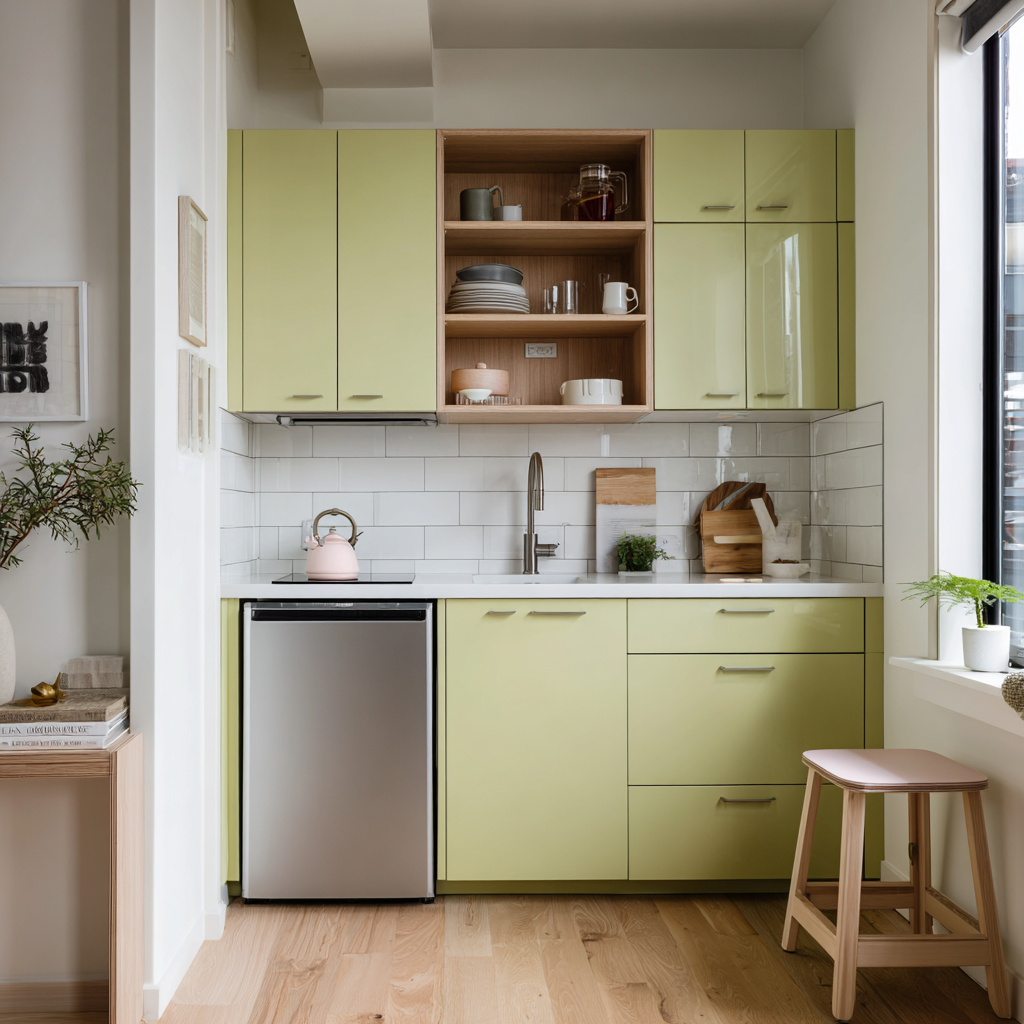
A one-wall kitchen organizes cabinetry, appliances, and countertops along a single plane. This configuration is particularly effective in open-plan ADUs, where preserving flexible living space is essential.
By consolidating utilities on one wall, construction complexity is reduced and mechanical coordination becomes more straightforward. Visually, the linear arrangement allows cabinetry to read as integrated millwork, preventing the kitchen from overwhelming the room.
An L-shaped layout extends your ADU kitchen’s cabinetry onto a second adjoining wall, increasing both storage and counter surface. This configuration naturally establishes zones between prep, cooking, and cleaning functions.
The return wall provides additional flexibility for corner storage solutions, which can significantly expand usable capacity. When detailed carefully, the L-shape improves functionality without enclosing the space.
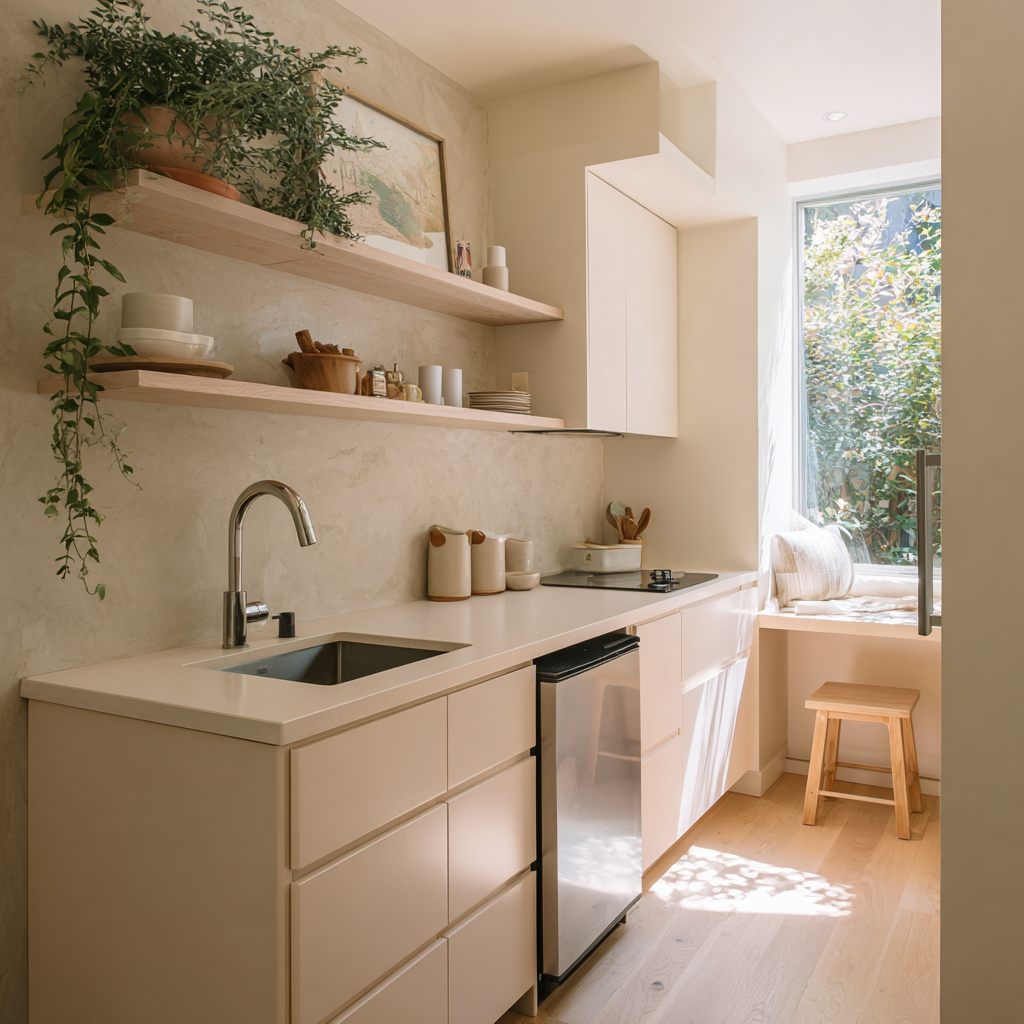
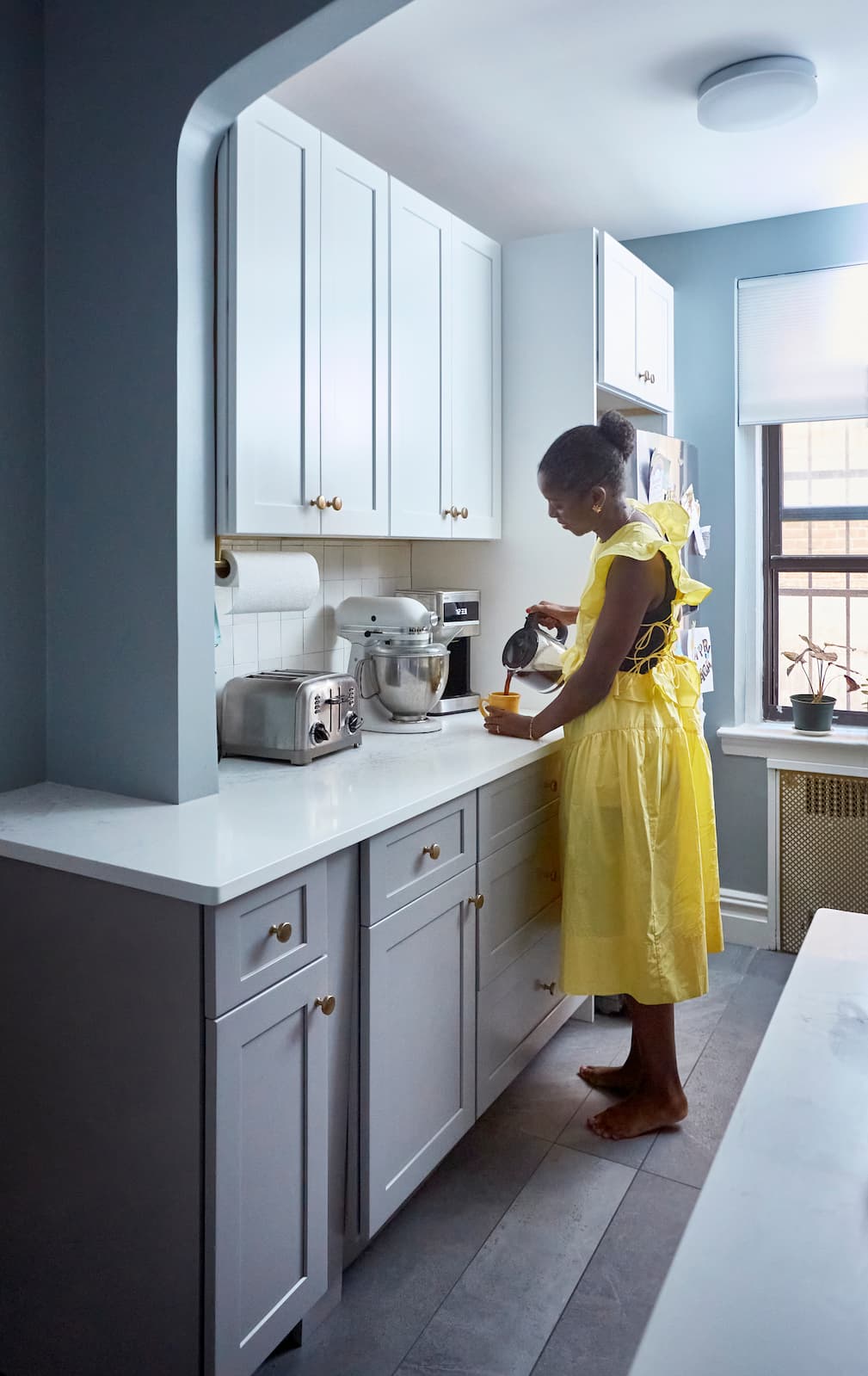
A galley kitchen introduces parallel cabinet runs, maximizing storage and prep surface within a compact footprint. For homeowners who cook frequently, this layout can feel surprisingly robust.
The success of a galley depends on proportion and clearance. Adequate walkway width preserves comfort and prevents the space from feeling compressed.
Most ADUs have nowhere obvious to put a washer and dryer, and a dedicated laundry closet costs you square footage the unit does not have. The kitchen already has the water line, the drain, and the 240-volt circuit, so it's usually the cheapest place to land them.
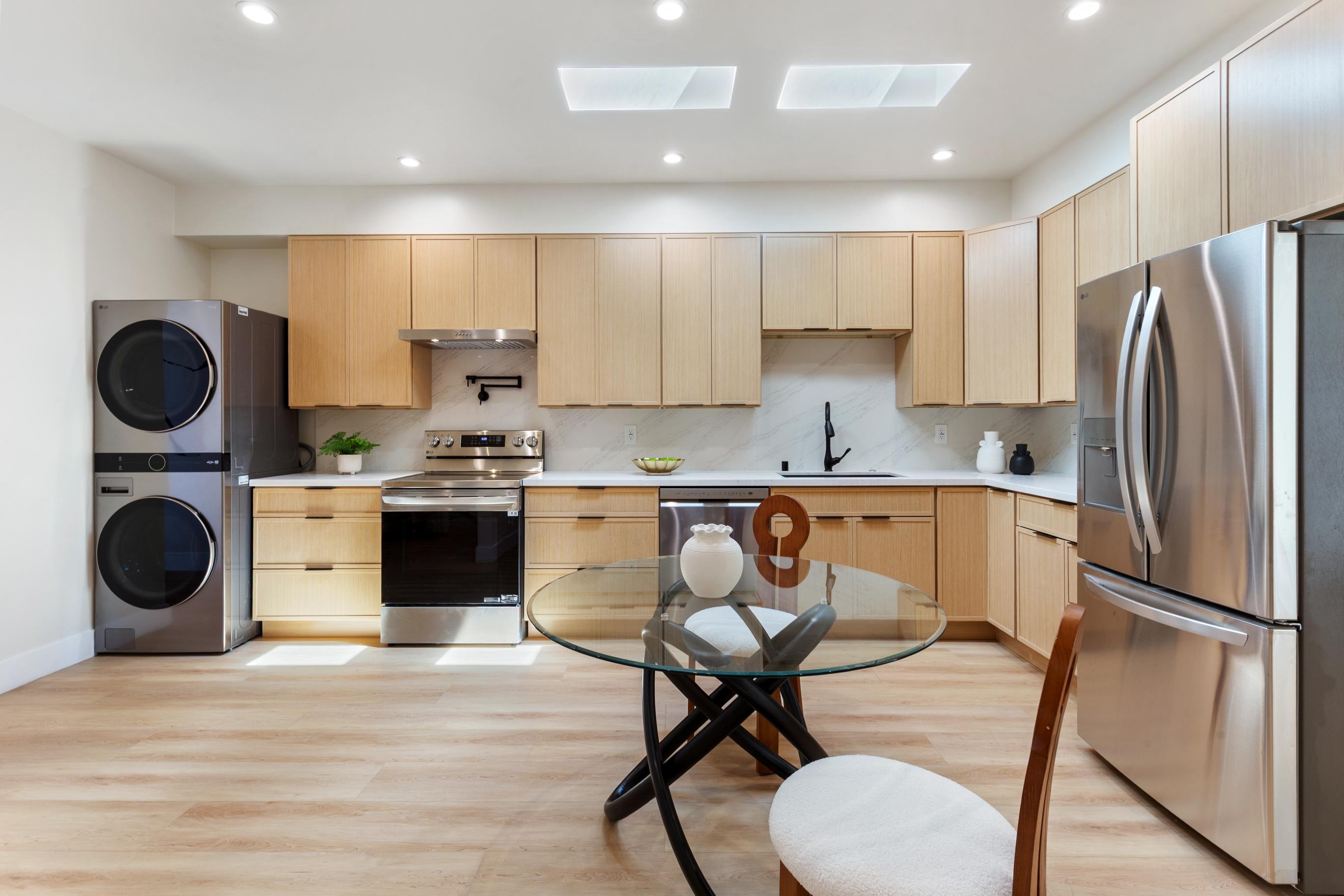
Tehran Construction did exactly that in a 1,000 square foot backyard ADU in Los Angeles, stacking the units at the end of the cabinet run instead of building a separate closet.
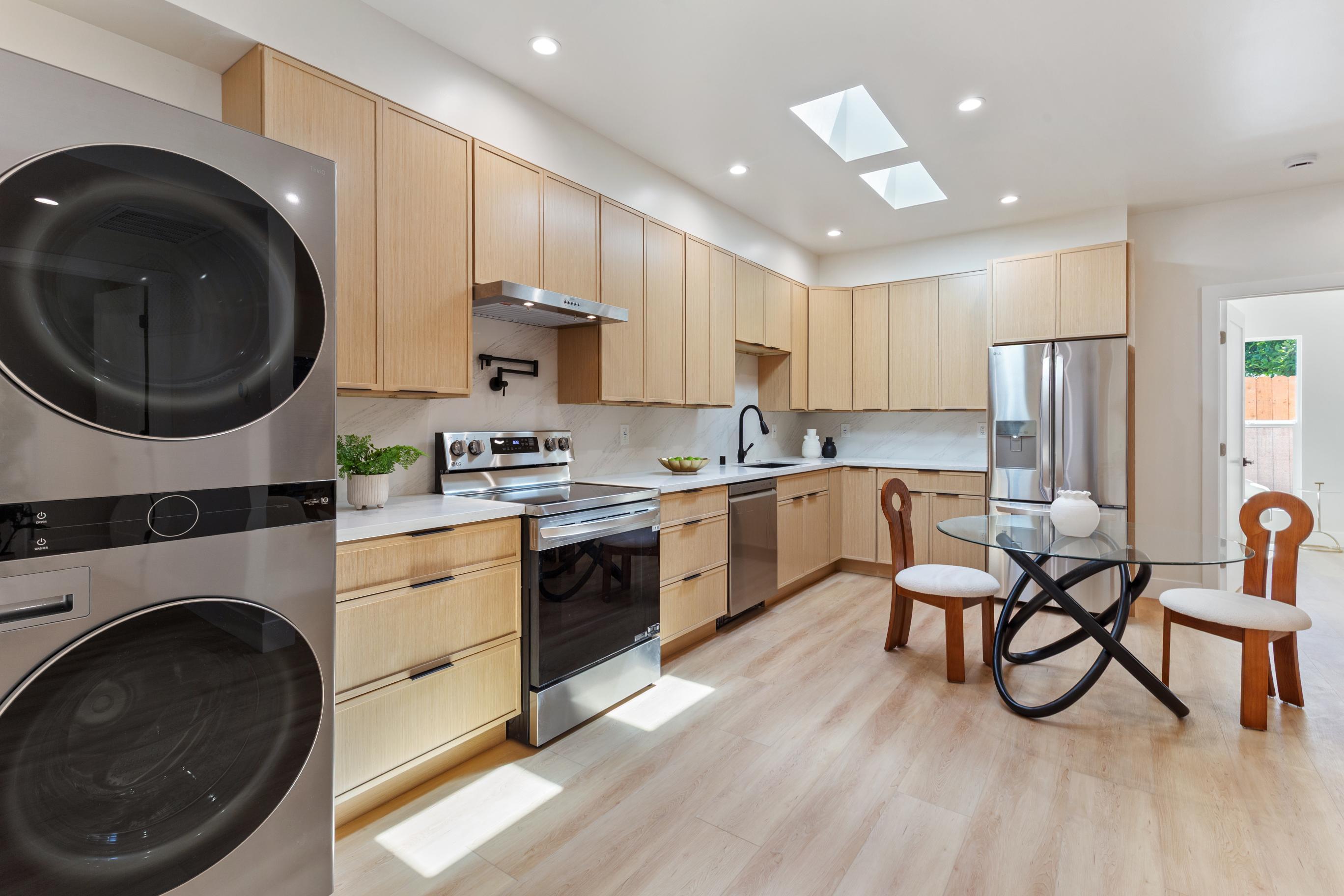
The trade is base cabinet. A stacked pair eats about 27 inches of wall, which in a one-wall kitchen can be a quarter of your storage.
In an ADU kitchen, materials are subjected to concentrated wear. Durability and cohesion should guide every specification, particularly in rental or multi-generational living scenarios.
Countertops must balance performance with visual restraint. Because they anchor the room and endure the heaviest use, their selection should be deliberate and proportionally appropriate.
Consider the following options:
Edge profiles, seam placement, and backsplash integration should be considered part of the countertop decision—not afterthoughts.
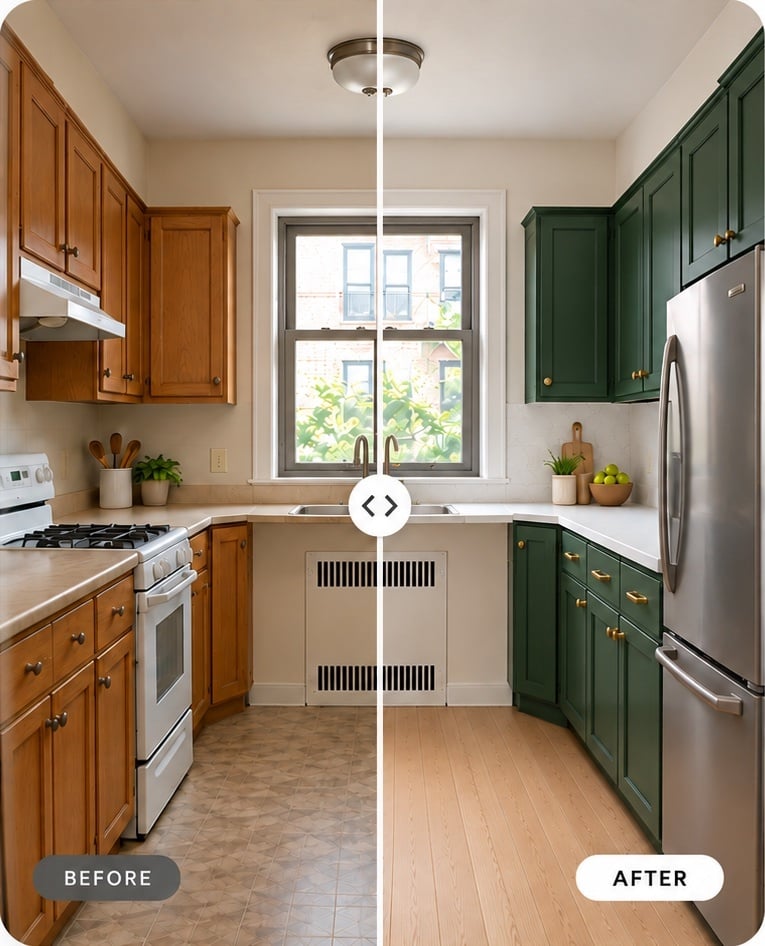
Cabinetry occupies the largest visual surface area in most ADU kitchens. Finish selection should reinforce architectural clarity rather than introduce unnecessary contrast. If you want to play it safe:
If you have a larger ADU kitchen or dare to go bold, you'll love how this particular ADU designed their kitchen with help from Oro Coast Builders. They paired white shaker bases with black glass-front uppers and walnut side panels. The glass and the wood carry the visual weight, and the lower cabinets stay plain enough that the room never feels crowded.
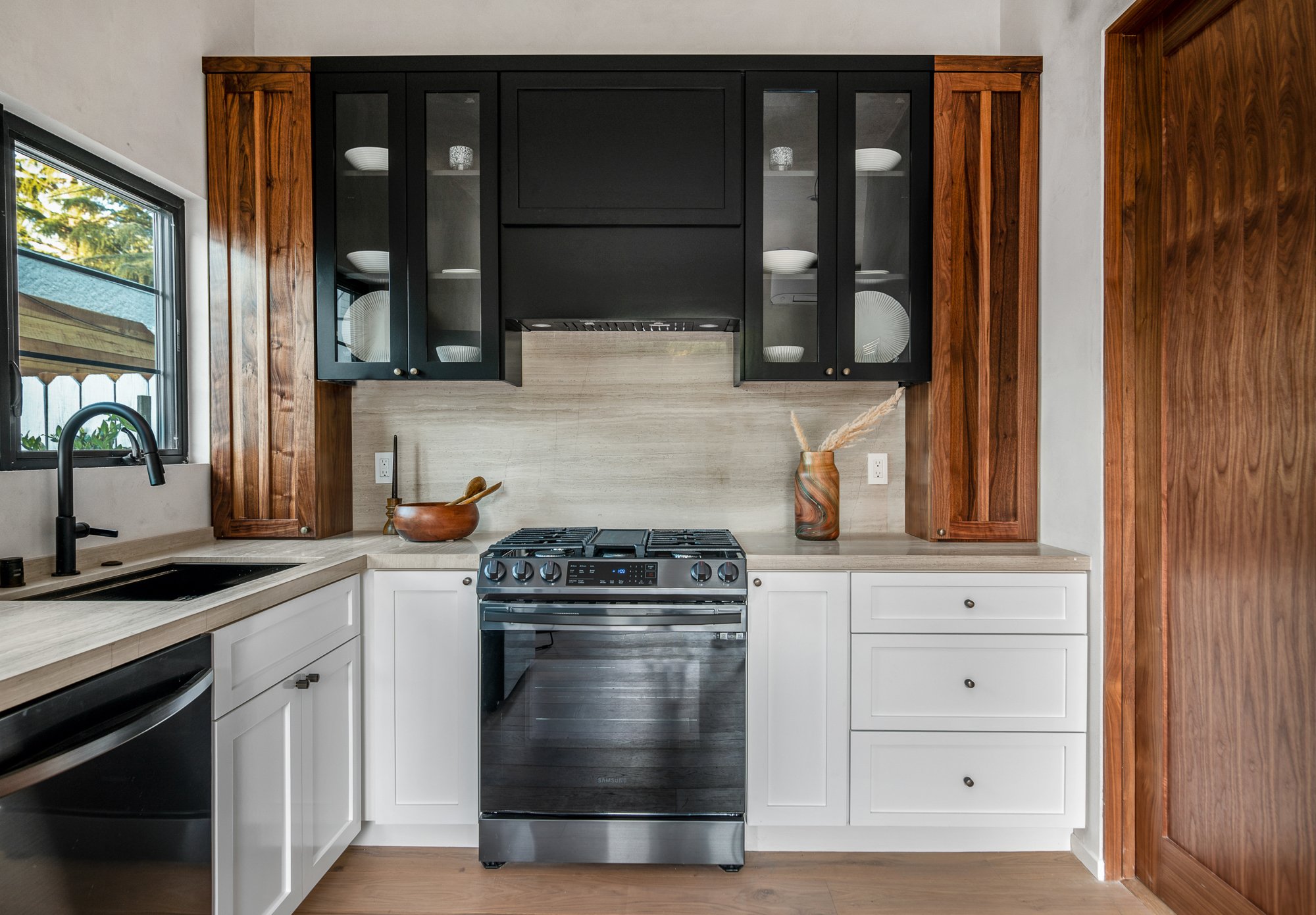
An important reason why this visual works so well is that they don't "cheap out" on materials; the entire ADU build came to $218,000. Moreover, the area surrounding the kitchen is minimalist so there's risk of clashing visuals.
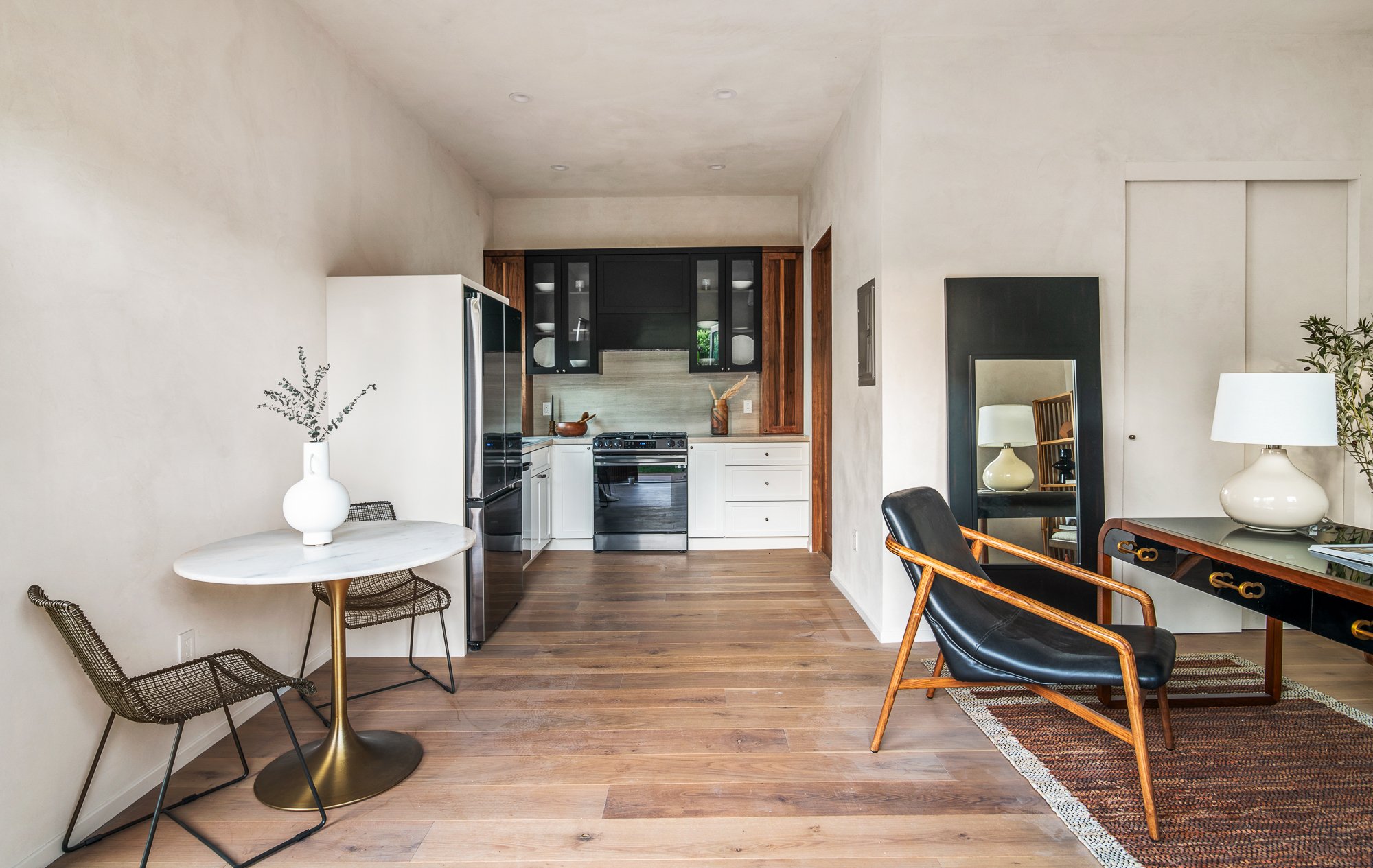
Flooring decisions influence how the kitchen relates to adjacent rooms. Continuity and durability are often more impactful than dramatic contrast.
Look for:
Luxury vinyl planks (LVP) offer strong water resistance and resilience under shifting appliances, making it a strong choice for ADU kitchens. Engineered hardwood provides warmth and dimensional stability, making it suitable for open layouts where continuity into living areas is important. Porcelain tile delivers exceptional durability and moisture resistance, particularly in ground-level or slab-on-grade ADUs.
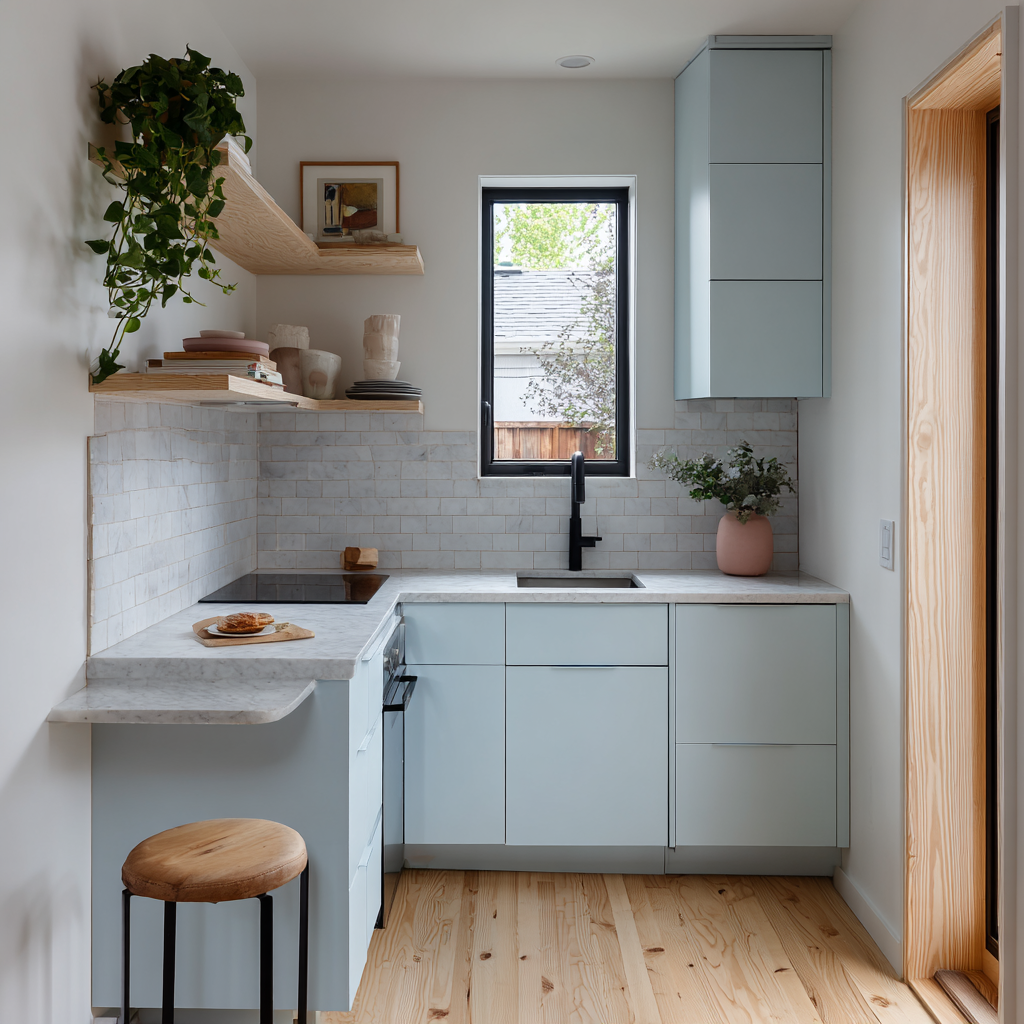
Even well-intentioned ADU kitchens can fall short when early decisions are rushed or disconnected from construction realities. In compact spaces, small missteps have outsized consequences—impacting workflow, permitting, durability, and long-term value.
Tight walkway dimensions may look acceptable on a floor plan but feel restrictive in daily use. Proper spacing between cabinet runs and appliance doors is essential for comfort and safety. Tina Dougherty, CEO of Paint It Forward, LLC, pointed out that optimal movement within a small kitchen is heavily reliant upon appliance placement.

Most people focus on squeezing in more cabinets or more countertop, but I think the biggest priority is actually appliance placement. A small kitchen works best when your refrigerator, sink, and range form an efficient work triangle. If you're constantly walking around an island or across the room to cook, no amount of extra storage will make the kitchen feel functional.
A full-scale 36-inch range or oversized refrigerator can dominate the footprint and restrict circulation in ways that are difficult to correct later. Selecting appropriately scaled appliances preserves counter space and ensures the kitchen feels proportionate to the ADU.
Doughtery explained it best: "I'd reduce appliance size before sacrificing workflow. A 33-inch refrigerator that fits the space well is almost always a better decision than forcing in a larger model that disrupts the layout."
Assuming minimal storage will suffice often leads to cluttered countertops and compromised organization. Thoughtful drawer systems, vertical cabinetry, and dedicated pantry zones prevent the kitchen from feeling chaotic over time.
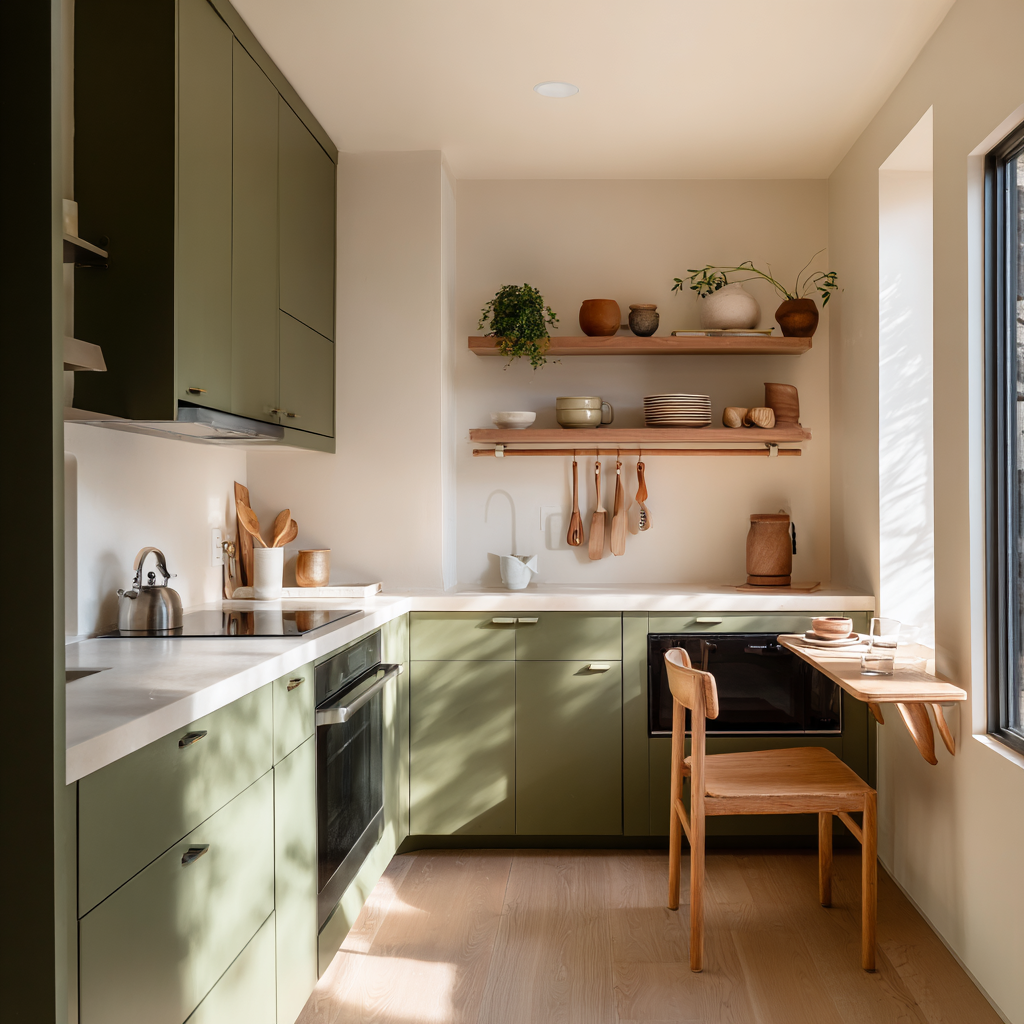
Introducing too many finishes, textures, or bold patterns can fragment a small space visually. A restrained, cohesive material palette creates architectural clarity and prevents visual fatigue. Plus, "complex patterns" are a look many professionals steer clients away from, regardless of the kitchen size, including Miko Pasanen, Owner of Miko LLC.

"Busy mosaic backsplashes and mixing too many finishes can make a kitchen look dated. I prefer a simple backsplash and quality cabinet hardware that gives the space a clean, timeless look."
Designing with temporary or plug-in appliances in mind can create permitting issues and undermine long-term usability. An ADU is a legal dwelling, and its kitchen should be planned as a permanent, fully functional space. Most jurisdictions require a permanent cooking appliance, a full sink, and dedicated circuits before they will sign off on the unit as a dwelling at all.
Finalizing cabinetry before confirming electrical capacity, vent routing, or plumbing locations often results in costly revisions. Coordinating these systems early protects both the design intent and the renovation timeline.
For example, a range that needs a 240-volt circuit or a hood that needs exterior venting can force cabinet modifications after the boxes are already ordered. Getting the electrician and plumber to walk through your ADU kitchen before the cabinetry is finalized can save you from an unnecessary change order.
Relying on a single overhead fixture can flatten the space and create shadows across prep zones. Layered lighting—ambient, task, and accent—ensures the kitchen functions effectively at all times of day.
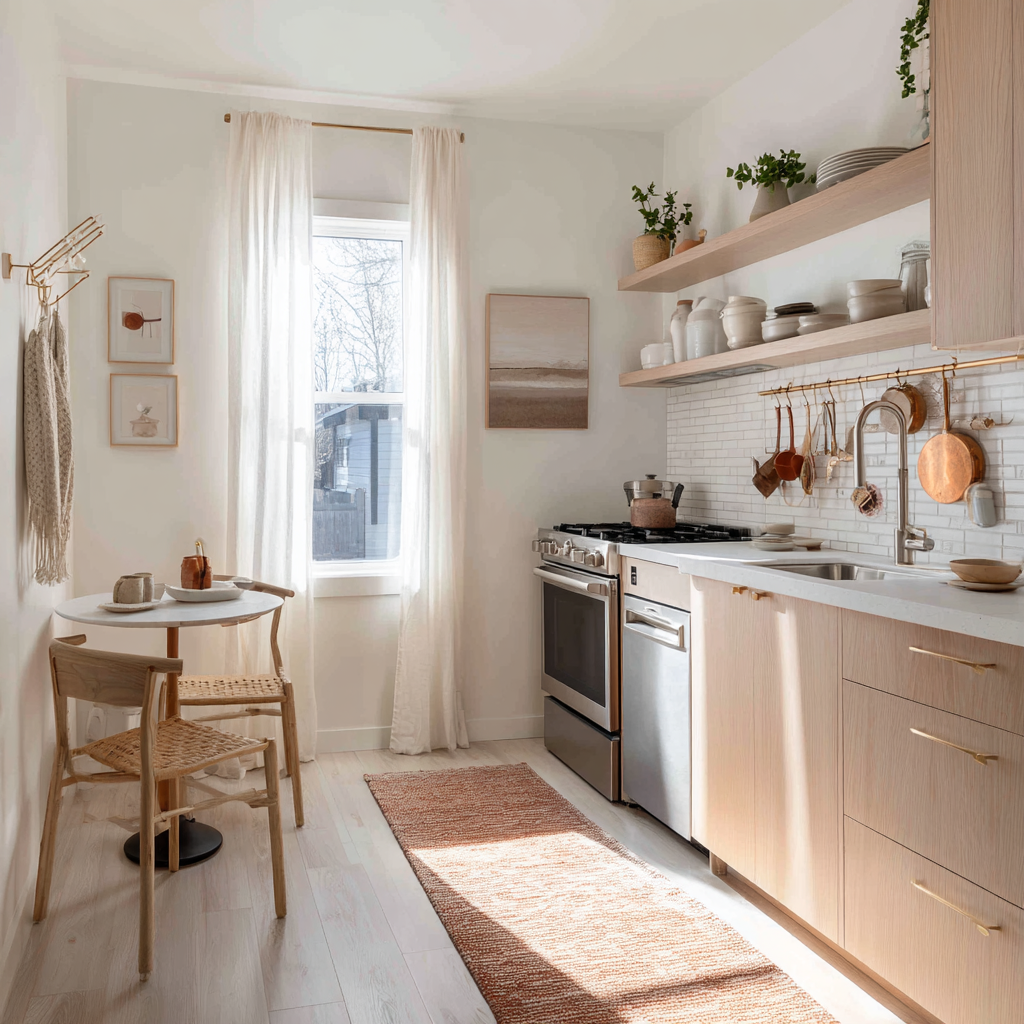
A successful ADU kitchen renovation requires disciplined coordination across design, permitting, and construction. Mechanical systems must align with layout decisions, material specifications must reflect real-world use, and code requirements must be met without compromising design intent.
Block Renovation connects homeowners with vetted contractors and a structured renovation process designed to reduce uncertainty. From transparent pricing to guided scope development, the focus is on aligning thoughtful design with experienced execution.
By collaborating with Block to identify the right builder for your ADU kitchen, you ensure that careful planning translates into precise construction—resulting in a space that meets regulatory standards, performs reliably, and adds lasting value to your home.
Remodel with confidence through Block

Connect to vetted local contractors
We only work with top-tier, thoroughly vetted contractors

Get expert guidance
Our project planners offer expert advice, scope review, and ongoing support as needed
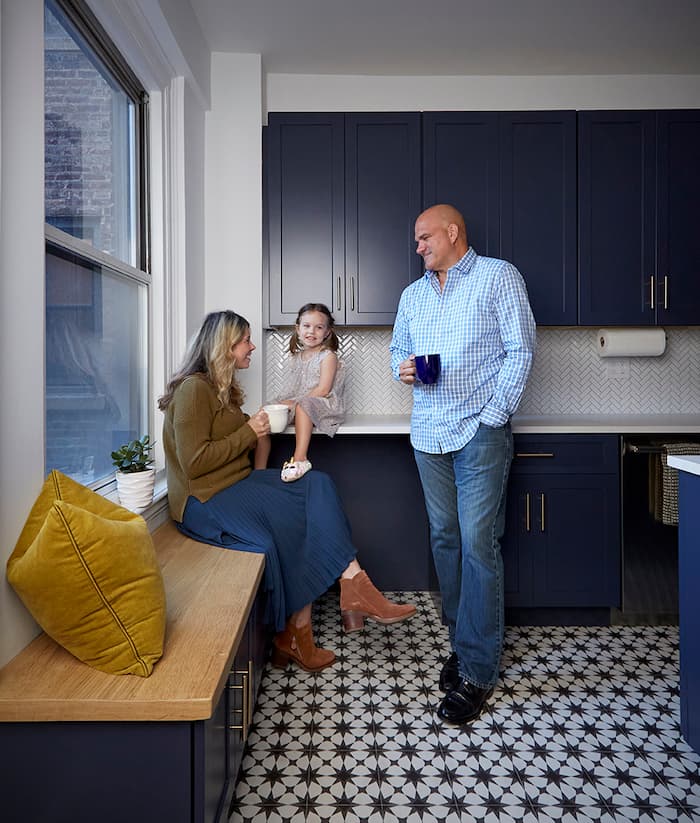
Enjoy peace of mind throughout your renovation
Secure payment system puts you in control and protects your remodel

Renovate confidently with Block
Easily compare quotes from top quality contractors, and get peace of mind with warranty & price protections.
Home Addition
Building Kitchen Additions: Costs & Design
08.21.2026
Cost
20x20 Room Addition Cost: What to Budget in 2026
07.28.2026
Home Addition
Bump Out Addition Cost, Ideas & Planning Guide
07.08.2026
Cost
2026 Home Addition Cost Guide: Per Square Foot & ROI
07.07.2026

Home Addition
How to Plan a Home Addition: Process and Timeline
07.01.2026