One Wall Kitchen Layouts: Floor Plans, Dimensions, and Design Ideas

The right renovation and design can bring out the full potential of your one wall kitchen layout. Explore expert ideas and design solutions to maximize function.

In This Article

    One wall kitchens don't get met with much fanfare. The layout has a reputation as the kitchen you settle for, the one a studio apartment forces on you, and renovation media mostly treats it as a problem to disguise. The reputation is wrong. Designers choose the layout on purpose in open-concept homes, it costs thousands less to build than any alternative, and the floor it leaves open is space every other layout would have spent on cabinetry. This guide covers what the layout does well, floor plans from 9 to 15 feet, the mistakes that ruin compact kitchens, and design ideas from a renovated single wall kitchen in Queens.

    What a one wall kitchen does better than other layouts

    It costs thousands less to build

    • A single wall run uses 8 fewer feet of cabinetry, worth $1,200 to $4,000. The 10x10 L-shaped kitchen the cabinet industry prices everything against holds about 20 linear feet, while a 12 foot run holds 12. At the $150 to $500 per installed linear foot that stock and semi-custom cabinetry costs, the difference is thousands before a single appliance is priced.
    • Counters and backsplash shrink along with the cabinets. Both are priced by the foot, so the savings compound across every surface on the wall.
    • One wet wall avoids $2,000 to $8,500 in service relocation. Plumbing, gas, and electrical concentrate in one place, and moving those services across a room is one of the most expensive line items in a kitchen remodel.
    • The whole kitchen fits in about 75 square feet. A single run needs roughly 6 feet of room depth, 25 inches of counter plus the work zone in front of it, and planning references put the full layout at around 75 square feet against roughly 108 for a comparable two-run galley. Every square foot the kitchen gives back is one less foot of flooring and finished surface to pay for, and one more for the rest of the home.

    One caveat applies. The full savings show up in gut renovations and new layouts, where services are placed from scratch. A remodel that keeps existing appliance locations captures less of the advantage, since the rough-in work is already done.

    One wall kitchens make an open floor plan possible

    Open floor plans are not for everyone, and nothing about this layout requires one. But if open-concept living is the goal, the one wall kitchen is the layout that gets you there, which is why it shows up so often in in-law suites and New York studio remodels, where the kitchen has to share space with the rest of life. Cabinetry claims one wall, and the floor in front of it is yours to assign: a dining table, an island if the room is deep enough, or nothing at all.

    The same flexibility extends to the walls around it. A partial wall between the kitchen and the next room can become a breakfast bar, adding seating and counter without an island's footprint. And removing a non-load-bearing wall entirely, with an island placed where it stood, opens sightlines and gives the single run a second work surface. A contractor needs to confirm what the wall is carrying first.

    The work triangle matters less than you think

    The most repeated rule in kitchen design does not apply here, and that is a feature. The classic work triangle asks the sink, range, and refrigerator to form a triangle with legs of 4 to 9 feet each, per National Kitchen and Bath Association guidelines. Three points on one wall never form a triangle, and homeowners who try to honor the rule anyway end up second-guessing a layout that was never going to satisfy it.

    While "the triangle" has made its mark on design websites and the general public, pros now consider it much less important or even outdated. Zone planning has become the true sign of a highly functional kitchen. Order the wall to match the sequence of cooking, so a meal moves down the counter without backtracking: refrigerator and storage at one end, sink and prep in the middle, cooking at the other end. The floor plans below all follow that sequence.

    Renovate with confidence every step of the way

    Step 1: Personalize Your Renovation Plan

    Step 2: Receive Quotes from Trusted Contractors

    Step 3: Let Us Handle the Project Details
    Get Started

    The one wall kitchen layout, from 9 to 15 feet

    Four numbers settle most single wall kitchen planning questions:

    • A functional run starts at 8 feet. Below that, a refrigerator, range, and sink will technically fit, but prep counter all but disappears.
    • Comfort starts at 10 to 12 feet. This is the range where full-size appliances and about 3 feet of continuous prep counter can coexist on one wall.
    • Keep 42 to 48 inches of clear floor in front of the run. Anything tighter and an open dishwasher or oven door blocks the room.
    • Appliances alone consume about 10 feet. A 36 inch refrigerator, 30 inch range, 30 inch sink base, and 24 inch dishwasher add up to 10 linear feet before the first inch of workspace.

    The four floor plans below show how those numbers play out as the room grows.
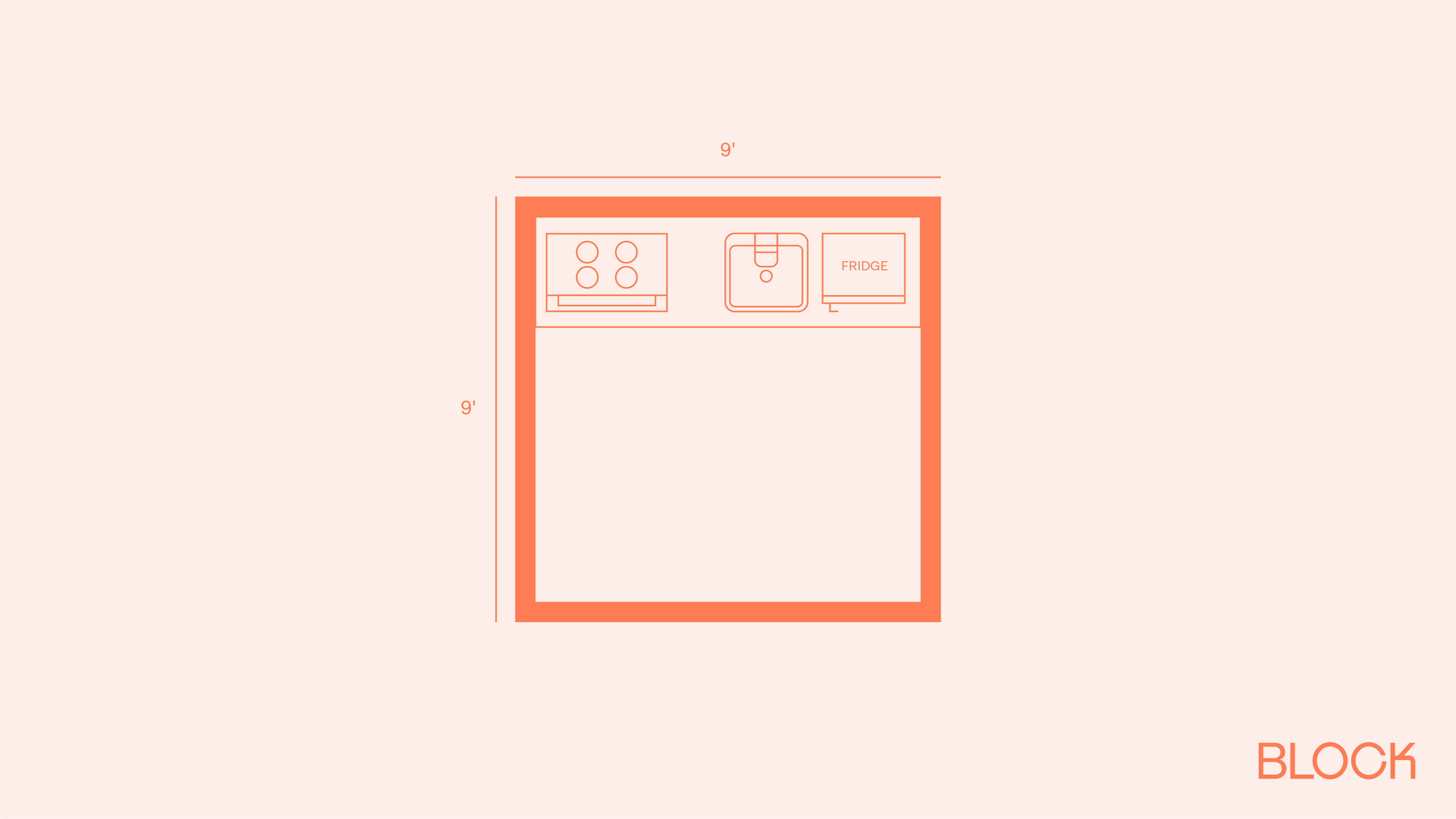
    9x9: compact appliances buy back the counter

    Block__Block_Plans_Kitchen_9x9-16

    A 9 foot run forces a choice between full-size appliances and counter space. This plan keeps the cooktop, sink, and refrigerator at standard widths and drops the dishwasher, which is the usual call at this length. Compact appliances reverse the choice: a 24 inch refrigerator and an 18 inch dishwasher claw back nearly 3 feet of run, enough to seat the dishwasher and keep workable prep counter. Our narrow kitchen design guide covers those swaps in detail.
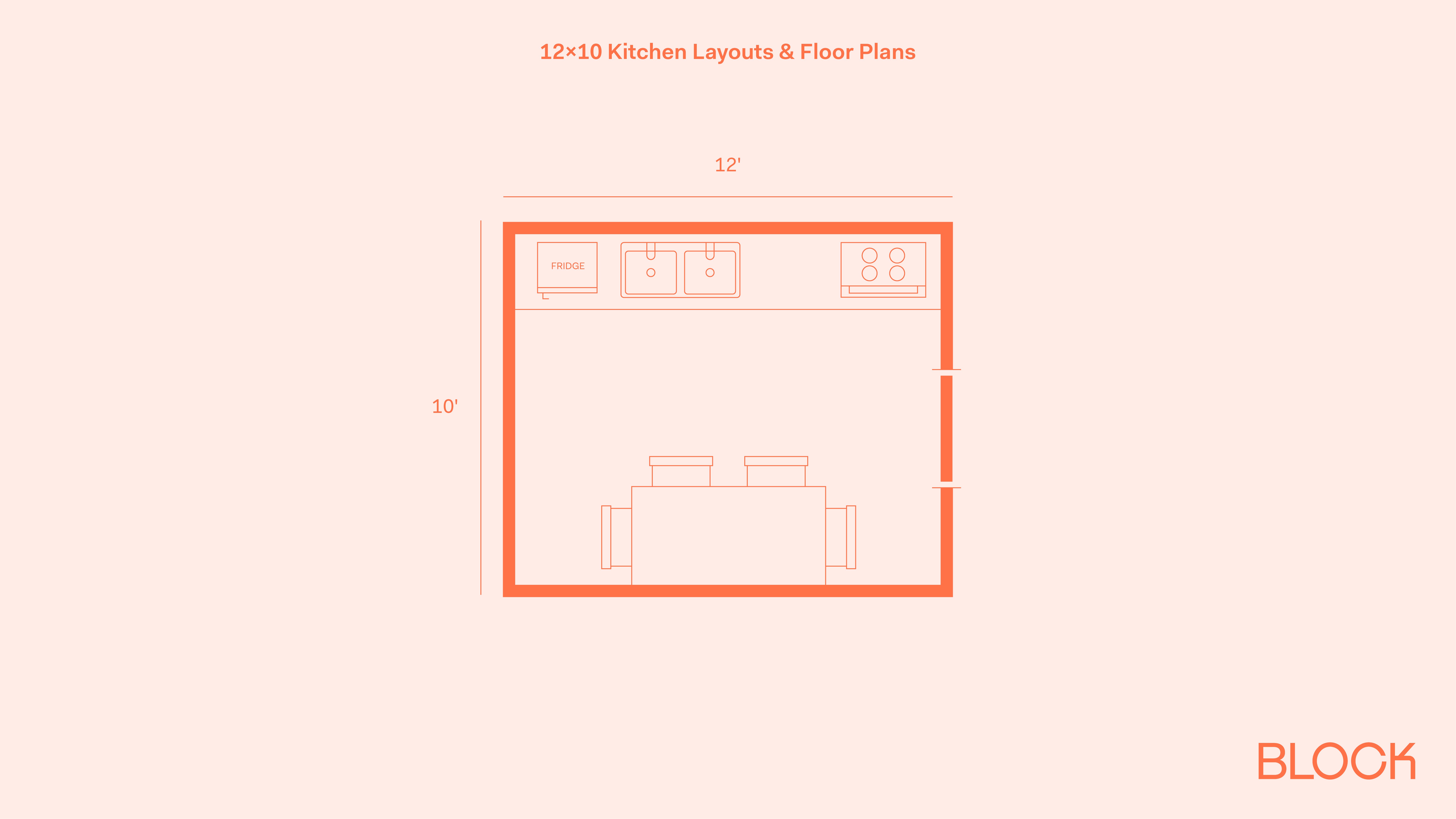
    12x10: the size where the layout starts working

    Block_12x10 Kitchen Layouts & Floor Plans-51

    Twelve feet is where the layout stops demanding sacrifices. Full-size appliances fit with real counter between them, and the sink can sit where it belongs, centered between the refrigerator and the range so prep, cooking, and cleanup each get their own stretch. The remaining floor takes a dining table without crowding the work zone.
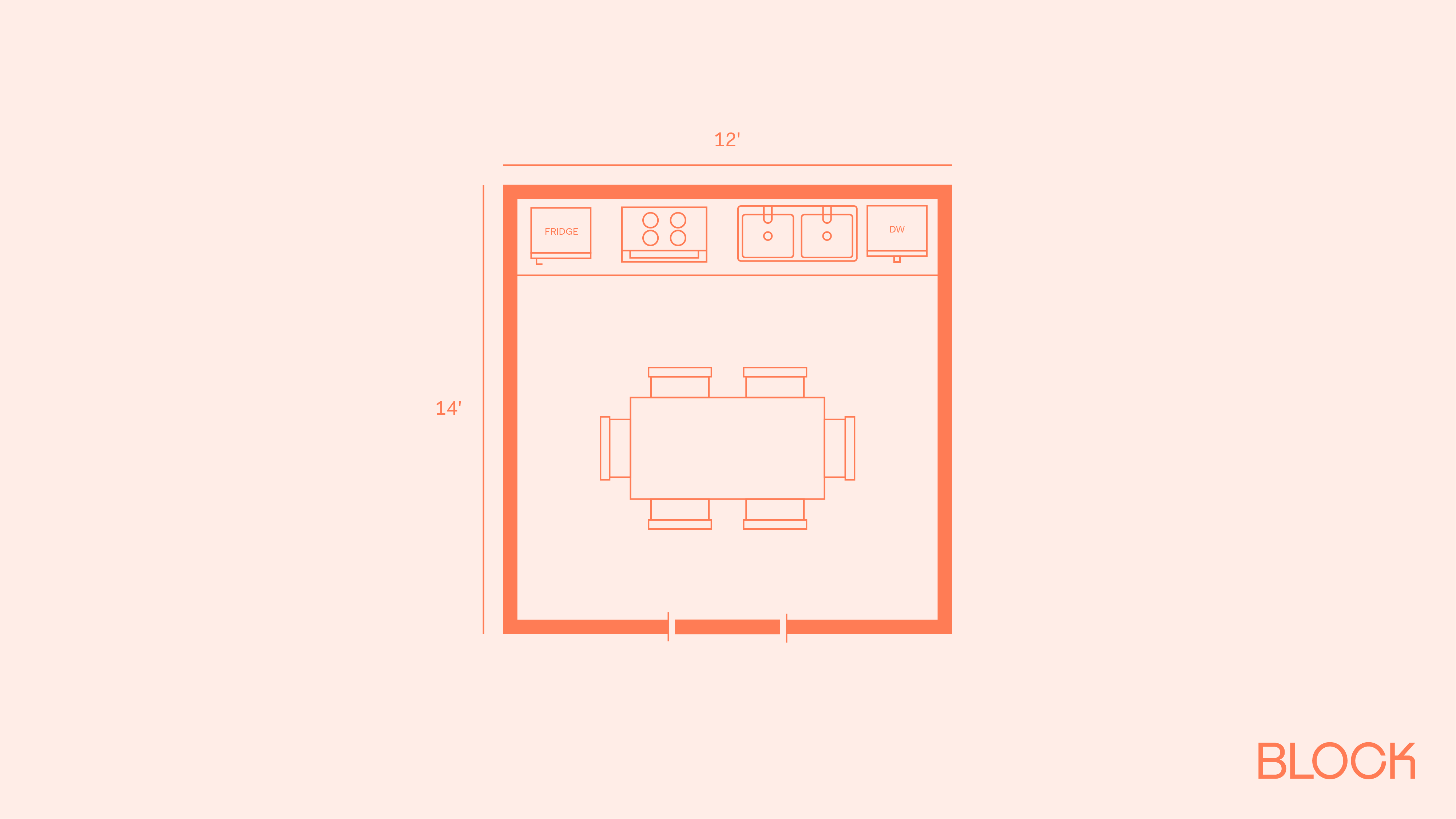
    12x14: the extra depth becomes the dining room

    Block_Plans_Kitchen_April_Block_Plans_Kitchen_14x12-04

    Past 12 feet of depth, the run stops being the constraint. The cabinet wall here is no longer than the 12x10 version. The gain is all floor, and it turns the room into a true eat-in kitchen with the table fully clear of the work zone. Rooms this deep can also support an island instead of a table.
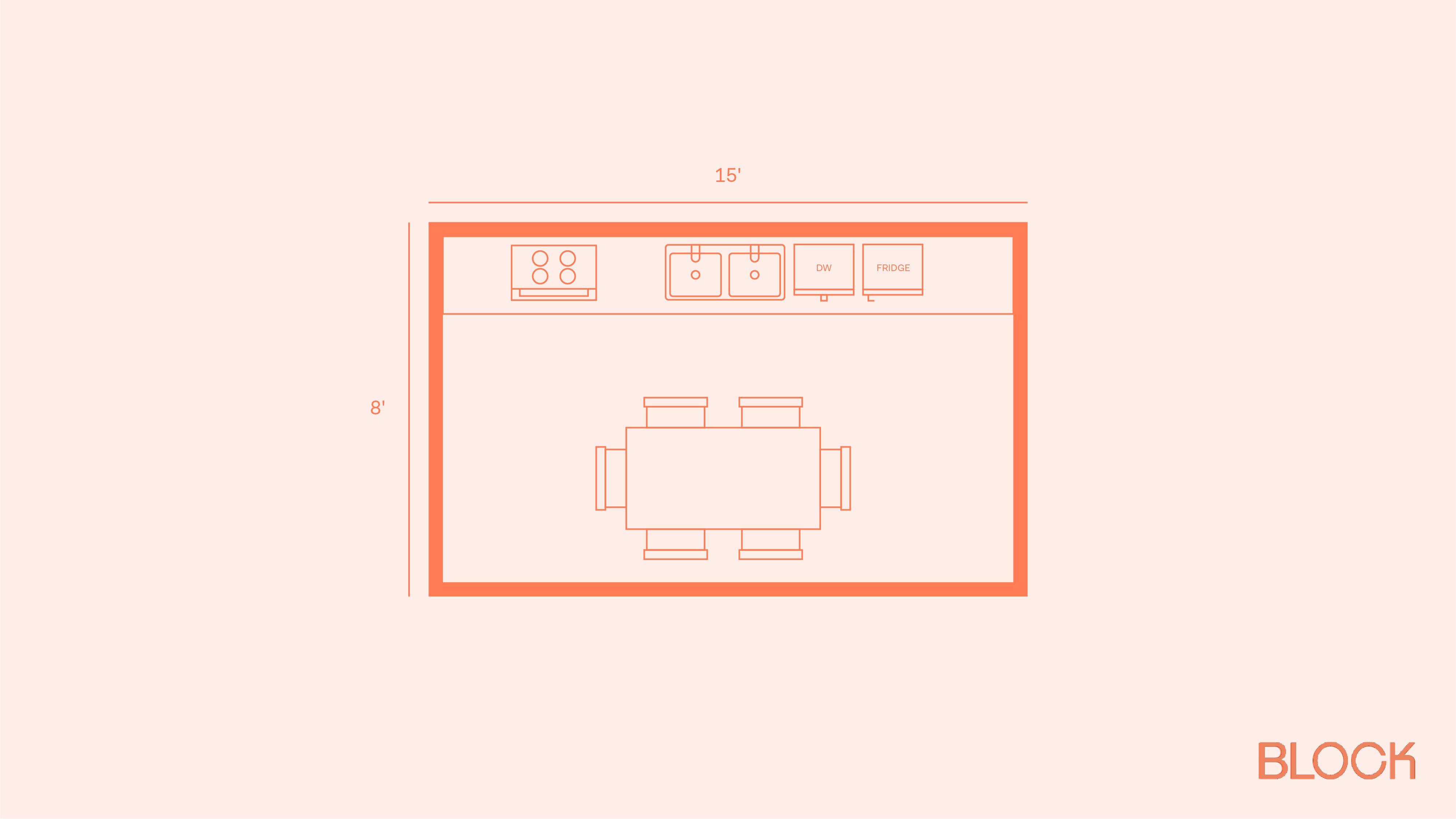
    15x8: more counter stops paying

    Block__Block_Plans_Kitchen_15x8-09

    Fifteen feet marks the point where adding run stops helping. The wall absorbs a dishwasher and a double sink with counter to spare, but somewhere past 12 to 15 feet, the walk between the refrigerator and the cooktop starts costing real steps. The better use of extra wall is a pantry cabinet or a peninsula rather than more counter.

    Mistakes that hurt a one wall layout

    • Pushing the sink to the end of the run. Center it between the refrigerator and the range so each task gets its own stretch of counter. A sink jammed against the wall turns every meal into a shuffle.
    • Cutting the clearance below 42 inches. An open dishwasher or oven door should never block the path through the room. If a table or island shrinks the walkway past that line, the floor piece is too big.
    • Specifying full-size appliances on a run under 10 feet. A 36 inch refrigerator on a 9 foot wall leaves almost nothing to cook on. Counter is the resource worth protecting, and compact appliances protect it.
    • Forcing an island into a shallow room. An island needs 42 to 48 inches of clearance on each side, which demands roughly 12 feet of room depth. In shallower rooms a dining table wins: it costs a few hundred dollars instead of several thousand, seats more people, and moves when your needs change.
    • Leaving the cooktop without landing counter. Keep workable counter on both sides of the burners. Hot pans need somewhere to go that is not across the room.

    Single wall kitchen design ideas borrowed from a real renovation

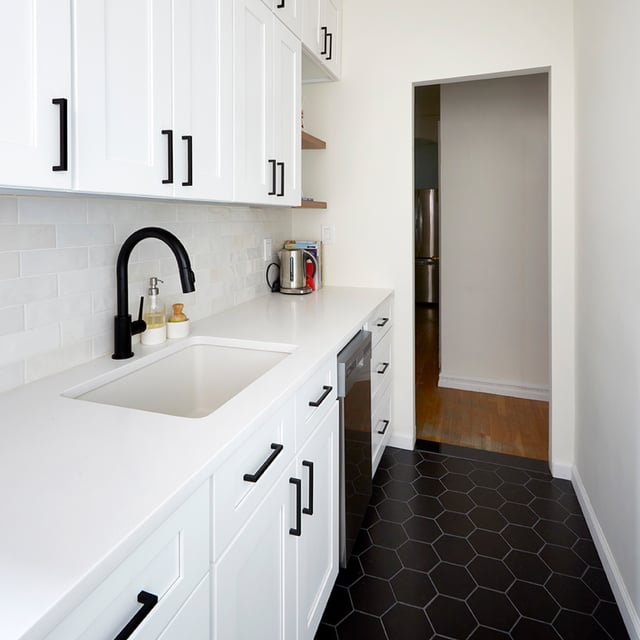
    The numbers set the layout, and the design decisions make it feel deliberate. This renovated kitchen in Sunnyside, Queens shows the approach executed well. The project went through Block Renovation, designed by Meredith and Quinn and built by Claudio, a vetted contractor in Block's network, in a narrow room with the entire kitchen on one side. Three of its decisions carry to almost any single wall kitchen:
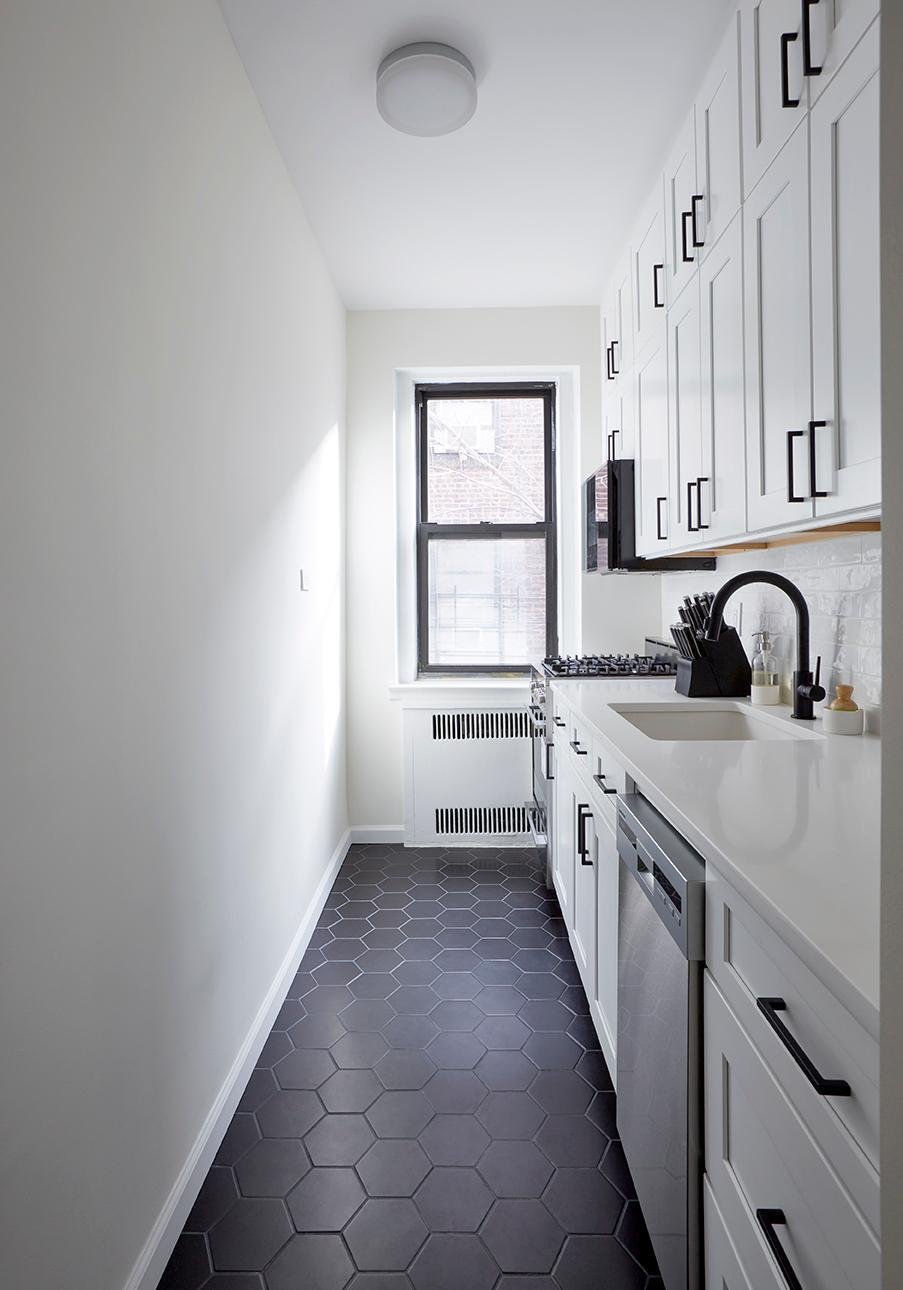
    A narrow, modern galley kitchen featuring white cabinetry with black hardware, white countertops, and dark grey hexagonal floor tiles.

    • Leave the facing wall bare. Every instinct in a small kitchen says to fill the second wall with shelving. Fight this instinct! Having this wall remain empty is what makes this narrow room feel open instead of cramped, and in rooms under about 10 feet wide it is almost always the right call.
    • Let the hardware carry the design. With one elevation, the cabinet wall is the entire composition. The matte black pulls against white shaker fronts give the run its rhythm, doing the work a second cabinet run would do elsewhere.
    • Mount the microwave under the upper cabinets. Counter is the layout's scarcest resource, and getting the microwave off it reclaims 2 feet.

    A few more ideas recur in well-executed compact kitchens, including this project built by Ion, a Block vetted contractor:
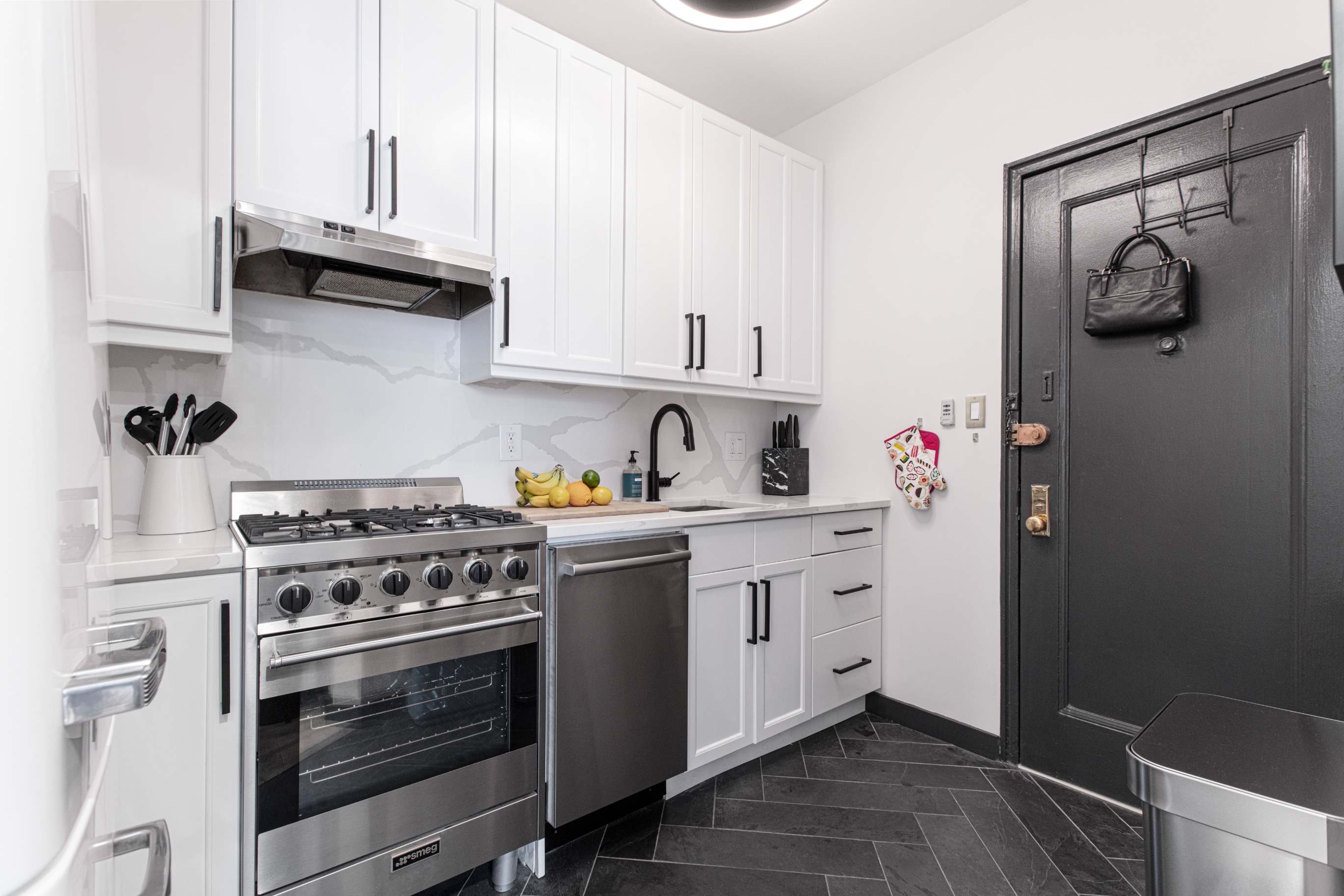
    A modern kitchen featuring white cabinetry, black hardware, a stainless steel stove and dishwasher, and dark herringbone-patterned tile flooring.

    • Run the cabinets to the ceiling. The top row holds seasonal and seldom-used items, and the continuous line makes the wall feel taller and more deliberate.
    • Build a pull-out trash and recycling cabinet into the run. On a single wall there is nowhere for a freestanding can to hide, so integrated pull-outs keep the floor clear and the lines clean.
    • Choose flat-front or handle-free cabinets. An uninterrupted surface makes the single run feel longer and calmer.
    • Light colors on cabinetry and walls reflect light and make a compact room feel larger than it measures. Whites, soft grays, and warm neutrals all do the job, especially when the upper cabinets match the wall color so the run blends into the room instead of stopping the eye. Save dark, saturated tones for the floor or the hardware, where they add contrast without closing the room in.

    Build your one wall kitchen with Block Renovation

    Test the layout in Block's Renovation Studio

    A single wall layout leaves no room for error, because every inch of the run has a job. Block's free Renovation Studio lets you design the space, see personalized renders that reflect your material choices, and watch cost estimates update as you make decisions, so the run is settled before a contractor ever quotes it.

    Get matched with vetted contractors

    When the design is ready, tell Block your project details once and vetted local contractors compete for the work with quotes built on an expert-reviewed scope, so missing line items and red flags surface before construction starts rather than as change orders. Payments are released as the project progresses, and you get guidance from planning through final walkthrough. Get your estimates and compare quotes from contractors who have built kitchens like yours.

    Remodel with confidence through Block
    Happy contractor doing an interview

    Connect to vetted local contractors

    We only work with top-tier, thoroughly vetted contractors

    Couple planning their renovation around the Block dashboard

    Get expert guidance

    Our project planners offer expert advice, scope review, and ongoing support as needed
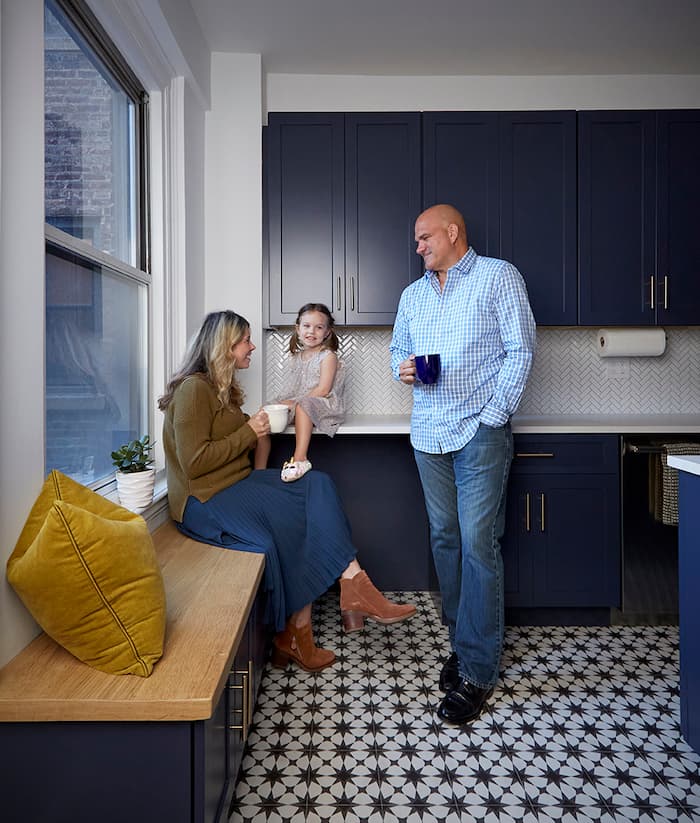
    Familty enjoying coffee in their newly renovated modern ktchen

    Enjoy peace of mind throughout your renovation

    Secure payment system puts you in control and protects your remodel

    Get Started

    Frequently Asked Questions

    How long does the wall need to be for a one wall kitchen?

    Eight feet is the functional minimum, and that length covers a refrigerator, range, and sink with very little prep counter. A run of 10 to 12 feet fits full-size appliances plus about 3 feet of continuous workspace, which is where the layout becomes comfortable for daily cooking.

    Is a one wall kitchen the same as a galley kitchen?

    No. A galley kitchen has two parallel runs of cabinetry with a walkway between them, while a one wall kitchen places all cabinetry, counters, and appliances on a single run. The single wall version leaves the rest of the room open for a table, an island, or living space.

    Is a one wall kitchen cheaper to build than other layouts?

    Yes, when built from scratch it is the least expensive layout. Concentrating plumbing and electrical on one wall reduces labor, the layout eliminates corner cabinets, and it requires fewer linear feet of cabinetry and countertop than an L-shape, U-shape, or galley.

    Where should the refrigerator go in a one wall kitchen?

    Place the refrigerator at one end of the run, with the sink in the middle and the range at the other end. That order matches the sequence of cooking, so groceries, prep, cooking, and cleanup each happen in their own zone without backtracking.

    Can you add an island to a one wall kitchen?

    Yes, if the room is deep enough. An island needs 42 to 48 inches of clearance on each side, which generally requires about 12 feet of room depth. In shallower rooms, a dining table or a rolling cart provides extra surface without crowding the work zone.

    What is the ideal length for a one wall kitchen run?

    Between 10 and 15 feet. Shorter runs force compromises on appliances and counter space, and runs longer than about 15 feet spread the work zones far enough apart that a pantry cabinet or peninsula becomes a better use of the extra wall than additional counter.