




Flooring
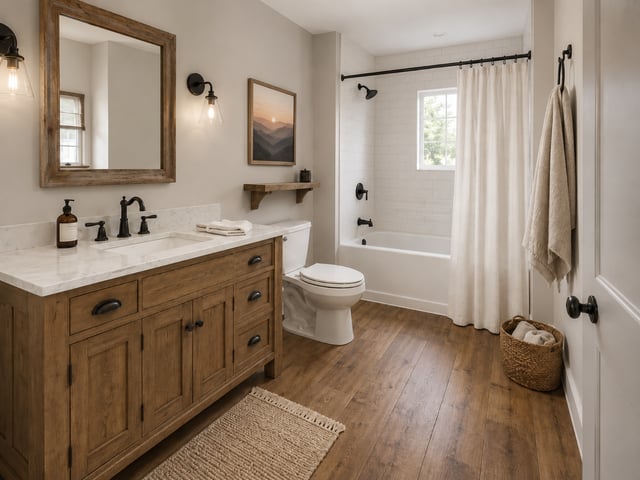
Wood Floors in Bathrooms: Pros, Cons & Is It a Good Idea
07.14.2026
12.16.2025


In This Article
Choosing between engineered wood and traditional hardwood flooring is a pivotal decision that affects your space’s performance, appearance, and value for years. The best option for your project depends on more than just budget and taste—it involves climate, installation surface, intended usage, and long-term maintenance. Here’s an in-depth, authoritative examination to help you make an informed decision.
Solid hardwood flooring is made from thick, single pieces of genuine wood. This classic construction allows you to sand and refinish the floor multiple times across its lifespan. Solid boards are known for their warmth underfoot and the details in their grain, but they do react quickly to changes in humidity, which can cause gaps or swelling.
Engineered wood flooring uses a real wood veneer mounted on a multi-layered core of plywood or high-density fiberboard. The layered structure creates a more stable floor that holds up better in challenging conditions, such as basements or over radiant heat. The visible top layer is authentic wood—so the look and texture are genuine—but the construction underneath is what makes it behave differently from solid hardwood.
|
Feature |
Engineered wood flooring |
Solid hardwood flooring |
|
Structure |
Wood veneer over layered core |
Solid wood throughout |
|
Climatic stability |
Performs well in variable humidity |
Prone to shifting, gaps, or cupping |
|
Refinishing |
0–2 times, based on veneer thickness |
Many times, over the floor's life |
|
Installation surfaces |
Works on concrete, radiant, below-grade |
Requires wood subfloor, above-grade |
|
Plank size options |
Wide and long planks are common |
Width and length are limited by stability concerns |
|
Upfront cost |
Often lower, especially for materials/labor |
Higher, especially for premium woods |
|
Installation speed |
Faster (including floating or glue options) |
Slower (typically nailed or stapled) |
|
Lifespan |
20–40+ years (product dependent) |
40–100+ years with care |
|
Environmental impact |
Uses less slow-growth hardwood |
Higher hardwood consumption |
|
Market perception |
Growing acceptance, especially in new builds |
Considered the premium standard |
Cost is often one of the first factors homeowners weigh when selecting between engineered wood and hardwood floors. Both options offer real value and beauty, but the pricing structure—and what you get for your investment—looks very different.
Engineered wood flooring typically ranges from $8 to $16 per square foot for materials, depending on the wood species, wear layer thickness, and finish. Entry-level products use thinner wear layers, which are less expensive but won’t allow for future refinishing.
Higher-quality engineered floors—with a thicker hardwood veneer and a more robust core—cost more upfront but add both durability and versatility. Labor and installation are generally more budget-friendly, especially when a floating or glue-down method makes sense for your space.
Engineered wood can often be installed directly over concrete or radiant heat, minimizing extra construction costs.
Solid hardwood flooring usually starts around $12 to $18 per square foot for common species like oak or maple, with premium or exotic woods (such as walnut or hickory) commanding much higher prices.
Moreover, the installation process for hardwood is more intensive than for engineered wood, requiring nailing or stapling to a wood subfloor; if one isn’t already in place, that adds to the overall budget.
Many homeowners also choose site-finished hardwood for a custom look, which increases both material and labor costs but allows for tailored stain and finish options. The upfront investment is higher, especially for custom work, but solid hardwood’s long lifespan and ability to be completely refinished multiple times can stretch that value for decades.
Transparent Pricing You Can Trust

Engineered hardwood is a popular choice for many renovations, offering real wood beauty with practical features that suit modern homes and busy lifestyles. Still, like any material, it comes with specific strengths and some details to consider before making your decision.
Turn your renovation vision into reality
Get matched with trusted contractors and start your renovation today!
Find a Contractor
Hardwood is the standard that many homeowners compare other options to. Here’s what that means in practice.
Engineered wood is good for:
Solid hardwood is good for:
Choosing between engineered wood and hardwood is an important step, but the success of your project depends on having the right team by your side. With Block Renovation, you work with a network of trusted, thoroughly vetted contractors who understand the details that make a floor not just beautiful, but built to last. Block helps you compare transparent proposals, matches you with professionals who fit your needs, and supports you throughout your renovation. When your contractor is as committed to your home as you are, you can feel confident that your floors—and your entire renovation—will exceed expectations.
Remodel with confidence through Block

Connect to vetted local contractors
We only work with top-tier, thoroughly vetted contractors

Get expert guidance
Our project planners offer expert advice, scope review, and ongoing support as needed

Enjoy peace of mind throughout your renovation
Secure payment system puts you in control and protects your remodel


Renovate confidently with Block
Easily compare quotes from top quality contractors, and get peace of mind with warranty & price protections.
Flooring
Wood Floors in Bathrooms: Pros, Cons & Is It a Good Idea
07.14.2026
Flooring
Cheap Flooring: Best Budget Options and the Risks
07.04.2026

Flooring
Engineered Wood Flooring vs Laminate: Cost & Durability
07.02.2026
Flooring
Flooring Made in USA: Hardwood & Engineered Wood Brands
07.01.2026
Cost
Radiant Floor Heating Cost in 2026: Bathrooms & More
06.27.2026