




.png?width=640&name=u5821215421_Apartment_Therapy_style_home_tour_photograph_sing_a3a1e050-1d33-4891-9440-72d3268ea754_3%20(1).png)
Indiana
Custom Home Building in Fort Wayne, IN: A Practical Guide
05.14.2026

03.05.2026


In This Article
Indianapolis offers a rare combination for custom home builders: big-city infrastructure with a cost of living that remains well below the national average. The city’s diversified economy—anchored by healthcare, logistics, motorsports, and a growing tech sector—provides employment stability, while its extensive parks system, vibrant arts district in Mass Ave, and nationally recognized sporting events make it a genuinely enjoyable place to live. Neighborhoods range from the historic charm of Meridian-Kessler to the new-build energy of Carmel and Fishers, giving future homeowners an unusually wide palette of settings in which to build. For anyone seeking to design a home from the ground up, Indianapolis provides both the affordability and the lifestyle to justify the investment.
That said, building a custom home in Indianapolis requires navigating a few realities that don’t always appear in national cost guides. Central Indiana’s glacial till soils, dramatic seasonal weather swings, and a construction labor market that tightens sharply during spring and summer all shape project costs and timelines. Preparing for these factors upfront is what separates a smooth build from a frustrating one.
Design a Home That’s Uniquely Yours
Block can help you achieve your renovation goals and bring your dream remodel to life with price assurance and expert support.
Get Started
Understanding what drives local building costs is essential before you begin designing or shopping for land in Indianapolis. National averages can be misleading here, because Indiana consistently ranks as one of the more affordable states for new construction.
Custom home construction in Indianapolis typically ranges from $130 to $230 per square foot depending on the grade of finishes, not including land or sitework. Standard-grade construction falls in the $130 to $150 range; premium builds with upgraded finishes run $150 to $190; and luxury custom homes with high-end materials, complex architecture, and extensive customization can push past $230. For a 2,500-square-foot home, that means a construction budget of roughly $325,000 to $575,000 before land. Marion County land prices average around $44,000 per acre, though finished lots in desirable suburban areas like Carmel or Zionsville can run $80,000 to $150,000 or more.
Labor costs account for 30 to 50 percent of the total construction budget in Indianapolis. The city benefits from a relatively deep construction workforce compared to coastal metros, but seasonal demand spikes—particularly in spring when the building season opens—can tighten availability and push labor rates upward. Material costs track national trends, with lumber, concrete, and steel prices having stabilized after pandemic-era spikes but remaining above historical averages. Indianapolis’s central location does offer a logistical advantage: building materials ship efficiently from Midwest distribution hubs, keeping freight costs lower than in more remote markets.
Lot selection creates significant cost variation. Infill lots in established neighborhoods like Broad Ripple or the near-north side carry higher land costs but typically include existing utility connections and established streetscapes. Suburban lots in Hamilton or Hendricks County offer more space at lower per-acre prices, though they may require additional investment in site grading, utility extensions, or stormwater management. Corner lots and cul-de-sac lots tend to command premiums due to added privacy and reduced traffic.
Foundation work in Indianapolis is shaped by the region’s glacial till soils, which are generally stable but can include pockets of poorly drained clay and buried boulders that complicate excavation. Full basements are standard in central Indiana—a cultural and practical expectation that adds $20,000 to $40,000 compared to slab-on-grade construction but provides valuable living and storage space. Framing and structural systems represent 15 to 20 percent of the budget, with most Indianapolis homes using conventional wood framing. Interior finishes create the widest cost swing: builder-grade kitchens might run $15,000 to $25,000, while a custom kitchen with soft-close cabinetry, quartz countertops, and commercial-grade appliances can exceed $60,000. HVAC is a critical line item given Indianapolis’s hot, humid summers and cold winters; a dual-system setup with a high-efficiency furnace and central air is effectively mandatory. Permit fees in Marion County start at a $32 application fee plus plan review costs calculated on project value, and total permitting costs typically run $2,000 to $5,000 for a custom home.
Custom home buyers in Indianapolis frequently consider these enhancements, each of which adds meaningfully to the baseline cost:
A typical Indianapolis custom build takes 10 to 14 months from design initiation to move-in. Pre-construction—design, engineering, permitting, and contractor procurement—usually takes two to four months. Active construction for a 2,000- to 3,000-square-foot home runs eight to ten months under normal conditions.
Indiana’s weather is the primary timeline variable. Winters can bring prolonged freezing that halts concrete work and exterior construction, while spring rains saturate sites and delay excavation and grading. The best strategy is to begin design and permitting in late summer or fall so that foundation work can start before winter freeze or immediately after spring thaw. Material lead times for custom windows, specialty cabinetry, and imported fixtures should be ordered during the design phase to avoid mid-construction delays.
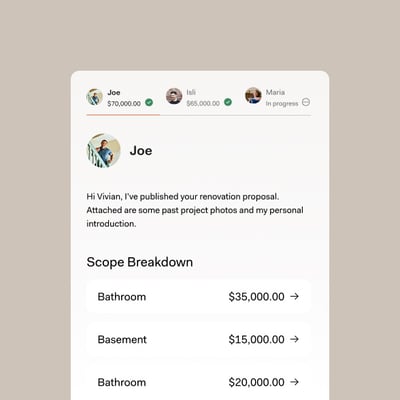
Compare Proposals with Ease
A builder who knows Indianapolis well can assess a lot’s true buildability before you invest. What looks like a flat, easy parcel might sit over poorly compacted fill or in a low area prone to seasonal flooding. Having your builder evaluate the following factors will protect your investment:
Indianapolis homeowners consistently value strong school districts—Carmel Clay Schools, Zionsville Community Schools, and the Center Grove district are perennial draws—alongside reasonable commute times and access to the city’s parks and trail network. Proximity to the Indianapolis International Airport is also a factor for frequent travelers and corporate relocators.
Indianapolis’s architectural character draws from its Midwestern roots while incorporating contemporary influences that reflect the city’s evolving demographics and lifestyle preferences.
Building a custom home in Indianapolis means contending with conditions that differ significantly from those on either coast or in the Sun Belt. Local expertise is the best defense against these challenges.
Indianapolis’s subsurface is a complex legacy of Pleistocene glaciation: layers of clay, silt, sand, gravel, and boulders deposited by retreating ice sheets over tens of thousands of years. This variability means that two lots on the same street can have meaningfully different soil profiles. Poorly drained Brookston clays in low-lying areas can cause hydrostatic pressure against basement walls, while pockets of loose sand may require compaction or replacement. A site-specific geotechnical investigation—typically $2,000 to $4,000—is essential before foundation design. Your builder and structural engineer should use the geotechnical report to specify footing depth, waterproofing strategy, and drainage systems tailored to your lot’s conditions.
Indianapolis experiences a full range of weather extremes: summer heat indices above 100°F, winter cold snaps that plunge below zero, tornado-season storms from April through June, and ice storms that can shut the city down. These conditions demand a building envelope designed for performance, not just aesthetics. Insulation must meet or exceed Indiana Energy Code requirements, and roofing materials should be rated for high wind and hail impact. Sump pumps with battery backup are standard in most basements, and standby generators have become common in higher-end builds. Scheduling concrete pours and framing around freeze-thaw cycles and severe weather windows is a core competency of experienced Indianapolis builders.
Marion County and surrounding counties fall within EPA Zone 1 for radon, meaning average indoor radon levels are predicted to exceed the action threshold of 4 pCi/L. Radon is a naturally occurring radioactive gas that seeps into homes through cracks in foundation slabs and basement walls, and long-term exposure increases lung cancer risk. The good news is that radon mitigation is straightforward and inexpensive to install during new construction—a sub-slab depressurization system typically costs $800 to $1,500 when built in from the start, compared to $1,500 to $3,000 for a retrofit. Every Indianapolis custom home should include passive radon piping at minimum, with an active fan ready to be added if post-construction testing indicates elevated levels.
Central Indiana’s combination of clay-heavy soils, a shallow water table, and increasingly intense rainfall events makes stormwater management a critical design element. Indianapolis’s stormwater utility requires new construction to manage runoff on-site in many areas, which may involve retention swales, French drains, or permeable paving. Basements—nearly universal in Indianapolis custom homes—require robust waterproofing systems including exterior membrane coatings, interior drainage mats, perimeter drain tile, and a high-capacity sump pump. Builders who treat waterproofing as an afterthought rather than an integrated design element are setting homeowners up for future moisture problems and costly repairs.

“Strong design aligns vision with budget. The most expensive choice is a dysfunctional space.”
The builder you choose will be your most important partner for a year or more. Beyond credentials and craftsmanship, you’re looking for someone whose communication style and problem-solving approach match your own. Questions to ask potential Indianapolis custom home builders include:
Block Renovation’s matching process connects Indianapolis homeowners with rigorously vetted local contractors who have passed background checks, insurance verification, and reference reviews. Block’s algorithm pairs you with builders experienced in the type of project you’re planning—whether that’s a Broad Ripple infill, a sprawling Carmel estate, or a modern farmhouse in Hendricks County. You receive up to three personalized proposals from matched contractors, making comparison straightforward.
Once you’ve selected a builder, Block’s protections keep your project on track. A secure, progress-based payment system ensures contractors are paid only as milestones are completed, and Block’s dashboard gives you real-time visibility into your construction timeline. Every contractor in the network provides a workmanship warranty, and Block’s renovation experts offer ongoing support from proposal review through final walkthrough—all at no cost to you.
Remodel with confidence through Block

Connect to vetted local contractors
We only work with top-tier, thoroughly vetted contractors

Get expert guidance
Our project planners offer expert advice, scope review, and ongoing support as needed

Enjoy peace of mind throughout your renovation
Secure payment system puts you in control and protects your remodel


Renovate confidently with Block
Easily compare quotes from top quality contractors, and get peace of mind with warranty & price protections.
Indiana
Custom Home Building in Fort Wayne, IN: A Practical Guide
05.14.2026

Garage
Indianapolis, IN Garage Renovation: Costs, Tips & Local Styles
04.10.2026

Indiana
Kitchen Remodel in Fort Wayne, IN: Costs & Tips
04.09.2026
Indiana
Custom Home Building in Indianapolis, IN | Costs & Guide
03.05.2026

Indiana
Kitchen Remodel Costs & Tips in Indianapolis, IN
02.11.2026