



Before and After
Limewash Brick Before and After: Photos and What to Know
06.10.2026
06.10.2026


In This Article
Few finishes change brick as completely as limewash while leaving every brick still visible. A heavy, saturated red wall turns soft mineral white, the texture and mortar lines hold on, and the space around it feels redesigned even though nobody touched anything else.
That trick is why limewash brick before and after photos are so satisfying to scroll, and the appeal survives contact with reality:
Limewash is slaked lime (calcium hydroxide) mixed with water, sometimes with mineral pigment added. Instead of forming a film on the surface the way paint does, it soaks into porous brick and hardens there through a process called carbonation, where the lime reacts with carbon dioxide and converts back into limestone.
That chemistry explains most of what you see in the after photos. The finish is matte and slightly chalky rather than glossy. Coverage is naturally a little uneven, with brick tone ghosting through in places. That unevenness gives limewashed walls a depth flat paint can't match. And because there is no film, there is nothing to peel. The coating erodes gradually instead, and the brick continues to release moisture rather than trapping it behind a sealed surface.
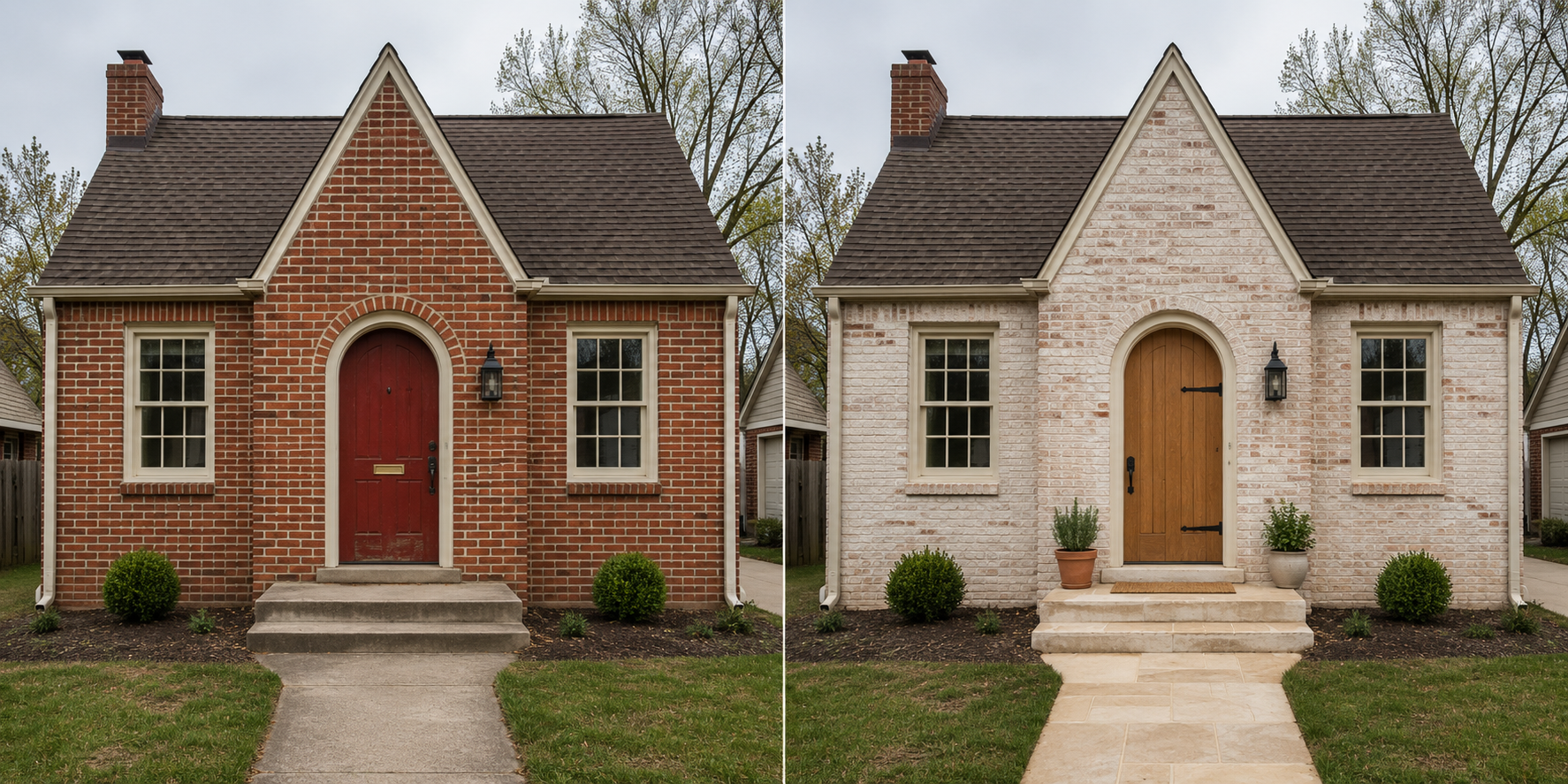
The cottage above is a textbook limewash red brick before and after. The orange-red brick once set the temperature of the entire facade, and the red front door disappeared into it. The after softens the color to a warm white while traces of brick tone show through, so the arched entry, steep gable, and chimney stay legible. If that balance is the goal, specify it: ask the contractor for a single-coat or rubbed-back application and approve a test patch before the crew commits, since full-coverage limewash starts to look like ordinary painted brick.
Budget for the surrounding elements while the crew is already there. The old red was busy enough to camouflage the door, the trim, and the light fixtures. Against the new neutral, every one of those finishes has to match, and updating them in the same scope costs less than calling a painter back later. On this project, that meant a stained wood door, a darker fixture, and hardscaping picked up from the limewash's warmth.
Brick ranch houses produce some of the most dramatic before and after limewash results of any house style. A typical mid-century ranch puts a long, low band of orange or red brick across most of the elevation, and that much saturated masonry can make a modest house feel heavier and more dated than it is. Limewashing lightens the entire elevation at once while keeping the texture that distinguishes a real mid-century home from new construction.
The shape of the house works in your favor too. A single-story ranch can be limewashed without scaffolding or lifts, which keeps labor at the low end of the professional range. Test your tint against the shingles before committing, and consider leaving an element exposed, such as the chimney or a planter wall, so the house keeps a hint of its original red. The roof deserves the extra attention because it is a huge share of what you see from the street, and a warm white that looks perfect on the sample board can curdle next to the wrong brown roof.
Interior limewash projects are smaller and cheaper than exteriors, and the four transformations below show how far one treated wall can move a room.
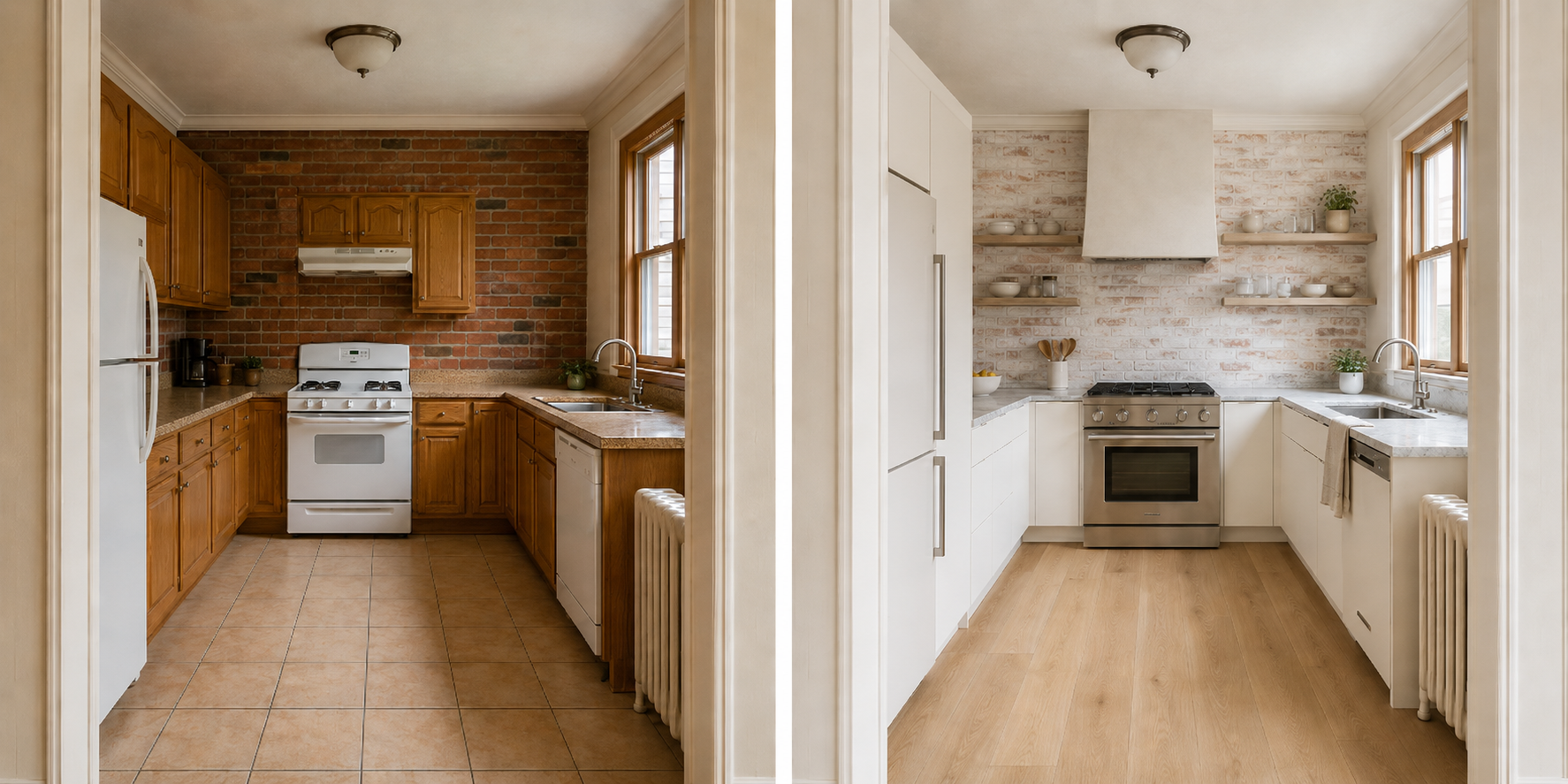
This kitchen started out the color of toast, courtesy of a red brick wall and golden oak cabinets pulling in the same warm direction. After the limewash, flat-front white cabinetry, open wood shelving, and pale plank flooring take over, and the brick supplies texture behind the range without competing for attention.
If the brick wall is staying either way, price limewash before you price demolition or drywall, which cost far more and erase the texture. Choose cabinet and counter finishes first, then tint the limewash to their undertone, because two close-but-different whites in one room look like an error instead of a palette.
For more tips on pulling off related looks, look to our guides about industrial and farmhouse kitchen aesthetics.
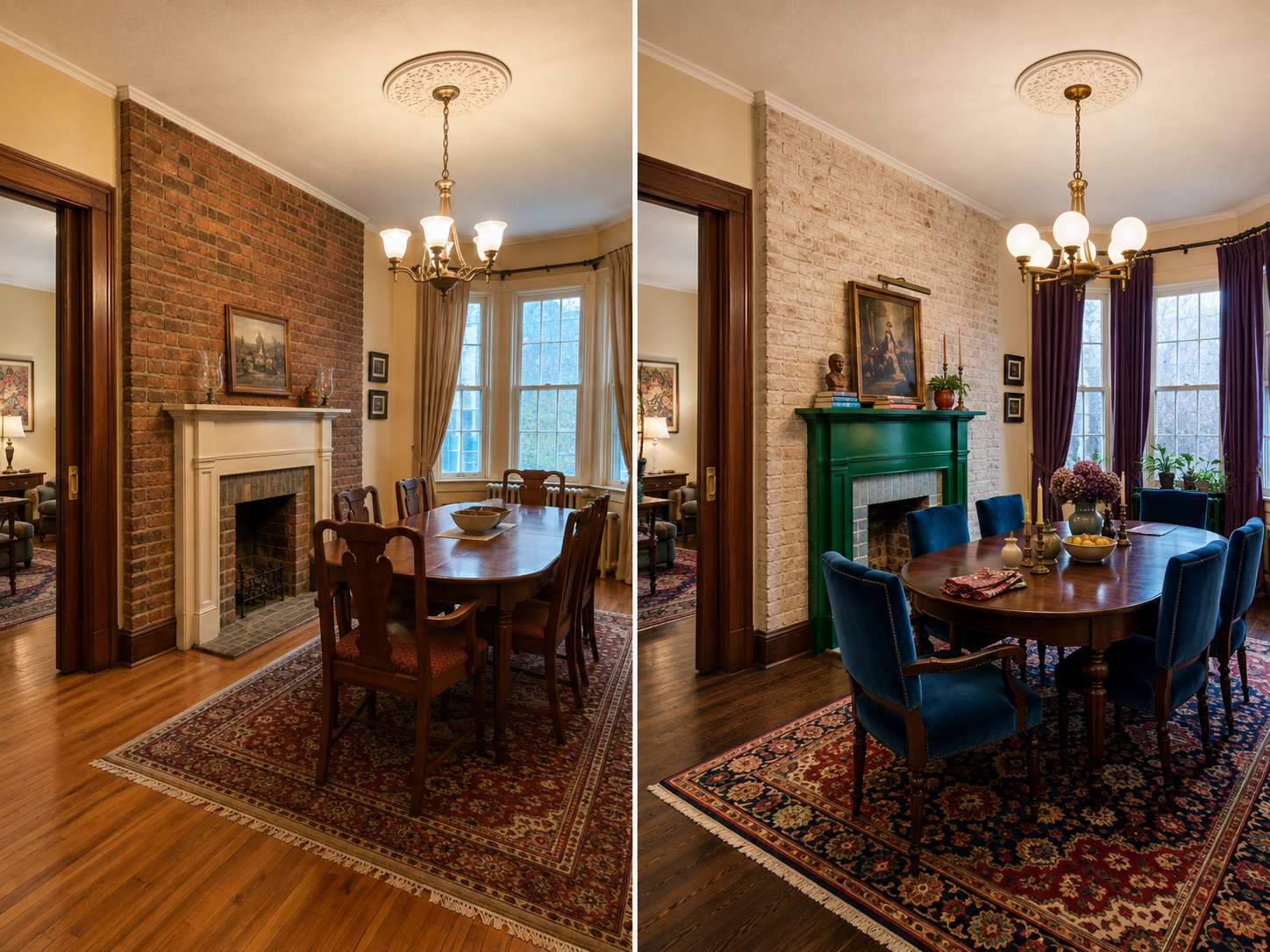
The before is a classic old-house dining room: exposed brick chimney wall, wood furniture, oriental rug, everything warm and slightly heavy. The after limewashes the brick and then gets braver everywhere else. Three decisions make the result repeatable in other rooms:
Limewash gets marketed as a farmhouse finish, but a textured neutral is exactly what maximalist color needs to stay coherent.
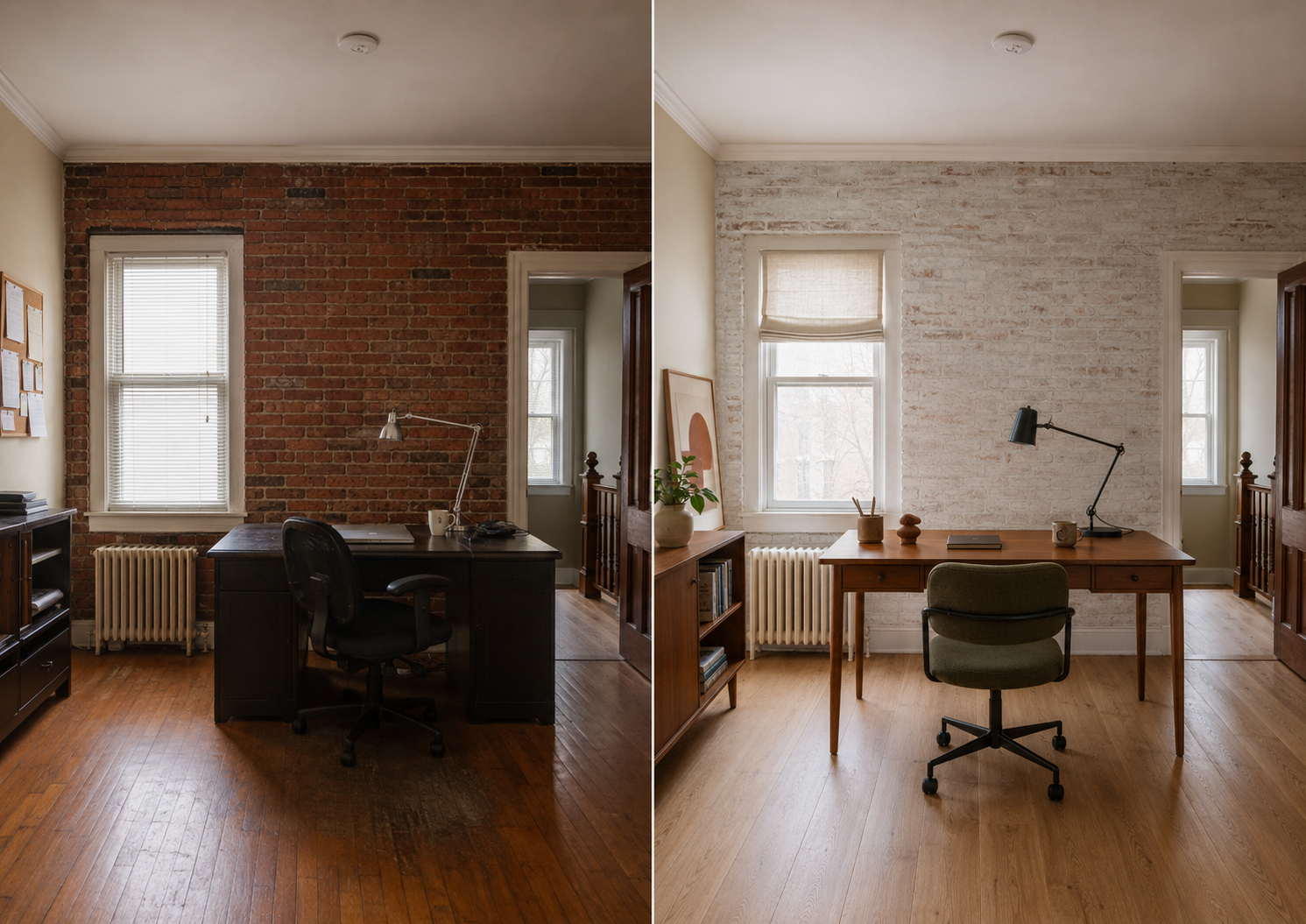
Exposed brick has real costs in a workspace. Here, a deep red wall swallowed most of what came through the single window, and the dark furniture finished the job. If your room is similarly short on natural light, ask for fuller coverage rather than a translucent wash, since you want the wall bouncing light and a thin coat leaves too much red soaking it up. The limewashed version does exactly that, and details like the arched brick header over the window show up again, possibly for the first time in decades.
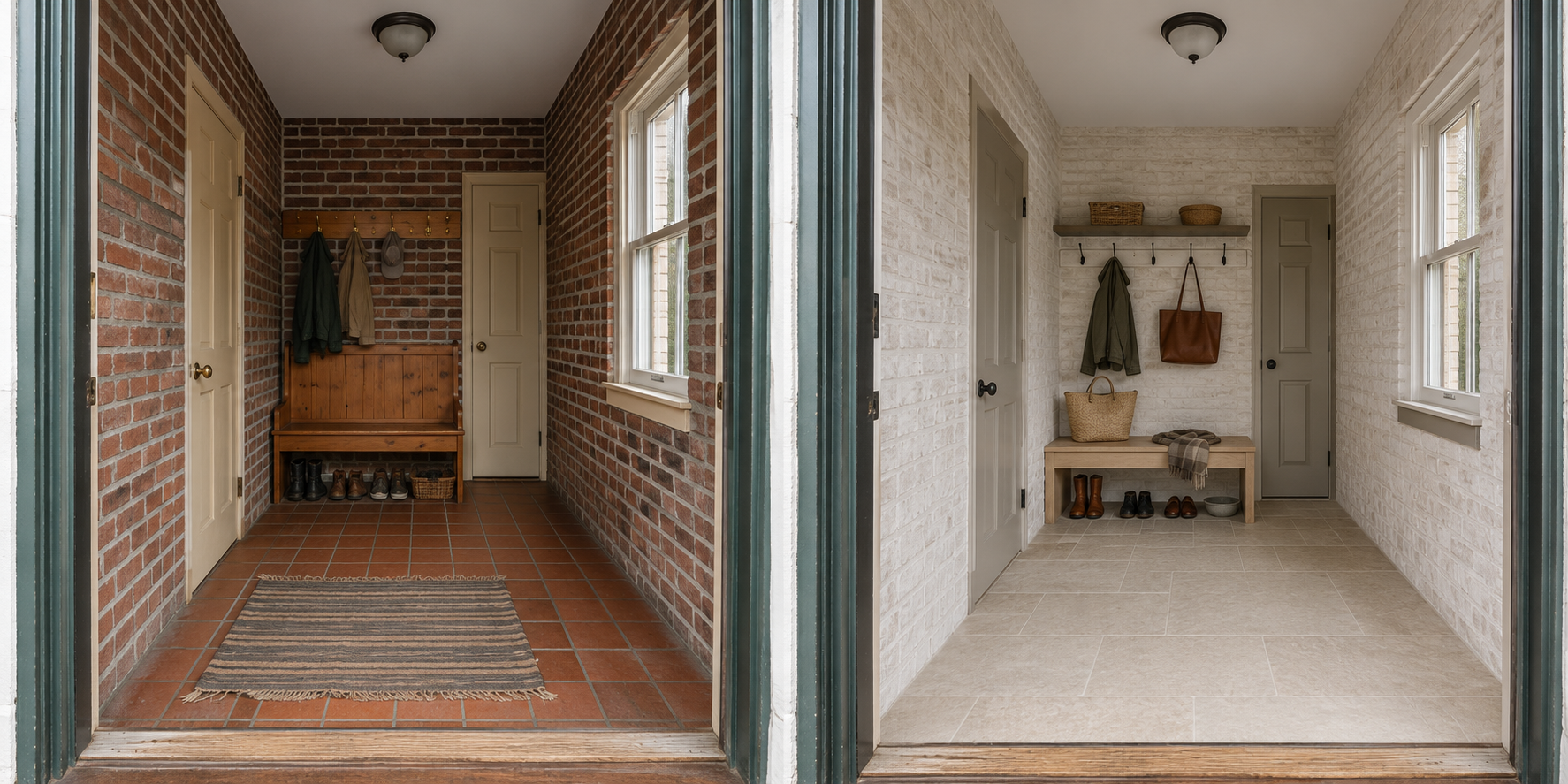
Limewash suits utility spaces better than almost any other finish. This mudroom spent years as a dim corridor of red brick and terracotta tile, and the renovation kept every durable surface while lightening them all. The brick took limewash, the floor went to pale stone-look tile, and a simple bench with black hooks handles the gear. Because the finish is matte and slightly uneven by nature, scuffs and paw-level smudges blend in rather than standing out. A wall that takes daily hits from boots and bags has no film to chip, and cleaning takes a soft brush and mild soap.
Limewash only works on brick that can absorb it. Check six things before pricing the project:
Turn your renovation vision into reality
Get matched with trusted contractors and start your renovation today!
Find a Contractor
Professional limewashing runs $1.50 to $5 per square foot including labor. A typical full exterior comes in between $1,500 and $6,700 in industry cost data. Single-story homes like ranches land at the low end because crews can work without scaffolding. Brick condition moves the number too: basic cleaning is usually included, but masonry repair is billed separately and can add $20 to $50 per square foot in the affected areas.
Interior projects are far smaller. A single accent wall often comes in at a few hundred dollars professionally, and limewash is one of the few finishes where DIY is realistic, with materials for an entire house running $50 to $200. For comparison, painting brick costs $1.50 to $4.50 per square foot, a nearly identical range up front. The gap appears years later. Limewash erodes gradually and takes a fresh coat with no prep drama. Paint that has started to fail has to be scraped or stripped before the next coat goes on. (Internal link opportunity: Block's guide to exterior painting or renovation costs, anchored on the painting comparison.)
Two walls can both be "limewashed" and look nothing alike. Pin down these decisions before work starts:
An exterior limewash touches enough of the house that choosing the contractor matters as much as choosing the finish. Block Renovation matches homeowners with vetted local contractors and has them compete for the project, with every scope reviewed by experts to catch missing prep work, like masonry repair or paint removal, before it turns into a change order. Payments are progress-based and released through Block as the work advances, so you stay protected from the first sample patch to the final walkthrough. If your brick is ready for its own before and after, start by telling Block about your project.
Remodel with confidence through Block

Connect to vetted local contractors
We only work with top-tier, thoroughly vetted contractors

Get expert guidance
Our project planners offer expert advice, scope review, and ongoing support as needed
Enjoy peace of mind throughout your renovation
Secure payment system puts you in control and protects your remodel

Renovate confidently with Block
Easily compare quotes from top quality contractors, and get peace of mind with warranty & price protections.
Before and After
Limewash Brick Before and After: Photos and What to Know
06.10.2026
Before and After
Budget Small Kitchen Remodel: Before and After Ideas
06.08.2026
Before and After
Mid-Century Modern Exterior Before and After Ideas
06.04.2026
Before and After
1970s Kitchen Remodel Ideas: Before & After Pictures
05.29.2026

Before and After
Small Condo Renovation Before and After Inspiration
05.27.2026