




.png?width=640&name=u5821215421_Apartment_Therapy_style_editorial_exterior_photo__b84e16d6-fde1-40fe-abbd-16303f9fe837_3%20(1).png)
Connecticut
Custom Home Building in Bridgeport, CT: The Real Guide
05.05.2026
.png?width=640&name=u5821215421_Apartment_Therapy_style_home_tour_photograph_sing_c3f08809-6a1e-428b-9e3d-4914aa15e5ba_3%20(1).png)
04.21.2026


In This Article
Stamford sits at the intersection of two housing markets that do not always want the same things. One is the New York financial commuter market—buyers who work in the city, want train access to Grand Central, and bring Manhattan expectations about finishes, scale, and what constitutes a real kitchen. The other is longtime Fairfield County residents who have lived here through multiple market cycles, know the neighborhoods block by block, and care about things like setbacks, tree preservation, and whether the contractor has actually worked on a home like theirs before.
Both groups build custom homes in Stamford. They just build very different ones. If you are still working through whether to renovate an existing home or start fresh with new construction, Stamford's land costs and permitting complexity tend to favor building new when the numbers are run honestly. Getting clear on which buyer you are—and building for the life you are actually going to live, not the one you imagine impressing someone else with—is the most important decision you will make before you break ground.
Design a Home That’s Uniquely Yours
Block can help you achieve your renovation goals and bring your dream remodel to life with price assurance and expert support.
Get Started
The commuter buyer
The New York commuter profile tends to prioritize size, finish level, and proximity to the Metro-North stations at Stamford or Greenwich. Open floor plans, large primary suites, chef kitchens with high-end appliances, and home offices that function as actual workspaces. These buyers have often spent time in expensive Manhattan or Brooklyn apartments and are building their first real house. They know what premium looks like but sometimes underestimate what it costs to build it in Fairfield County's labor market.
The risk for this profile is designing to impress rather than to live. A 5,500 square foot home on a 0.4-acre lot in North Stamford looks great on paper and feels enormous compared to an Upper West Side apartment. But if the lot cannot support the footprint, or the budget does not account for Stamford's permitting timeline and site conditions, the project runs into problems that a different set of priorities would have avoided.
The legacy buyer
Longtime Fairfield County residents building custom homes tend to know what they want in more specific terms. They have lived in the area, they understand the neighborhoods, and they have often watched other people's construction projects succeed or fail. Many of Stamford's established neighborhoods are defined by American Foursquare and Colonial Revival homes that set a strong architectural context — and legacy buyers typically want their new home to fit that fabric rather than break from it. They are more likely to prioritize indoor-outdoor connection, lot utilization, and getting the site plan right than chasing square footage. They also tend to have clearer views on which contractors are worth working with; local reputation travels fast in Stamford's custom market.
The risk for this profile is different: over-customizing to personal taste in ways that limit resale appeal. Not every buyer who follows you will share your design sensibility, and Stamford's market is competitive enough that future buyers have choices.
Stamford's geography puts a significant portion of its residential land either within or adjacent to FEMA-designated Special Flood Hazard Areas. The city sits on Long Island Sound, with tidal rivers and tributaries running inland through neighborhoods including Shippan, Cove, and portions of the South End. If you are evaluating a lot anywhere near those areas, flood zone status is not a secondary consideration. It is a primary site constraint.
What FEMA designations actually mean for construction
Lots in Zone AE—the most common high-risk coastal designation in Stamford—carry mandatory requirements for elevated foundation construction. The Base Flood Elevation (BFE) for a given parcel determines the minimum finished floor height, and Connecticut coastal construction standards add requirements on top of FEMA's federal baseline. In practice, this means:
These requirements add real cost. An elevated foundation on a coastal Stamford lot can add $80,000 to $150,000 or more to the structural cost compared to standard construction on a comparable non-flood zone parcel. Budget for this explicitly before you make an offer on any lot near the Sound or its tributaries.
FEMA map updates
Flood zone maps are not static. FEMA has been conducting ongoing remapping in Fairfield County, and parcels that were not in a flood zone five years ago may be designated today, or the reverse. Always pull the current FIRM (Flood Insurance Rate Map) panel for any lot you are seriously evaluating, and understand that a map amendment or revision may have occurred since the last time the parcel was assessed. Your architect and contractor should be familiar with the current BFE for your specific site before design begins.
Flood insurance
Homes in FEMA AE zones require flood insurance if they carry a federally backed mortgage. Post-Biggert-Waters Act reforms have made that cost larger and less predictable than it once was. Get a flood insurance estimate for any lot you are considering before you close on it. Not after..
Stamford's Building Department manages permits for new residential construction within city limits. Connecticut does not have a single county-level planning authority; Stamford operates its own Planning and Zoning Board with its own regulations, and the city's coastal properties are also subject to review by the Connecticut Department of Energy and Environmental Protection (DEEP) under the state's Coastal Management Act.
For a new single-family custom home on a non-coastal lot in Stamford, permit approval typically runs 8 to 12 weeks from a complete submission. Coastal parcels, wetland-adjacent lots, or projects in Historic Districts trigger additional review layers that can add months to the timeline.
What you will typically need to submit
Connecticut contractor licensing
Connecticut requires Home Improvement Contractors (HIC) and New Home Construction contractors to be licensed through the Department of Consumer Protection. General contractors must hold the appropriate license classification and carry general liability and workers' compensation insurance. Verify both the HIC license and the specific new construction endorsement before signing any agreement.
The most expensive custom home mistake in Stamford is building for a hypothetical buyer rather than for yourself. It comes up in both profiles but shows up differently.
For the commuter buyer, it often looks like this: square footage and finish level are maximized because that is what is expected at this price point, the house feels impressive on a walkthrough, but the layout does not serve how the family actually moves through the day. The mudroom is in the wrong place. The primary bedroom is at the end of a long hallway that makes no sense for daily life. The outdoor space got squeezed to fit the footprint. The house cost $2.8 million and the family is already thinking about what they would change.
For the legacy buyer, it often looks like this: intensely personal design decisions—unusual material choices, non-standard layouts, specialized rooms—that reflect a very specific vision but do not translate to a broad buyer pool. When it comes time to sell, the house sits.
The fix in both cases is the same: design for the life you are actually planning to live in Stamford, not for a projected buyer or a projected self. A home built around how you work, eat, host, and rest will almost always serve the market better than one built around what you thought a custom home at this price point should look like.
Compare Proposals with Ease
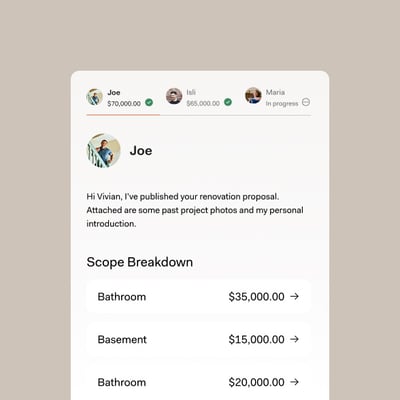
Stamford is one of the most expensive custom home markets in the country. That is not a warning. It is a baseline. Connecticut's labor market, Fairfield County's material and logistics costs, and the regulatory complexity that comes with coastal and inland site conditions all push project costs above what buyers coming from other markets expect.
Construction cost ranges
Custom home construction in the Stamford market currently runs approximately $400 to $650 per square foot for the structure, depending on finish level, complexity, and site conditions. Coastal lots with flood zone requirements sit at the higher end. A 3,500 square foot home at the midpoint represents roughly $1.8 million in construction cost before land, permits, and soft costs.
Add land—Stamford lots suitable for custom construction typically run $400,000 to over $1 million depending on location and size—and total project costs for a custom home in this market regularly reach $2.5 million to $4 million and above.
Budget categories to plan for
Where to be strategic
At this price point, the question is rarely whether to invest in quality. It is where. The envelope (windows, insulation, air sealing) and the mechanical systems (HVAC, ERV ventilation) are the places to invest that affect daily life most directly and that are most expensive to upgrade after the fact. Finish materials are highly visible but largely swappable. Structural and mechanical decisions are not.
Stamford's custom home contractor market is active but not deep at the top. There are a handful of builders who actually know the combination of Fairfield County's regulatory environment, coastal construction requirements, and the finish expectations of this market. Finding one, and getting on their schedule, takes time.
Start the contractor search before you have finalized your design. The best builders in this market have work, and waiting until plans are complete to begin conversations means competing for availability against buyers who started earlier.

“A general contractor shouldn’t be the labor. They should be managing trades, schedules, and risk.”
What to look for
Ask specifically about experience with coastal and flood zone construction in Connecticut. This is not a general skill; it requires knowledge of FEMA elevation requirements, Connecticut DEEP coastal permit processes, and foundation systems that work in tidal flood contexts. A contractor whose portfolio is primarily inland North Stamford homes may be excellent at what they do and still lack this specific experience.
Ask to see completed homes in a similar price range and finish level. Visit them if possible. Talk to the homeowners about how the contractor managed the permit process, handled change orders, and communicated through the build.
Verify the Connecticut Home Improvement Contractor license and new construction endorsement through the Department of Consumer Protection. Confirm general liability and workers' compensation with certificates from the insurer.
Getting multiple bids
Three bids minimum, and make sure each is priced against the same scope. At Stamford's price points, bid variation can be $200,000 or more on the same project, not because one contractor is wrong but because they are making different assumptions about scope, allowances, and contingency. Line-item proposals are the only way to understand what you are actually comparing.
Connecticut's climate is demanding enough to require real attention in the design and construction phase. Winters bring freeze-thaw cycles that affect foundation curing schedules and exterior work windows. Stamford's proximity to the Sound means elevated humidity relative to inland markets, which affects framing moisture management.
Coastal sites add wind load requirements to the structural spec. Homes within a certain distance of the Sound must meet higher wind resistance standards under Connecticut's coastal construction rules; your structural engineer should be designing to these without prompting, but confirm it explicitly.
Typical timeline
A custom home in Stamford typically takes 14 to 20 months from permit approval to certificate of occupancy. The wide range reflects the variation in site complexity: a straightforward inland lot with no coastal review runs shorter; a coastal parcel that requires DEEP approval and an elevated foundation runs longer. Budget the permit process itself at 3 to 6 months for a complete application depending on whether coastal review is triggered.
Staying involved
Weekly check-ins with your contractor during active construction phases are the baseline. In Stamford's market, where project costs are high and contractor schedules are tight, catching issues early—before additional work is built over them—has a disproportionate financial impact. A framing question raised in week four costs a conversation. The same question raised in week fourteen can cost a wall.
Stamford's custom home market asks a lot of buyers before the first shovel goes in: lot evaluation, flood zone diligence, coastal permitting, contractor vetting at a price point where the wrong choice is very expensive. Block Renovation is built to make that process navigable. If you want a full walkthrough of how the custom home building process works from start to finish, Block's guide covers every phase.
Block connects you with vetted contractors matched to your project's specific demands, reviews your scope for gaps before you commit to a bid, and provides a payment structure where your contractor is paid as work is completed. Every contractor in the Block network carries a one-year workmanship warranty.
In a market where the wrong contractor, the wrong scope, or the wrong site choice can cost you hundreds of thousands of dollars, having an expert set of eyes on every decision is not a luxury. It is how the best outcomes here happen.
Lay the groundwork for a successful custom home
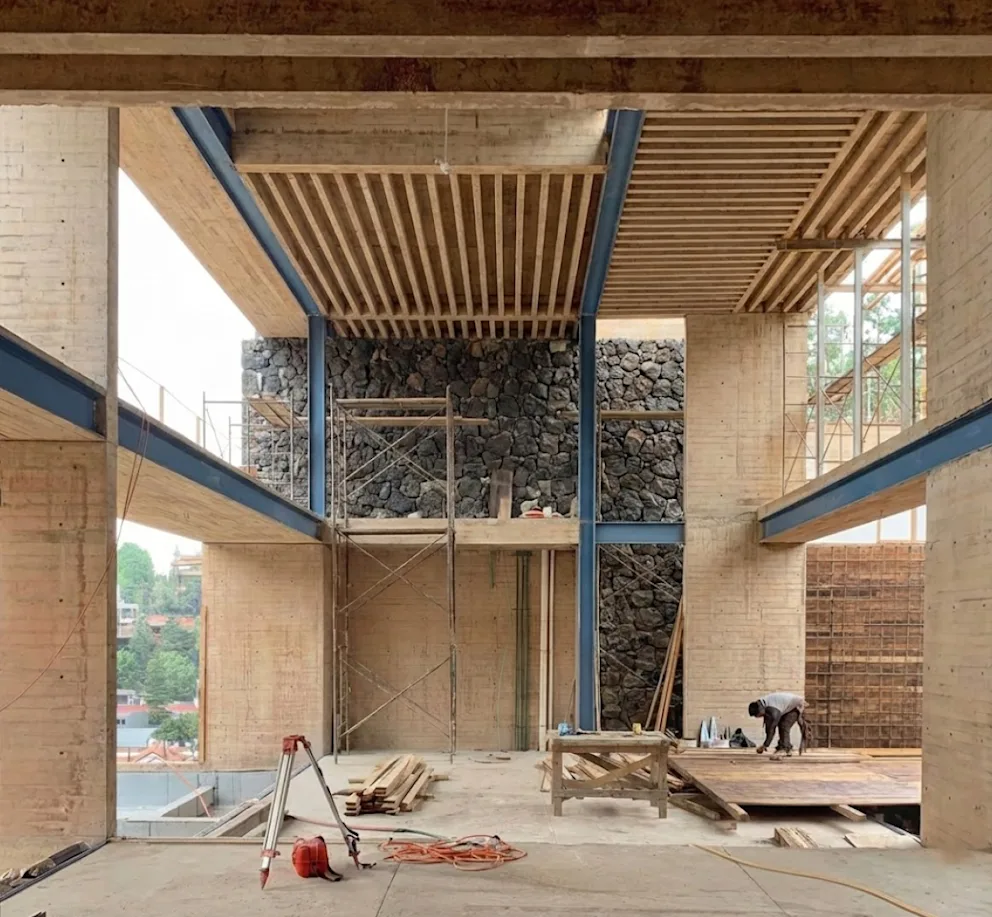
Match with vetted builders
Receive quotes from experienced contractors aligned to your vision.

Hire with confidence
Partner with Block experts to review quotes and timelines for end-to-end clarity.

Stay in control
Avoid surprises with Block Protections and a progress-based payment system.


Renovate confidently with Block
Easily compare quotes from top quality contractors, and get peace of mind with warranty & price protections.
Connecticut
Custom Home Building in Bridgeport, CT: The Real Guide
05.05.2026
Connecticut
Custom Home Building in Stamford, Connecticut: Local Guide
04.21.2026

Connecticut
Bathroom Remodel Hartford CT | Costs & Local Tips
03.25.2026

Connecticut
Custom Home Building in Hartford, CT | Cost Guide
03.12.2026

Connecticut
Kitchen Remodel Hartford: Costs, Tips & Local Ideas
02.09.2026