



Bathroom
York City Bathroom Remodel: Costs, Planning & Design
09.17.2026
05.08.2026


In This Article
Bathroom cabinets are the difference between a room that works and a room that fights you every morning. The right cabinetry hides the clutter, lasts through years of steam and splash, and disappears into the room. The wrong cabinetry warps at the edges, swells at the seams, and reminds you of every shortcut someone took to save $200.
Vertical grooves bring texture and movement to flat-front cabinetry. Powder rooms are where reeded doors land best, since the vanity is the focal point and the wear and tear is minimal. Expect to pay 15% to 30% more than a flat-front equivalent, since the doors are harder to mill and harder to finish evenly. If you're working with a tighter budget, a single reeded accent on the vanity face or just the drawer fronts reads almost as strong as committing the whole room.
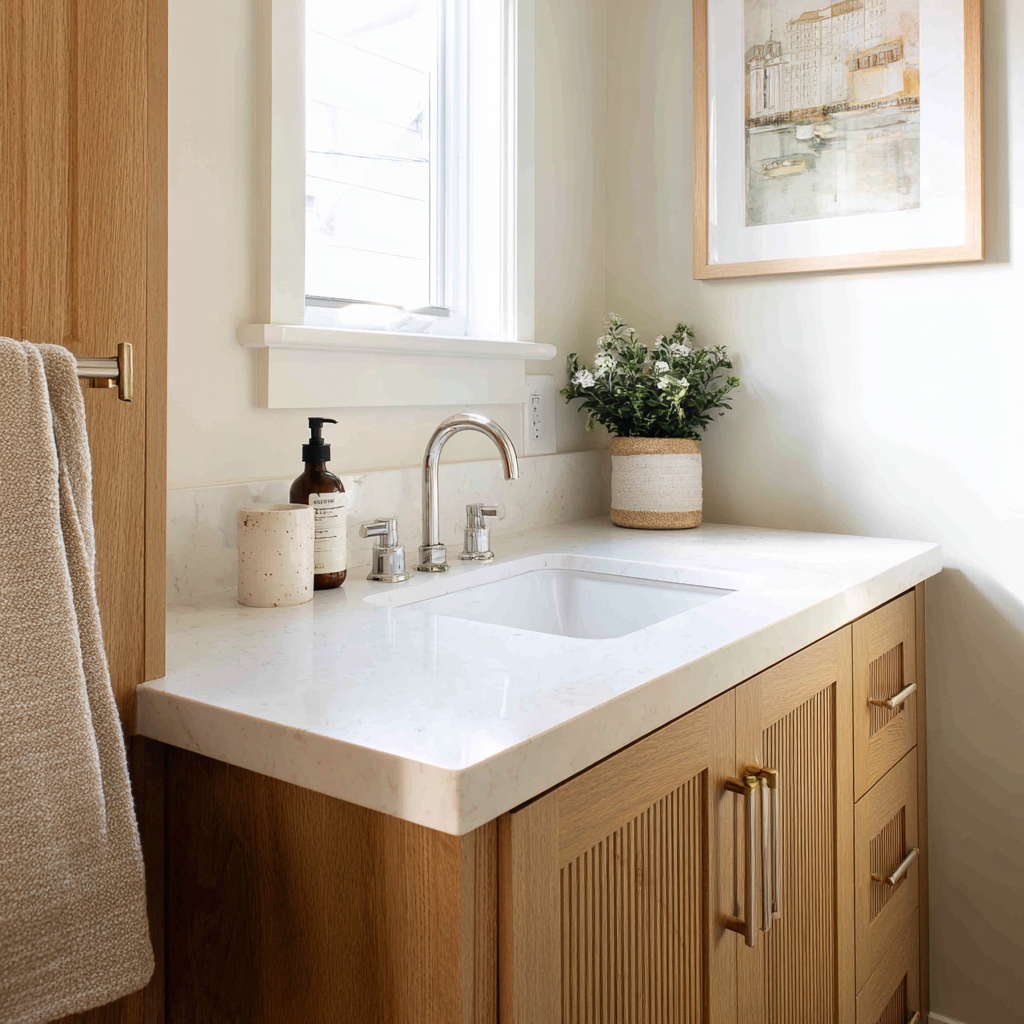
Push-to-open and integrated finger pulls eliminate hardware from the vanity entirely, which gives you a cleaner, more architectural look. The cabinet face becomes one continuous plane rather than a grid interrupted by knobs and pulls. This idea is particularly useful if your cabinet needs lean modern and minimalist, and it pairs well with bold countertops or statement tile that you actually want the eye to land on. The trade-off is fingerprints, since you're pushing the door with bare fingers, so darker matte finishes will show smudges faster than light or glossy ones.
Push-to-open hardware needs more clearance behind the door than a traditional hinge, so confirm with your contractor that the cabinet boxes are spec'd for it. Integrated finger pulls (a routed groove along the top or side of the door) are a good middle path if you want the clean look without relying on a mechanism, and they tend to age better since there's no spring or magnet to fail.
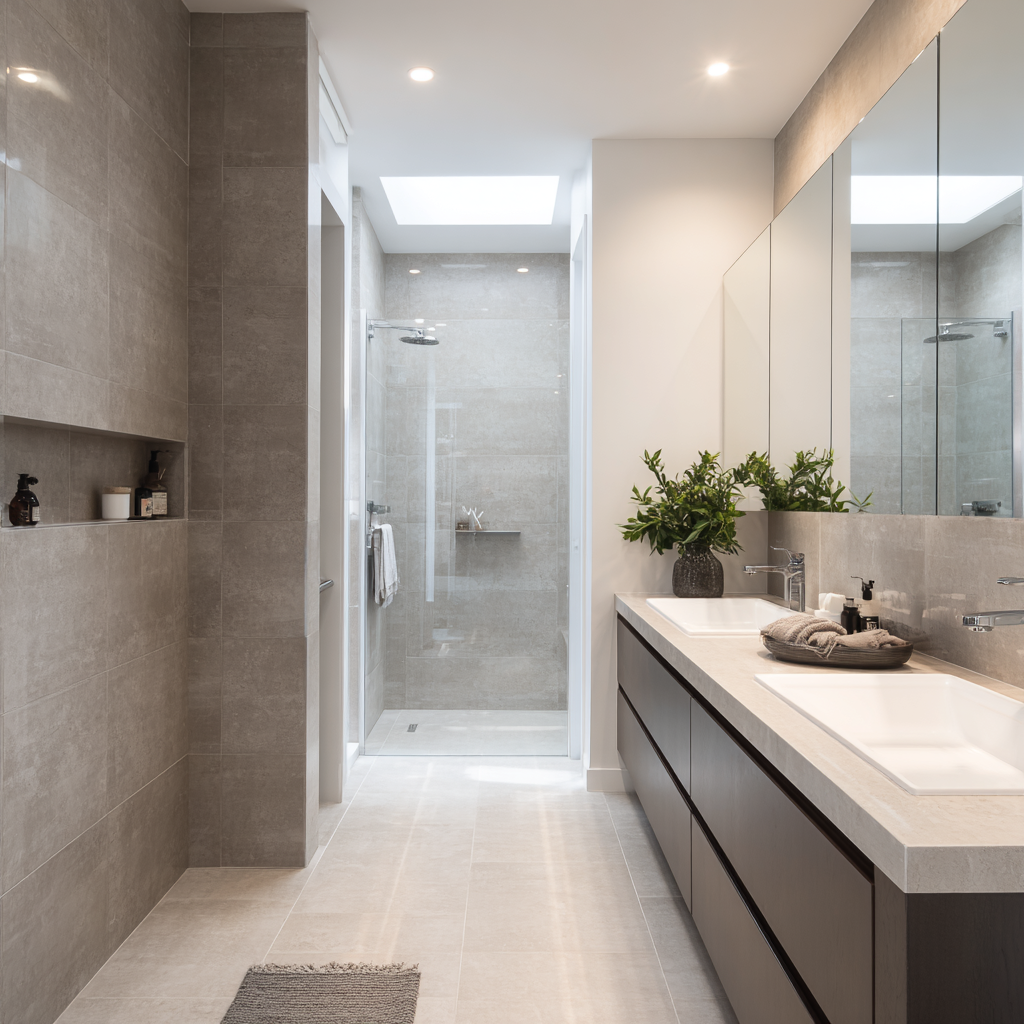
Run power into a drawer or cabinet so toothbrushes, electric razors, hair tools, and other small appliances charge out of sight. The vanity is the obvious place, but a linen cabinet or tall storage cabinet can hold a lot more than people realize: an electric toothbrush sanitizer, a robot vacuum dock, a small humidifier, or the charger for a heated towel rack controller. An electrician can add outlets for around $150 to $300 each during a renovation, and the countertops and floors stay clear.
A few practical tips before you finalize your bathroom cabinet ideas:
Pair a deep navy or forest green vanity base with white or natural oak uppers, or take the same idea to the room level by pairing a painted vanity with a contrasting freestanding linen cabinet. The contrast adds depth without committing the whole bathroom to a single color story. Darker finishes hide water spots and toothpaste splatter better than light ones, so darker tones tend to make sense on the cabinetry that gets daily use and lighter or natural wood tones on storage that stays dry.
For the contrast to look intentional rather than mismatched, pick finishes that share at least one quality: the same hardware across two paint colors, the same stain undertone across two woods, or the same sheen across two finishes.
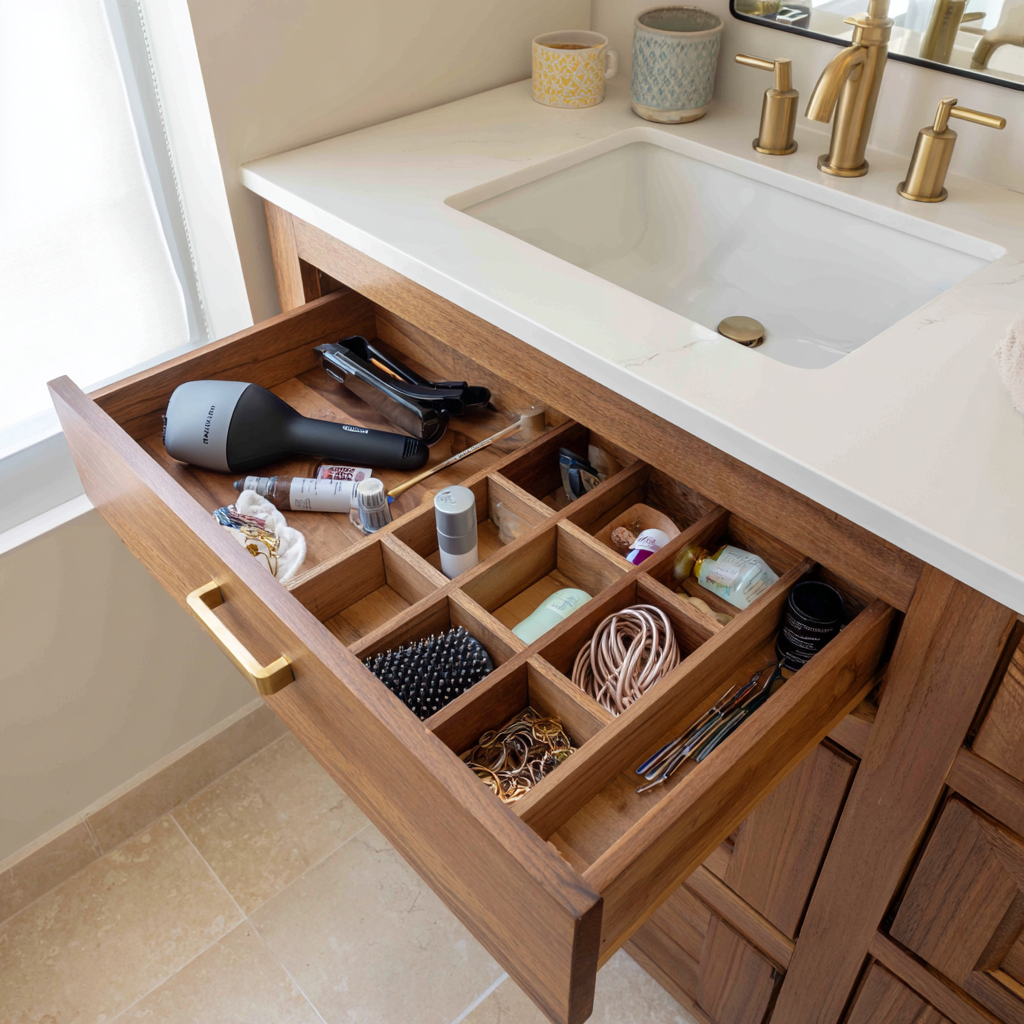
The dividers, inserts, and adjustable shelves you specify often matter more than the cabinet box itself, because they're what you actually interact with every day. The principle applies across the room: the vanity drawer holding your hair tools, the linen cabinet stacking your towels, the tall storage cabinet hiding cleaning supplies, and the medicine cabinet organizing your skincare. The cost runs $200 to $800 across a typical bathroom, and the upgrade pays back daily. A $1,500 stock vanity with $600 in custom organizers will out-perform a $4,000 vanity with a single open shelf inside, every time. Bring a list of what you actually store in your bathroom to the design conversation, since the best organizers are built around real items rather than generic categories.
For practical planning, group items by frequency of use rather than by category. The drawer or shelf you reach for ten times a day should hold your daily-use items, while the storage you open once a week can hold backup products, travel-size items, and folded extras. Walnut and white oak inserts hold up better than maple in a humid bathroom, since softer woods absorb more moisture and can swell against the drawer walls. Heat-resistant inserts are worth specifying for any drawer that holds a curling iron or flat iron, since residual heat can warp untreated wood or plastic dividers over time.
A tilt-out or pull-out hamper built into the vanity keeps laundry off the floor. It's most worth installing in a primary bathroom, since the alternative is a wicker basket in the corner that everyone politely ignores. Look for a removable cloth liner you can lift out and carry to the laundry room, since fixed bins are a pain to empty.
Wall-mounted cabinets make a small bathroom feel larger by exposing more floor. Add an LED strip underneath for a soft nightlight that doubles as a wayfinder at 2 a.m. Floating vanities work best in powder rooms and small ensuites, since in a primary bathroom shared by a family, the storage you give up may not be worth the visual gain. The wall behind a floating vanity needs blocking installed before drywall goes up, so flag this early in the renovation and not after framing is closed.
Front-lit and backlit options eliminate shadows on the face, which is a noticeable upgrade for anyone who shaves or applies makeup. A well-chosen medicine cabinet replaces a separate mirror, vanity light, and wall-mounted storage piece all at once, which is especially valuable in small bathrooms where every wall is doing double duty. Look for models with anti-fog heating elements built into the mirror surface, since steam from the shower otherwise renders the mirror useless for the first few minutes after you'd actually want to use it.
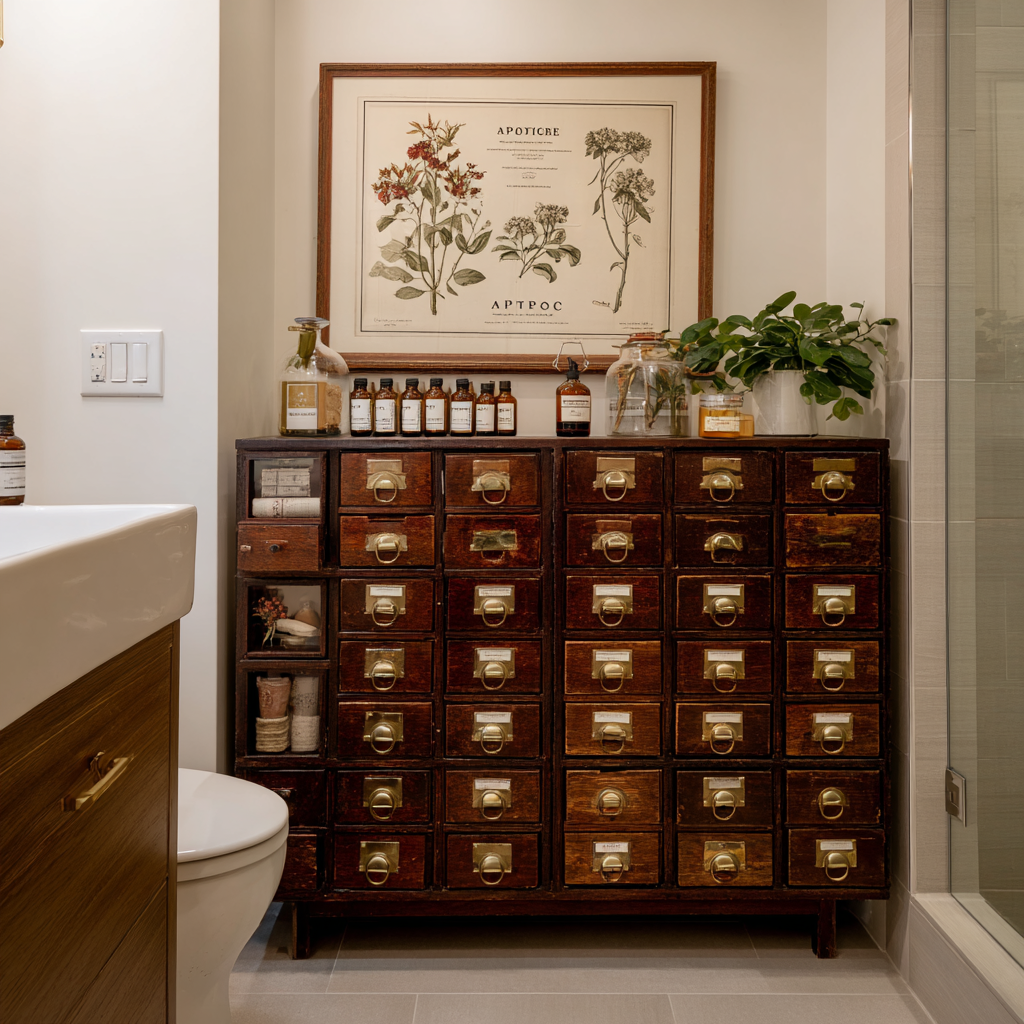
The hardest things to store in a bathroom are the small items: nail clippers, hair ties, bobby pins, contact lens cases, lip balm. They get lost in deep drawers and crowded out by bigger items. An apothecary-style cabinet, a tall narrow piece with rows of small drawers, solves the problem directly. Each drawer is sized for exactly the kind of small item that has nowhere else to live.
Expect to pay $600 to $2,500 for a quality piece, with vintage examples running higher. The cabinet should sit on legs or a base rather than directly on the floor, so water from a wet floor doesn't wick into the bottom. Skip the piece entirely if your bathroom doesn't have a working exhaust fan, since the small drawers are slow to dry out once humidity gets into them.
Most bathrooms have an awkward 12 to 24 inch gap between the vanity and the tub or wall that ends up holding nothing useful, or worse, a wire shelf with a stack of toilet paper on it. A narrow console cabinet built or sourced to fit that exact dimension turns the dead space into real storage: drawers for backup toiletries on top, a deeper compartment for towels or a hamper below. The fix is most valuable in older apartments and small bathrooms where the rest of the layout is fixed and that gap is the only square footage you can rework. Done well, the cabinet looks built-in.
For practical planning, measure the gap at floor level, at counter height, and at the top, since walls in older buildings are rarely plumb. If the cabinet sits next to a tub, the side facing the tub will get splashed regularly, so specify a finish that can handle direct water contact rather than a typical cabinet finish.
That dead space at the bottom of a vanity can hold a flat drawer for scales, step stools, or extra rolls of toilet paper. Push-to-open hardware is the right call here, since toe-kick drawers don't have room for a traditional pull.
This cabinet idea is hardly revolutionary but it’s too helpful to exclude. For starters, a recessed medicine cabinet gives you storage without the bulk of a protruding box. The format is especially valuable in tight bathrooms, where a protruding cabinet would feel cramped at face height. The install requires checking what's behind the wall first, since plumbing or electrical can complicate the work. If the wall is shared with a wet wall (the one carrying the shower or sink plumbing), you'll likely need to find an adjacent wall instead.
For practical planning, confirm the rough opening before you order the cabinet, since recessed units come in fixed sizes and most wall cavities are 3.5 inches deep between studs. Anything deeper requires furring out the wall on the back side or finding an exterior wall, which introduces insulation considerations.
Standard vanities are 32 to 34 inches tall. Bumping to 36 inches (counter height) is more comfortable for most adults and a small change with a big daily payoff. Still, a standard-height vanity is still the right call in a kids' bathroom, though, since the difference between 32 and 36 inches is the difference between a child reaching the sink and not.
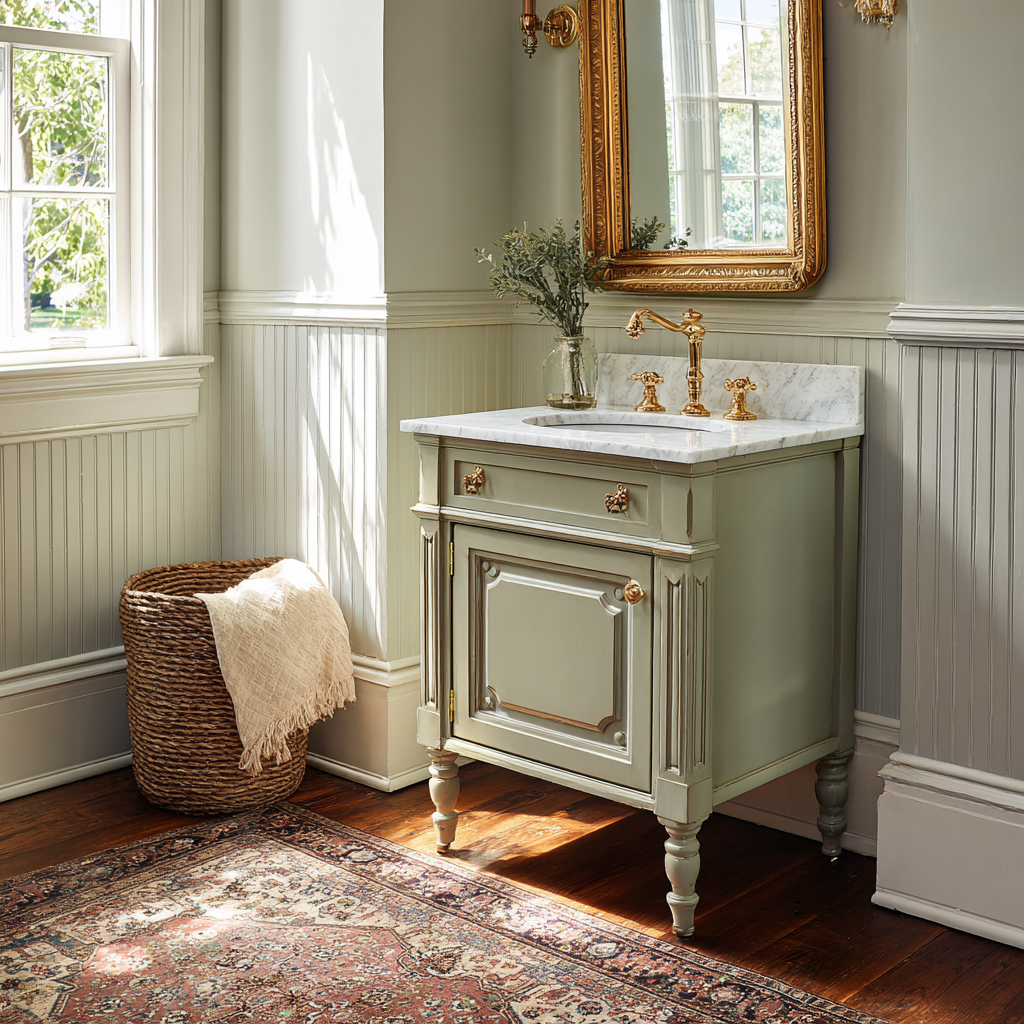
In a larger primary bathroom, extending the cabinetry to include a knee-space makeup area turns the vanity into a getting-ready station. This idea is particularly useful if your cabinet needs to include a dedicated getting-ready zone, and only works if you have the square footage to support it. Seated vanity height is typically 28 to 30 inches, which is shorter than the standing vanity, so the cabinetry has to step down for the seated section to feel right.
Bring Your Dream Bathroom to Life
Open shelving should not be your primary source of bathroom storage.
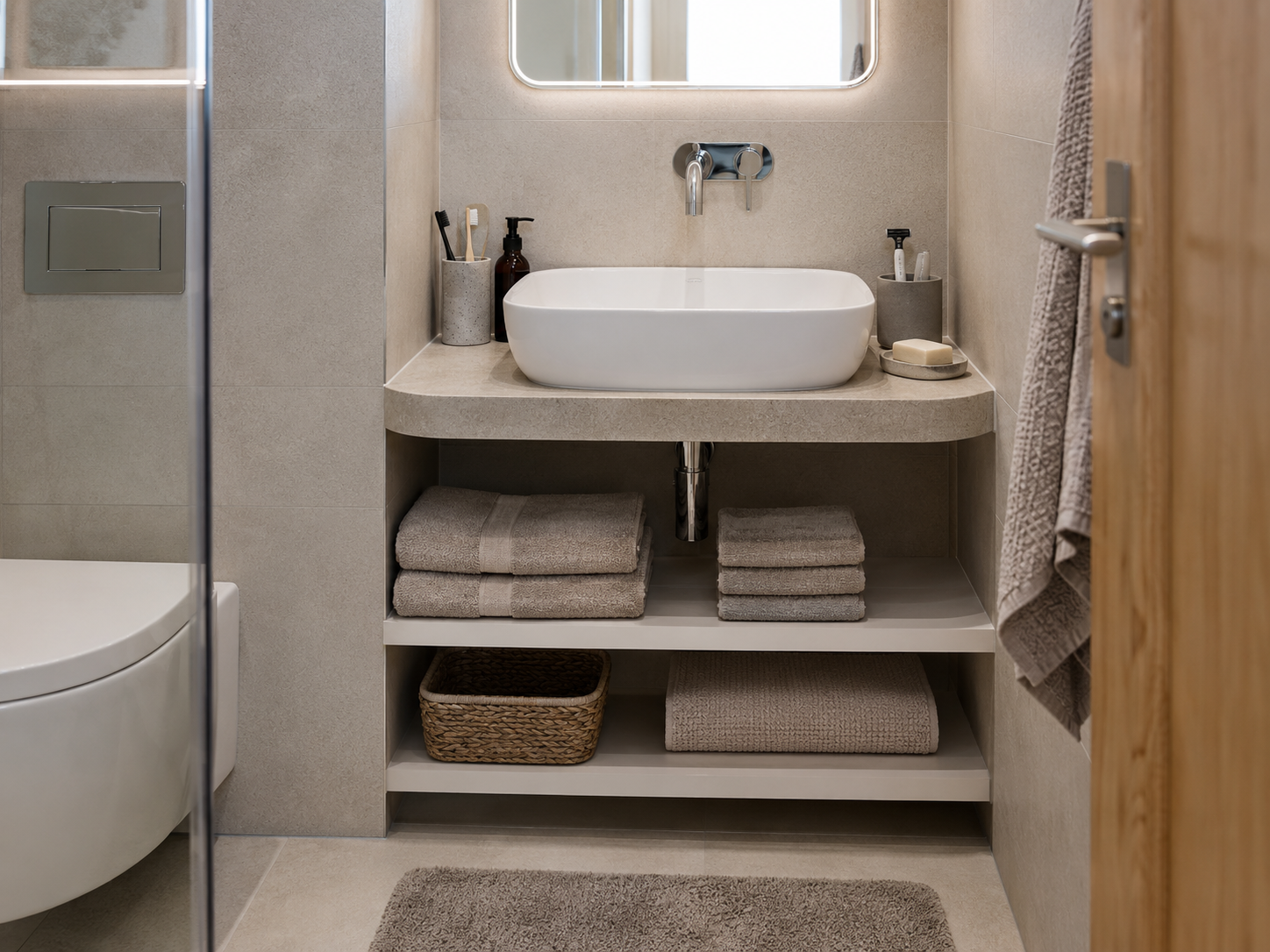
It looks incredible in renderings and listing photos, but not in a space that is genuinely lived in. Just think about how much stuff your bathroom currently holds: sunscreen tubes, half-empty shampoo bottles, retainers, prescription pill bottles, contact lens solution, Q-tips, floss . . .
A few open shelves for folded towels, a ceramic vase, or a stack of nice soaps are fine. Treat them as styling rather than storage. Everything you actually use every day belongs behind a door or in a drawer. Plan the closed storage first and generously, then keep the open shelving to a few thoughtful pieces.
Don’t under-estimate the effect moisture can have on cabinets, especially those that are subpar. A bathroom regularly spikes past 70% humidity during a hot shower, and that moisture finds every unsealed edge or untreated screw hole. Cabinetry built to kitchen specs (or worse, bedroom specs) won't hold up to it.
The fixes aren't dramatic, but they have to be specified up front. Mel Stutzman of Countryside Amish Furniture explains "Standard furniture-grade lacquer wasn't built for a room where humidity climbs every time someone showers. Conversion varnish or a two-part catalyzed polyurethane will hold up far longer than a standard topcoat, especially on the toe-kick and the lower edges of the doors where steam settles. On painted cabinets, an oil-based or hybrid alkyd primer under the color coat blocks moisture from reaching the substrate. Latex alone won't.”

Particleboard and MDF act like sponges the moment a raw edge meets steam. The factory finish on the face means nothing if the bottom of the door, the back of the cabinet, and the hardware holes are left bare.
Mel also noted, “Hardware matters as much as the finish. Solid brass and stainless steel hinges are worth the upgrade. Zinc, on the other hand, will corrode surprisingly fast.”
Bathroom cabinetry has to be specified for the bathroom, not borrowed from kitchen logic. Ask your contractor what finish system they're using, what hinges and slides come standard, and whether the cut edges will be sealed.
A bathroom renovation is one of the most detail-heavy projects a homeowner can take on. Cabinet specs, finish chemistry, plumbing, ventilation, and a dozen small decisions about hardware all have to land correctly, and any one of them done wrong can cost you years of regret.
Thousands of homeowners have remodeled bathrooms with Block. Tell Block your project details once and have your area's best contractors compete with detailed, line-itemed scopes. Every scope is reviewed by Block experts who know the difference between cabinetry built for a bathroom and cabinetry borrowed from kitchen logic. Block manages the payments through a secure system that releases funds as the work progresses, so contractors stay on schedule and your money stays protected. Every contractor in the network provides a one-year workmanship warranty.
Whether your bathroom needs a full gut renovation or a vanity-and-finishes refresh, Block helps you plan the project, hire the right contractor, and stay in control through the final walkthrough.
Remodel with confidence through Block

Connect to vetted local contractors
We only work with top-tier, thoroughly vetted contractors

Get expert guidance
Our project planners offer expert advice, scope review, and ongoing support as needed
Enjoy peace of mind throughout your renovation
Secure payment system puts you in control and protects your remodel

Renovate confidently with Block
Easily compare quotes from top quality contractors, and get peace of mind with warranty & price protections.
Bathroom
York City Bathroom Remodel: Costs, Planning & Design
09.17.2026
Bathroom
Walk-In Tub vs. Walk-In Shower for Seniors
09.16.2026
Cost
The Cost to Add a Half Bath & How to Plan for It
09.04.2026
Bathroom
Non-Tile Bathroom Flooring Options
08.26.2026
Design
Bathtub to Shower Conversion: Cost, Ideas, Examples & More
08.11.2026