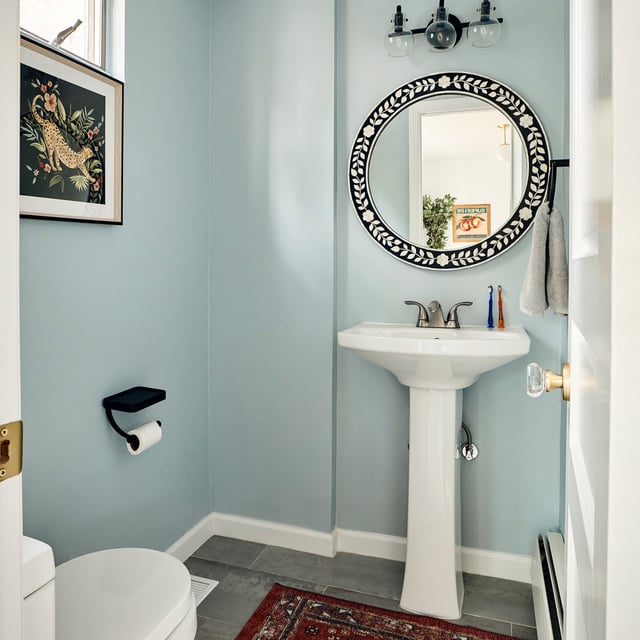
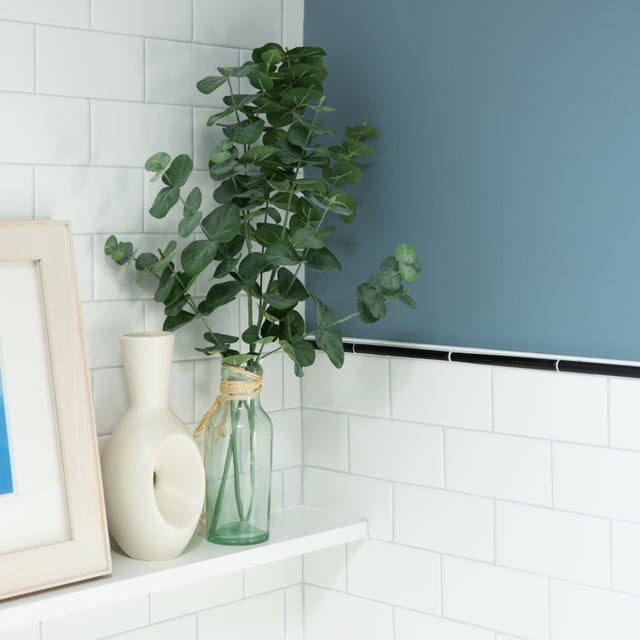
Some bathrooms don't give you options. Between doors, windows, and existing plumbing, you're left with one clear wall to work with. That's where a linear bathroom layout comes in.
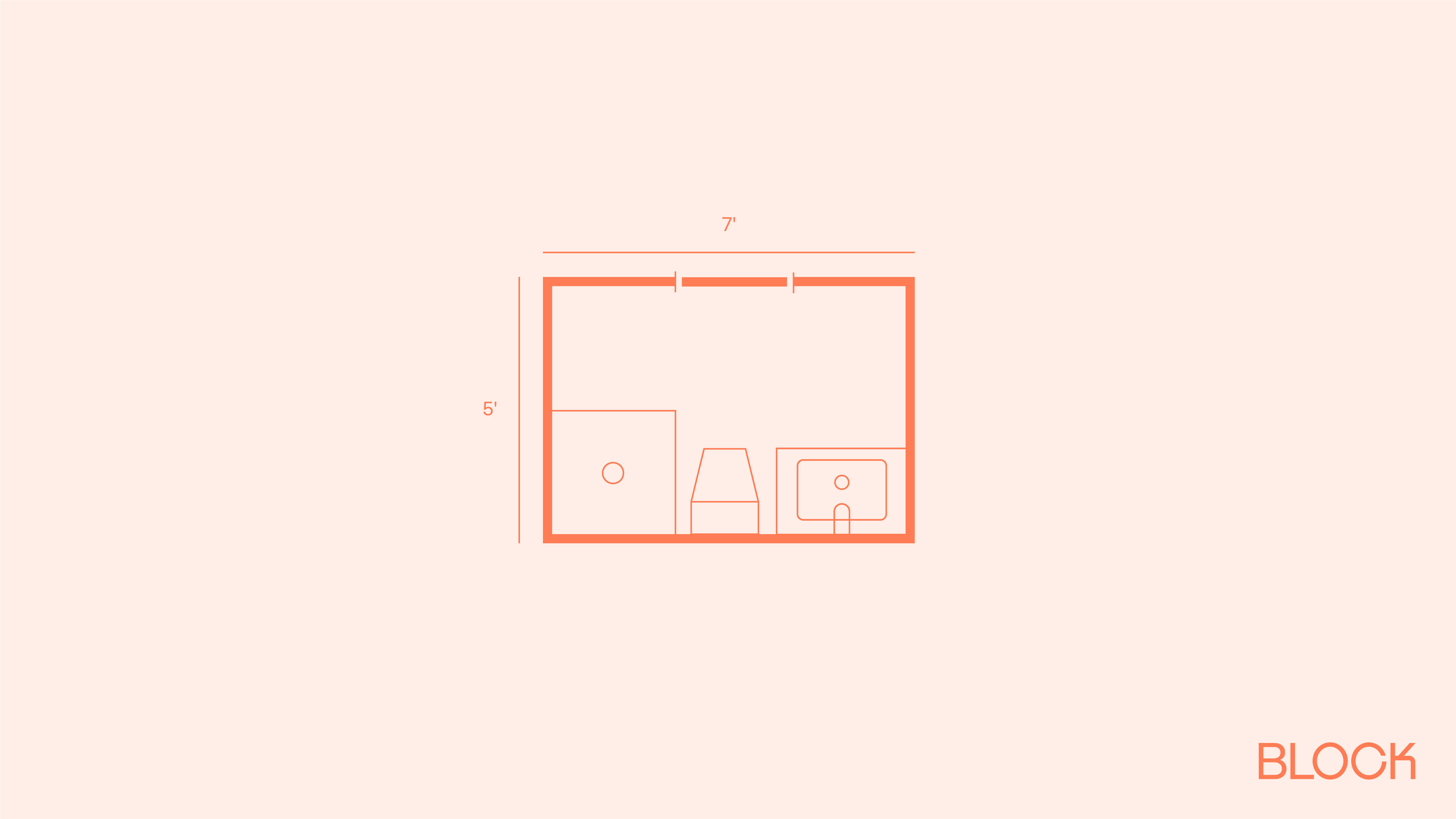
In a linear layout, everything (the sink, toilet, and shower or tub) is arranged along a single wall. The opposite side stays open, creating a straightforward path through the room. It's one of the most efficient ways to handle a constrained space, and it puts pressure on every decision. When everything lives in one line, small choices carry more weight.
Pros and cons of a linear bathroom layout
A linear bathroom layout solves real constraints, but it introduces tradeoffs worth understanding early.
Pros
- Works with existing plumbing. Keeping fixtures on one wall aligns with how plumbing is already set up, which reduces rerouting behind walls or under floors and keeps the project more predictable.
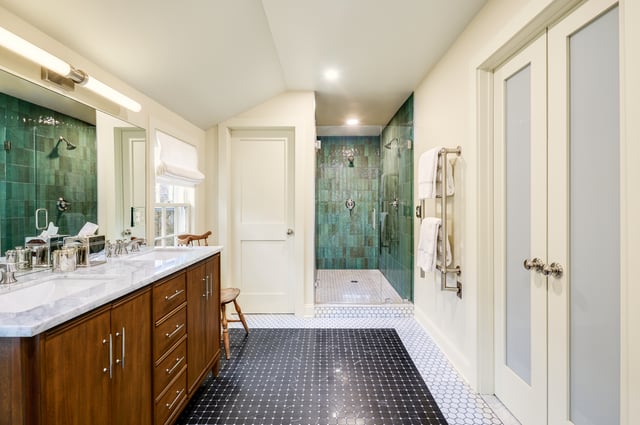
- Maximizes walkway space. Consolidating fixtures to one side keeps the opposite wall open, which makes a narrow bathroom easier to move through than a layout that crowds both sides. The extra clearance also makes the room more comfortable for two people to share, since one person can step out of the way without backing into a fixture. This is one strategy for making compact bathrooms ADA and wheelchair-friendly.
- Simplifies layout decisions. There are fewer ways to arrange the room, so planning is faster. Instead of comparing dozens of variations, you're refining a single line of fixtures. That means more of your design energy goes into fixture selection, finishes, and lighting rather than wrestling with the floor plan.
- Creates a clean visual structure. A linear layout reads as more organized, which matters most in smaller bathrooms where visual clutter makes the room feel tighter.
- Easier to renovate in stages. Because everything ties into a single wall, you can replace the vanity now and the shower later without re-plumbing the whole room. That flexibility matters for homeowners working through a remodel in phases.
- Frees up the opposite wall for storage or display. A tall linen cabinet, a built-in bench, or a row of hooks fits comfortably across from the fixture wall without crowding the room. The open side becomes useful real estate instead of empty space.
Cons
- Limits fixture size and flexibility. With everything sharing one wall, depth becomes a constraint. A deeper vanity or larger shower eats into the walkway, forcing tradeoffs.
- Can feel crowded along one side. Even when the overall room feels open, the fixture wall starts to feel dense if too many elements are packed together.
- Less separation between functions. In shared bathrooms, having the sink, toilet, and shower in a single line makes it harder for two people to use the space at once.
- Higher impact from small mistakes. Because everything is compressed into one wall, misjudging spacing by a few inches affects how the entire bathroom feels.
How to make a linear floor plan work for your family
A linear layout has to support how your household uses the bathroom day to day, not just fit fixtures.
- Tactical fixture order. Placement along the wall affects both privacy and usability. The vanity goes closest to the entry since it's the most-used element. The toilet sits further down the line where it's less visible from the doorway. The shower or tub anchors the far end of the room.
- Smart storage. With one primary wall, there's less opportunity to spread storage across the room. Recessed medicine cabinets and vanity drawers keep items contained without encroaching. Floating shelves above the toilet can pick up overflow without adding visual bulk. For families sharing a single bathroom, a tall linen tower at one end of the fixture wall holds towels and supplies that would otherwise creep onto the vanity.
- Door placement. A door that swings into the fixture wall blocks access to the sink or toilet. A pocket door, or a hinge swap that sends the door against the open wall instead of the fixture wall, fixes the problem without changing the underlying layout.
- Lighting. Shadows fall along the open side of a linear bathroom. Vanity lighting alone leaves the rest of the room dim, so overhead fixtures or wall sconces are needed to balance the room and make it usable at all hours. A dimmer on the overhead fixture lets the same bathroom work for a 6 a.m. shower and a late-night bath without retrofitting later. If the bathroom has a window, position the vanity to catch natural light during the day so artificial fixtures are doing less work.
- Accessibility and aging in place. A single open wall opposite the fixtures makes a linear bathroom easier to adapt later. Grab bars, a curbless shower, and a wider walkway all fit naturally into the layout, which is worth thinking about even if no one in the household needs those features yet.
Aesthetic choices that help (or hurt) a linear bathroom experience
Design decisions in a linear bathroom have a direct effect on how the space feels. With everything arranged along one wall, the eye moves through the room in a single direction. Materials, lighting, and scale either reinforce that movement or fight it.
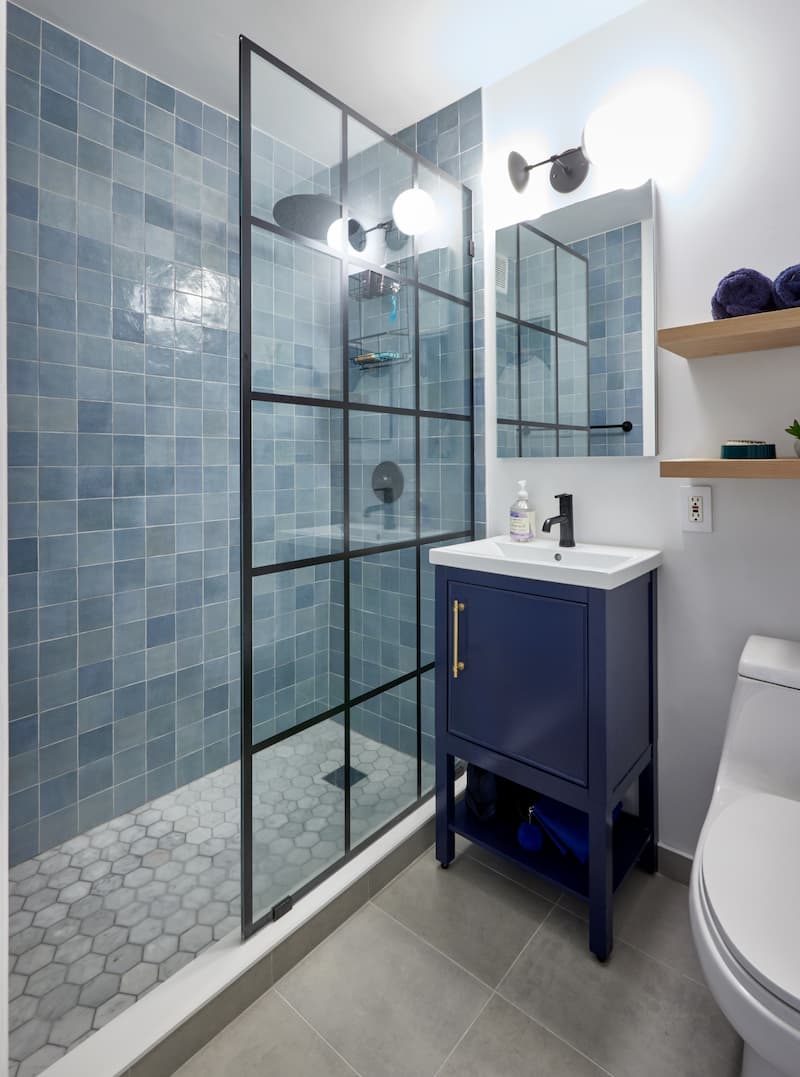
- Consistent materials make the space feel wider. Carry the same tile or finish across the fixture wall to keep the visual line uninterrupted. Materials that change every few feet break the line and make the room feel compressed. The same logic applies to grout color: keep it consistent across the wall so the eye reads the surface as one continuous plane rather than a patchwork.
- Directional patterns reinforce the layout. Run flooring or wall tile along the length of the room to draw the eye forward. This emphasizes the natural flow of a linear layout and makes the space read longer than it is.
- Lighter tones reflect more light. Narrow bathrooms benefit from surfaces that bounce light. Dark finishes work, but they absorb light and close the room in. If you use them, balance with lighter walls or reflective surfaces so the room doesn't feel heavy.
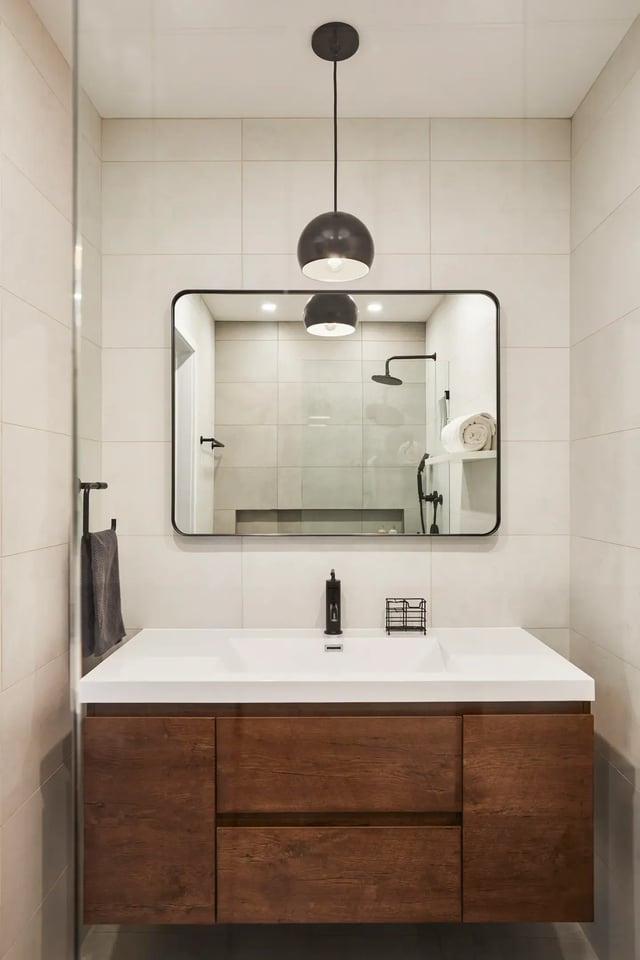
- Mirror scale changes how the room reads. A mirror that spans most of the vanity wall visually expands the space, reflecting both light and depth to offset the narrow proportions.
- Lighting needs to reach beyond the vanity. Vanity lighting alone leaves the rest of the room dim, which emphasizes the narrow layout. Ceiling fixtures or wall sconces distribute light more evenly. Layered lighting (overhead, task, and accent) lets the room shift from bright and functional in the morning to warm and softer in the evening. Pay attention to color temperature too: anything above 4000K reads cold and clinical in a small bathroom, while 2700K to 3000K keeps the space feeling more relaxed.
- Too many competing finishes break the layout. A linear bathroom works best when the design feels cohesive. Mixing too many materials, colors, or textures disrupts the visual flow and makes the room feel smaller. A useful rule: pick two main materials for the fixture wall (like a stone counter and a single tile) and let the rest of the finishes (faucet, hardware, mirror frame) pull from a single metal tone.
.png?width=4001&height=2251&name=Block_Plans_Bathrooms_April_V3_Block_Plans_Bathroom_5x12-05%20(1).png)
Design your layout with Block's Renovation Studio
A linear layout looks one way on graph paper and another way once you can actually walk through it. The walkway feels narrower than the measurement suggested. The tile you loved in a swatch reads dark when it covers the whole wall. The vanity you sized at 36 inches turns out to crowd the door swing.
Block Renovation's free Renovation Studio is built for exactly this problem. Plug in your dimensions, drop in fixtures, swap materials, and see your linear bathroom render in real time.
Move the toilet six inches and watch the clearances update. Try the same bathroom with three different tile options before you commit to one. Pricing changes as you change the design, so the budget question and the design question stay connected instead of getting answered separately.
Get matched with the right contractor for your remodel
A linear bathroom layout depends on precision. With fixtures aligned along a single wall, spacing and installation details matter more.
Block connects homeowners with vetted contractors who are matched to the project and compete to provide quotes. Each scope is reviewed to make sure it's complete and clearly defined, which reduces the risk of surprises once construction starts.
Payments run through a secure system tied to project milestones, so progress stays visible and controlled. With the right planning and the right contractor, a linear bathroom is a practical, well-executed solution that fits your home.

Written by
Keith McCarthy
Keith McCarthy
Keith McCarthy is a Senior Project Planner at Block Renovation, helping homeowners feel confident in their renovation journey. He coordinates site visits to proposal reviews to negotating contracts all to make sure his clients have the best experience here at Block.






.jpg?width=640&name=c5bb14cf-6708-468f-9328-a4f2b4adf6ac%20(1).jpg)