




Countertops
Slate Countertops vs. Granite, Quartz and Soapstone
09.20.2026
02.11.2026


In This Article
Countertops do a lot of work in your home—but they also say a lot. The color, finish, and detailing you choose can make a kitchen feel calm and minimal, or a bathroom feel warm and layered. And while durability and cost matter, many homeowners start with one key question: how will it look?
Corian and laminate often come up in the same conversation. Both offer broad style options and budget-friendly price points, but they create very different visual effects.
Here, we’ll focus on aesthetics: how each material reads in real life, where it shines in kitchens vs. bathrooms, and the small design choices that can make either option feel more elevated.
If you place Corian and laminate next to each other, the first difference you’ll notice is depth.
Corian has a “through-and-through” look. The color and pattern go all the way through the material, so when you look at an edge or corner, it feels like one continuous slab. Even in simple solid colors—warm whites, mushroom tones, deep charcoal—it has a dense, quiet presence. The finish is usually matte or softly satin, which keeps reflections low and makes the surface feel calm rather than shiny.
Laminate feels lighter and more layered. It’s built from a printed decorative sheet fused to a core, so you’re seeing an image of stone, wood, or color rather than the material itself. That’s not a drawback in itself—today’s laminates can be surprisingly convincing—but up close you can usually tell that the pattern sits on top rather than inside the slab. Edges, seams, and corners tend to give that away.
Joy Aumann, a licensed realtor (CIPS), interior designer, and co-founder of LUXURYSOCALREALTY, has strong opinions about laminate for this very reason:

"I am very picky about cheap laminate that tries to mimic the look of natural stone or wood. Laminate is appropriate for some uses, but choosing the lower end of this material can result in a flat appearance and devalue the room. In the luxury market, buyers expect more. If you cannot afford natural stone, it is better to invest in a high-quality quartz or porcelain slab for your countertops."
In a finished room, Corian often reads closer to stone or a specialty solid surface, especially in simple, low-contrast designs. Laminate often reads more casual and familiar, which can be exactly what you want in a busy kitchen or a family bathroom.
When assessing laminate and Corian in terms of color and pattern, Corian is the quieter of the two. It does soft marbling, gentle speckling, and stone-inspired neutrals very well. Compared to laminate, Corian countertops are more likely to disappear gracefully into the background, supporting cabinets, tile, and lighting instead of competing with them.
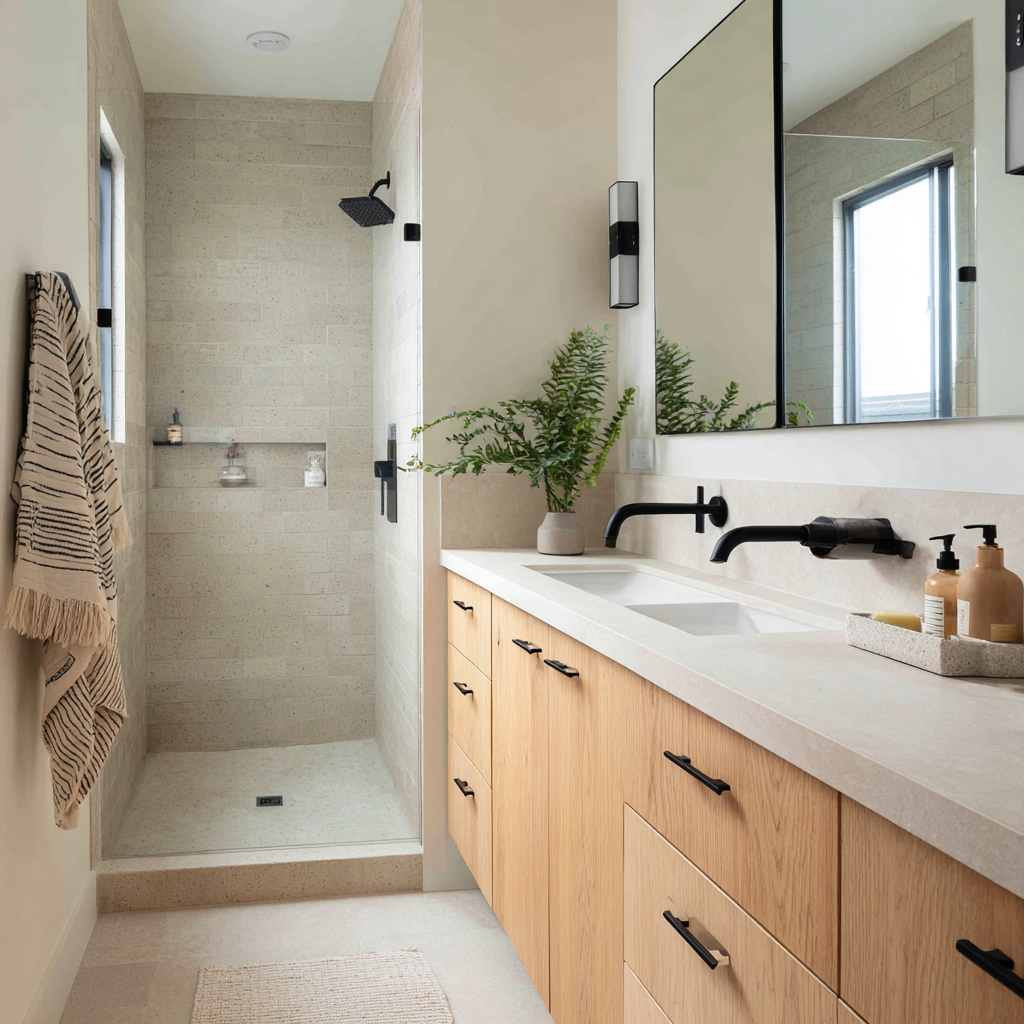
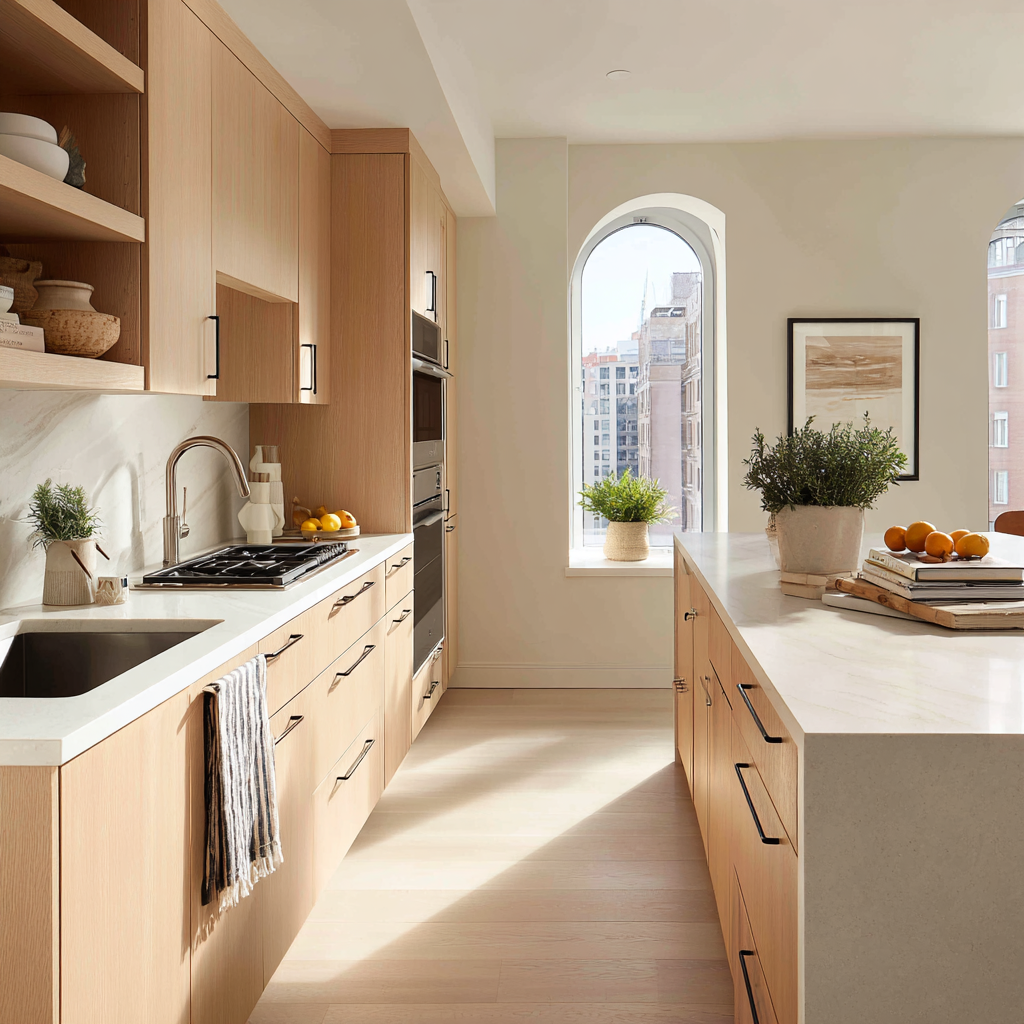
For example, a warm off‑white Corian countertop paired with white oak cabinets can make a kitchen feel soft and restrained. In a bathroom, a pale, stone‑look Corian with a matte finish helps create that spa-like, uncluttered feel many homeowners want.
Because the pattern runs through the material, subtle designs tend to feel more authentic at scale than many printed alternatives. When you extend Corian across a long island or wall-to-wall vanity, the pattern usually stays calm and believable instead of feeling oversized or busy.
Compared to Corian, laminate countertops give you more freedom to experiment with color and dramatic pattern at a lower cost. The printed layer can mimic high-contrast marble, concrete, wood grain, or saturated solid hues that might feel risky in a more expensive material.
If you picture a faux‑concrete island in a loft-style kitchen, or a rich green counter against pale oak cabinets, laminate is often where those ideas become practical. In a bathroom, a graphic black-and-white marble-look laminate can completely change the personality of a basic vanity.
The tradeoff is scale. When assessing laminate and Corian side by side, it’s common to see that a laminate pattern which looks subtle on a hand sample feels stronger across an entire countertop run. Aggressive veining or high-contrast imagery can quickly take over a space if you’re not careful with length and depth.
In smaller bathrooms, that difference is magnified. A compact powder room with a bold laminate top can feel energetic and fun; the same treatment in a tiny primary bath might feel busy. In those cases, a low-contrast Corian often gives you a calmer backdrop.
Transparent Pricing You Can Trust

Edges: the detail that reveals the material
When you compare laminate and Corian at their edges, you see some of the clearest visual differences.
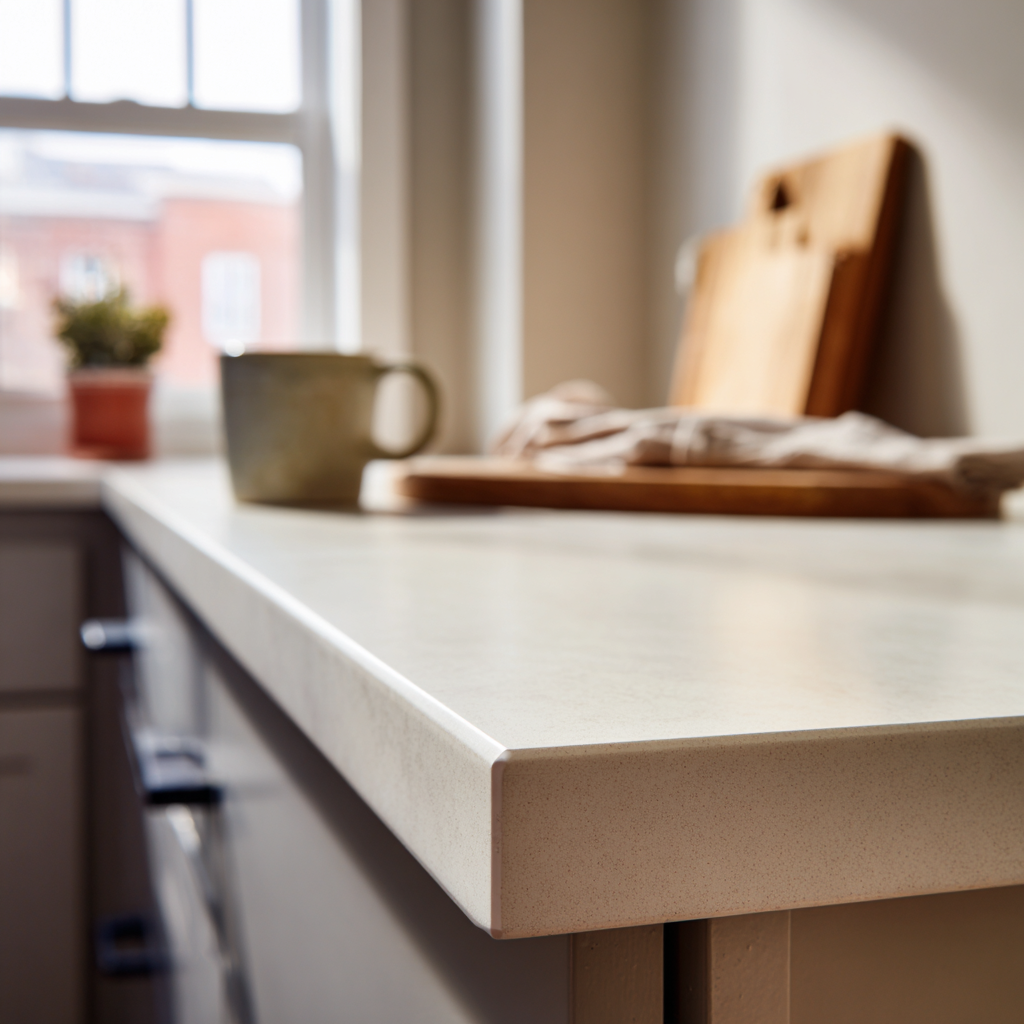
Because Corian is a solid surface, fabricators can shape the edge—square, eased, bullnose, even more decorative profiles—without exposing a different material inside. The result is a clean, continuous line. Compared to laminate, Corian countertops are better at creating that “this is one thick, solid piece” impression, even when the apparent thickness is built up at the front.
On a kitchen island or floating bathroom vanity, a simple squared Corian edge can feel almost architectural. It helps the surface read as part of the overall millwork instead of as a separate piece that’s been dropped on top.
Laminate tells more of its story at the edge. The decorative layer wraps over a core and ends, so the edge must be formed either by rolling the laminate (a postformed edge) or applying banding.
Compared to Corian, laminate countertops tend to show more visual “steps” here. A rolled edge has a soft, rounded face that many homeowners recognize from classic kitchens. A square edge with banding looks sharper and more contemporary, but when you look closely, the thin line where the laminate stops and starts is still visible.
On a small vanity, this difference may not matter to you. On a long peninsula or island that faces a seating area, the choice between a continuous Corian edge and a banded laminate edge can noticeably shift the room’s overall polish.
When assessing laminate and Corian, another clear distinction is how seams look.
Corian pieces can be joined with color‑matched adhesive and then sanded so seams are discreet. On a long run of countertops or an L‑shaped layout, the joint often virtually disappears. Compared to laminate, Corian countertops have a real advantage when your goal is a clean, uninterrupted surface that lets your eye move smoothly across the room.
In bathrooms, that becomes especially important with wall‑to‑wall vanities. Two pieces of Corian can be joined so tightly that the vanity reads as a single custom slab, which supports a more built‑in, furniture-like look.
Laminate seams are more apparent. When comparing laminate and Corian, laminate will almost always show its joints sooner—especially in patterned finishes.
On an L‑shaped kitchen, you’ll see a clear line where two laminate sections meet, usually at an angle across the corner. On longer runs, seams are carefully placed, but the shift in pattern, light reflection, or texture tends to give them away. Around sinks and appliances, banding and cutouts introduce additional small breaks.
This doesn’t mean a laminate kitchen looks disjointed; it just means the countertop reads as a series of pieces rather than one nearly seamless plane. In smaller or more casual spaces, those breaks can feel perfectly natural. In a showpiece kitchen with a long, open island, Corian’s ability to downplay seams will often feel more refined.
When you directly compare laminate and Corian in how they meet sinks and walls, Corian is the more integrated option.
Corian can be fabricated into integrated sinks and coved backsplashes. The basin flows out of the countertop without a visible seam, and the back edge can curve gently up the wall or form a low curb with a smooth joint. Compared to laminate, Corian countertops can create a very quiet, almost sculpted look at these transitions.
In bathrooms, that often translates to a more serene, hotel‑inspired vanity. The counter, sink, and short backsplash all feel like one element, which is especially effective in compact rooms where too many lines can make things feel crowded.
Laminate, by contrast, almost always pairs with separate sinks and backsplash materials. You’ll typically see a defined line where an undermount or drop‑in sink meets the countertop, and the transition at the wall is handled with tile, stone, or another surface.
When you compare laminate and Corian on this point, laminate may sound like the less polished option, but visually it can be an asset if you like layering. A stone‑look laminate counter with a contrasting tile backsplash and a clean porcelain or stainless sink can look vivid and intentional. In a remodel of a kid’s bathroom, that layered look often feels more playful and expressive than a fully integrated surface.
If your instinct is toward continuous forms and as few visible joints as possible, Corian is the stronger aesthetic match. If you enjoy mixing materials and want the sink and backsplash to feel distinct from the counter, laminate fits that style more naturally.
In a kitchen, comparing laminate and Corian countertops is often about the kind of atmosphere you want when you walk in.
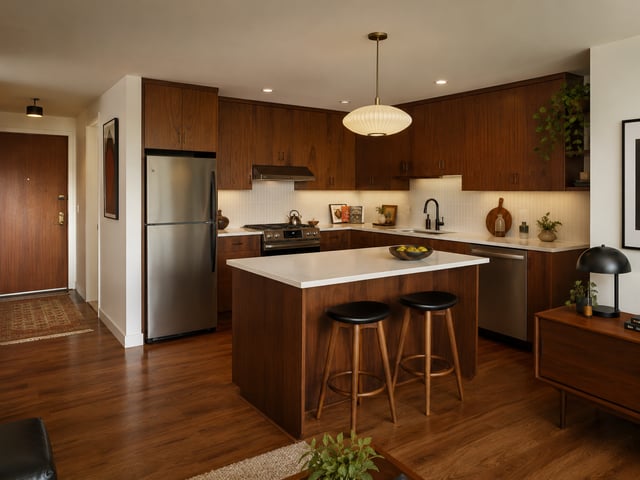
A kitchen with Corian typically feels calm and composed. Flat-front or Shaker cabinets, a soft white or greige Corian counter, and a simple tile backsplash can read as very tailored without being showy. Compared to laminate, Corian countertops in this setting usually look closer to engineered stone: solid, continuous, and slightly more architectural.
Corian is also helpful if you want some drama elsewhere. Strong cabinet colors, patterned tile, or sculptural lighting can all coexist more comfortably with a quieter countertop. When assessing laminate and Corian for a design like that, Corian’s restraint can make the difference between “collected” and “visually busy.”
In a more casual or experimental kitchen, laminate has its own appeal.
Compared to Corian, laminate countertops make it easier to follow your bolder instincts. A faux‑concrete laminate with black base cabinets and open shelving can feel loft‑like and relaxed. A rich blue laminate on a smaller island, paired with neutral counters along the perimeter, creates a focal point without the commitment of a stone slab.
When assessing laminate and Corian for a kitchen where trends or personal taste might evolve, many homeowners appreciate laminate’s flexibility. If you want to try a graphic marble pattern, a striking color, or a wood‑look top, laminate is often a lower‑stakes way to express that style, especially in a home where kids, hobbies, or heavy cooking might wear surfaces faster.
Bathrooms condense design into a much smaller footprint, so differences between Corian and laminate become more pronounced.
In primary baths and powder rooms, Corian is often the first choice for homeowners who want a calm, “finished” look. Compared to laminate, Corian countertops with integrated sinks and minimal seams create a cleaner line under the mirror and lighting. The focus stays on tile, fixtures, and mirrors, while the countertop feels like a quiet foundation.
A floating vanity with a Corian top can read almost like a custom piece of furniture. In a powder room, that single, sculpted surface can make the entire space feel more considered, even if the room is only a few feet wide.
In kids’ baths, secondary bathrooms, and laundry rooms, laminate often makes a different kind of sense.
When assessing laminate and Corian for these spaces, some homeowners prioritize personality and practicality over a totally seamless look. A pale wood-look laminate on a simple vanity can warm up a white-tiled kids’ bath. A marble-look laminate in a remodeled guest bathroom can visually tie into a more elevated primary suite without mirroring it exactly.
Here, the more visible seams and edges of laminate usually feel like a fair trade for the ability to play with color and pattern—and to update the space more easily in the future. Compared to Corian, laminate countertops in these rooms tend to deliver a more relaxed, approachable vibe that suits everyday use.
When you step back and compare laminate and Corian across different home types, Corian often emerges as the more adaptable in spaces where architecture is a strong presence.
In older homes—brownstones, townhouses, prewar apartments—Corian can sit comfortably between past and present. A soft, stone‑inspired Corian in a classic bath with subway tile and traditional fixtures feels updated without clashing with original details. In a kitchen with existing millwork or molding, Corian offers the look of a unified surface without competing with the room’s bones.
In newer construction, where floor plans are more open and lines are straightforward, Corian reinforces that clarity. Long runs of countertop with nearly invisible seams keep the space feeling expansive and cohesive.
In other contexts, laminate is the better visual fit.
Compared to Corian, laminate countertops feel especially at home in modest mid‑century houses, rentals, basements, and secondary spaces where you want things to look finished and intentional without becoming the star of the show. Solid colors and simple wood‑look laminates can echo original design eras without pretending to be stone.
Laminate is also useful when you want different levels of finish across your home. It’s common to see homeowners choose Corian or stone in a primary kitchen and primary bath, then use laminate in a laundry room, guest bath, or kids’ space. When assessing laminate and Corian this way, the choice isn’t “either/or” so much as “where does each one make the most sense visually and practically?”
Seeing a few samples on a countertop is helpful—but seeing how those same samples look as part of a complete design is what really builds confidence.
Block’s free Renovation Studio is designed for exactly that stage. You can:
When you can compare laminate and Corian side by side in a realistic rendering of your own space, the right choice usually becomes much clearer. From there, Block’s team can help you move from the design you love to vetted contractors, clear scopes, and proposals that match the look you’ve chosen—so your countertops don’t just work on paper, they feel right every time you walk into the room.
Bring Your Dream Bathroom to Life


Renovate confidently with Block
Easily compare quotes from top quality contractors, and get peace of mind with warranty & price protections.
Countertops
Slate Countertops vs. Granite, Quartz and Soapstone
09.20.2026
Countertops
Laminate Countertops vs. Quartz: How to Choose
09.15.2026
Countertops
Kitchen Counter Overlay: Cost, Durability and More
09.13.2026
Countertops
What Color Countertops Go With Oak Cabinets?
09.01.2026
Countertops
Walnut Cabinets With White Countertops
08.24.2026