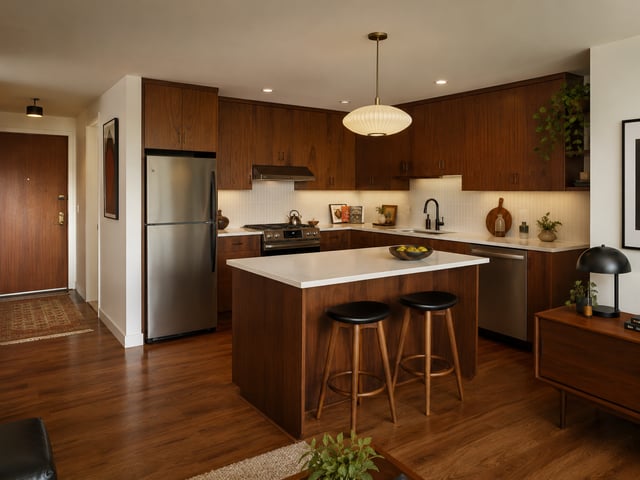
Two stones. Both naturally gorgeous, both incredibly tough, both capable of anchoring your kitchen for decades. So why does the choice between quartzite and granite trip up so many homeowners? Because surface-level similarities hide meaningful differences in how these materials behave, what they cost, and which kitchens they're built for.
Granite's been the go-to for years—reliable, varied, proven. Quartzite's the newer darling with marble's elegance and toughness that actually backs it up. Your decision hinges less on which is objectively "better" and more on which trade-offs you're willing to live with.
Get to know quartzite and granite
- What is quartzite: Quartzite starts as sandstone, then spends millennia under crushing pressure and searing heat until quartz crystals fuse into something nearly indestructible. The result is metamorphic rock that ranks among the hardest surfaces you can install in a kitchen. Most quartzite showcases delicate veining and a soft glow that reads like marble—minus marble's maddening fragility.
- What is granite: Granite forms when molten rock cools slowly underground, allowing minerals to crystallize into the speckled, flecked, or veined patterns we recognize instantly. It's igneous rock composed mainly of quartz and feldspar, with trace minerals creating everything from midnight black to peachy gold. Granite's been extracted for construction since ancient times, and its kitchen dominance over the past few decades speaks to its reliable performance.
|
Feature
|
Quartzite
|
Granite
|
Winner
|
|
Cost (installed)
|
$70–$200+ per sq ft
|
$60–$150+ per sq ft
|
Granite
|
|
Hardness
|
Harder than granite
|
Very hard
|
Quartzite
|
|
Heat resistance
|
Excellent
|
Excellent
|
Tie
|
|
Maintenance
|
Requires sealing
|
Requires sealing
|
Tie
|
|
Scratch resistance
|
Superior
|
Excellent
|
Quartzite
|
|
Aesthetic
|
Marble-like, flowing veins
|
Speckled, varied patterns
|
Depends on preference
|
|
Color range
|
Limited (whites, grays, earth tones)
|
Extensive (all colors)
|
Granite
|
|
Lifespan
|
50+ years
|
50+ years
|
Tie
|
What works in quartzite's favor compared to granite
- It's legitimately harder to damage: Quartzite outranks granite on the Mohs scale, which measures mineral hardness. Practically speaking, this means dragging a heavy Dutch oven across quartzite won't leave the faint marks that might appear on granite. You could technically cut directly on it without harming the surface, though your knives would suffer. For households where countertops take a beating, this extra hardness translates to surfaces that stay pristine longer.
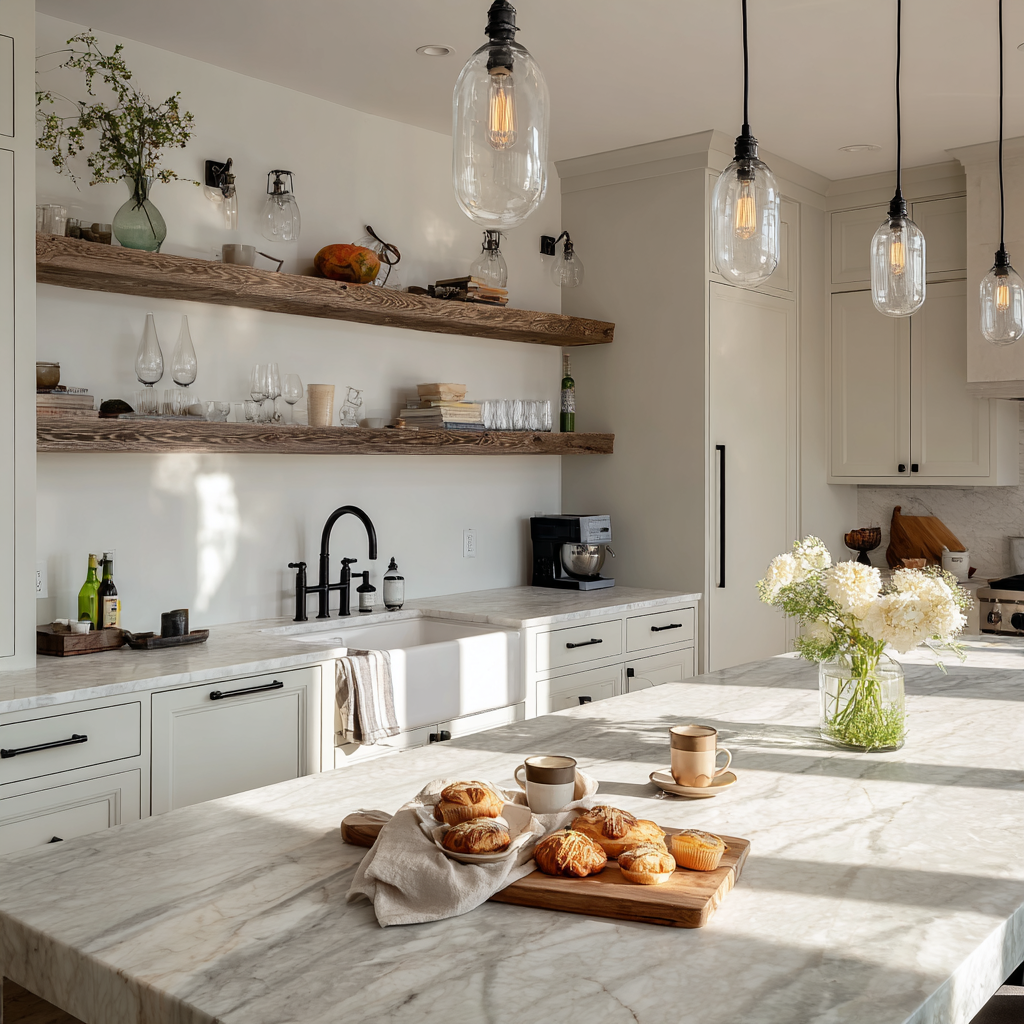
- You get marble's glamour without the drama: People fall hard for marble's sweeping veins and soft luminosity, then panic when they realize how easily it stains and etches. Quartzite delivers that same flowing elegance—the kind that photographs beautifully and elevates a kitchen instantly—while actually standing up to tomato sauce, wine, and lemon juice. It's the cheat code for marble aesthetics with stone-level toughness.
- Heat isn't even a consideration: Drop a scorching pan straight from the oven onto quartzite and walk away. The stone won't flinch. This heat imperviousness gives you complete freedom when cooking—no trivet hunting, no panic when you forget where you set down that cast iron skillet. For people who actually cook rather than just reheat, this matters.
- It signals you went premium: Quartzite carries cachet. It's less common than granite, tends to cost more, and people recognize it as a step up. In neighborhoods where finishes get scrutinized, quartzite communicates that you invested thoughtfully. Whether that matters to you depends on how much you care about resale perception, but the premium positioning is real.
- It ages gracefully with minimal babying: The extreme density means quartzite holds its polish remarkably well. Other stones might show gradual dulling from years of use, but quartzite maintains that newly-installed sheen with just basic care. You're not constantly second-guessing whether your countertops look tired.
Where quartzite falls short
- The price point gets steep fast: Quartzite regularly runs $70 to $200+ per square foot installed, and showstopper slabs climb even higher. That's considerably more than most granite, and the gap widens quickly when you're covering a large kitchen. This price differential can determine whether you afford the island you wanted or whether you're compromising on cabinet quality to make the budget work.
- Color options narrow significantly: Quartzite lives primarily in whites, grays, and muted earth tones. If you're envisioning deep emerald, rich burgundy, or warm cognac tones, granite offers infinitely more options. Quartzite's palette is undeniably elegant but decidedly restrained. For kitchens where a specific color anchor is non-negotiable, this limitation matters.
- You're still sealing it regularly: Despite the hardness, quartzite remains porous and demands sealing at install plus resealing every year or two. Many quartzites actually need more frequent sealing than granite because their lighter colors telegraph staining quickly. If you imagined upgrading to quartzite meant escaping maintenance, think again—you're signing up for the same commitment.
- Verifying authenticity gets complicated: Unscrupulous suppliers sometimes label softer marble or dolomite as quartzite because they can charge more. Real quartzite won't etch from acid; imposters will. You need a fabricator willing to perform tests, and not all of them are. This verification step adds friction to a process that's already involved, and mistakes here mean living with stone that underperforms.
- Finding the right fabricator narrows your options: Quartzite's hardness requires specialized cutting equipment and genuine expertise. Not every stone shop can handle it well, which limits your choices and potentially increases labor costs. In smaller markets, you might have just one or two qualified fabricators, reducing your leverage on pricing and timelines.
Kitchen styles where quartzite shines
Quartzite's refined elegance and exceptional toughness make it particularly well-suited for contemporary minimalist kitchens where soft veining adds organic warmth to clean lines, transitional spaces that bridge traditional warmth and modern simplicity, and all-white or monochromatic designs where pale quartzite introduces texture without breaking the color scheme. It excels in chef-focused kitchens with serious cooking needs, where superior hardness and heat resistance handle constant action without complaint.
Quartzite also works beautifully in homes coordinating luxury materials throughout—extending marble's visual language from other rooms while performing better for food prep—and in modern tuscan kitchens with elevated finishes, where the stone prevents rustic elements from reading as too casual.
What works in granite's favor compared to quartzite
- Decades of proven performance remove guesswork: Granite's been the premium countertop standard long enough that we know exactly how it behaves. Fabricators everywhere understand its quirks, installation is straightforward, and predicting how it'll age is easy. This track record eliminates the uncertainty that comes with trendier materials. You're choosing something thoroughly road-tested.
- The color universe is genuinely vast: Granite quarries worldwide produce everything from whisper-soft neutrals to dramatic statement slabs. Want black with gold flecks? Done. Creamy beige with rust undertones? Easy. Cool gray with white veining? Dozens of options. This variety means you're far more likely to find something that nails your exact vision rather than settling for close enough.
- Budget flexibility improves dramatically: At $60 to $150 per square foot installed, granite opens up natural stone to homeowners who'd be priced out by quartzite. Common patterns fall toward the lower end, letting you invest in genuine stone without sacrificing other renovation priorities. That extra $30–$50 per square foot you save with granite versus quartzite can fund better appliances or additional storage.
- It handles real life without complaint: While marginally softer than quartzite, granite still resists scratches, heat, and impacts better than the vast majority of countertop materials. Unless you're comparing them directly side-by-side with identical abuse, you won't notice granite's relative softness. It performs beautifully for typical cooking, entertaining, and daily chaos.
- Busy patterns are forgiving: Granite's characteristic flecking and mineral variation hide minor imperfections brilliantly. Small scratches disappear visually. Water spots don't announce themselves. Daily wear doesn't telegraph the way it might on solid-colored surfaces. This forgiving quality means your kitchen looks put-together even when life gets messy.
Where granite falls short
- Scratches can accumulate over time: Heavy pots scraped across granite, aggressive cutting, or abrasive cleaning can eventually leave marks. These scratches are rarely catastrophic, but perfectionists notice them. If maintaining an absolutely flawless surface matters deeply to you, granite's slightly lower hardness becomes relevant. Most people won't care; some people will fixate.
- Seams interrupt larger installations: Granite slabs max out around 10 feet, meaning bigger kitchens need multiple pieces joined together. Skilled fabricators minimize seam visibility, but they're never truly invisible. If your design sensibility revolves around uninterrupted surfaces, these seams will bother you. They're the price of working with natural stone that comes in finite dimensions.
- Some patterns feel too busy: Heavily speckled or boldly veined granite can overwhelm, particularly in compact kitchens where the pattern dominates sightlines. Finding granite that feels calm and sophisticated requires careful selection—you can't just grab the first slab. Quartzite's typically gentler movement can be easier to incorporate without visual chaos.
- It's lost its novelty factor: Because granite became ubiquitous in the 2000s and 2010s, it no longer is seen as being as “special” in upscale markets. Buyers in luxury price points expect it as baseline rather than viewing it as a special upgrade. If differentiation matters—either for your own satisfaction or resale positioning—granite may feel too standard.
- Maintenance commitment remains constant: Sealing every one to three years isn't optional. Skip it, and you risk stains penetrating the stone or water damage affecting structural integrity. The actual task isn't onerous, but remembering to do it and following through requires discipline. Some homeowners religiously maintain sealing schedules; others forget for years and suffer consequences.
Kitchen styles where granite thrives
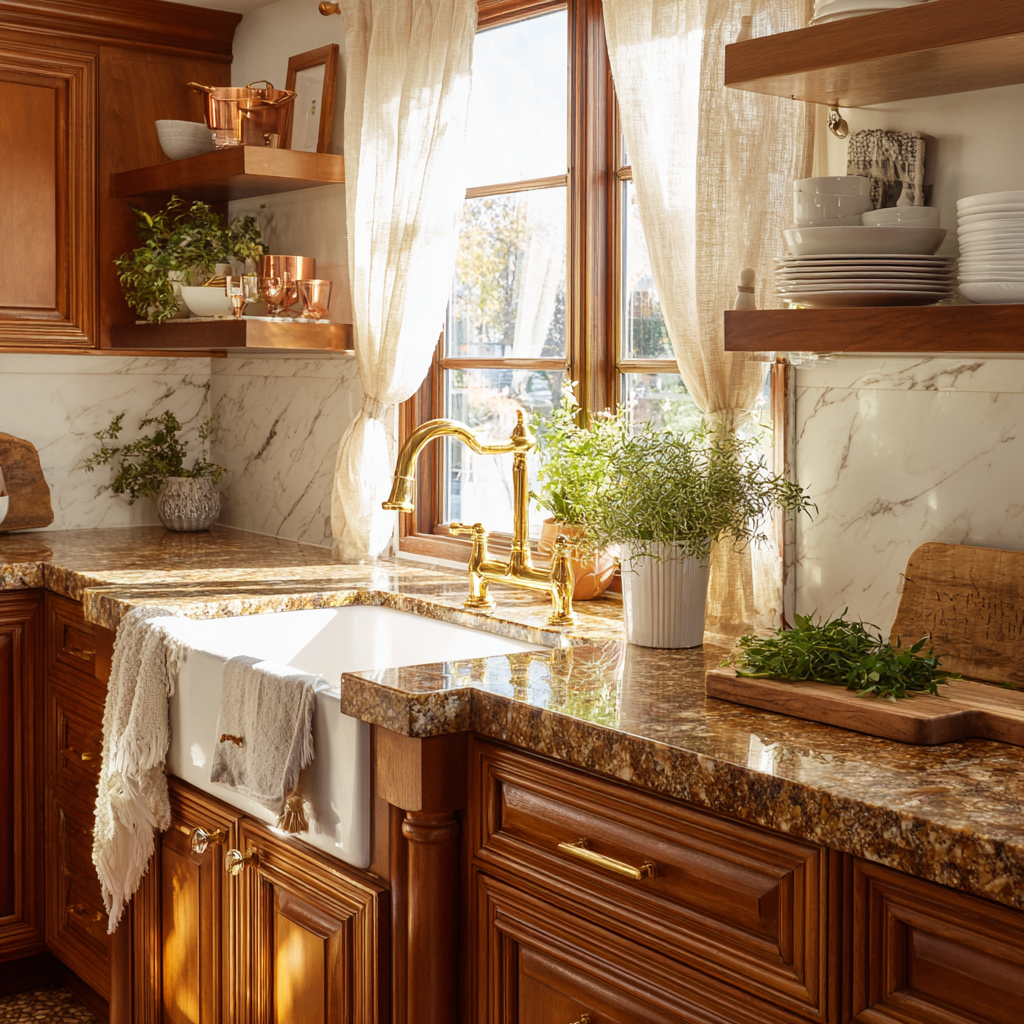
Granite's proven versatility and rich variation make it particularly well-suited for traditional kitchens with architectural detail where the stone's warmth complements raised-panel doors and formal molding, farmhouse and cottage styles where organic character pairs naturally with apron sinks and open shelving, and eclectic kitchens mixing periods where granite's color range anchors disparate elements without forcing exact matches.
It performs beautifully in large open-concept layouts where expansive surfaces showcase natural variation and define zones across bigger spaces, warm layered designs with wood tones where granite's earthy minerals echo colors in cabinetry and flooring, and budget-conscious renovations wanting stone where granite delivers natural material credibility without compromising appliances or layout.
Test drive your choice digitally first
Small samples under showroom fluorescents tell you almost nothing about how stone will actually look spanning your countertops under your specific lighting with your cabinet colors. You need to see the material in context before committing thousands of dollars.
Block's Renovation Studio lets you visualize both quartzite and granite in your actual kitchen layout. Swap between stones, adjust other finishes, and watch budget estimates update in real time. You'll see exactly what you're getting—and exactly what it costs—before any fabricator cuts a single slab.
Connect with kitchen specialists who know their craft
Choosing your stone is step one. Installing it correctly determines whether that choice pays off. Block connects you with up to four thoroughly vetted local fabricators and installers who specialize in natural stone.
You'll receive itemized proposals covering templating, fabrication, edge details, cutouts, and installation. Our project planners walk you through bid comparisons, explain pricing differences, and flag anything that looks off. Block's payment structure releases funds based on completed milestones, keeping your project moving forward without exposing you to upfront risk.

Written by
Shahe Demirdjian
Shahe Demirdjian
Shahe supports clients and builders throughout the full project lifecycle, from early planning and scoping through execution and closeout, ensuring clear communication, alignment on timelines, and successful delivery across both residential and commercial projects.