






Bathroom
Converting a Laundry Room Into a Bathroom: Costs & Layouts
10.08.2026
04.08.2026


In This Article
A running toilet at 2 a.m. has a way of turning "someday" into "today." Whether yours is wobbling, cracking, constantly running, or just a decade past its prime, replacing it is a project most homeowners face eventually, and the real cost is almost always different from what the price tag at Home Depot suggests.
Toilet replacement cost depends on a lot more than the sticker price of the unit itself. Labor, supplies, disposal, the condition of what's hiding under the old toilet, and whether you're doing any plumbing adjustments along the way all factor in. Below, we'll walk through what a new toilet actually costs in 2026, which upgrades are worth it, which ones aren't, and why "just swapping it yourself" is one of the riskiest DIY calls you can make in a bathroom.
| Total toilet installation cost | A standard new toilet installation costs $400 to $900, though toilet replacement prices in major metros can run 30 to 50% higher. |
| Best value toilets |
The $300 to $600 mid-range tier is the sweet spot for new toilet installation cost, with models like the Toto Drake II and Kohler Highline outperforming cheaper toilets and offering replacement parts for 15+ years. |
| Hidden installation costs | Common surprises that drive up the cost to install a new toilet include corroded flanges, rotted subfloors, seized shut-off valves, and cast-iron drain issues, adding $75 to $2,500+ to your toilet replacement cost. |
For most homeowners, a standard toilet replacement, including unit, labor, supplies, and disposal, runs between $400 and $900. There's plenty of room to go higher if you're upgrading to a premium model or running into unexpected conditions under the old one.
Here's how the costs of a new toilet break down:
| Line item | Typical range | Notes |
|---|---|---|
| The toilet itself | $150 –$1,500+ | Budget models start at $150; mid-range sweet spot is $300–$500; premium and smart toilets exceed $1,500 |
| Professional labor | $200 – $500 | Most plumbers charge by the job; complex installs push the high end |
| Supplies | $20 – $75 | Wax ring or waxless seal, closet bolts, new supply line, caulk, shims |
| Disposal and haul-away | $0 – $150 | Often included by the plumber; municipal bulk pickup is usually free |
| Total (standard replacement) | $400 – $900 | National average; major metros can run 30–50% higher |
| Possible add-ons | $200 – $2,000+ | Flange repair, subfloor patching, shut-off valve replacement, flooring work |
One caveat: these are national averages. Labor in New York City, San Francisco, or Boston can run 50% higher than in smaller markets, and buildings with access restrictions such as walk-ups or co-op freight elevator rules can push costs up further.
If you want a single recommendation: a Toto Drake II or a Kohler Highline in the $400 to $600 range will outlast and outperform almost anything cheaper. When issues arise, spare parts will be on any plumber's truck for the next fifteen years.
Turn your renovation vision into reality
Get matched with trusted contractors and start your renovation today!
Find a Contractor
The $400 to $900 range covers a standard replacement in a home where nothing unexpected is lurking under the old toilet. Here are the most common culprits, roughly in order of how often they show up:
A corroded or broken flange. The closet flange is the ring that connects the toilet to the drainpipe, and in older homes it's often made of cast iron, brass, or lead. After decades of moisture, these flanges corrode or crack, and the damage is usually only visible once the old toilet comes off. That makes flange repair the single most common surprise line item in a toilet replacement, typically adding $150 to $400 to the job.
A damaged subfloor. A wax ring that's been slowly failing for years can rot the plywood beneath the toilet without anyone noticing. You'll sometimes catch it beforehand because the floor feels spongy near the base, but often the damage is only visible once the toilet is out. Patching a small area might run $200 to $500. A larger section that affects joists or requires flooring replacement can climb to $1,500 or more.
A seized or leaking shut-off valve. The small valve that feeds water to your toilet tank is one of those parts nobody thinks about until it matters. On toilets older than 20 years, the valve has often been sitting in one position long enough that turning it off causes it to seize or drip. Replacing it runs $75 to $200.
A rough-in mismatch. Most modern toilets are built for a 12-inch rough-in, which is the distance from the finished wall behind the toilet to the center of the drain. Homes built before the 1960s sometimes have 10-inch or 14-inch rough-ins, which limit your toilet options and can require either a specialty model (typically $100 to $300 more) or minor plumbing adjustments.
Cast-iron drain connections. In homes built before about 1970, the drain line itself is often cast iron, and the joint where the toilet connects can crack when disturbed. If that happens, you're no longer doing a toilet replacement, you're doing a drain repair, with costs climbing into the $800 to $2,500 range.
Building rules and access complications. Condo and co-op owners face a separate set of cost variables. Many buildings require a licensed plumber with proof of insurance on file, water shutoffs often need to be coordinated with building management, and some HOAs require advance notice or approval for any plumbing work. None of these are deal-breakers, but they can add $100 to $500 in coordination costs.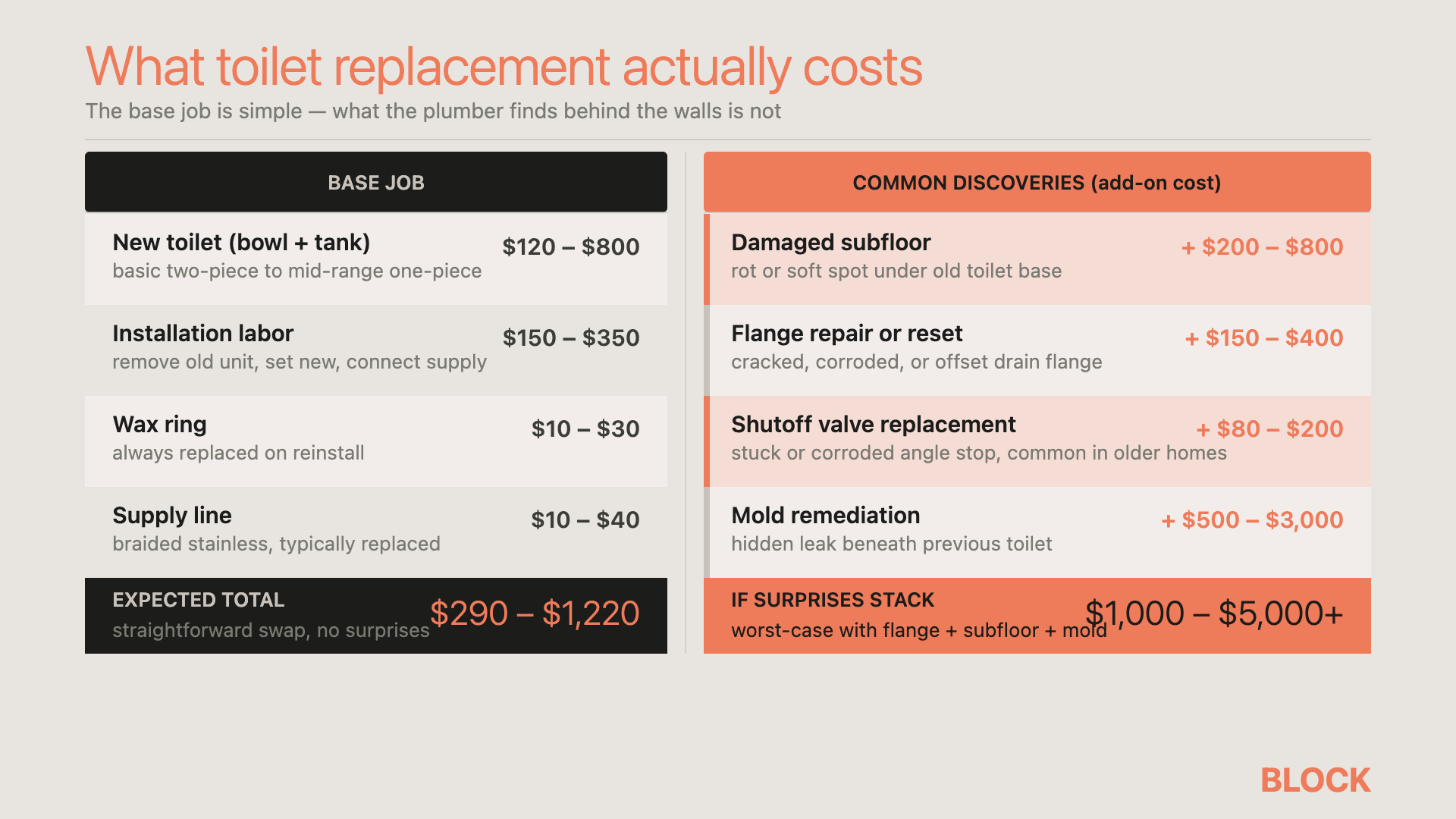
You don't have to wait for a catastrophic failure to get a new toilet. A few signals that it's time:
It wobbles. If tightening the bolts doesn't fix it, the flange is likely compromised.
Visible cracks in the porcelain. Hairline cracks in the tank or bowl will eventually fail, usually without warning.
It's constantly running or leaking at the base. If replacing the flapper and fill valve didn't solve it, the toilet is telling you something.
Frequent clogs. Older low-flow toilets from the mid-1990s were notoriously under-powered. Modern ones are engineered completely differently.
It's older than fifteen years. Even if it's working, you're leaving water and money on the table every day, which brings us to the hidden cost most homeowners never calculate.
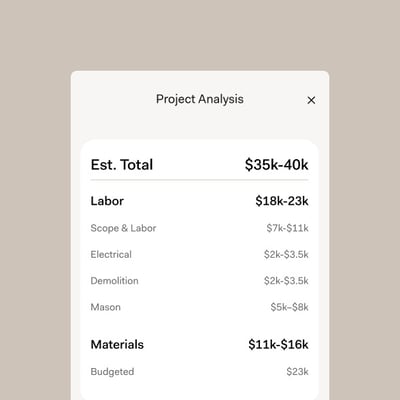
Know the Cost Before You Start
A toilet manufactured before 1994 uses between 3.5 and 7 gallons per flush. A modern WaterSense-certified toilet uses 1.28. For a family of four flushing a combined 20 times a day, that's at least 15,000 gallons of water per year, and often much more for older toilets.
Depending on where you live, that's $100 to $300 a year in water and sewer charges you don't need to be paying. Over the ten-year lifespan of a new toilet, a $500 upgrade can pay for itself in water savings alone, and that's before you factor in that you also got a new, better-performing, non-leaking fixture out of the deal.
If your toilet is older than about 1995, it's quietly working against your budget every single day you keep it. Pulling up your last water bill and doing the math often turns "I should probably replace it eventually" into "I should replace it this month."
But a toilet that works fine mechanically can still be the wrong toilet for the people using it. The single biggest example is a comfort-height bowl. Sometimes called "right height" or "chair height," these sit about two inches taller than a standard toilet. Anastasia Jones, Director of Social Services at a Pennsylvania nursing facility, shared with us how important and prevalent the need for an elevated toilet is among older adults.

Taller toilets are simply easier for 99% of the people I work with. So much so that I often get a commode (a portable seat with armrests) for them to put over their toilet so they have something to hold onto and the seat is higher.
In this spirit, consider a taller toilet if your household includes:
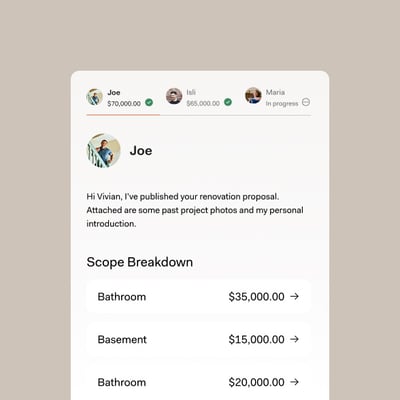
Compare Proposals with Ease
A lot of online guides will tell you that replacing a toilet is a weekend project you can knock out with a wrench and a YouTube video. That advice has cost homeowners a lot of money. Overlook an issue under the old toilet and a $500 job becomes a $3,000 one.
A plumber sees these conditions every week and knows how to address them on the spot. A first-time DIYer usually doesn't, and the consequences of getting it wrong are severe. A wax ring seated even slightly off will leak invisibly into the subfloor for months before you notice a soft spot or a stain on the ceiling below. An overtightened closet bolt can hairline-crack the porcelain base, which won't fail immediately but will fail eventually, usually in the middle of the night. A flange that needed replacing but got a "close enough" install will wobble, rock, and eventually break the seal entirely. The repair bill for any of these scenarios, whether it's subfloor replacement, ceiling repair below, or mold remediation, starts around $2,000 and climbs fast.
Best case scenario, DIY installation will only save you $200 to $400 in labor. In light of all that can go wrong, the risks far outweigh any rewards.
Toilets rarely fail in isolation. If yours is fifteen-plus years old, the vanity, tile, and lighting are probably aging on the same timeline, and pulling the toilet is the cheapest moment you'll ever have to address what's underneath. If a bigger bathroom project is starting to make sense, Block can match you with vetted local contractors, help you compare proposals side by side, and protect your investment with progress-based payments and a one-year workmanship warranty. Not ready to talk to a contractor yet? Block's free Renovation Studio lets you visualize your space and get a real cost estimate in minutes.
Remodel with confidence through Block

Connect to vetted local contractors
We only work with top-tier, thoroughly vetted contractors

Get expert guidance
Our project planners offer expert advice, scope review, and ongoing support as needed

Enjoy peace of mind throughout your renovation
Secure payment system puts you in control and protects your remodel

Renovate confidently with Block
Easily compare quotes from top quality contractors, and get peace of mind with warranty & price protections.
Bathroom
Converting a Laundry Room Into a Bathroom: Costs & Layouts
10.08.2026
Bathroom
Converting a Bedroom Into a Bathroom: Costs and Layouts
10.05.2026
Bathroom
Bathroom Mirror Trends to Inspire Your Ideas
09.23.2026
Bathroom
Brooklyn Bathroom Renovation Costs: What Shapes the Budget
09.19.2026
Bathroom
York City Bathroom Remodel: Costs, Planning & Design
09.17.2026