




Commercial
Commercial Tenant Improvement Contractors Explained
07.27.2026
04.24.2026


In This Article
Dallas-Fort Worth led more than 60 U.S. retail markets in 2025 with nearly 7.15 million square feet of retail space under construction. Texas has over 82,000 franchise units, more than any other state for three years running, and the Urban Land Institute and PwC ranked DFW as the number one commercial real estate market in the country heading into 2026. Retail vacancy hovers around 4.5 to 4.9%. Asking rents are climbing at 3.3% annually. The metro's population of 8.3 million keeps growing as companies and workers relocate from higher-cost states.
For business owners opening a new location or remodeling an existing one, the DFW market offers something increasingly rare: abundant new commercial space, a pro-business regulatory environment, and a customer base that spends $54 billion annually. No state income tax, minimal zoning friction, and real estate availability that most coastal operators can only dream about.
All of that growth, though, comes with its own problems. The building boom that creates opportunity also creates competition for good contractors, pressure on construction timelines, and a pace of development that punishes anyone who can't execute. The question in DFW isn't whether there's a space for your business. It's whether you can get that space built out and running before the market moves past you.
Turn your renovation vision into reality
Get matched with trusted contractors and start your renovation today!
Find a Contractor
What a Dallas commercial remodel looks like when you're building into new space
A lot of the commercial space hitting the market in DFW right now is brand new. That's a meaningful difference from cities where businesses are mostly taking over second-generation spaces from previous tenants.
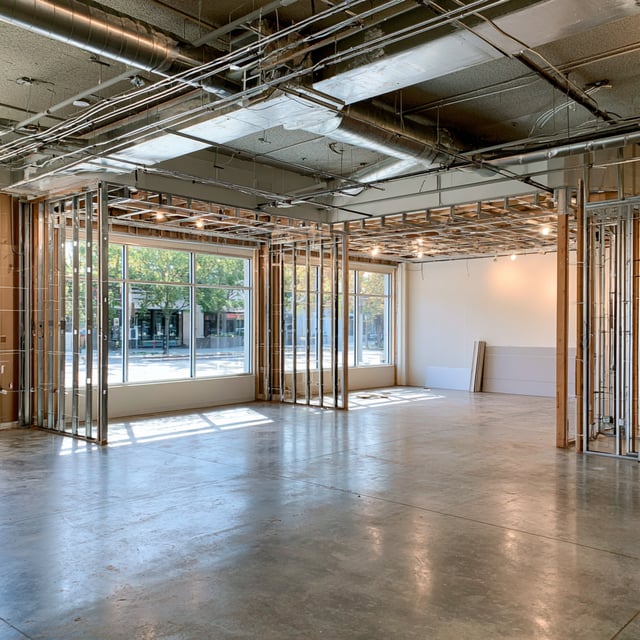
When you're building into a new shell in a recently completed retail center, you're starting with concrete floors, exposed ceilings, bare stud walls, and utility stubs. The HVAC distribution, finished flooring, restrooms, kitchen infrastructure (if you're a food business), and storefront all need to be built from scratch.
This gives you the advantage of designing exactly what your business needs. It also means you're managing a more complex and more expensive construction project than you would in a space that already has bones.
These numbers have moved up over the past two years. Material prices and contractor demand have both outpaced what most operators budgeted for even recently.
Tenant improvement allowances in DFW have nearly doubled since the pandemic, now averaging $60 to $70 per square foot for many retail and office spaces. That sounds generous until you realize that for a restaurant buildout, it might cover less than half the total cost. Know the gap before you sign, and make sure your financing accounts for it.
In a market adding 7 million square feet of new retail space, the scarcest resource isn't square footage. It's the people who build it out.
DFW's construction labor market is stretched. The volume of simultaneous projects across the metro means experienced general contractors and specialized trades (HVAC, plumbing, electrical, fire suppression) are booked well in advance.
Texas's reputation is well earned, and it does have real implications for construction.
No state income tax keeps operating costs down. Zoning is more flexible than in coastal markets. And the permitting process, while not instant, tends to move more predictably than in cities with heavier bureaucracy.
In the City of Dallas, commercial building permits are typically reviewed within a few weeks, though complexity affects timing. Projects requiring health department review, fire marshal approval, or sign permits each add their own timeline. And because the metro includes dozens of municipalities (Fort Worth, Arlington, Frisco, Plano, and many more), each with its own permitting process and fee structure, the specifics depend entirely on where your project is located.
Having a contractor who knows the process in your particular city saves time and avoids the revision cycles that happen when applications come in incomplete.
Transparent Pricing You Can Trust
One area where Texas does impose real requirements is fire code compliance, especially for restaurants and assembly-use spaces. Fire sprinkler systems, commercial kitchen suppression systems, and occupancy load calculations all require engineering review and compliance with local fire marshal standards. These systems represent a meaningful portion of both your buildout cost and your timeline, and they're not something you can figure out on the fly.
With demand this high, contractor quality varies more than it should. Some operators learn this the hard way after their project is already underway.

“Vague bids are a red flag. A detailed scope shows a contractor truly understands your project.”
The best commercial contractors in DFW will do a thorough site walk before they give you a number. They'll flag items you didn't think about (the condition of the roof above your HVAC, whether the existing fire suppression covers your new layout, whether the utility company needs to upgrade the electrical service to the building). They'll give you a construction schedule with dependencies mapped out, not just a start and end date. And they'll be upfront when something in your plan doesn't make sense, rather than agreeing to everything and sorting it out later with a change order.
DFW is massive, and the demographics shift significantly from one submarket to the next. A buildout that works in Uptown Dallas would be out of place in Southlake, and vice versa.
In corridors like Deep Ellum, Bishop Arts, and Henderson Avenue, the customer base skews younger, more experience-oriented, and more attuned to design. These are neighborhoods where the physical space is part of the product. Businesses invest more in custom finishes, unique architectural details, and interiors that feel specific to the location. The buildout budget here leans heavier on finish work.
In Frisco, McKinney, Prosper, and Celina, the customer base is largely young families with strong household incomes. Retail centers here favor proven concepts: fast-casual restaurants, fitness studios, pediatric practices, tutoring centers, personal care. The buildouts don't need to be flashy. They need to be professional, complete, and functional. A half-finished space in a new suburban center sends exactly the wrong message to customers who value dependability.
The customer base here mixes corporate workers, business travelers, and a growing residential population. Spaces need to function during weekday business hours and also compete for evening and weekend traffic with suburban centers nearby.
Understanding your submarket should drive decisions about layout, finish level, signage, and operational design. These aren't cosmetic choices. They're business decisions that affect how much revenue your space generates.
Every experienced operator in Dallas has a buildout horror story. The causes are almost always predictable.
It's tempting to build the minimum and start generating revenue as fast as possible. Sometimes that's the right call, especially if you're testing a new market.
But for a five- or ten-year lease, which is standard in DFW retail, the buildout should be planned with the full term in mind. A kitchen layout that can't accommodate growth will become a constraint within two years. Finish materials that look sharp on opening day but can't handle daily commercial use will need replacing sooner than you'd like. Mechanical systems sized for today's operation but not tomorrow's will mean costly upgrades later.
The operators who do best here treat the buildout as an investment in the business, not just a cost to get through.
DFW's growth is creating opportunities that few markets can match. But capitalizing on them requires getting your space right, on time and on budget, with a contractor who knows both the construction and the market.
Block Renovation connects Dallas-Fort Worth business owners and franchise operators with pre-vetted contractors who have the experience to handle commercial buildouts. Whether you're opening your first location or your fifteenth, Block matches you with a qualified professional for your project's specific needs, so you can put your energy into building the business while your space gets built right.
Build your business with confidence


Renovate confidently with Block
Easily compare quotes from top quality contractors, and get peace of mind with warranty & price protections.
Commercial
Commercial Tenant Improvement Contractors Explained
07.27.2026

Working with Contractors
Is a Property Renovation Company Worth the Cost?
06.24.2026
.png?width=640&name=u5821215421_Mediterranean_apartment_kitchen_with_a_rounded_is_b5261b9d-7d5a-498f-955d-d2ccbf7355fc_3%20(1).png)
Texas
Katy Home Additions: What Pays Back (Cost Guide)
05.29.2026
Texas
The Best Dallas-Fort Worth Renovation Contractors
05.28.2026
.png?width=640&name=u5821215421_Single_photograph_Apartment_Therapy_style_exterio_ad4a23c3-b656-4a69-9bf1-f1fc04660eef_3%20(1).png)
Texas
Custom Home Building in El Paso, TX: A Regional Guide
05.13.2026