




Living Space
Bump Out Living Room: Cost, Feasibility & Options
09.06.2026
05.06.2026


In This Article
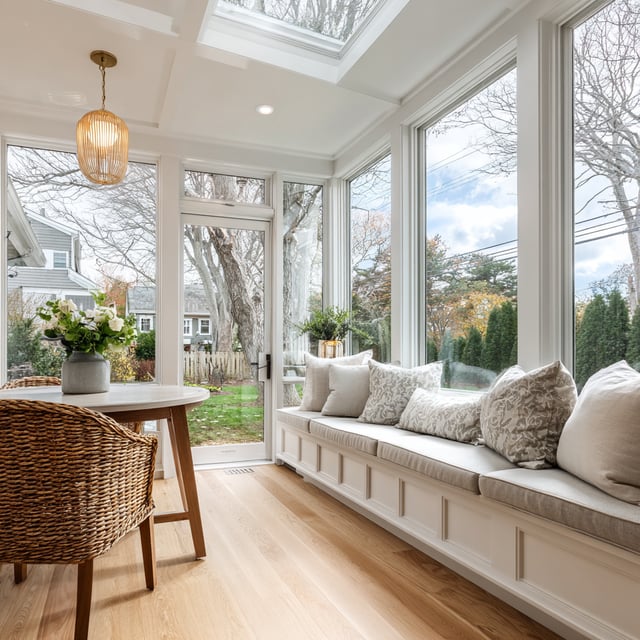
A four season room is a fully insulated, climate-controlled extension of your home, built to be as comfortable in January as it is in July. The category gets confused with sunrooms, three season porches, and solariums, and the confusion costs homeowners money. A real four season room ties into your HVAC, uses insulated glass with thermal breaks, sits on a proper foundation, and gets appraised as living square footage. A glorified porch with a space heater does not.
| Four-season value is earned | Appraisers look for conditioned living space, not the label on the estimate. Without insulation, HVAC, a real foundation, and thermal control, the room can fall into three-season valuation, about 25% of normal living-area value. |
| Size the system first | A 200-square-foot addition can add roughly half a ton of cooling load. Run the calculation before choosing a $2,300 to $20,500 tie-in or a $3,000 to $7,000 mini-split, because the wrong equipment can leave an otherwise finished room clammy, drafty, or underused. |
| Weather decides the spend |
The 30% to 50% four-season premium needs enough bad-weather days to pay for itself. More than 90 days outside 55°F to 85°F favors four-season construction; fewer than 60 usually makes three-season the cleaner buy. |
The line items:
An $80,000 sunroom on a $250,000 home rarely pays back at resale. Match the addition's quality to your home's tier.
If a contractor quotes $25,000 for a "four season" addition in a cold climate, ask exactly what is behind the label. A room you can actually use in February needs four things.
A contractor who can answer those four questions confidently is building a four season room. A contractor who waves them off is building a three season porch with optimistic branding.
The roof shapes how the room feels in a way no other choice does.
A solid insulated roof delivers the best thermal performance and the most "room-like" feel, and it allows for ceiling fans, recessed lighting, and a flush integration with the existing house. This is the default choice for cold climates and the most common roof on four season rooms across the country. It also gives the contractor the most flexibility on tying the new roofline into the existing house, which matters more for resale value than most homeowners realize. The tradeoff is light: a solid roof means windows do all the work of bringing the outdoors in, so the wall design and glazing budget become more important.
A cathedral or vaulted ceiling opens up the space without the full thermal penalty of a glass roof, and it pairs well with skylights for added light.
A glass roof in the solarium style delivers maximum light and a greenhouse effect at the highest cost and the highest maintenance load. It looks beautiful in photos, but the thermal swings and leak risk frustrate a lot of homeowners by year three.
South- and west-facing rooms get spectacular light but need solar control. Plan for low-E glass selected for your climate, plus retractable solar shades on any wall over 12 feet wide. North-facing rooms stay cooler with softer light, which works well for a workspace, plant room, or reading area.
Knee walls, which are low solid walls under the windows, make furniture placement easier, improve insulation, and reduce cost. Floor-to-ceiling glass maximizes the view but limits where a sofa or console can sit. The right choice depends on how you'll actually use the room.
Porcelain or stone tile handles temperature swings and humidity well, especially if you plan to keep plants. Engineered wood and LVT both work in fully conditioned rooms. Solid hardwood is risky even with HVAC, because the room's thermal cycles are sharper than the rest of the house.
For furnishings, UV exposure does more damage than temperature or humidity ever will. Outdoor-rated cushions, fade-resistant upholstery, wicker, and seagrass all hold up well, while standard indoor fabrics fade fast. Window treatments deserve attention from day one of the design conversation.
Turn your renovation vision into reality
Get matched with trusted contractors and start your renovation today!
Find a Contractor
The "50 to 65% return on investment" stat gets cited in most every cost-related sunroom article on the internet, and it's misleading without context. Two facts sit behind the number.
The case for a four season room addition is daily use. Homeowners who use the room every morning for coffee, every evening for reading, every Sunday for breakfast with the family get their money's worth. Homeowners who build it to impress a future buyer rarely do.
The rooms that get used (and recoup value at resale) are the ones designed around a specific, daily purpose from day one.
"Flex space" is the kiss of death. Rooms designed without a primary purpose tend to become the place where the treadmill collects dust and the kids drop their backpacks. Pick a use, design around it, and the room earns its place.
Climate decides this one. In a cold climate where winter temperatures regularly drop below 30 degrees, the cost premium for four season construction is almost always worth it. A three season room used three months a year is a much worse deal per use than a four season room used 365 days, even though the four season build costs 30% to 50% more.
The math flips in mild climates. A three season room in coastal California, the Gulf Coast, or the Southwest can deliver most of the same lifestyle value at a fraction of the cost, because the days when the room is uncomfortable without HVAC are rare enough to plan around. Building a fully conditioned four season room in those climates often means paying for insulation and HVAC capacity that almost never gets used.
A useful test: count the days each year when the outdoor temperature falls outside the 55 to 85 degree range.
A solid existing patio slab or screened porch can save several thousand dollars on foundation work, but only if a structural engineer confirms the existing footing and slab can carry the new load. Older slabs frequently fail that test, especially in regions with significant freeze-thaw cycles. A confident "yes" from an engineer is worth getting in writing before the rest of the project depends on it.
Prefab kits are faster to install and cheaper upfront, but they offer less flexibility on roofline integration and often look bolted on to an older home. Custom builds take longer and cost more, and they tend to read as part of the original architecture when finished. For a newer home or one where the addition won't be visible from the street, prefab usually wins on cost and timeline. For an older home, especially one with a distinctive roofline, the custom build pays for itself at resale.
The HVAC choice does more than any design call to determine whether the room actually feels four season, and contractors get it wrong more often than they get it right.
Extending the home's existing ductwork delivers the cleanest aesthetic outcome. The cost runs higher than a mini-split, and the central system often needs an upgrade to handle the additional load. A 200 square foot addition can add the equivalent of half a ton of cooling demand, which a system already running near capacity won't absorb without help. An HVAC contractor should perform an ACCA Manual J load calculation on the whole house before quoting, not just the new room.
A ductless mini-split is the middle path and works well for rooms up to about 400 square feet. It costs $3,000 to $7,000 installed and requires no ductwork. The common mistake is oversizing. A mini-split rated for the room's peak load will short-cycle in mild weather, never running long enough to dehumidify properly, which leaves the room feeling clammy in summer and dry in winter. A right-sized unit, sometimes a step smaller than the contractor's first instinct, performs better year-round.
Radiant floor heat is the third option, and it shines in cold climates. It pairs especially well with stone or tile flooring (the same flooring that handles the room's thermal cycles best) and delivers an even, comfortable warmth that forced air can't match. The cost is significant: $10 to $20 per square foot installed, plus a separate cooling solution because radiant floors only heat. For a homeowner already planning tile flooring in a cold-climate four season room, the combined system is often worth the investment.
Thousands of homeowners have renovated with Block Renovation to add the kind of square footage that gets used every day. Block matches each project with vetted local contractors who've built four season additions before, and facilitates competitive bidding with expert-reviewed scopes that catch missing line items early. Insulation specs, HVAC tie-in details, and foundation requirements are the things that separate a real four season room from an expensive three season one, and they are exactly what Block's scope review looks for.
Payments run through a secure, progress-based system, so contractors are paid as the work gets done rather than before. Every contractor in the Block network provides a one-year workmanship warranty, along with ongoing support if something comes up after the project closes.
Remodel with confidence through Block

Connect to vetted local contractors
We only work with top-tier, thoroughly vetted contractors

Get expert guidance
Our project planners offer expert advice, scope review, and ongoing support as needed

Enjoy peace of mind throughout your renovation
Secure payment system puts you in control and protects your remodel


Renovate confidently with Block
Easily compare quotes from top quality contractors, and get peace of mind with warranty & price protections.
Living Space
Bump Out Living Room: Cost, Feasibility & Options
09.06.2026
Closet
Bump Out Closet Addition: Sizing and Cost by Closet Type
08.27.2026
Additions
Bathroom Bump Out Ideas, Costs & Planning
08.27.2026
Additions
Two Story Addition at the Back of the House: Cost, Design, and Scope
08.19.2026
Additions
400 Sq. Ft. Master Suite Addition Cost: 2026 Guide
06.30.2026