




Commercial
Commercial Tenant Improvement Contractors Explained
07.27.2026
02.03.2026


In This Article
Walk into your QSR tomorrow morning and watch what actually happens. Not what you think happens—what actually happens.
A customer pushes through the door and pauses, scanning for where to order. Another stands at the counter for 40 seconds squinting at your menu board, then orders the same thing they always get. Someone with a mobile order wanders through your dining room looking confused. Two people collide near the pickup counter because there's no clear path. Your staff makes the same inefficient trip between the grill and the assembly station they've made 200 times today.
These aren't random annoyances. They're design failures, and they're costing you money.
Your interior isn't just aesthetic—it's operational infrastructure. Layout determines how fast you can serve customers. Lighting affects whether your food looks appealing or institutional. Signage either guides decisions or creates confusion. Every element either supports your revenue model or undermines it.
This guide shows you how to audit your QSR interior with fresh eyes, identify the specific design elements hurting your performance, and prioritize improvements that move revenue and customer satisfaction.
Walk your space as a first-time customer. You've stopped noticing the flaws you see every day. What's confusing? What feels dated or worn? Where do you naturally want to go, and does the space guide you there?
Observe during peak periods. Where do people pause or look uncertain? Where do customers bump into each other? These friction points cost you money.
Talk to your staff. Your team knows where the layout creates problems and what customers repeatedly ask about.
Define your metrics. Average service time, items per transaction, customer count during slow periods, and online review sentiment about your space give you measurable benchmarks.
The first 10 seconds determine whether fast food customers feel welcomed or confused.
Is your entrance obvious and inviting? When customers open the door, do they see your menu board, ordering area, or a clear path forward—or do they face a wall or visual clutter? Is there 6-8 feet of clear space with obvious cues about where to go? Does your space feel maintained, or do scuffed paint, worn flooring, and dead bulbs signal low standards?
Customers look confused about where to go. Add floor graphics or ceiling-mounted signage pointing to "Order Here." Position your menu board so it's visible immediately upon entry.
The entry area feels cramped during busy periods. Reconfigure queue layout to begin further into the space, or remove unnecessary merchandise displays consuming square footage.
Entry looks dated or doesn't match your brand evolution. Entry refresh is high-impact, low-cost. Repaint in brand colors, replace door hardware and signage, improve lighting, add branded graphics. Budget: $3,000-$8,000.
Your queue is where customer anxiety builds or dissipates, where they decide what to order, and where their perception of wait time forms.
Can customers see the menu while they wait, or do they first see it at the counter? Does your queue feel organized with clear markers, or chaotic? What's the environment—blank walls or merchandising opportunities? Is there separation between people ordering and people waiting for food?
Customers reach the counter and spend 30+ seconds deciding. Position menu boards where customers in queue can study them. Add menu boards on walls flanking the queue path, not just behind the counter.
Queue feels interminably long even when moving quickly. Create visual progress with multiple small segments rather than one long line. Add mirrors, brand graphics, or timing displays ("Average wait: 3 minutes"). People tolerate known waits better than unknown waits.
No clear queue structure. Install retractable stanchions for peak hours, or use permanent floor graphics showing queue path.
Customers who've ordered block the counter area. Create distinct zones with physical separation or clear signage directing people to designated waiting areas.
Queue path is blank and boring. Line it with merchandising (bottled drinks, grab-and-go snacks), brand storytelling graphics, or menu add-on suggestions. Position high-margin impulse items at eye level.
.png?width=1024&height=1024&name=u5821215421_Quick_service_restaurant_counter_and_menu_board_s_26c76d51-d7c3-48ac-89cd-8377be11c6d1_0%20(1).png)
Your menu board is your fast food restaurant’s primary selling tool. Poor design directly costs revenue.
Can customers easily find what they're looking for? Is your menu overwhelming (more than 12 entrees likely hurt sales)? Do your highest-margin items get appropriate emphasis? Is photography high-quality and appetite-appealing? Can the menu be read from queue distance?
Too many options create decision paralysis. Cut your slowest sellers. Consolidate similar items. Fewer options often lead to more sales because customers can actually make decisions.
High-margin items aren't prominent. Redesign your menu board to give hero items larger placement, photos, or highlighted boxes in the top-right position where eyes go first.
Photos are low-quality or dated. Invest in professional food photography. Budget $2,000-$5,000 for a full menu shoot. Poor photos are worse than no photos—they make food look unappealing.
The menu board doesn't reflect your current brand. Either commit to updating static boards annually (budget $3,000-$8,000) or transition to digital menu boards ($8,000-$20,000 upfront) that can be updated centrally.
The counter is your revenue center. Its design affects speed, accuracy, and customer comfort.
Counter feels cluttered. Radical decluttering. Move everything non-essential off the counter. The counter should have only POS equipment, one small promotional card holder maximum, and transaction space.
Counter design is generic or dated. Replace counter fronts with materials that align with your brand: reclaimed wood for rustic, solid surface for modern, tile for artisan. Budget: $5,000-$15,000.
Staff behind counter are invisible or too far from customers. Lower the counter backdrop. Consider open service lines where customers can see food prep—this creates entertainment and trust.
Furniture looks dated. Furniture replacement transforms space perception ($8,000-$25,000+ depending on capacity). Start with most visible areas like window seating, then phase remaining areas over time.
No accommodation for solo diners. Counter seating with outlets and USB ports, small two-tops positioned for privacy, and good lighting encourage extended stays during slow periods without taking valuable rush-hour space.
Dining area has no personality. Add murals, graphic wallpaper, dimensional signage, or photography. Consider a statement wall that customers naturally photograph and share. Budget: $3,000-$10,000.
Harsh fluorescent lighting feels institutional. Replace with warm LED (2700-3000K) that creates inviting atmosphere while maintaining necessary brightness. Retrofitting existing fixtures: $500-$2,000. Replacing fixtures entirely: $3,000-$10,000.
Single-source overhead lighting feels flat. Layer your lighting. Combine ambient, task, and accent lighting. Add pendant lights over counters. Use track lighting to emphasize menu boards or feature walls.
Fixtures are dated. Light fixtures are jewelry for your space. Distinctive pendant lights or modern track fixtures create immediate impact. Budget: $2,000-$8,000 for dining area replacements.
A dirty or poorly designed restroom colors the entire fast food brand experience quite negatively.
Restroom feels like an afterthought. Repaint in brand colors, add brand graphics, upgrade lighting, replace dated fixtures. Budget: $2,000-$5,000 per restroom for cosmetic refresh.
Touchpoints create sanitation concerns. Upgrade to sensor-operated faucets, soap dispensers, paper towel dispensers, and flush mechanisms. While more expensive upfront ($1,000-$2,000 per restroom), they reduce touch points and improve hygiene perception.
Ventilation is inadequate. Upgrade exhaust fans and verify they're exhausting to exterior. Add air freshening systems. Budget: $500-$2,000 per restroom.
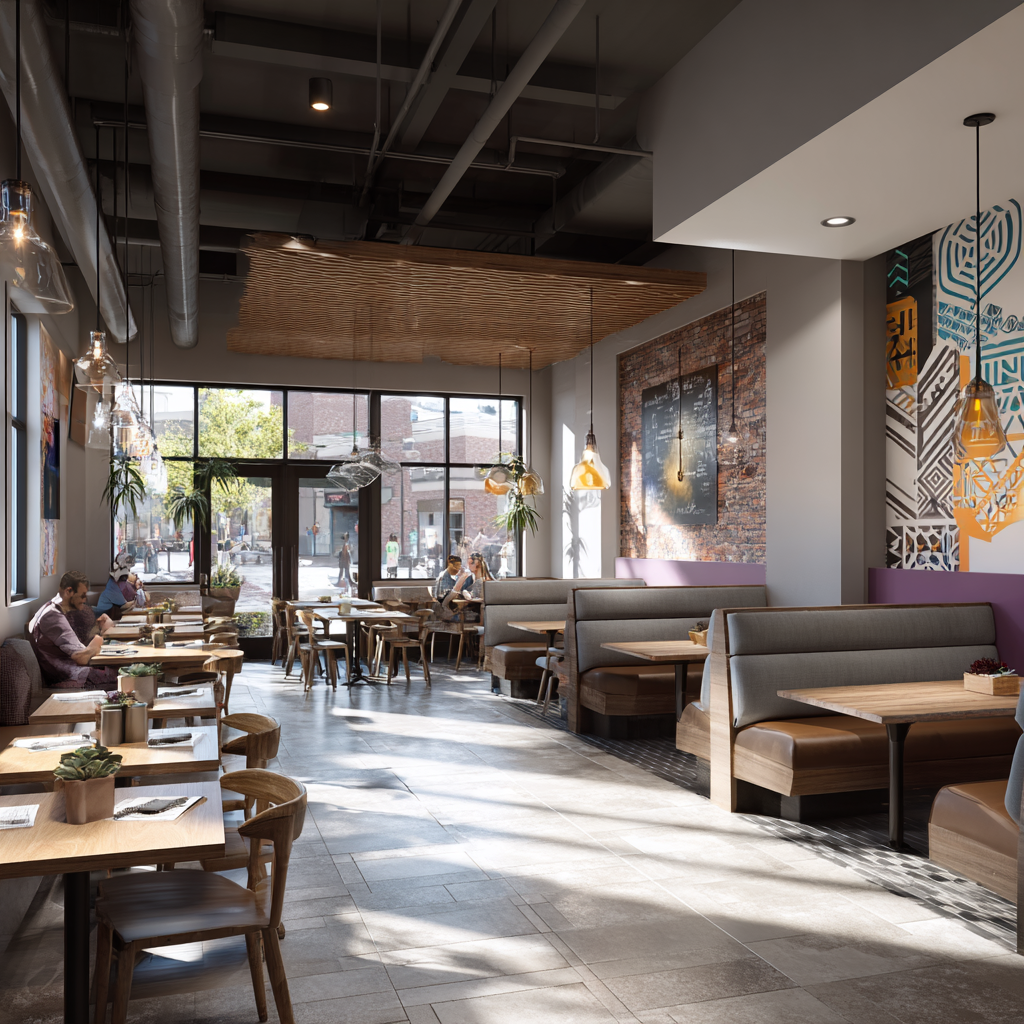
Your fast food restaurant’s interior design isn't just décor—it's a marketing tool that either reinforces or undermines your brand positioning. Every material, color, and fixture choice sends a message about who you are and what you stand for. When those messages conflict with your QSR brand promise, customers notice, and it costs you.
Think of your interior design as part of your QSRs’ marketing materials.
If you market yourself as organic and health-focused but your interior uses synthetic materials, harsh fluorescent lighting, and sterile white surfaces, you're contradicting your own message. Customers who choose you for natural, wholesome food expect to see that philosophy reflected in your space—reclaimed wood, living plants, natural light, earthy colors, and materials that feel authentic rather than manufactured.
If you market premium quality and charge premium prices but your space uses cheap materials, worn furniture, and poor lighting, customers feel overcharged. Premium positioning requires premium finishes—solid surface counters instead of laminate, custom light fixtures instead of builder-grade, commercial-grade furniture instead of residential pieces that show wear after six months.
When your interior design contradicts your fast food brand’s identity, several things happen. Price resistance increases—customers won't pay premium prices in spaces that look cheap, regardless of food quality. Brand perception weakens—inconsistency signals disorganization or inauthenticity. Customer loyalty declines—generic environments don't create emotional connection, so customers treat you as interchangeable with competitors.
Your staff feels it too. Employees want to work somewhere they're proud of. Spaces that don't reflect brand values affect morale and ultimately service quality.
Edible Arrangements rebranded to Edible—a strategic shift that required significant investment in advertising and a new web presence to communicate the evolution. But leadership recognized something critical: without updating physical locations to match, the rebrand would be incomplete. Lighter woods replaced darker materials. Focused lighting highlighted products and created zones. Updated graphics communicated the expanded product range beyond arrangements. The overall vibe shifted from being a “pickup counter” to a richer retail experience.
This is the lesson: your interior is part of your brand ecosystem, not separate from it. When you reposition in the market, your physical spaces must evolve simultaneously.
For franchisors especially, this means coordinating interior updates across locations when brand evolution occurs. Customers who see your new advertising and then visit a location with old interiors experience disconnect that damages the rebrand's effectiveness.
For franchisors, brand-interior alignment becomes even more critical, as acknowledged in this QSR marketing guide. Your interior is how customers recognize you across different markets and locations. A customer who visits your Boston location and loves the experience should walk into your Dallas location and immediately feel they're in the same brand ecosystem.
Inconsistent interiors confuse customers and dilute brand equity. If your Dallas location looks modern and fresh while your Boston location still has 2015 finishes, customers question whether quality and standards are equally inconsistent. They wonder if the food will be different, if service standards vary, if they can trust the brand uniformly.
This doesn't mean every location must be identical—local adaptation matters. But core brand elements need consistency: color palette, materials vocabulary, furniture style, lighting approach, and graphic treatments. A customer should be able to photograph your space and have it be instantly recognizable as your brand, regardless of location.
High impact, low cost: Decluttering counters, adding floor graphics, repainting, fixing broken fixtures, improving restroom protocols.
High impact, moderate cost: Menu board redesign, entry refresh, furniture replacement in visible areas, lighting upgrades, counter refresh.
High impact, high cost: Full furniture replacement, complete lighting redesign, major brand refresh.
Months 1-3: Quick wins. Deep clean, declutter, fix lighting, improve restrooms, add queue graphics. Budget: $2,000-$5,000.
Months 4-6: Brand consistency. Entry refresh, menu board updates, counter improvements, brand graphics. Budget: $8,000-$20,000.
Months 7-9: Seating and atmosphere. Replace furniture in visible areas, upgrade lighting, add statement walls, improve restroom aesthetics. Budget: $10,000-$25,000.
Months 10-12: Refinement. Complete furniture phasing, final lighting adjustments, address remaining pain points. Budget: $5,000-$15,000.
Total 12-month budget: $25,000-$65,000. This is manageable for most QSRs when spread over a year, and the ROI in improved customer experience and increased traffic justifies the cost.
To further guide your design ideas and budgeting, read our guides Restaurant Remodeling Guide: Costs & Other Insights and Restaurant Renovation Costs - A Deep Dive.
For independent QSR owners, a delayed renovation is a headache. For franchisees, it can mean violating your franchise agreement. Many franchisors set hard deadlines for remodels, and when every location in your market is racing to meet the same requirements, you're all competing for the same contractors and the same materials at the same time.
We asked Rory O'Driscoll of Block Renovation how franchisees can protect their timelines when contractor and supply demand is at its highest. His answer was straightforward: start sooner than you think you need to.
"We always recommend starting contractor conversations early. While contractors will be unable to provide a final price prior to receiving a set of plans, you should begin engaging contractors as soon as you start working with an architect to design the space. That way, you can narrow down your short-list of candidates and have them ready to bid as soon as the plans are complete, versus starting that process after plans are drawn."

You should also apply for permits simultaneous to contractor bidding. Don't wait to select a contractor before submitting your permit application. In an ideal world, the contractor starts bidding as soon as they receive the plans and starts construction the day after permits are approved.
Interior design improvements seem straightforward until you encounter permitting requirements, building code constraints, operational disruptions, and the challenge of maintaining service while renovating.
Block Renovation connects QSR owners and operators with contractors and designers who specialize in commercial food service environments. Our vetted professionals understand durability requirements, health department regulations, minimal-disruption phasing, and how to balance brand vision with operational reality.
Whether you're tackling a complete refresh or making strategic improvements to specific areas, Block provides the expertise and project management to keep your project on schedule, on budget, and with minimal impact to daily operations.
Remodel with confidence through Block

Connect to vetted local contractors
We only work with top-tier, thoroughly vetted contractors

Get expert guidance
Our project planners offer expert advice, scope review, and ongoing support as needed

Enjoy peace of mind throughout your renovation
Secure payment system puts you in control and protects your remodel


Renovate confidently with Block
Easily compare quotes from top quality contractors, and get peace of mind with warranty & price protections.
Commercial
Commercial Tenant Improvement Contractors Explained
07.27.2026

Working with Contractors
Is a Property Renovation Company Worth the Cost?
06.24.2026

Commercial
Commercial Remodeling in San Diego by Neighborhood | Block Renovation
04.27.2026
Commercial
Commercial Remodeling and Buildouts in Dallas-Fort Worth | Block Renovation
04.24.2026
Commercial
2026 Restaurant Design: 11 Trends Defining the Industry
04.24.2026