




Kitchen Floor Plans
Galley Kitchen Floor Plans and Ideas That Work | Block
07.15.2026
02.15.2026


In This Article
At 121 square feet, an 11x11 kitchen crosses an important threshold. You're no longer working around tight constraints or making compromises just to fit the basics — you're making real design decisions about how the space should function, how it should look, and how much you want to invest. That extra square footage compared to a standard 10x10 opens up possibilities that smaller kitchens simply can't support: a center island with seating, a full-depth pantry wall, a dedicated baking station, or a layout that comfortably accommodates two cooks at once.
These kitchens are common in suburban homes, newer construction, and older houses where a previous renovation or addition expanded the original footprint. If you're planning a renovation at this size, the question isn't whether you have enough room — it's how to spend your budget where it matters most.
An 11x11 kitchen sits just above the industry-standard 10x10 pricing benchmark. That extra 21 square feet translates to roughly 10–15% more cabinetry, countertop material, flooring, and backsplash coverage compared to a 10x10 — and the cost scales accordingly. But the bigger budget driver at this size isn't square footage itself. It's what the extra room tempts you to add: an island, a second sink, upgraded appliance packages, or more complex layouts with additional utility runs.
Here's what homeowners can generally expect at each renovation level:
Basic refresh: $30,000–$45,000. Stock cabinetry, standard countertops, new appliances in the mid-range tier, and updated lighting. The existing layout stays largely the same, and plumbing and electrical remain in their current locations. At this level, you're updating the look and feel of the kitchen without rethinking how it's organized. This is where a simple cabinet refacing, new hardware, a fresh backsplash, and a countertop swap can make the room feel new without the disruption of a full gut.
Mid-range renovation: $45,000–$70,000. Semi-custom cabinetry with soft-close drawers and interior organizers, quartz or natural stone countertops, a tile backsplash, and appliance upgrades (think a slide-in range or a counter-depth refrigerator). At this tier, you may also relocate one or two fixtures to improve the work triangle — moving the sink to an island, for instance, or shifting the stove to a different wall. Plumbing and electrical modifications at this level typically add $3,000–$8,000 depending on complexity and local labor rates. This is also where a dishwasher addition (if you don't already have one) or under-cabinet lighting becomes standard.
High-end renovation: $70,000–$100,000+. Custom cabinetry built to your exact specifications, premium appliances (professional-grade ranges, built-in refrigeration, integrated ventilation), full layout reconfiguration, and finish-level details like waterfall-edge countertops, specialty tile, or architectural lighting. At this budget, you're likely gutting the room to the studs and rebuilding — which means new subflooring, updated electrical panels, and potentially structural modifications if you're removing a wall or adding a window. Permit costs alone at this level can run $1,500–$3,500 depending on your municipality. Read more about luxury kitchen remodeling.
Know the Cost Before You Start
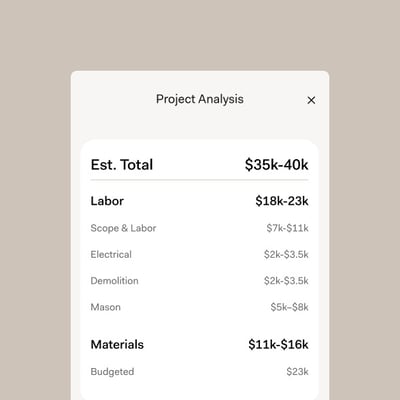
Understanding the cost breakdown helps you decide where to invest and where to pull back. Here's how a typical mid-range 11x11 kitchen renovation distributes across major categories:
Cabinetry: 30–35% of total budget. In an 11x11 kitchen, you're looking at roughly 20–25 linear feet of cabinetry for an L-shaped layout, and up to 30+ linear feet for a U-shape or galley with island. Semi-custom cabinets run approximately $200–$400 per linear foot installed, while custom options can reach $800–$1,200+. The jump from stock to semi-custom is where most homeowners see the best return — you gain better construction quality, more finish options, and interior accessories like pull-out trays and lazy Susans without the lead times and cost of full custom work. Use this free AI tool to visualize and budget your kitchen cabinets.
Countertops: 10–15%. At 11x11, you may have 35–50 square feet of countertop surface depending on layout. Laminate runs $15–$40 per square foot installed, quartz $50–$100, and natural stone like marble or granite $60–$150+. If you're adding an island, budget for an additional 10–15 square feet of surface plus any overhang for seating.
Appliances: 15–20%. A mid-range appliance package (range, refrigerator, dishwasher, microwave, and ventilation) typically runs $5,000–$10,000. Premium and professional-grade packages can push $15,000–$25,000 or more. The 11x11 footprint gives you room for full-size, 36-inch appliances across the board — a meaningful upgrade from the 30-inch models that smaller kitchens often require.
Labor: 25–35%. Labor is consistently the largest single expense. In an 11x11 kitchen, expect labor costs of $12,000–$25,000 for a mid-range renovation and $20,000–$40,000+ for high-end work. This covers demolition, rough-in trades (plumbing, electrical, HVAC), carpentry, tile installation, painting, and final connections. Labor rates vary significantly by region — a kitchen renovation in New York City or San Francisco will run 30–50% higher in labor costs than the same project in a mid-size metro area.
Flooring: 5–8%. At 121 square feet (minus the footprint of base cabinets and appliances), you're covering roughly 80–90 square feet of visible floor. Luxury vinyl plank runs $4–$8 per square foot installed, porcelain tile $8–$15, and hardwood $10–$20+. Click here for insights into the cost of new kitchen floors.
Backsplash, lighting, and finishing details: 5–10%. Subway tile backsplash installed runs $800–$2,000 for an 11x11 kitchen. Specialty tile (zellige, handmade ceramic, natural stone mosaic) can push that to $3,000–$6,000+. Under-cabinet LED lighting adds $500–$1,500, and a recessed lighting plan with dimmer controls typically runs $1,000–$3,000.
Block's Renovation Studio can show you how each of these choices affects your total estimate in real time — so you can experiment with different materials and configurations before committing to a budget.
The floor plan you choose has a direct impact on cost — sometimes more than the finishes you select. Here's how the major layout types compare in an 11x11 kitchen:
Single-wall layouts carry the lowest base cost. With cabinetry, plumbing, and electrical concentrated on one wall, you minimize linear cabinet footage, reduce countertop material, and keep utility runs short. Expect to save 15–25% compared to an L-shaped or U-shaped configuration at the same finish level.
L-shaped layouts are the mid-range standard. Two walls of cabinetry with a corner junction add roughly 30–40% more cabinet and countertop material than a single wall, plus the cost of corner cabinet hardware (lazy Susans, blind-corner pull-outs). Plumbing stays relatively contained since most L-shapes keep the sink on the same wall as the original rough-in.
U-shaped and galley layouts are the most material-intensive. Three walls of cabinetry mean the highest cabinet count, the most countertop square footage, and potentially multiple plumbing or electrical relocation points. These layouts typically cost 20–35% more than an equivalent L-shape.
Adding an island introduces its own cost layer. A basic island with cabinetry and countertop starts around $3,000–$5,000. Add plumbing for a prep sink and you're looking at $1,500–$3,000 more. Electrical for outlets or an induction cooktop adds another $1,000–$2,500. A fully loaded island with seating, storage, a sink, and electrical can run $8,000–$15,000 on its own.
Renovate with confidence every step of the way
Step 1: Personalize Your Renovation Plan
Step 2: Receive Quotes from Trusted Contractors
Step 3: Let Us Handle the Project Details
With 121 square feet, you have enough room to avoid the forced compromises that define smaller kitchens. But more space also means more ways to get the layout wrong — a poorly placed island can choke circulation, and too much open floor can make the kitchen feel under-furnished and inefficient. A few principles keep things on track.
Respect the work triangle, but know when to expand it. The classic triangle between stove, sink, and refrigerator should total no more than 26 feet with no single leg exceeding 9 feet. In an 11x11 kitchen, you have room to spread the triangle out comfortably — but going too wide means extra steps that add up over hundreds of daily trips.
Plan for two work zones if you cook with a partner. The 11x11 footprint is one of the first sizes where two-cook layouts become viable. An island with a prep sink opposite a main cooking wall, for example, lets two people work simultaneously without crossing paths. If this is a priority, make sure each zone has its own landing space and access to storage.
Don't fill every wall. Just because you have 44 linear feet of wall space doesn't mean you should cabinet all of it. Leaving one wall open for a window, a display shelf, or simply visual relief keeps the kitchen from feeling like a showroom and more like a room you actually want to spend time in.
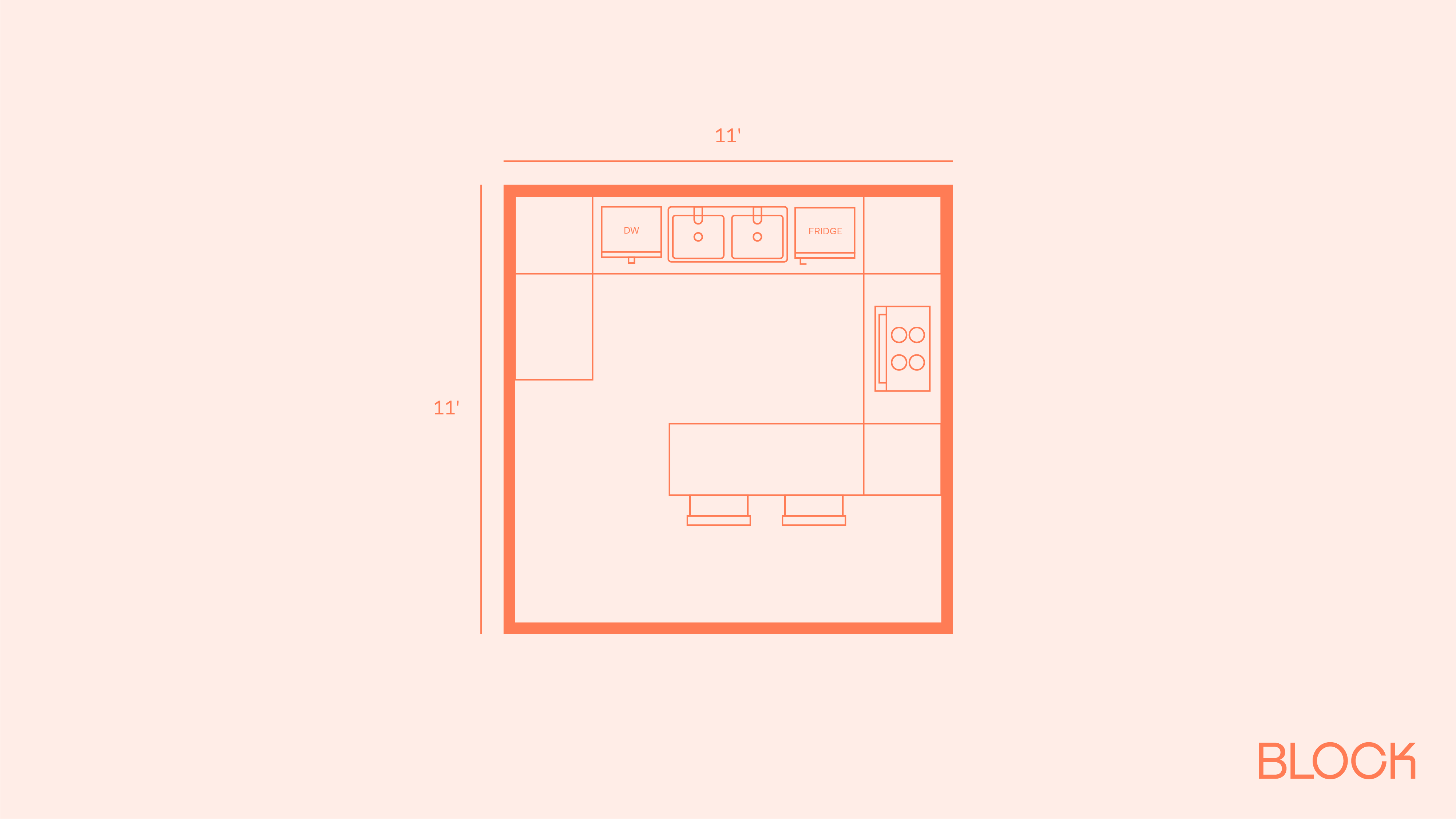
The sink, dishwasher, and refrigerator line the upper wall, while the stove anchors the right-hand wall with cabinetry extending down both sides. A center island with seating for two occupies the open floor, creating a clear separation between the cooking perimeter and a casual dining or gathering spot.
This is the layout that gets the most out of an 11x11 footprint. The L-shaped perimeter keeps the work triangle compact and places all the primary cooking functions within a few steps of each other, while the island adds prep surface, storage, and a social anchor that draws people in without putting them in the cook's way. The 11-foot walls give you enough depth for comfortable clearance on all sides of the island — typically 42 inches or more — which is where many 10x10 kitchens struggle with this configuration.
From a cost perspective, this is a mid-to-upper-range layout. The island adds cabinetry, countertop material, and potentially plumbing or electrical if you include a prep sink or outlets. But it also adds the most functional value per dollar in a kitchen this size.
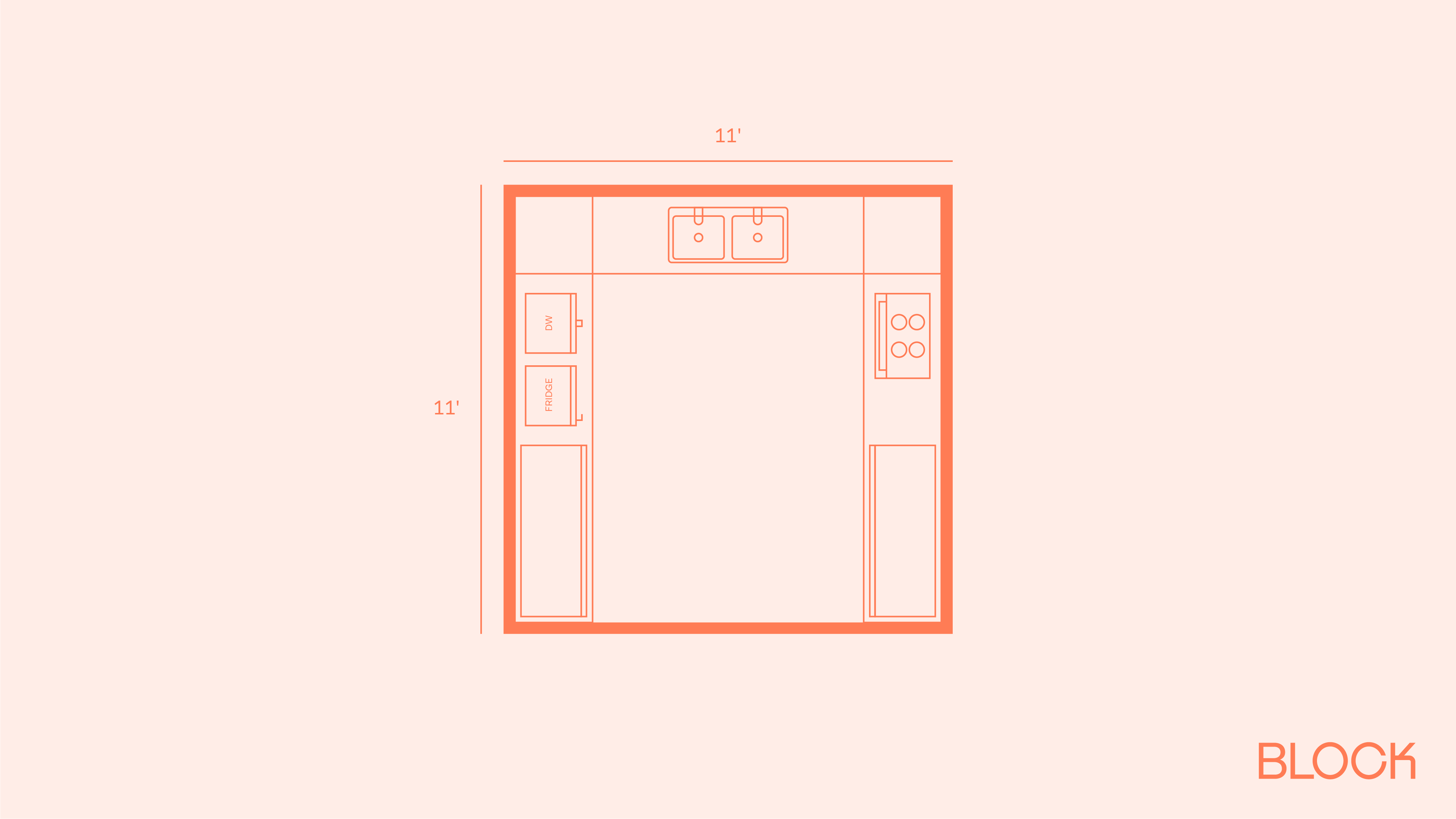
Cabinetry wraps three walls — the sink on the upper wall, the dishwasher and refrigerator on the left, and the stove on the right. The lower portion of the U extends into a peninsula with base cabinets on both sides, creating a bar-height seating area and additional storage.
The U-shape provides the highest total storage capacity and the most counter space of any 11x11 layout. The peninsula is a cost-effective alternative to a freestanding island because it doesn't require its own plumbing or structural support — it simply extends the existing cabinet run. Seating along the peninsula gives you an eat-in option without the footprint of a full table.
This layout is best suited for households that need serious pantry-level storage, multiple prep zones, or heavy daily cooking routines. The three-wall coverage does mean more cabinetry cost and potentially more complex utility routing if you're relocating the stove or adding a second dishwasher zone. Budget for the higher material quantities, but know that the per-square-foot storage return is the best you'll get at this size.
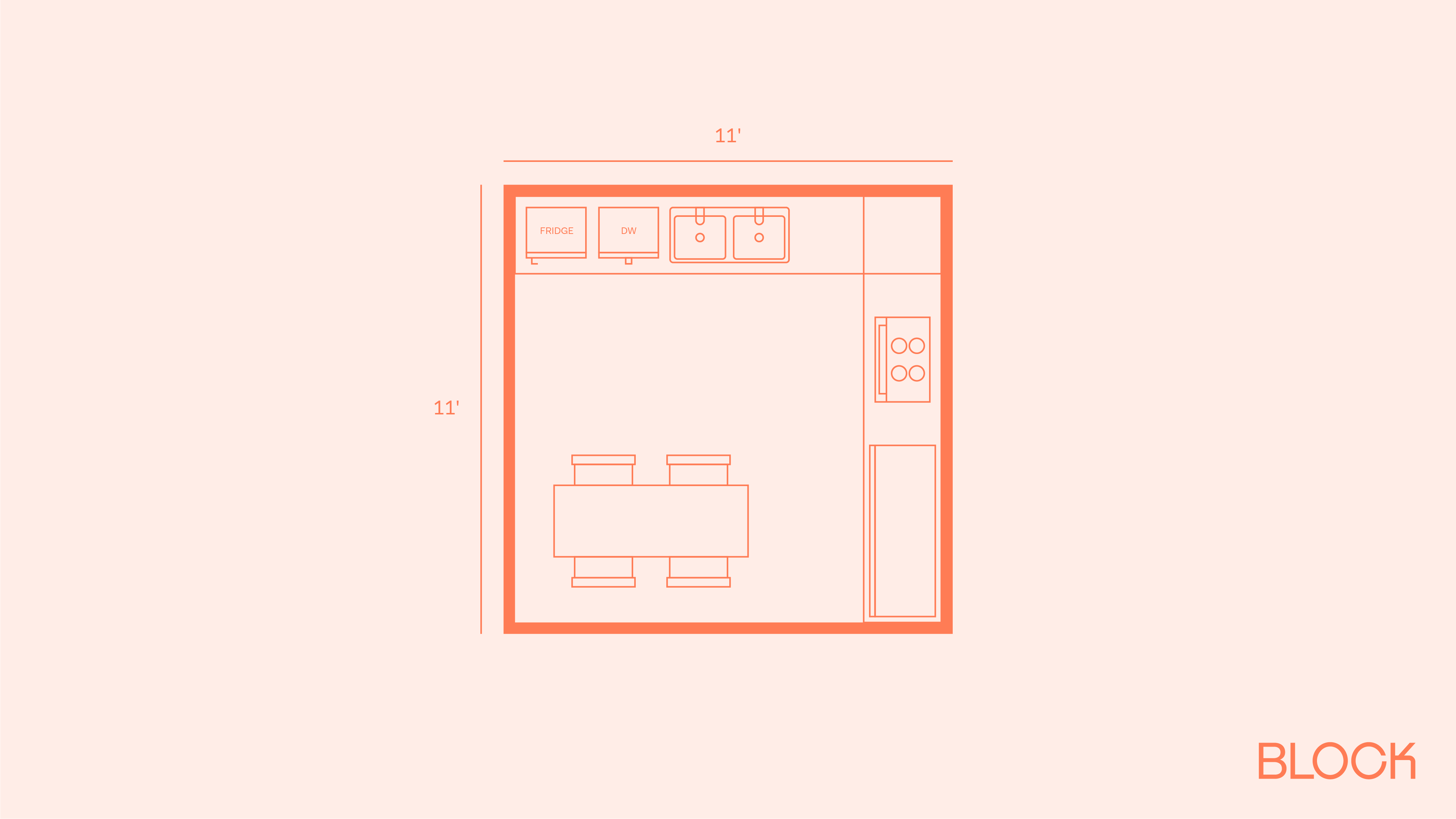
The refrigerator, dishwasher, and sink run along the upper wall. The stove sits on the right-hand wall with cabinetry extending below it. The open floor area holds a rectangular dining table with seating for four to six, turning the kitchen into a combined cooking and dining space.
This layout prioritizes the eat-in kitchen — a configuration that's increasingly popular with families and homeowners who want to consolidate cooking and dining into a single room rather than maintaining a separate, rarely used dining room. The 11x11 footprint provides enough room for a properly sized table with adequate clearance from the cooking zone, something that smaller eat-in layouts can't always deliver.
Cost-wise, this is one of the more economical configurations. The L-shaped cabinetry keeps material quantities moderate, and with no island to plumb or wire, the utility work stays straightforward. The dining table and chairs are a furnishing cost, not a construction cost, which means you can upgrade them over time without touching the renovation budget.
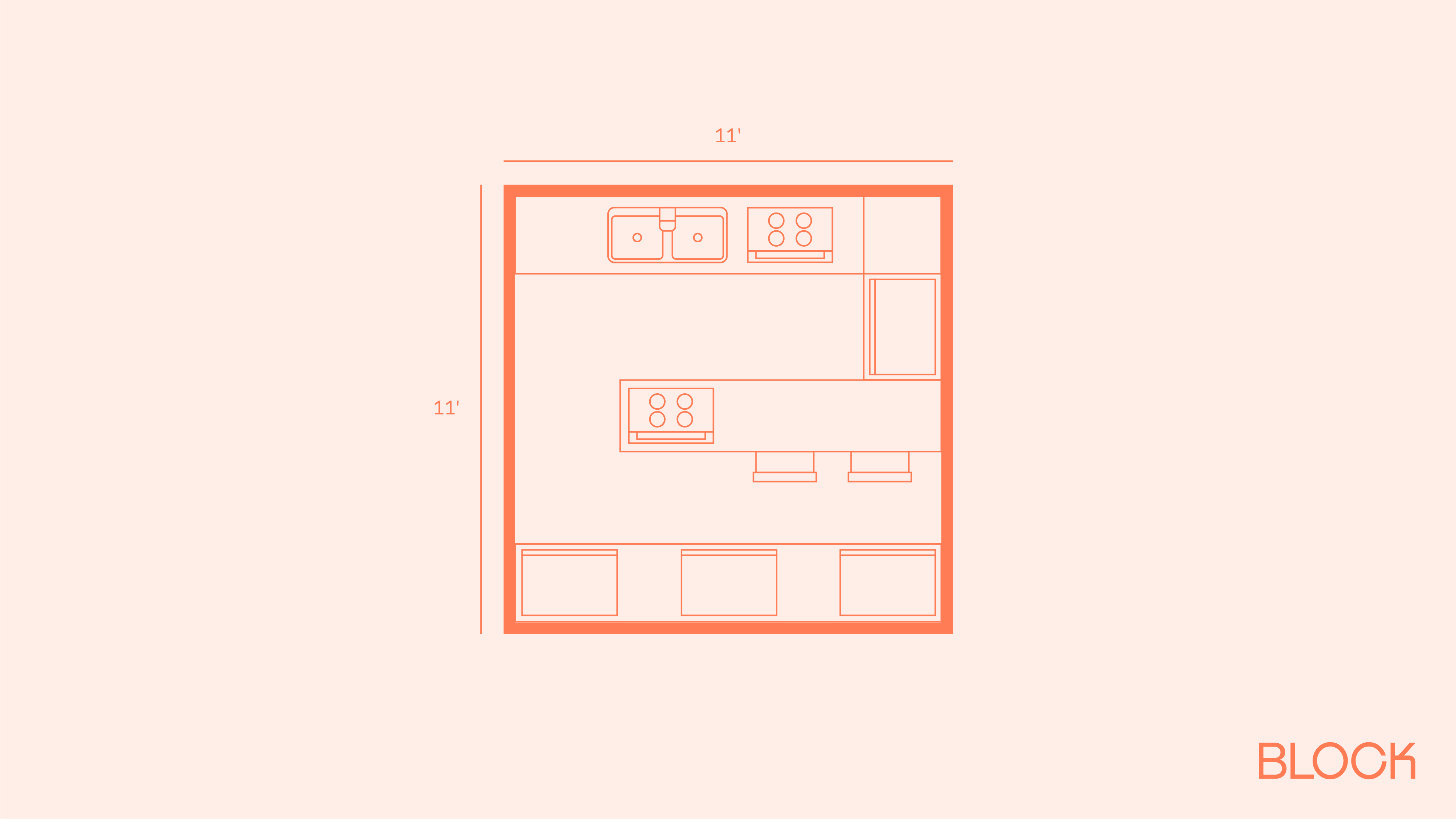
The sink and stove share the upper wall, with cabinetry extending to the right. A second cooktop sits on a center island, flanked by bar seating. The lower wall features additional base cabinet storage. The right-hand wall has a refrigerator and additional cabinetry.
This is the most ambitious layout in the set — essentially a professional-style kitchen scaled for residential use. The dual cooktop arrangement and extensive cabinetry make it ideal for serious home cooks or households that entertain frequently. The island doubles as a cooking station and a social hub, allowing the cook to face the room rather than a wall.
It's also the most expensive configuration to build. A second cooktop on the island requires dedicated electrical (or gas) and ventilation — either a downdraft vent integrated into the island or a ceiling-mounted hood, both of which add $2,000–$5,000 to the budget. The additional cabinetry on three-plus walls pushes material costs toward the high end. This layout is worth the investment if you'll use the cooking capacity regularly, but it's overkill for households that cook simple meals most nights.
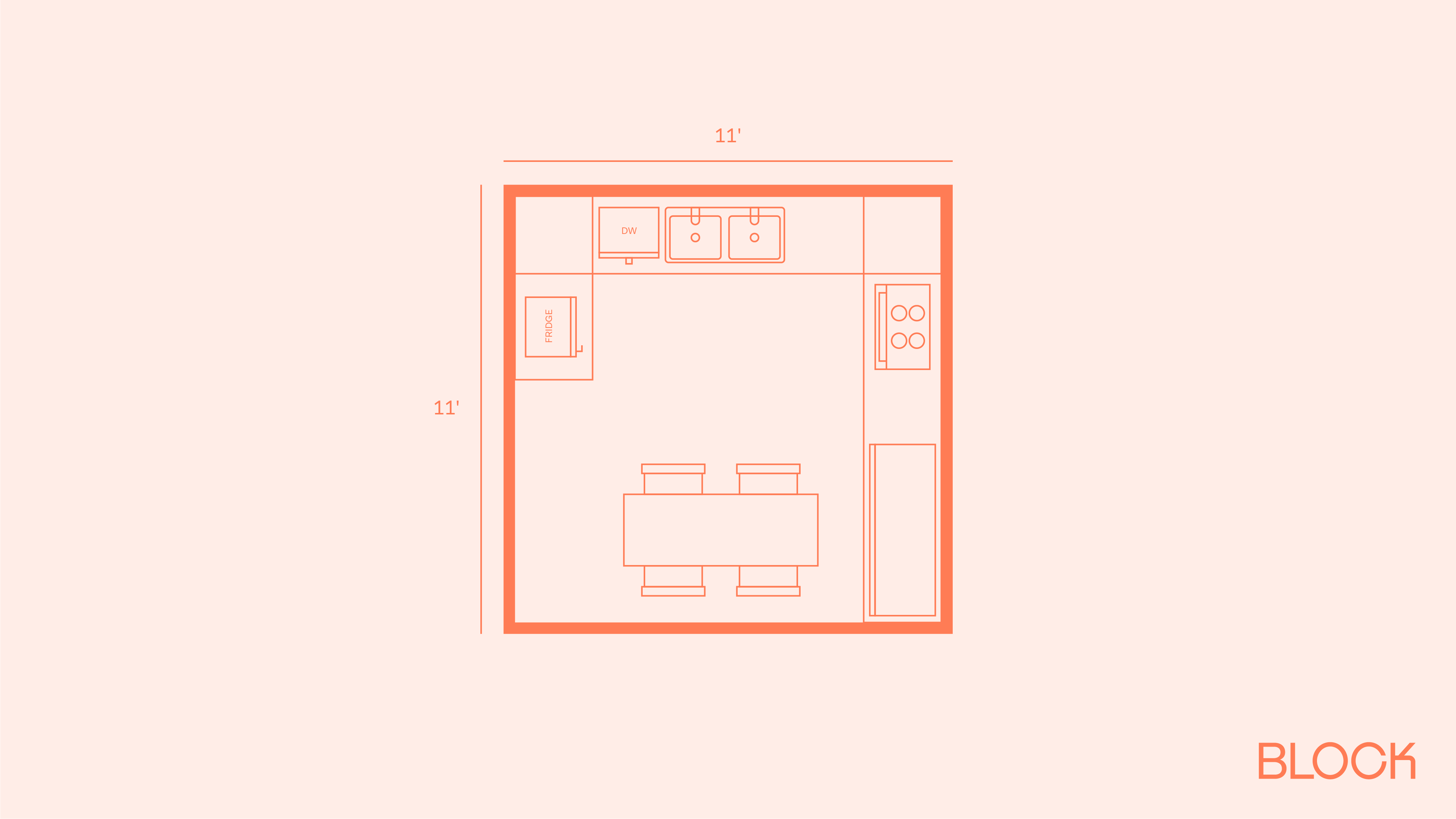
The dishwasher and sink line the upper wall, with the fridge positioned freestanding on the left-hand wall. The stove occupies the right-hand wall with cabinetry running the full length. A rectangular dining table with seating for four sits in the center-lower portion of the room.
This layout combines the storage benefits of a U-shape with the eat-in functionality of a dedicated dining area. By pulling the refrigerator off the upper wall and onto a side wall, you open up additional counter space along the primary working run — a meaningful upgrade for prep-heavy cooking. The freestanding fridge placement also means you can choose a larger-capacity model without being constrained by a cabinet surround.
The cost profile is similar to a standard U-shape, with the caveat that the fridge relocation may require extending a water line (for ice maker or water dispenser) to a new wall, adding $500–$1,500 to the plumbing budget. The trade-off is worth it if you regularly meal prep or store large quantities — the longer uninterrupted counter beside the sink becomes one of the most-used surfaces in the kitchen.
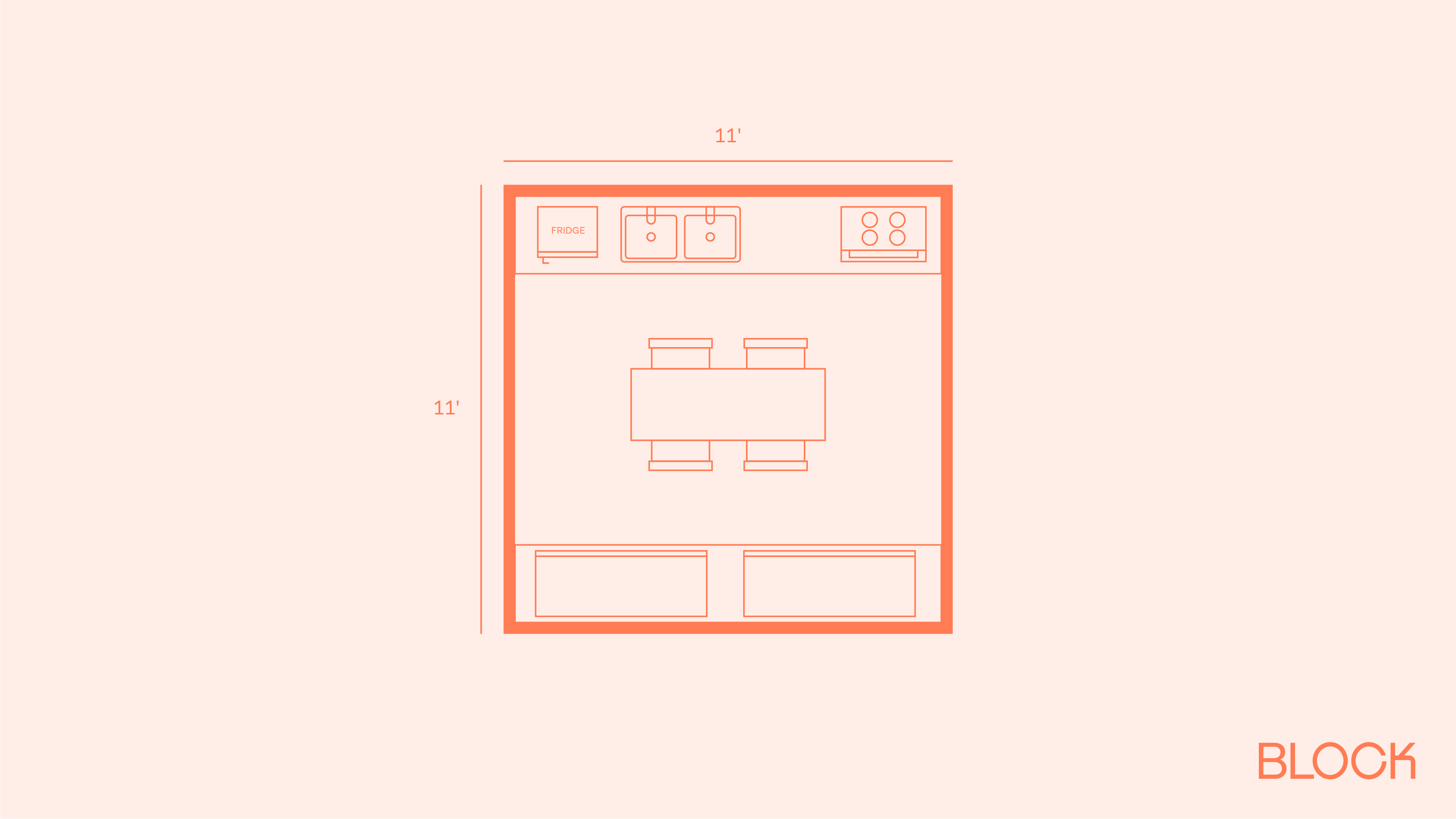
The upper wall carries the same appliance run as the single-wall layout — fridge, double sink, and stove. The lower wall adds a second row of base cabinets, creating a galley-style configuration with the dining table positioned between the two runs.
This is a practical upgrade over the pure single-wall layout. The second row of base cabinets nearly doubles your storage and adds a full run of counter space along the back wall for serving, buffet-style meals, or as a landing zone for groceries. The dining table fits comfortably between the two runs with adequate clearance for chair pull-out on all sides.
From a budget perspective, the additional base cabinets and countertop surface add roughly $4,000–$8,000 compared to the single-wall version at the same finish level. There's no additional plumbing or electrical required since the lower wall is purely storage and surface. This makes it one of the most cost-efficient ways to gain meaningful storage in a dining-focused kitchen.
In a kitchen this size, a few choices have an outsized impact on the final bill. Being aware of them early helps you steer the budget toward what matters most.
Sink placement drives plumbing cost. Moving the sink from its original position — whether to an island or a different wall — is one of the most common renovation upgrades, and also one of the most expensive. Extending supply lines and drain pipes to a new location can add $2,000–$5,000 to the plumbing bill, depending on distance and complexity. If your budget is tight, keeping the sink in its current spot and redesigning the layout around it is one of the most effective ways to save.
Cabinet interior accessories add up fast. Soft-close hinges, pull-out trash bins, spice rack inserts, drawer dividers, and lazy Susans all improve daily function — but they also add $50–$200 per cabinet to the total. In a kitchen with 20+ cabinets, that accessory layer alone can represent $2,000–$4,000. Prioritize accessories in the cabinets you'll use most (the ones flanking the sink and stove) and skip them in less-accessed zones.
Ventilation is often underbudgeted. A basic over-the-range microwave with built-in ventilation costs $300–$600 installed. A dedicated range hood with proper CFM for your stove runs $500–$2,000 for mid-range models and $2,000–$5,000+ for professional-grade. If your stove is on an island, you'll need either a ceiling-mounted hood or a downdraft system — both of which require additional structural and electrical work.
Lighting has more cost range than most people realize. A simple recessed lighting plan with four to six cans runs $800–$1,500 installed. Adding under-cabinet LED strips, pendant fixtures over an island, and dimmer controls can push the lighting budget to $3,000–$5,000. The difference in how the kitchen feels, though, is significant — lighting is one of the few upgrades that changes the room at every hour of the day.
At this size, the risk isn't running out of room — it's spending in the wrong places. A kitchen with premium countertops but poor lighting, or custom cabinetry but a cramped layout, won't feel like the investment it is.
With Block Renovation, you can map out different configurations and see how each material and layout decision affects your total budget — all through the free Renovation Studio. When you're ready to move forward, Block matches you with vetted local contractors who provide detailed, line-item proposals you can compare side by side, backed by progress-based payments and a one-year workmanship warranty.
The best 11x11 kitchen renovations don't just look good on completion day. They're built around a clear understanding of cost, a layout that fits your daily routine, and a budget that's spent where you'll feel it most.
Remodel with confidence through Block

Connect to vetted local contractors
We only work with top-tier, thoroughly vetted contractors

Get expert guidance
Our project planners offer expert advice, scope review, and ongoing support as needed
Enjoy peace of mind throughout your renovation
Secure payment system puts you in control and protects your remodel


Renovate confidently with Block
Easily compare quotes from top quality contractors, and get peace of mind with warranty & price protections.
Kitchen Floor Plans
Galley Kitchen Floor Plans and Ideas That Work | Block
07.15.2026
.webp?width=640&name=King%20-%20Final%20Kitchen%20(1).webp)
Kitchen Floor Plans
AI Floor Plan Generator: Best Free & Paid Software
06.26.2026
Kitchen Floor Plans
U-Shaped Kitchen Layouts & Floor Plans: 8 Designs
05.28.2026

Kitchen Floor Plans
Kitchen Floor Plans With Islands: 6 Layouts That Work
05.14.2026

Kitchen Floor Plans
12x10 Kitchen Layouts: 5 Designs That Work
04.26.2026