


Bathroom Remodel in Buffalo, NY: Costs and Local Planning

Budget your upcoming Buffalo bathroom remodel with help from Block
How we get your estimate
Fill out the form above to either connect with contractors for a personalized quote or estimate your costs with Block's Renovation Studio.
A serene guest bathroom features soft blue-gray walls, a long marble countertop with a double sink, warm wood cabinetry and shelving, a cream-colored vessel sink, and a white marble tile floor.

In This Article

    Buffalo is a city of proud history, energetic revival, and architecture you can feel street by street—from the tree-lined blocks of Elmwood Village to the stately homes of North Buffalo and Parkside. That mix of classic housing and modern momentum shapes what you expect from a bathroom upgrade. When you remodel in Buffalo, your decisions usually balance period charm, durability through rough winters, and everyday comfort.

    A well-planned bathroom project in this climate does more than refresh tile. It can make cold mornings easier, cut down on maintenance in an older home, and help a compact floor plan work better for the way you live now. It also gives you a chance to modernize plumbing, ventilation, and electrical in a room that often reveals the age of the house fastest.

    Turn your renovation vision into reality

    Get matched with trusted contractors and start your renovation today!

    Find a Contractor

    Typical costs of bathroom remodeling in Buffalo

    Bathroom remodel costs in Buffalo often sit close to national averages, but the city’s older housing stock and winter climate can nudge budgets up or down depending on what is behind the walls. Labor rates, how busy licensed plumbers and electricians are, and how much repair work your home needs can all shift the final number.

    Project scope

    Cost range in Buffalo

    Cosmetic bathroom updates

    $6,000–$15,000

    Mid-level bathroom renovations

    $16,000–$35,000

    Major bathroom overhaul

    $36,000–$75,000+

    Cosmetic bathroom updates usually cover paint, a new vanity and faucet, basic lighting swaps, a new toilet, and a mirror or medicine cabinet. You generally keep the existing layout, avoid opening many walls, and skip intensive shower or subfloor work. In Buffalo, you might repaint, replace a dated oak vanity with a stock shaker unit, install ceramic subway tile as a splash zone, and keep the existing tub with a new curtain rod and trim.

    Mid-level bathroom renovations often include new flooring, a better vanity and counter, more substantial lighting changes, and a new tub/shower system—either tiled or a higher-quality prefab unit. You may move plumbing slightly, but most fixtures stay roughly where they are. This is also the budget level where many Buffalo homeowners improve ventilation and upgrade waterproofing, since humidity and older framing are recurring concerns.

    Major bathroom overhauls tend to involve layout changes, full demo of the tub or shower, extensive tile work, and significant plumbing and electrical updates. The cost jumps when you move drains or supply lines, rebuild a shower pan, replace old wiring, or correct structural issues like sagging floors. In Buffalo’s older homes, you may also need to straighten out past DIY work, reframe out-of-square walls, and address hidden water damage before finishes go in. Extras such as heated floors , custom glass, and specialty tile add material and labor cost quickly.

    What Buffalo residents commonly care about when renovating their bathroom

    Every household has its own priorities, but in Buffalo, many bathroom projects circle around the same themes: staying comfortable through long winters, managing moisture, updating older systems safely, and getting more performance from modest room sizes.

    Anticipating Buffalo’s extreme climate with smart bathroom design

    Long, snowy winters and lake-effect storms shape how your bathroom feels and functions. An exterior-wall bath with thin insulation can feel icy, and cold surfaces encourage condensation that damages paint and trim. Thoughtful design can soften all of that.

    • Plan for warmer surfaces, not just warmer air. Adding electric radiant floor heat under tile or a hydronic loop off your heating system keeps bare feet comfortable and can let you run the main thermostat a bit lower on bitter days.
    • Use tile and grout systems that tolerate frequent moisture. Dense porcelain tile with a quality membrane underlayment and polymer-modified grout stands up better when warm shower steam regularly meets cold outside walls, reducing cracking and staining.
    • Upgrade ventilation for winter condensation control. A quiet, well-sized exhaust fan with a timer or humidity sensor helps clear steam quickly so you are not dealing with fogged mirrors, sweating windows, and peeling trim every time someone showers.
    • Tighten the building envelope around the bathroom. When walls are open, add or replace insulation, air-seal gaps around plumbing penetrations, and consider higher-performance windows for exterior baths. You gain comfort and reduce heating costs during Buffalo’s cold season.

    Renovate now, pay later

    Achieve the space you're looking for today, while financing it over time with our trusted partner.*

    *Not available in NYC

    Learn More
    Designing your Buffalo bathroom to stand up to high humidity

    Summers in Buffalo can be muggy, and bathrooms add intense moisture on top of that. In older houses, underperforming fans and leaky ductwork often push humid air into attics or wall cavities instead of outdoors, which encourages mildew and shortens the life of finishes.

    • Install a properly sized, quiet exhaust fan. Many older baths still have noisy, undersized fans or none at all. A modern unit sized to the room and duct run will clear steam faster and actually get used.
    • Vent directly to the exterior, not into the attic. Routing bathroom exhaust through a dedicated duct to an exterior cap prevents moist air from condensing on roof framing and insulation, which is a common hidden problem in cold climates.
    • Use mold-resistant substrates in wet zones. Cement board behind tile and moisture-resistant drywall in splash zones hold up much better than standard drywall behind a shower curtain.
    • Choose bathroom-rated primers and paints. Quality primers and semi-gloss or satin paints labeled for baths stand up to repeated steam cycles and cleaning without peeling.
    • Favor porcelain tile in wet and splash areas. Porcelain absorbs less water than many ceramics or stones, stays dimensionally stable, and is easier to keep clean in a humid room.

    Budgeting for older homes’ bathroom needs

    If you live in an Elmwood two-story, a Parkside foursquare, or a 1920s bungalow, your bathroom project will likely involve more than just surfaces. Behind tile and plaster, you may find galvanized pipes, knob-and-tube wiring, and uneven subfloors. Those discoveries influence scope, timing, and cost.

    • Expect some plumbing upgrades once walls are open. Replacing old galvanized or mixed piping with modern materials improves water pressure, lowers leak risk, and makes future work easier, but it adds labor and patching to the budget.
    • Plan for electrical corrections and additions. Bringing the room up to modern safety standards usually means dedicated GFCI-protected circuits, adequate capacity for hair tools and heated floors, and code-compliant lighting and fan wiring.
    • Allow time and money to correct floors before tiling. Many Buffalo homes have settled or flexing subfloors. Leveling and stiffening the floor with new underlayment helps prevent cracked tile and uneven grout joints.
    • Assume there may be hidden water damage. Around old tubs and toilets, it is common to find rotted subfloor, compromised framing, or moldy insulation. Repairing these issues is not optional but can push your project into a higher cost tier.
    • Anticipate venting challenges in complex rooflines. Routing a properly sized vent for the fan and plumbing through older framing can take more carpentry work, especially in bathrooms tucked under dormers.

    Making the most of smaller bathroom footprints

    Many Buffalo homes, especially doubles and early-20th-century houses, have compact full baths. You may not be able to expand walls without serious framing changes, so the design work is in layout, storage, and visual tricks that make the space feel more open.

    • Wall-hung vanity
    • Pocket door or out-swing door (when allowed)
    • Larger-format wall tile to reduce grout lines
    • Tall, recessed medicine cabinet storage
    • Clear glass shower panel instead of curtain
    • Layered lighting with a brighter vanity zone

    A wall-hung vanity frees up floor area and gives the impression of more room, which helps in Buffalo’s narrower baths. Pocket or out-swing doors can ease congestion in tight hallways. Larger-format tile and clear glass cut visual clutter, and taller recessed cabinets reclaim storage in walls rather than on the floor.

    Sean Brewer-2

    “Ceiling height is a major value driver in New York. Raising ceilings instantly changes how a home feels.”

    Renovating bathrooms for renters – smart design choices

    Buffalo’s renter population is substantial near downtown, the medical campus, and area colleges. If you own a rental, the bathroom is one of the first things prospective tenants judge, and it is also one of the rooms that drives the most service calls.

    • Use porcelain tile flooring for durability and water resistance.
    • Choose a simple, proven toilet model with widely available parts.
    • Install a one-piece acrylic tub/shower surround for faster cleaning.
    • Pick a sturdy, stock vanity with an easy-to-replace top.
    • Use semi-gloss, bathroom-rated paint to resist scuffs and moisture.
    • Add bright, uniform LED lighting to improve perceived cleanliness.
    • Specify satin or brushed hardware to hide fingerprints and water spots.

    These choices favor durability and straightforward maintenance. A reliable toilet with standard parts, a smooth acrylic surround without grout joints, and brighter lighting can significantly reduce turnover work and complaints about cleanliness.

    Finding inspiration for your Buffalo remodel in your home’s architectural roots

    Buffalo’s architecture ranges from compact workers’ cottages to expansive, architect-designed homes. Craftsman bungalows, Colonial Revival houses, Victorians, and mid-century designs each have proportions and details that can guide bathroom choices so the renovation feels like it belongs to the house.

    Instead of copying a trendy image, you can pull color, shapes, and materials from your home’s trim profiles, doors, and stair details. That approach usually ages better and helps your bath feel consistent with the rest of the home.

    Ideas for Craftsman bathrooms in Buffalo

    Buffalo Craftsman homes often feature strong trim, modest ornament, and natural-material cues. Bathrooms here are usually modest in size, with alcove tubs and simple window and door casing.

    • Choose a shaker-style vanity with straightforward hardware. This echoes original millwork and feels appropriate next to Craftsman-style doors and baseboards.
    • Use warm-toned porcelain that nods to wood or stone. You get the color warmth of Craftsman interiors without the maintenance issues of real wood in a wet room.
    • Incorporate wainscoting in moisture-safe materials. Beadboard or panel-style wainscoting in PVC or well-sealed wood adds character but must be detailed to handle humidity.
    • Keep the tub alcove straightforward. A well-trimmed alcove tub with a simple apron reads more authentically Craftsman than a large, platform-style tub.
    • Use recessed medicine cabinets for storage. Built-in cabinets respect the practical, built-in ethos of Craftsman design and free up circulation space.

    Ideas for Colonial Revival bathrooms in Buffalo

    Colonial Revival homes in neighborhoods like North Buffalo often have symmetrical facades, center halls, and trim that feels refined but not overly ornate. Bathrooms tend to be rectangular with centered fixtures.

    • Center the vanity and mirror on the main wall. This aligns with the home’s inherent symmetry and creates a calm focal point.
    • Use white subway tile with a subtle accent band. A simple border or bullnose cap can echo traditional millwork without overpowering a compact room.
    • Pick traditional-centric faucet styles. Widespread or bridge faucets with cross or lever handles suit the architectural language better than highly contemporary shapes.
    • Keep your palette restrained. Whites, soft grays, and muted blues work well alongside typical Colonial trim and door styles.
    • Consider a small-scale mosaic floor. Hex or basketweave mosaics reference early-20th-century bathrooms and can visually fit narrow rooms nicely.

    Ideas for Victorian bathrooms in Buffalo

    Buffalo’s Victorian homes frequently combine elaborate exterior details with tall ceilings and idiosyncratic interior layouts. Bathrooms may be retrofits in former dressing rooms or corners of larger bedrooms, which creates both opportunity and complexity.

    • Scale lighting to higher ceilings. Decorative fixtures, such as small chandeliers or multi-light sconces, can feel appropriate in a tall Victorian bath when installed safely and away from direct wet zones.
    • Use pedestal sinks or furniture-style vanities. These pieces fit the era’s character and work well in rooms where walls and floors are not perfectly square.
    • Select patterned floor tile with restraint. A classic patterned tile suits Victorian style, but keeping colors and patterns controlled helps the room feel balanced rather than busy.
    • Budget extra for leveling and framing corrections. Many Victorian floors slope and walls bow. Your tile and glass will look better if the substrate is corrected first.
    • Combine vintage-inspired fixtures with modern internals. You can enjoy period-appropriate faucet and valve designs while still using reliable modern cartridges and pressure-balancing technology.

    Ideas for mid-century bathrooms in Buffalo

    Mid-century homes in Buffalo suburbs often favor simple profiles and efficient layouts. Bathrooms are usually compact but lend themselves naturally to clean-lined, contemporary-feeling updates.

    • Use flat-panel cabinetry with minimal pulls. This respects the original design intent and pairs well with slab doors elsewhere in the home.
    • Install large-format wall tile for a sleek plane. Fewer grout lines can make a small bath feel calmer and easier to clean.
    • Consider a floating vanity. A wall-mounted vanity echoes mid-century design and makes the floor easier to mop.
    • Add a focused color accent. A single bold tile band, vanity color, or painted wall can nod to period palettes without overwhelming the room.
    • Quietly upgrade ventilation and lighting. New fans and LED fixtures can dramatically improve comfort while keeping the overall aesthetic minimal.

    Visualize and budget your bathroom remodel with Renovation Studio

    Renovation Studio is Block’s planning tool that helps you move from loose ideas to a clear bathroom plan before construction starts. You can test layouts, compare materials visually, and see how choices such as tile coverage, glass type, or fixture tiers affect estimated pricing as you go.

    For a Buffalo project, that means you can quickly weigh, for example, a fully tiled shower versus a tub-shower combo, or standard versus heated flooring, with a better sense of how each path sits against your budget. Having that clarity early makes conversations with your contractor more focused and helps you avoid mid-project changes that add cost and time.

    Bring Your Dream Bathroom to Life
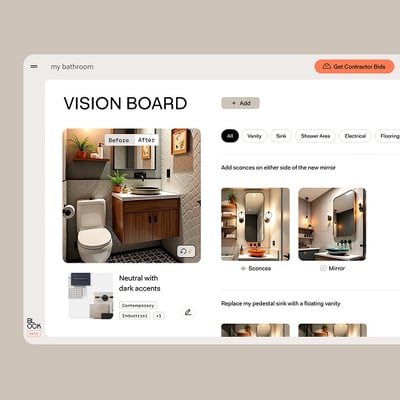
    Explore stunning design ideas, materials, and color schemes tailored to your space—no guesswork, just inspiration.
    Start Designing

    Ready to build? How Block supports finding contractors in Buffalo

    Finding the right contractor is often the most stressful part of a bathroom remodel. Block helps by matching you with vetted, well-reviewed contractors so you spend less energy on cold calls and more on making good design and scope decisions.

    Through Block, your project is supported by structured planning, organized documentation, and milestone-based payments, which can help keep expectations aligned between you and your contractor. Block Protections add another layer of confidence during the remodel, so you are not navigating every step on your own.

    Remodel with confidence through Block

    Happy contractor doing an interview

    Connect to vetted local contractors

    We only work with top-tier, thoroughly vetted contractors

    Couple planning their renovation around the Block dashboard

    Get expert guidance

    Our project planners offer expert advice, scope review, and ongoing support as needed

    Familty enjoying coffee in their newly renovated modern ktchen

    Enjoy peace of mind throughout your renovation

    Secure payment system puts you in control and protects your remodel

    Get Started

    Frequently asked questions

    What is the most expensive part of bathroom renovations in Buffalo?

    Labor-heavy wet-area work usually drives the largest share of the budget. Custom showers, waterproofing systems, detailed tile installation, and any relocation of plumbing consume time and skilled labor. Costs also climb quickly if your contractor has to repair hidden water damage, replace deteriorated framing, or upgrade outdated electrical in the process.

    When is it valuable to have an interior designer for a bathroom remodel?

    Design help is especially worthwhile if you are changing the layout, trying to respect the character of a historic Buffalo home, or coordinating several finishes in a small space. An experienced designer can help you use the room more efficiently, select materials that work well under your lighting and humidity conditions, and avoid costly re-orders caused by scale or color mismatches.

    When is the best time of year to remodel a bathroom in Buffalo?

    Many homeowners aim for spring through early fall to avoid the coldest stretch, when snowstorms, frozen ground, and ventilation challenges can complicate work. That said, good contractors often book those months quickly, so your actual timing may depend more on availability and how easily your household can manage losing a bathroom for several weeks.