
Bathroom
York City Bathroom Remodel: Costs, Planning & Design
09.17.2026
07.16.2026


In This Article
If the grout in your bathroom has gone dark and the tile behind it is chipped or dated, you've probably started pricing the fix in your head before calling anyone. For most homeowners, tiling a bathroom runs $3,000 to $12,000 depending on the size of the room, the material, and how much of the space gets tiled. Here's the part that surprises people: the tile itself is often the smaller half of that number. Labor at $5 to $15 per square foot can double or triple the material bill, which is why homeowners who spend weeks comparing tile samples and 10 minutes comparing installers usually get the budget backwards.
The sections below break down installation costs by material and by zone, what a tile floor costs on its own, and what changes when you're ripping out old tile rather than starting fresh.
|
Project |
Typical total cost |
|
Small bathroom, up to 50 sq ft of tile |
$3,000 to $4,500 |
|
Medium bathroom, 50 to 100 sq ft |
$4,500 to $7,000 |
|
Large bathroom, over 100 sq ft |
$7,000 to $12,000 or more |
|
Tile floor only |
$800 to $2,500 |
|
Full retile (demo plus new tile) |
Add 15 to 25% to the ranges above |
These are planning ranges. Your quote will land somewhere inside them based on material, layout complexity, and the condition of whatever is underneath.
Four variables account for most of the movement in any tile quote: the material, the square footage, the labor rate, and the complexity of the layout.
Material is the lever you control most directly. Installed costs below include both the tile and professional labor:
|
Tile material |
Material cost per sq ft |
Installed cost per sq ft |
|
Ceramic |
$8 to $15 |
$13 to $30 |
|
Porcelain |
$12 to $25 |
$17 to $40 |
|
Natural stone |
$18 to $65 |
$23 to $80 |
|
Glass |
$20 and up |
$25 and up |
|
Mosaic and penny tile |
$30 and up |
$40 and up |
Ceramic works well on walls and lower-traffic surfaces, while porcelain's density makes it the standard pick for showers and floors. Natural stone like marble and slate carries the highest price and the highest upkeep, since it needs regular sealing to resist stains.
Notice that mosaic and penny tile sit at the top of the installed column even when the sheets are cheap at the store. Small tile costs more to install than big tile, because an installer has to check alignment across every sheet and grouting hundreds of tiny joints takes hours that 12x24 porcelain never asks for. That $6 sheet of penny tile can carry a $25 per square foot install rate. For layout and pattern inspiration, see Block Renovation's modern shower tile ideas and designs.
More square footage means more tile and more installation hours, but small rooms don't scale down the way you'd hope. A powder room with an intricate pattern can cost as much per square foot as a large primary bath, because cuts and detail work take the same labor time no matter how small the room is. If you're working with a tight footprint, Block's minimum bathroom size guide covers how to plan the layout before you pick tile.
Professional installation runs $5 to $15 per square foot in most markets, and on a mid-range job that line item quietly becomes the biggest one on the invoice. Rates climb with tile size extremes, with pattern complexity, and with regional labor costs. Large-format tile needs a substrate flat to within 1/8 inch over 10 feet, so self-leveling compound can add $500 to $1,500 before the first tile goes down.
Here's a spending rule worth taking seriously: cheap tile with a great installer beats expensive tile with an average one. Lippage, wandering grout lines, and awkward cuts around the toilet flange are what make a bathroom look cheap, and no marble slab can hide them. A $12 porcelain laid perfectly will outshine a $60 stone laid carelessly, so if the budget forces a choice, put the money on the labor side.
The $5 to $15 labor spread mostly maps to geography. In mid-market metros and suburbs, straightforward tile work lands near the bottom of the range, while high-cost coastal markets like New York, San Francisco, and Boston start near $10 and climb from there. City work also carries costs that never appear in national averages: paid parking for the crew, longer material hauls up narrow stairs, and building requirements in condos and co-ops.
A certificate of insurance, restricted work hours, and elevator reservations can add days to a schedule, and time is what you're paying for. If you're renovating in a managed building, ask the contractor whether they've worked under board rules before, because a crew learning your building's process on your dime is an expensive education.
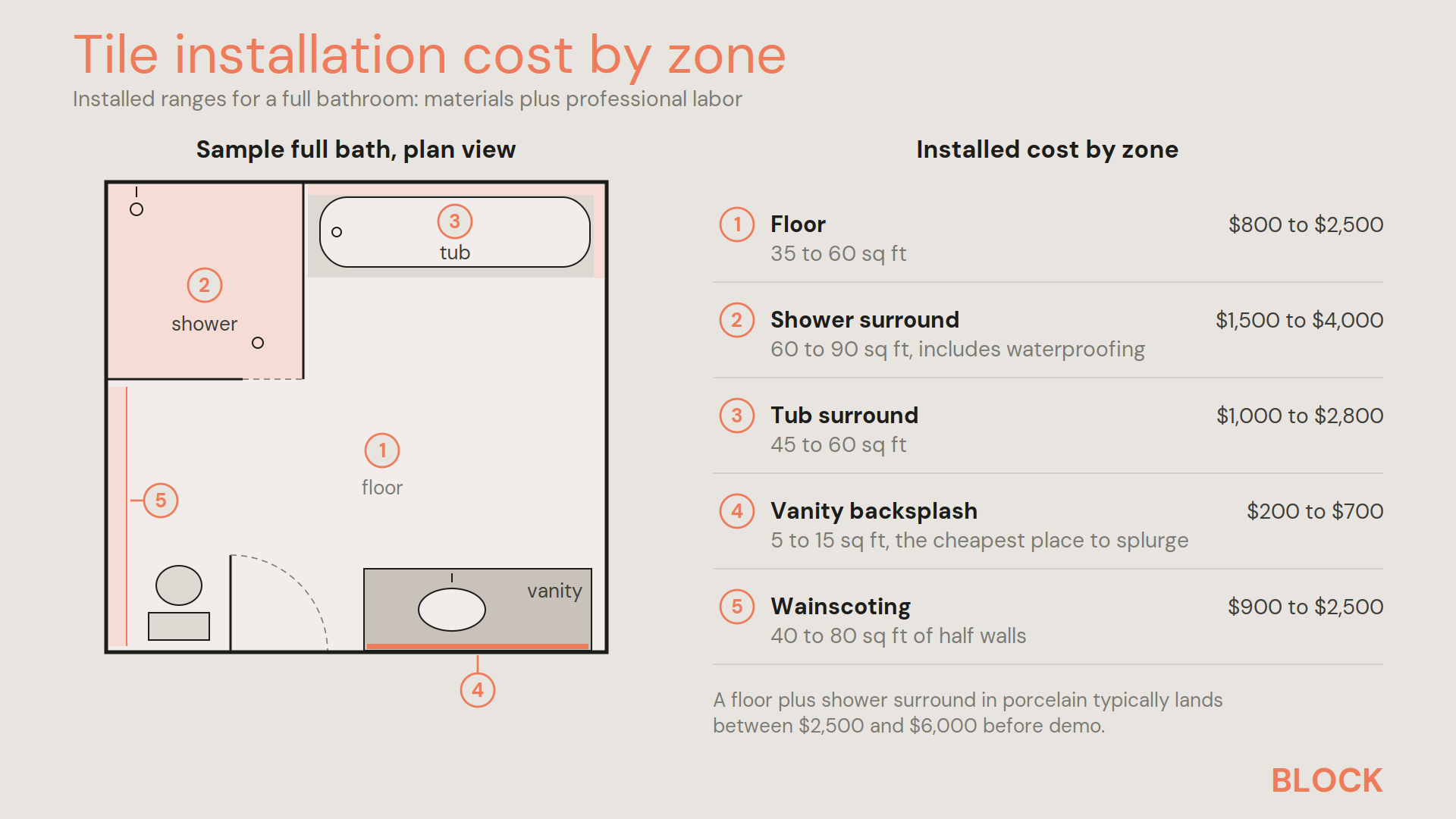
Most bathrooms don't get tiled wall to wall, so your budget depends on which surfaces are in scope. Typical zones break down like this:
|
Zone |
Typical area |
Installed cost |
|
Floor |
35 to 60 sq ft |
$800 to $2,500 |
|
Shower surround (3 walls) |
60 to 90 sq ft |
$1,500 to $4,000 |
|
Tub surround |
45 to 60 sq ft |
$1,000 to $2,800 |
|
Vanity backsplash |
5 to 15 sq ft |
$200 to $700 |
|
Wainscoting (half walls) |
40 to 80 sq ft |
$900 to $2,500 |
The shower surround is usually the most expensive zone per square foot, because it carries the waterproofing work, the niche construction, and the tightest tolerance for error. A backsplash is the cheapest place to try a splurge tile, since the square footage is small and the surface stays dry. Adding zones together gets you close to a real budget: a floor plus shower surround in porcelain typically lands between $2,500 and $6,000 before demo.
A bathroom floor is the most common standalone tile project, and it's cheaper than most homeowners expect. Typical bathroom floors run 35 to 60 square feet, which puts installed costs at $800 to $2,500 for ceramic or porcelain. Natural stone pushes a standard floor to $2,000 to $4,000 once you account for sealing and the stiffer substrate requirements.
Floor tile costs slightly more per square foot than wall tile because the material has to handle foot traffic and resist slipping, and because floor prep (leveling, backer board, uncoupling membrane) adds a layer walls don't need. Budget $2 to $7 per square foot for prep on top of the installed tile price if your subfloor needs work.
One more line item homeowners rarely see coming: grout. Epoxy grout costs 3 to 5x what cement grout does and installs slower, but it never needs sealing and shrugs off stains for the life of the floor. On a full bathroom that's a $300 to $600 decision, and most people make it without knowing they made it.
Ranges get easier to use when they're assembled into whole projects. The three example budgets below show how typical line items combine at different scopes. Your numbers will differ, but the proportions hold.
Small bathroom, ceramic floor and tub surround: about $3,800
Mid-range bathroom, porcelain floor plus full shower retile: about $6,600
Large bathroom, natural stone throughout: about $11,500
Notice what stays constant across all three: labor, demo, and prep together account for roughly half the budget no matter which tile you pick. That's the half most homeowners forget to plan for.
Not every tired bathroom needs a full retile, and the cheaper fixes deserve a look before you commit to demolition. If the tile itself is sound and only the grout has gone dark or cracked, regrouting runs $400 to $900 for a typical bathroom and buys years of life. A few cracked or chipped tiles can be replaced individually for $25 to $75 each, provided you have spares from the original install or can find a close match. Refinishing (spraying a new glaze over existing tile) costs $500 to $1,200 and freshens the color, though the coating wears in 5 to 10 years and can't be redone indefinitely.
The repairs stop making sense when the problem is behind the tile rather than on it. Three signs point to a failed substrate:
Any of these means repair money is wasted money, and the section below covers what the full retile costs.
Retiling starts with a demolition day, and demolition day is when your quote stops being theoretical. Nobody, including your contractor, knows what the old waterproofing hid until the tile comes off the wall. Plan for a full retile to run 15 to 25% above the new-install ranges, which puts a small bathroom at roughly $3,500 to $5,500 and a large one at $8,500 to $15,000.
The added cost comes from three places:
If your retile is part of a larger shower rebuild, the shower installation cost guide breaks out pan, valve, and glass costs separately.
Bathrooms are, unfortunately, the worst room in the house to learn tiling. The projects that draw DIYers in (a small floor, a shower surround) are the ones where waterproofing, slope, and cuts around a toilet flange leave no room for a beginner's learning curve. A mistake on a kitchen backsplash is a cosmetic problem. A mistake behind a shower wall is a leak you find a year later, and at that point the labor you saved has been spent several times over on repairs.
That said, a confident DIYer with the right tools can handle a simple floor in a dry area of the bathroom. Block's step-by-step floor tiling guide walks through what the job involves so you can judge honestly whether it's your project. Anything in the wet zone belongs to a pro.
A polished tile that photographs beautifully can be a slip hazard on a bathroom floor, and a soft, porous tile in a shower will stain and wear early. For floors, check the tile's slip rating: the industry standard is a dynamic coefficient of friction (DCOF) measured under ANSI A326.3, and manufacturers now publish product use classifications that tell you whether a tile is rated for wet areas. Match the material and the rating to the surface first, then pick the finish you like within that category. Porcelain for wet zones and floors, ceramic for walls, is the pairing that holds up.
Material prices are easy to research, so homeowners anchor on them and treat demo, leveling, and waterproofing as afterthoughts. Those line items routinely account for 20 to 30% of a tile quote. Get every prep step written into the scope before comparing bids. A low quote that omits waterproofing costs more than the high quote that includes it.
Two tile quotes can be $2,000 apart and describe different jobs, so the comparison only works line by line. Before signing, confirm the quote spells out:
A missing line item isn't a discount. It's a cost that shows up later with worse timing, which is why every scope on Block gets reviewed for gaps like these before homeowners compare bids.
The fastest way to turn these ranges into a real number is to put your specific bathroom in front of vetted contractors and compare detailed scopes side by side. Block matches homeowners with contractors who compete for the project, reviews every scope to catch missing line items like waterproofing and disposal before work begins, and ties payments to progress. If tile is one piece of a bigger project, start with the bathroom remodel cost guide to budget the full renovation.
Remodel with confidence through Block
Connect to vetted local contractors
We only work with top-tier, thoroughly vetted contractors

Get expert guidance
Our project planners offer expert advice, scope review, and ongoing support as needed
Enjoy peace of mind throughout your renovation
Secure payment system puts you in control and protects your remodel

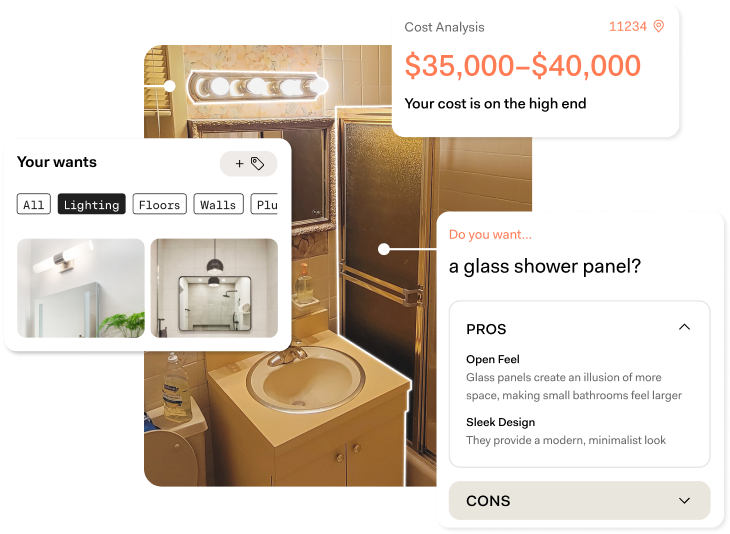
Calculate the true cost of your bathroom remodel
Get real-time cost estimates for materials and labor, so you can budget your renovation with confidence—no guesswork.
Bathroom
York City Bathroom Remodel: Costs, Planning & Design
09.17.2026
Bathroom
Walk-In Tub vs. Walk-In Shower for Seniors
09.16.2026
Cost
The Cost to Add a Half Bath & How to Plan for It
09.04.2026
Remodeling
How to Remodel a Game Room: Ideas and Costs
09.03.2026
Remodeling
How Much Does It Cost to Remodel a 2,000 Sq Ft House?
08.26.2026