







Bathroom
Bathroom Renovation Order of Trades: Coordination Guide
11.09.2026
Budget your upcoming New York bathroom remodel with help from Block
09.17.2026


In This Article
You can choose every finish for your New York City bathroom before demolition and still have the plan change once the walls open. Pipes land where you hoped to put a niche, a co-op has stricter working hours than expected, or the 40-square-foot footprint makes moving a fixture far more consequential than it looked on paper.
Those constraints are part of budgeting a New York bathroom remodel. The cost depends less on whether the room is 40 or 70 square feet than many homeowners expect because both still need demolition, waterproofing, plumbing, electrical work, tile labor, and access through the building.
Broadly, a full New York bathroom remodel can stretch from $20,000 well past $50,000. But that number still tells you surprisingly little on its own.
Research about NYC bathroom costs, and any broad figures will provide surprisingly little insight. Take the examples below; all hail from the New York City area, and yet the bathroom renovations span from $23,000 to $52,857.
| Real bathroom remodel | Known build time | Total cost |
|---|---|---|
| Quick Bathroom Upgrade, Hoboken | 4 weeks | $23,000 |
| Arched Mirror & Clay Tile, Queens | 4 weeks | $29,300 |
| Modern Matte Bathroom Makeover, Manhattan | 5 weeks | $30,000 |
| Bayside full-gut bathroom | 3 weeks | $45,000 |
| Tribeca water-damage remodel | 6 weeks | $45,000 |
| Minimalist Serenity Bathroom, Brooklyn | Not published | $52,857 |
Case in point, the $29,300 Arched Mirror & Clay Tile bathroom and the $45,000 Bayside remodel are both in Queens, but their scopes are very different. The lower-cost project followed an established client design without major mid-build changes. Meanwhile, the Bayside was a full gut renovation with new tile, vanity, shower, toilet, and electrical work.
Bayside and Tribeca are an even more interesting pair. Both cost $45,000, but Bayside was built in 3 weeks and Tribeca took 6. Tribeca included water-damage remediation, extensive plumbing and waterproofing, plus Calacatta marble. The identical totals show why build time and price do not move together neatly. A project can spend considerably more time on necessary work behind the finish without ending up more expensive than a faster full gut.
The best way to predict your own bathroom remodel is to get a free estimate from real New York contractors based on the room's condition and your goals.
The biggest cost differences tend to come from scope rather than one expensive faucet or tile selection.
Some NYC bathroom frustrations can be fixed for a few thousand dollars during a remodel; others become expensive the moment plumbing has to move.
| Problem | Practical solution | Cost |
|---|---|---|
| Poor ventilation | Upgrade or add an exhaust fan; add ductwork when the existing ventilation is inadequate | $500 to $2,500+ |
| Almost no useful storage | Replace a pedestal sink with a vanity, add a recessed medicine cabinet, or build shallow storage into unused wall space | $1,000 to $5,000+ |
| Awkward radiator or pipe placement | Design around exposed pipes when possible; relocate a radiator or reroute accessible piping when the layout gain justifies it | $1,500 to $5,000+ |
| Inconsistent water pressure or temperature | Replace failing valves or fixtures and investigate in-unit plumbing before assuming the problem is building-wide | $500 to $3,000+ |
| Bad lighting in a windowless room | Combine better overhead lighting with dedicated mirror or vanity lighting | $800 to $3,000+ |
| Layouts built around outdated fixtures | Replace oversized fixtures in place when possible; move plumbing only when the extra floor space or function is worth the added work | $5,000 to $20,000+ |
| Recessed features do not fit where planned | Confirm wall conditions after demolition and be ready to move the niche or medicine cabinet, use a shallower option, or switch to surface-mounted storage | $500 to $3,000+ |
A rendering can tell you where a recessed medicine cabinet looks best, but it cannot tell you whether a plumbing riser is occupying that exact section of wall. Existing pipes are especially important in NYC condos and co-ops because the bathroom sits inside a larger building system.
A niche, recessed cabinet, outlet, or light location that appears simple during design can become much more complicated once the wall is open. New York interior designer Meredith Sells advises homeowners to treat those recessed features differently from movable finishes such as mirrors or hardware.

“I would treat anything that needs to be set into the walls as TBD. Don’t get your heart set on it. A lot of homeowners will design a bathroom around an accent niche in a perfect spot, maybe with accent tile around it. Because it’s recessed into the wall, I always put a big asterisk next to it: this has to be confirmed in construction.”
That is a specific disappointment she is trying to prevent. You can spend weeks choosing the accent tile around a niche, position the rest of the shower around it, and then discover after demolition that a pipe owns that piece of wall.
A better plan is to choose your preferred niche location and a fallback before demolition. Then the contractor has somewhere to go if the first option fails without forcing a rushed redesign.
The same problem can reach the ceiling. In some apartments, adding overhead lighting means lowering part of the ceiling to create enough room for the electrical work.
For many apartment owners, the building comes before the city. Your co-op or condo may require an alteration agreement, insurance documents, contractor credentials, elevator reservations, protection of common areas, and approval before anyone starts work.
Some buildings also limit construction hours or days. Those restrictions matter because they reduce the amount of productive time a crew actually has inside the apartment.
Once building requirements are clear, the city-permit question depends on scope. Swapping a faucet, toilet, or sink into the same location can qualify as cosmetic plumbing work. Touch the valve, trap, or piping location and a licensed plumber and applicable permits enter the picture.
A newer DOB NOW requirement adds another dependency for condo and co-op renovations. Beginning February 2, 2026, the condo or co-op board is a required stakeholder on a filing when the owner is a condo unit owner or co-op tenant-shareholder. The board representative must attest that the applicant is authorized to file, and the filing cannot proceed until the required attestations are complete. In practical terms, a slow board can now delay the city filing itself, not merely the building's internal approval.
Plan on roughly 3 to 6 months from initial design work to a finished bathroom. Active construction itself is much shorter, usually around 4 to 6 weeks, but design, building review, permits, procurement, and contractor scheduling all add time before work begins.
Block's current NYC guidance puts design at roughly 2 to 6 weeks and pre-construction at 5 to 12 weeks. Art Deco Enterprises contractor Sorina Panfil estimates 4 to 12 weeks for approvals. Material delays can stretch the schedule further when one missing item holds up plumbing, templating, or another trade.
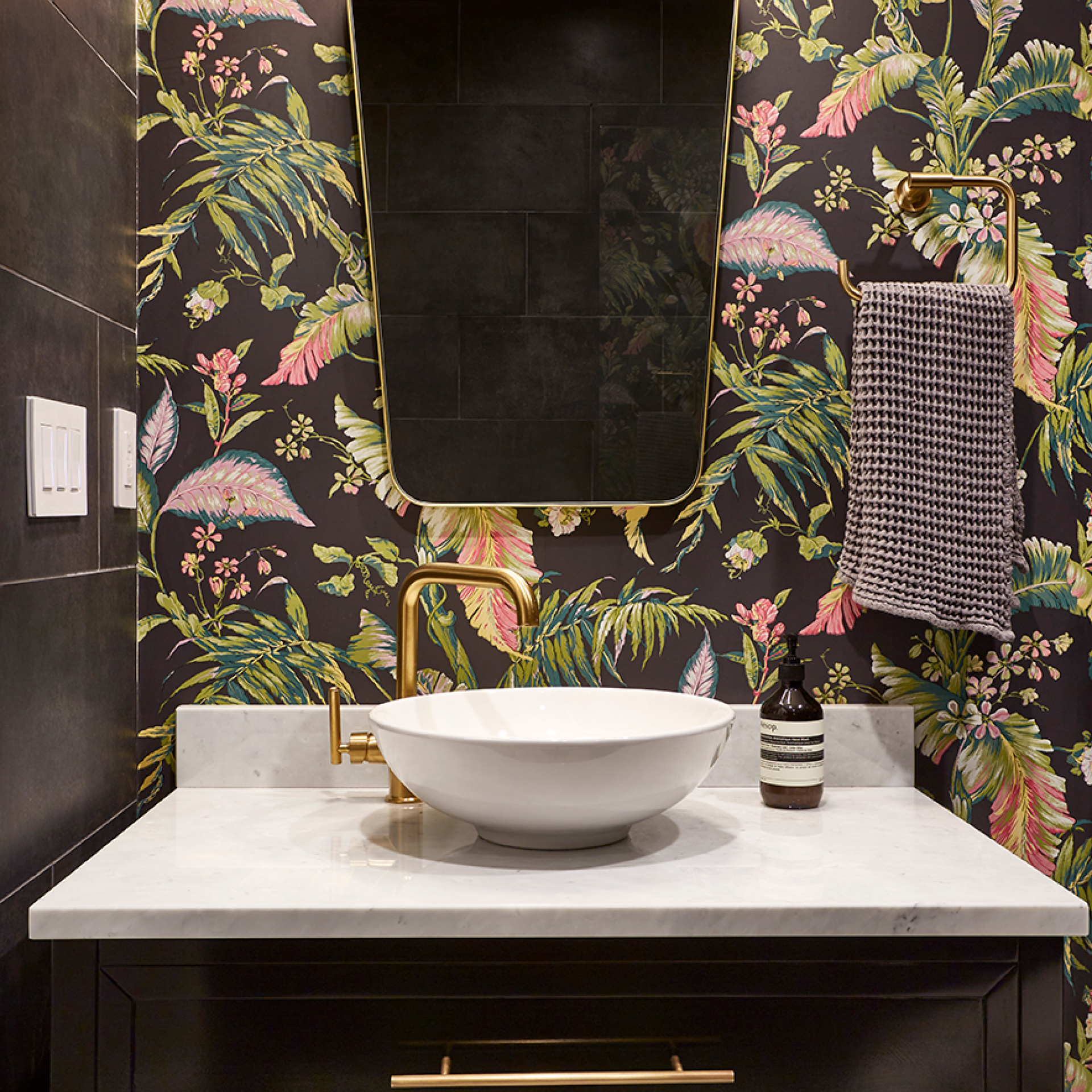
A small bathroom does not need to be pale, minimal, and stripped of personality, but it does need hierarchy. Trying to make the tile, vanity, hardware, lighting, and shower enclosure all compete for attention is where a compact room starts to feel overloaded. Meredith regularly talks New York City clients out of that instinct.

“One request I talk people out of is trying to do accent tile everywhere in a really small space. It just gets really busy. Particularly in New York City or smaller city apartments, it’s about restraint. There’s an opportunity for lots of pattern and color, but it can’t be every surface everywhere all the time.”
She is pushing against a familiar design instinct: if one bold material looks good, more must look better. In a small NYC bathroom, the opposite is usually stronger. Put the high-contrast tile on the floor, let it carry the room, and give the vanity, shower walls, and hardware supporting roles.
Block's small bathroom remodeling guide covers more layout strategies, but a few decisions matter especially in compact rooms:
In a 40-square-foot bathroom, a few inches matter. A 36-inch vanity instead of a 30-inch one can improve storage while making circulation noticeably tighter. A door swing can consume the same area you hoped to use for shelving or a larger sink.

A skillfully balanced budget and style resulted in this airy 40-square-foot bathroom renovation in Greenwich Village. By maintaining the original layout and preserving the existing bathtub, homeowner Matt managed to cut costs. His vision for the Manhattan bathroom renovation was to create a space that felt modern yet timeless, achieved by pairing a vibrant green wall with a natural wood vanity and brass accents.

Updating the two bathrooms in a Brooklyn condo was a top priority for Chris and Ryan. Previous renovations had been difficult, but their project with Block was significantly smoother and was designed to echo the black-and-white elements throughout their apartment. Chris explained, “Compared to what we’ve done before, the build was so much more seamless and communicative. Our contractor was amazing to work with, was extremely responsive and thoughtful throughout the whole process.”

For their renovated NYC bathrooms, they opted to create two unique looks: the black and white bath to suit Chris’s “clean-lined and structured” personality, and a playful pink bath to reflect Ryan, who Chris described as, “artsy, creative, and out there.” The 40-square-foot bath blends classic elements like white subway tile and brass fixtures with whimsical elements like the arched mirror and green shower curtain. If you're drawn to the artsy look of the second, click here for the full gallery.

Another Brooklyn bathroom renovation moved away from darker beige finishes and a dated shower toward white subway and hex tile, a glass enclosure, brass fixtures, and an updated vanity.
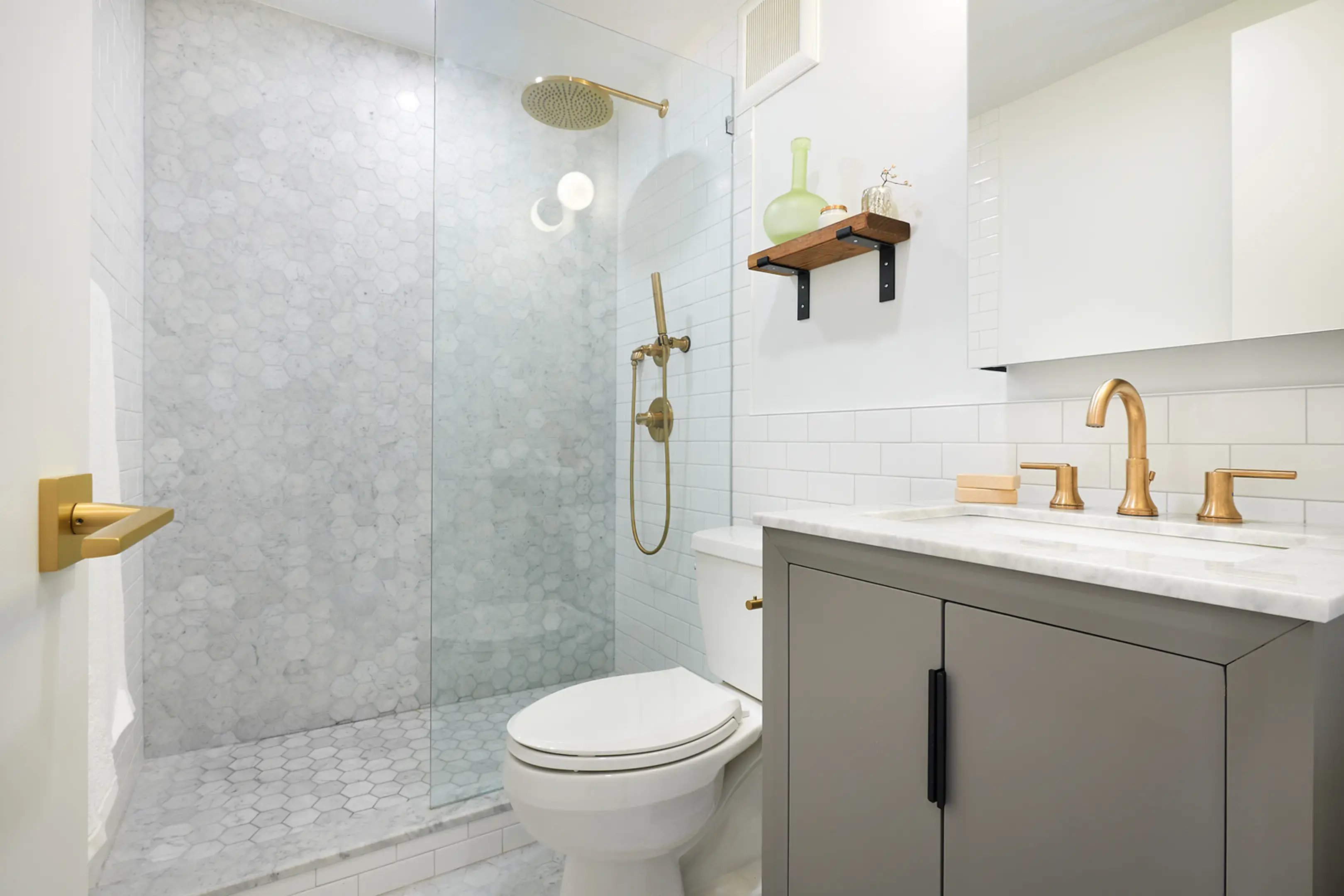
Most of the room is deliberately quiet. That leaves enough visual room for the brass and marble to feel special instead of making them compete with another patterned wall or highly decorative floor.
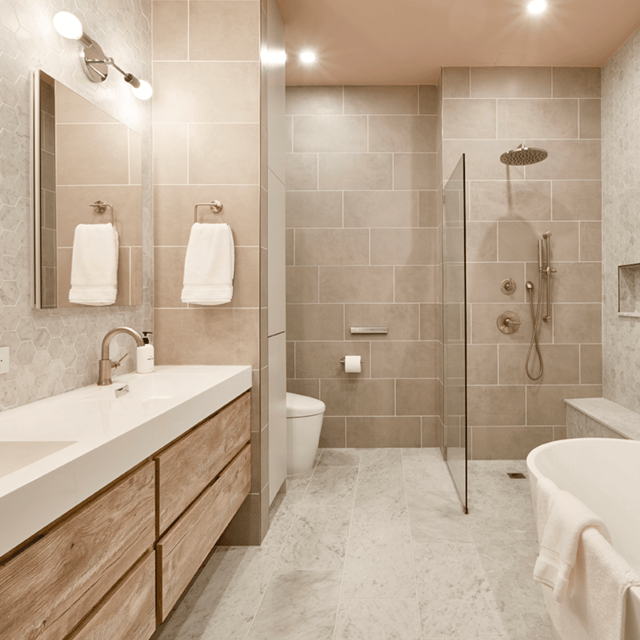
In one New York bathroom renovation, the original room had a tub-shower combination, bulky vanity, and limited storage. The renovation replaced the tub with a walk-in shower and frameless glass partition, while a wall-mounted sink replaced the old vanity.
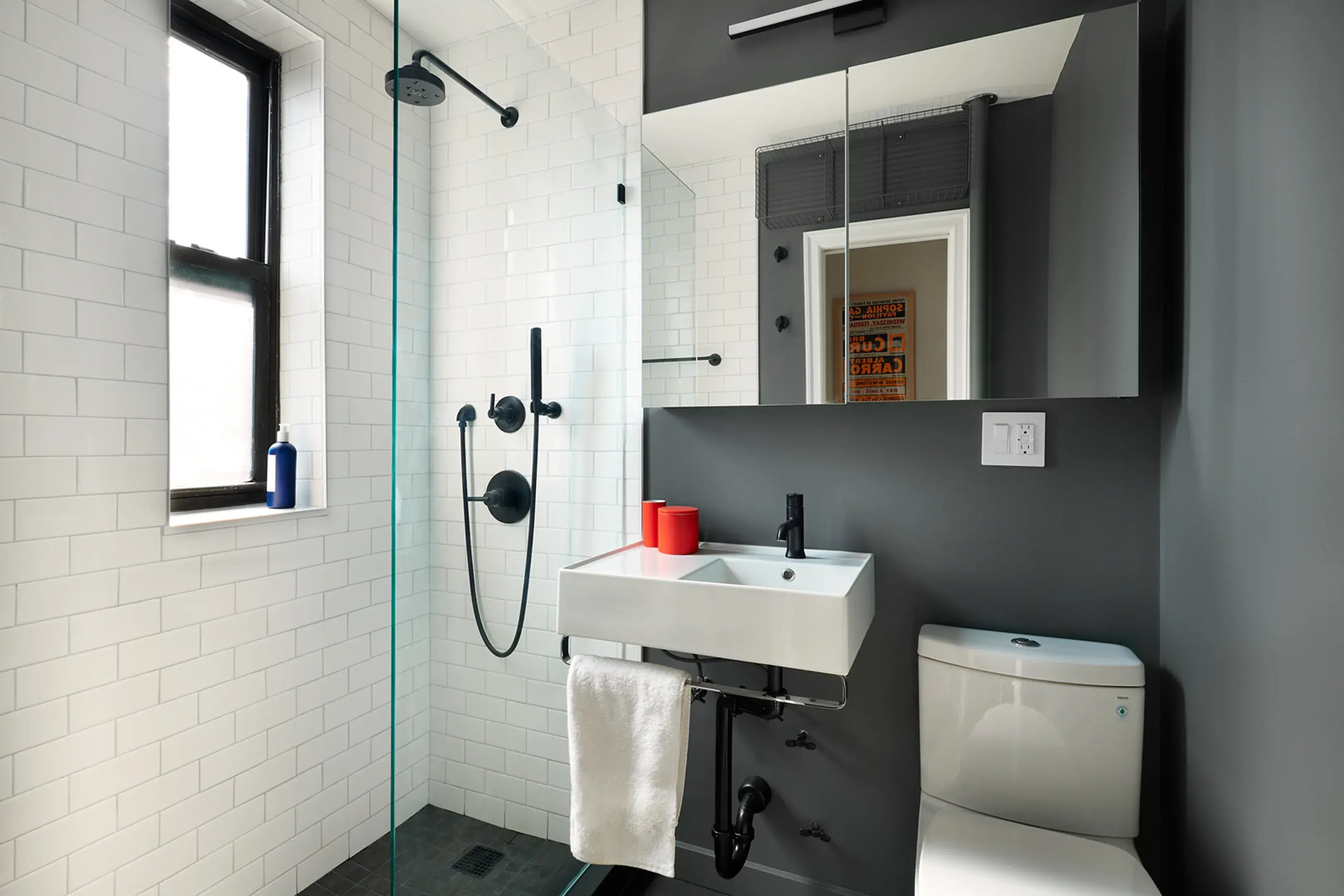
That combination makes sense when circulation is the real problem. Removing the tub alone does not suddenly create a spacious bathroom; the glass enclosure and sink choice determine how much of that visual and physical space you actually get back.
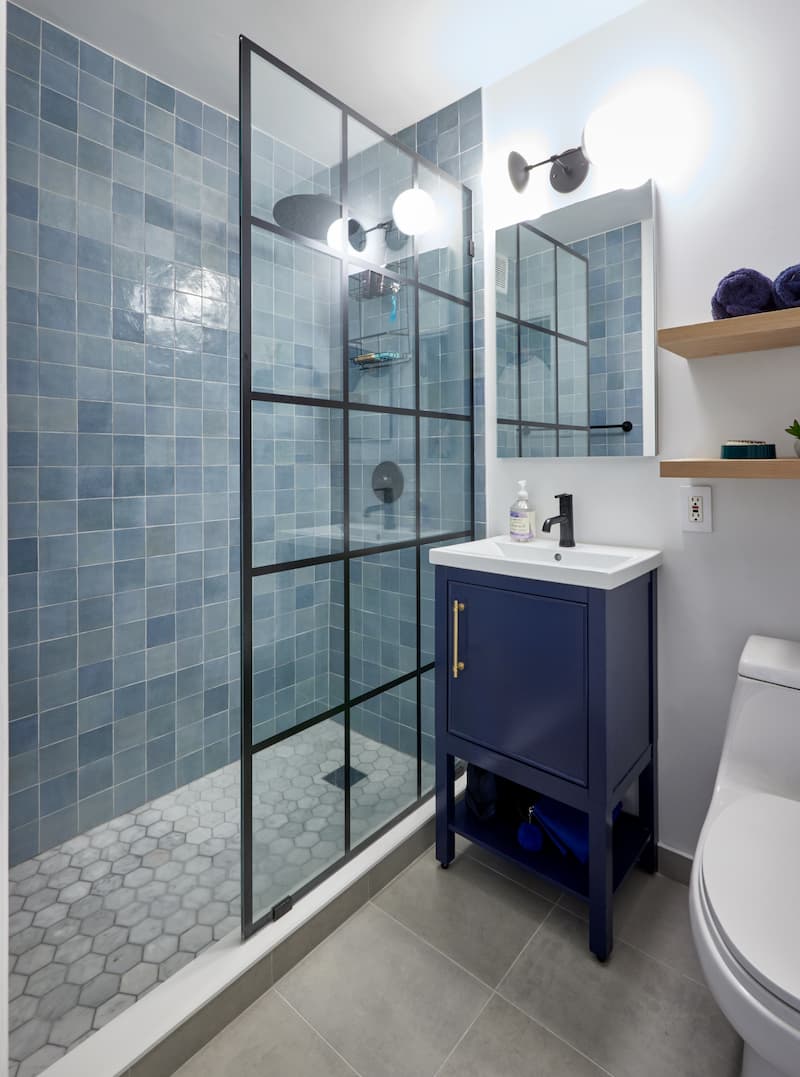
A different 60-square-foot Brooklyn bathroom uses blue tile across the floor and shower walls, black fixtures, a checkered shower curtain, orange shelving, and a colored ceiling light.
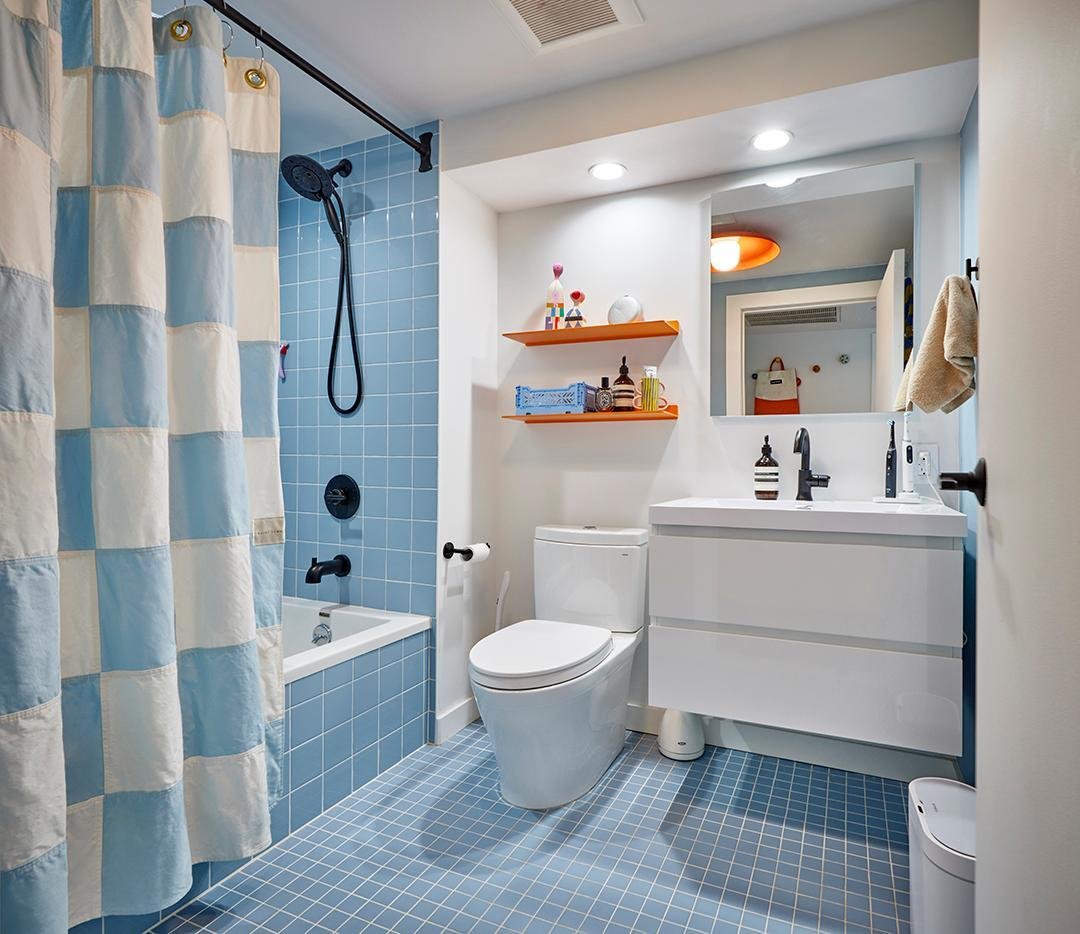
The room is colorful and playful without making every permanent finish compete for attention. The blue tile establishes the dominant palette, while the black and orange details work as accents. Meredith designed this New York bathroom remodel, proving her point about not having too many competing elements.
Look at the "before" of this particular Brooklyn bathroom, and you'll have a newfound appreciation for the remodel's "after." Everything worked against it aesthetically: the wallpaper, the lighting, the tile, the shower . . . the Block designer and contractor on this project worked wonders on this space to prove that no New York homeowner is ever truly "stuck" with what they inherited from past owners.

A bathroom budget gets stronger once you stop treating every upgrade as equally important. Some things are expensive to change later, while others can be swapped in an afternoon.
Moving the toilet, shower, or vanity should earn the additional construction cost. If the current arrangement functions well, keeping those fixtures near their existing plumbing is one of the clearest ways to control scope.
Replacing an awkward vanity or old tub while keeping the basic plumbing locations can still completely change the room.
Waterproofing, properly prepared substrates, and sound plumbing disappear once the bathroom is complete. That invisibility makes them easy to undervalue and expensive to regret.
Spend there before upgrading the faucet or choosing a more expensive mirror. Beautiful tile cannot rescue a shower that was waterproofed poorly.
The Tribeca project in the cost table shows why this deserves real budget. Water-damage remediation, plumbing, and waterproofing consumed part of a $45,000 renovation even though those are not the details anyone will notice first in the finished photos.
An odd alcove, unusual wall depth, or serious storage problem can justify custom cabinetry. A standard wall that comfortably accepts a stock vanity usually does not.
Paying for custom because the room requires a custom solution makes sense. Paying for custom dimensions when a stock product fits is harder to justify.
Heated flooring is one of the stronger bathroom luxuries to add during the renovation itself. The floor is already being rebuilt, so installation can be coordinated with work that is happening anyway.
Block designer Meredith puts the appeal more simply: “I don’t think people usually say, ‘I wish I didn’t have warm feet.’” She considers heated floors a luxury-level upgrade whose added installation cost can be relatively modest compared with the rest of a bathroom renovation.
The payoff is particularly noticeable in a smaller New Yorkbathroom. You are heating a compact floor area you step onto every morning rather than paying more for another decorative fixture that may fade into the background after a few months.

The NYC-specific question is whether the contractor knows how to work inside your building, not simply whether they have renovated bathrooms before. Ask how they have handled restricted work hours, plumbing shutdowns, common-area protection, deliveries, and elevator scheduling on comparable projects.
Then move quickly to the proposal itself:
A low proposal that leaves out work everyone assumes is included is not really the low proposal.
A free estimate is ultimately more useful than trying to reverse-engineer your bathroom price from somebody else's project. Block Renovation can match you with vetted local contractors who price the actual room, building conditions, and scope you are considering.
Block also reviews project scopes before construction, helping surface missing line items and unclear assumptions while there is still time to fix them.
Remodel with confidence through Block

Connect to vetted local contractors
We only work with top-tier, thoroughly vetted contractors

Get expert guidance
Our project planners offer expert advice, scope review, and ongoing support as needed
Enjoy peace of mind throughout your renovation
Secure payment system puts you in control and protects your remodel

Renovate confidently with Block
Easily compare quotes from top quality contractors, and get peace of mind with warranty & price protections.
Bathroom
Bathroom Renovation Order of Trades: Coordination Guide
11.09.2026

New York
Interior Renovation NYC: Costs, Rules & Contractors
10.22.2026
New York
Custom Millwork NYC: Costs, Ideas & Expert Advice
10.20.2026

New York
Brooklyn Basement Remodeling Costs: What to Budget
10.10.2026
New York
Prewar Condo Renovations: NYC Costs and Contractors
10.09.2026