




.png?width=640&name=u5821215421_A_sleek_15x8-foot_galley_kitchen_inspired_by_Apar_9ff6d0ad-f9e4-4838-84cd-9970bf80eee3_1%20(2).png)
Washington
Renovating in Spokane: Cost, Value, and Contractors
07.02.2026

03.09.2026


In This Article
Spokane has emerged as one of the Pacific Northwest’s most compelling alternatives to Seattle, offering mountain access, a revitalized downtown centered on the Spokane River, and a cost of living that lets families build the kind of home that would be out of reach on the west side of the state. The region’s economy has diversified beyond its timber and mining roots into healthcare, higher education, and a growing tech sector, while outdoor recreation—skiing at Schweitzer and Mt. Spokane, hiking in Riverside State Park, and lake life on Coeur d’Alene—remains a daily reality rather than a weekend escape. For homeowners who want a residence designed around four distinct seasons and genuine connection to the natural landscape, Spokane delivers on that promise.
Building here, however, means engineering for conditions that challenge even experienced contractors from milder climates. Frost depths reaching 24 inches, basalt bedrock that complicates excavation, heavy snow loads, and a compressed building season all require builders with specific Inland Northwest expertise.
Design a Home That’s Uniquely Yours
Block can help you achieve your renovation goals and bring your dream remodel to life with price assurance and expert support.
Get Started
Spokane’s construction costs are significantly lower than western Washington, making custom building accessible to a broader range of budgets—but understanding the local cost drivers prevents unpleasant surprises.
Custom home construction in Spokane typically costs $180 to $350 per square foot depending on design complexity, finish level, and site conditions. Standard builds with builder-grade finishes start around $150 to $180, while fully custom homes with premium materials push into the $250 to $350 range. For a 2,500-square-foot home, expect a construction budget of $450,000 to $875,000 before land. Residential lots in Spokane range from $50,000 to $150,000 in established neighborhoods, with premium view lots on the South Hill or along the Spokane River commanding higher prices.
Labor costs have risen alongside Spokane’s population growth, though they remain well below Seattle rates. Material costs benefit from proximity to regional lumber suppliers in Idaho and Montana, though specialty items and imported finishes carry standard lead times. The frost line at 24 inches below grade increases foundation costs compared to milder climates, and snow load engineering adds structural expense to roof systems.
Lot selection drives meaningful cost variation. A flat, utilities-ready lot in a South Hill subdivision develops straightforwardly, while a sloped lot above the river valley with basalt bedrock may require specialized excavation, retaining walls, and extended utility runs.
Foundation work in Spokane is shaped by the region’s 24-inch frost depth requirement, which means all footings must extend at least two feet below grade to prevent frost heave—adding concrete and excavation costs relative to southern markets. Full basements are common and practical, providing tornado and severe weather shelter while adding finished living space for $30 to $40 per square foot of basement footprint. Framing costs are driven by snow load requirements that range from 25 to 40+ pounds per square foot depending on elevation and roof geometry, demanding engineered trusses and potentially heavier lumber. Mechanical systems account for 12 to 15 percent of the build, with high-efficiency furnaces, central air conditioning, and increasingly heat pump systems specified for Spokane’s 100-degree annual temperature swing. Finish selections remain the widest variable, with kitchen and bath upgrades capable of shifting the budget by $50,000 to $100,000.
Spokane custom home clients commonly request these features:
A typical custom home in Spokane takes 10 to 14 months from design through move-in, though complex projects can extend to 18 months. Spokane’s building season is most productive from April through October, when temperatures allow concrete pours and exterior work to proceed without cold-weather accommodations. Winter construction is possible but adds cost for heated enclosures and can slow progress. Permitting through the City of Spokane or Spokane County typically takes four to six weeks for plan review, and trade scheduling has tightened as the region’s population growth has increased construction demand.
An experienced Spokane builder understands how the region’s geology, climate, and municipal codes affect a lot’s true development cost. Involving your builder before you close on land protects you from surprises that only become apparent during excavation. Key considerations include:
Spokane families consistently value proximity to highly rated schools in the Mead, Central Valley, and Spokane Public School districts, along with access to outdoor recreation, trail systems, and commute convenience. The South Hill, Eagle Ridge, and Five Mile Prairie communities are perennial favorites for custom home buyers.
Spokane’s architecture reflects its position between the Pacific Northwest’s modern design sensibility and the Inland Empire’s practical, four-season building traditions.
Spokane’s Inland Northwest climate and geology create building conditions that differ significantly from both the coastal Pacific Northwest and the Mountain West.
Compare Proposals with Ease
Spokane’s frost depth of 24 inches below finished grade is codified in the city and county joint policy, and all foundation footings must extend to or below this depth to prevent frost heave—the upward movement of soil as groundwater freezes. Frost heave can crack foundations, shift walls, and damage utility connections if footings are improperly placed. The freeze-thaw cycle also affects exterior concrete, requiring air-entrained concrete mixes for driveways, walkways, and patios to prevent spalling. Basement walls must be properly waterproofed and insulated to prevent condensation in the transition between heated interior space and frozen exterior soil. Experienced Spokane builders use steel-reinforced footings and stem walls that exceed minimum code requirements for long-term performance.
The Channeled Scablands geology underlying much of the Spokane area means basalt bedrock can be encountered at unpredictable depths during excavation. When rock is within the foundation zone, conventional excavation equipment cannot cut through it, requiring hydraulic rock hammers or controlled blasting that adds significant cost and requires separate permitting. Even utility trenching for water, sewer, and electrical lines costs two to three times more in rock than in soil. A pre-purchase geotechnical boring costing $1,500 to $3,000 reveals rock depth and prevents surprises that can blow a construction budget. Experienced Spokane builders factor rock probability into estimates based on the lot’s position relative to known basalt formations.
Spokane averages 44 inches of snowfall annually, and roof systems must be engineered for ground snow loads of 25 to 40+ pounds per square foot depending on location and elevation. Improperly designed roofs can deflect, sag, or in extreme cases fail under accumulated snow weight. Ice dams—ridges of ice at the eaves caused by heat escaping through the roof—are a common problem that proper attic insulation, ventilation, and ice-and-water-shield membrane at the eaves prevent. Snow guards on metal roofs prevent dangerous sheet-release of accumulated snow over walkways and entrances. A builder experienced in Spokane’s snow country understands these details as standard practice, not afterthoughts.
Regional wildfire activity during July through September has made summer air quality a recurring concern in the Spokane area, with smoke from fires in Washington, Idaho, Oregon, and British Columbia sometimes blanketing the region for weeks. New construction should incorporate high-efficiency HVAC filtration—MERV 13 or higher rated filters—and tight building envelopes that prevent smoke infiltration. Energy recovery ventilators provide fresh air exchange without opening windows during smoke events. Lots in the wildland-urban interface require defensible space planning, fire-resistant roofing and siding materials, and ember-resistant vents. These considerations add modest cost but significantly improve livability during smoke season and reduce risk for properties near forested areas.
Finding the right builder isn’t only about credentials—it’s about communication style and whether you feel comfortable trusting this team with one of your largest investments. These questions help you evaluate both qualifications and fit when interviewing Spokane custom home builders:

“Unplanned change orders derail budgets. The best contractors identify risks early instead of surprising you mid‑build.”
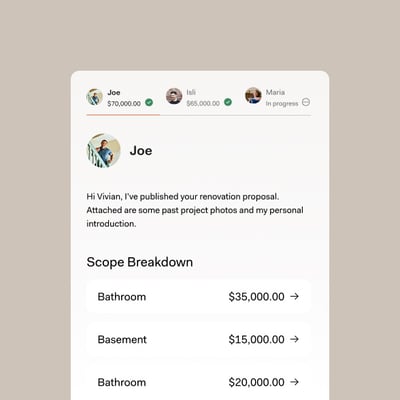
Block Renovation connects Spokane homeowners with thoroughly vetted local contractors who have passed insurance verification and reference reviews tailored to the Spokane market. Every contractor in Block’s network is handpicked for your project’s scope and style, so you receive personalized matches rather than a generic list. You can compare proposals side by side with guidance from a dedicated Project Planner who understands Spokane’s building landscape.
Once you’ve selected a builder, Block’s protections keep your project on track with systemized, milestone-based payments that ensure contractors are paid only as work is completed. Every homeowner receives expert guidance from their Project Planner through proposal review, timeline coordination, and contractor selection. Block’s structured process provides transparency and accountability from the first site visit through final walkthrough.
Remodel with confidence through Block

Connect to vetted local contractors
We only work with top-tier, thoroughly vetted contractors

Get expert guidance
Our project planners offer expert advice, scope review, and ongoing support as needed

Enjoy peace of mind throughout your renovation
Secure payment system puts you in control and protects your remodel


Renovate confidently with Block
Easily compare quotes from top quality contractors, and get peace of mind with warranty & price protections.
Washington
Renovating in Spokane: Cost, Value, and Contractors
07.02.2026
Washington
Seattle Bathroom Remodeling Trends – 13 Design Ideas for 2026
06.24.2026

Washington
Luxury Home Renovations in Seattle – 15 Ideas to Elevate Your Space
06.24.2026

Washington
Well-Reviewed Contractors in Seattle and Washington State
05.27.2026

Washington
Well-Reviewed ADU Builders in Seattle & Washington State
05.19.2026