








Stairs
Staircase Remodel Ideas to Enhance Your Home
07.05.2026
05.21.2026


.jpg?width=640&name=images%20(2).jpg)
In This Article
Most of the structure that holds a staircase together is hidden inside the wall or under your feet. It also sits in the most visible spot in the house, usually within the first ten feet of the front door. That combination is what makes stairs remodeling such a strange project to budget for. The price range runs from about $400 for a thoughtful repaint to north of $100,000 for a structurally engineered floating staircase, and most projects land somewhere in between.
Refinishing existing stairs runs $321 to $1,255 nationally, with an average of $788. A full staircase replacement falls between $953 and $3,236 for standard work, while custom builds with hardwood treads, new balusters, and a fresh railing system commonly land between $3,900 and $12,800. Floating staircases sit in their own tier entirely, ranging from $15,000 to $60,000 for residential projects and climbing past $100,000 for statement designs with glass railings and custom landings.
A few rough benchmarks help here:
Labor is usually the biggest line item. Skilled stair installers charge $50 to $150 per hour depending on the region, with a 12-step traditional replacement requiring $1,200 to $3,000 in labor alone. On a custom project, labor often runs higher than materials, especially when a master carpenter is involved. The same crew might charge $100 to $200 per step for a retro overlay, where new treads cover existing stringers, and $150 to $300 per step for a full replacement that includes demolition.
This is why two homeowners on the same block can spend ten times more than each other on stairs remodeling and both feel like they got a fair price. They are buying different scopes.
A stairs renovation can mean several different projects depending on what is wrong, what is dated, and what the homeowner wants to change. Most projects fall into one of four categories:
Turn your renovation vision into reality
Get matched with trusted contractors and start your renovation today!
Find a Contractor
Most homeowners come into a stairs project with one specific change in mind. The trick is figuring out which changes give the most visual return per dollar. A few ideas earn their cost.
Replacing wood spindles with metal balusters is the single most common upgrade in 2026 and the one that tends to date a staircase the least over time. Black powder-coated metal balusters paired with stained wood treads suit both modern and traditional homes, and the swap usually runs $1,200 to $1,600 for the balusters and labor combined.
Opening up closed risers, when the structure allows it, changes how light moves through a stairwell. The visual effect is dramatic, but the cost depends on whether the existing stringers are open-frame or closed-stringer construction.
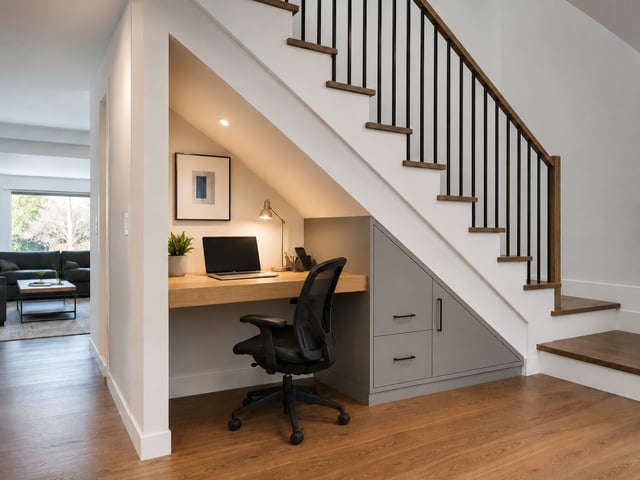
Built-in storage under the stairs is one of the few changes that adds usable square footage to a home. Pull-out drawers, a small library nook, or hidden cabinets can fit in spaces that previously held nothing but dust.
David Kim, a homeowner who renovated his entry staircase in Minneapolis, described the change this way: "The space under our stairs was completely wasted before the renovation. We turned it into deep pull-out drawers plus a couple of cabinets sized for shoes and sports gear. It ran about $6,500 just for the storage build-out, but it changed how the whole entry works."
The visible parts of a staircase carry most of the design weight. Spending money on what shows tends to pay off more than upgrading hidden structures that no one will see.
Renovation cost calculator
Start with a realistic budget
Get an initial estimate based on your space and project details.
This is one of the most-searched stairs remodeling projects, and one of the most cost-effective. Converting carpeted stairs to hardwood usually runs $1,250 to $3,300 for a 12-step staircase in red oak, including carpet removal and professional installation.
The process has three main steps. First, the existing carpet, padding, and tack strips come up. The plywood treads underneath get inspected for damage and either repaired or covered with retro-fit hardwood treads, also called tread overlays. Then new risers, a stain or finish, and any necessary trim go in.
A few things to know before starting:
Basement stairs renovation is its own category. Most basement stairs were built as utility access, not as a daily-use feature, which is why they often feel like a separate species from the rest of the home's staircases. Treads can be too narrow, lighting is usually poor, and headroom often falls short of current code.
A basement stairs renovation usually involves some combination of these changes:
How to remodel basement stairs depends heavily on whether the basement itself is finished. If the basement is unfinished and stays that way, a basement stairs renovation can be as simple as new treads, new lighting, and a continuous handrail for around $1,500 to $3,500. If the basement is being finished as living space, the stairs should match the quality of the rest of the home, which usually pushes costs into the $4,000 to $8,000 range.
The most common mistake is treating basement stairs as an afterthought. A finished basement with utility-grade stairs feels disjointed, and buyers notice during showings.
A basic straight-run permanent staircase to an attic typically runs $1,000 to $5,000 installed, and replacing a pull-down ladder with a permanent stair usually lands between $2,000 and $10,000 once framing and structural work are factored in. Spiral staircases, which solve the footprint problem in tight floor plans, range from $1,300 to $18,000 depending on materials and finish, and need only about a 5-foot diameter to install.
A few things worth knowing before pricing this out:
If the attic is staying storage-only, a quality pull-down ladder with a wide opening and grab handles is usually the better investment. If the attic is being converted to anything else, a permanent staircase belongs in the budget from the start.
Renovate with confidence every step of the way
Step 1: Personalize Your Renovation Plan
Step 2: Receive Quotes from Trusted Contractors
Step 3: Let Us Handle the Project Details

More than one million Americans are treated in emergency departments each year for stair-related injuries, according to a 23-year study published in the American Journal of Emergency Medicine. Stair codes have tightened steadily over the last few decades, which is part of why a renovation can run into compliance trouble. A few rules and permit triggers are worth knowing before a contractor walks in.
Under the International Residential Code, balusters must be spaced so a 4-inch diameter sphere cannot pass through. Many homes built before the mid-1990s have balusters spaced 5 or 6 inches apart, which means a "just replace the balusters" project often turns into a full railing system replacement once the inspector sees the existing layout.
Riser heights cannot vary by more than 3/8 of an inch across a single flight of stairs. In older homes, especially historic ones, riser heights drift over time as the structure settles. Bringing a flight into compliance can mean re-leveling treads or rebuilding sections that looked fine to the untrained eye.
Replacing spindles or refinishing treads usually does not require a permit. The moment a stringer gets cut or replaced, it does. More importantly, pulling a permit for any adjacent project, such as a kitchen remodel, addition, or basement finishing, can trigger a code-compliance requirement for the staircase, even if the homeowner did not plan to touch it. The kitchen work requires a permit, and permit work usually requires the rest of the relevant systems to be brought up to current code.
Margaret Holloway, who renovated an 1890s home in Charleston, ran into this directly. "Our original stairs were beautiful, and we wanted to keep them. Once our contractor opened up the wall for the kitchen project, the inspector said the railing height and baluster spacing had to come up to current code. We kept the original treads and the newel post, but the rebuild added about $4,000 to a project that was supposed to be cosmetic on the stairs."
Anything older than 1980 likely has at least one element that does not meet current code, and the homeowner needs to know that before the contractor opens a wall. Historic-district homes carry an extra layer, since preservation guidelines can limit which materials and finishes are allowed even when code compliance forces a rebuild.
Here is something worth knowing before treating a stairs renovation as a resale move: staircases are not tracked in the annual Cost vs. Value Report, the main industry benchmark for renovation return on investment. Kitchens, baths, garage doors, decks, siding, and windows all appear in the report. Stairs do not.
That makes the resale numbers for stairs remodeling more anecdotal than measured. Industry blogs and design firms occasionally quote figures like a 10% home value boost from a quality stair renovation, but those claims trace back to contractor marketing copy rather than transaction data or appraiser studies.
What is well-documented is the perception effect. A staircase is one of the first things a buyer sees on a walkthrough, and an updated staircase signals that the home has been cared for. Real estate agents consistently mention staircase condition during pre-listing consultations, particularly in homes where the rest of the interior has been updated and the stairs are the holdout.
A reasonable expectation for most projects is that a stairs renovation will help a home show better and possibly sell faster, but it will not deliver the same direct cost-to-value math that a minor kitchen remodel offers. Stairs remodeling is best treated as a quality-of-life investment first and a resale move second.
A stairs project rewards careful planning more than most renovations. The price range is enormous, the code rules are stricter than people expect, and the visible parts of the project carry most of the visual weight.
A few practical steps to take before getting quotes:
Block matches homeowners with vetted local contractors who have built and rebuilt the kind of staircase a project calls for. Every contractor scope is reviewed by Block experts to catch missing line items and red flags before the project starts. If a stairs remodeling project is somewhere on the horizon, the contractor you choose matters more than almost any other decision in the project.
Remodel with confidence through Block

Connect to vetted local contractors
We only work with top-tier, thoroughly vetted contractors

Get expert guidance
Our project planners offer expert advice, scope review, and ongoing support as needed

Enjoy peace of mind throughout your renovation
Secure payment system puts you in control and protects your remodel


Renovate confidently with Block
Easily compare quotes from top quality contractors, and get peace of mind with warranty & price protections.
Stairs
Staircase Remodel Ideas to Enhance Your Home
07.05.2026
Stairs
Under-Stairs Office & Desk: Design and Prep | Block
07.03.2026
Stairs
Stairs Remodeling: Cost, Ideas & What to Expect
05.21.2026

Stairs
Staircase Type Comparison: Find Your Perfect Style
01.15.2026
Stairs
Staircase Renovation Costs & Remodeling Tips
01.14.2026