




Structural Changes
How to Close an Open Concept Floor Plan
07.11.2026
05.05.2026


In This Article
A doorway is one of those things you stop noticing the day you move in. Then a parent moves in with a walker, a wheelchair enters the picture, or you drag a sectional through a 28-inch opening and realize the house was built for somebody else's life.
Knowing how to widen a doorway is rarely just a construction question. Design and budget always come into it, and accessibility often does too. This guide covers all three.
| Measure the route, not the door | A compliant opening can still fail in daily use if the hallway or turn is too tight. Doorways need 32 inches of clear width; accessible routes need 36. Chasing one extra foot in a hallway can pull in cabinets, wiring, framing, and nearby doors, pushing the scope into the $30,000 to $40,000 range. |
| Six inches can add trades | The riskiest part of a doorway widening is what the wall is carrying. A slightly wider opening can expose wiring, a water line, an HVAC return, or gas, shifting the job from carpentry to coordinated electrical, plumbing, or HVAC work. |
| Buy clearance before demolition | Offset hinges can add 1.5 to 2 inches of usable width without reframing. For a 30.5-inch opening that needs to reach 32 inches, $40 to $90 in hardware may solve the problem before anyone cuts into the wall. |
The cost of widening a doorway varies more than most online estimates admit. The same project can run $600 in a non-load-bearing wall with no utilities to reroute, or $15,000 once you factor in a structural beam, an electrician, and finish work that matches the rest of the house.
The easiest version of the project. A carpenter cuts back the drywall, removes a stud or two, installs a wider header, reframes the opening, hangs the door, and patches everything in. Most homeowners pay $600 to $2,000, with a national average around $1,200. If the wall is empty, you can come in lower. If the project uncovers asbestos, lead paint, or unpermitted electrical, costs climb fast.
Once a wall is carrying weight from above, the cost of widening the doorframe spikes. You need a structural engineer to size the new header (often a laminated veneer lumber beam, or LVL), temporary supports during construction, and an inspection afterward. Engineer fees alone run $300 to $1,000. The full project typically lands between $2,500 and $10,000 for a single-story home, and $9,000 to $15,000 for a multi-story home where you're carrying load from two floors plus a roof. Learn more with our guide about removing or modifying load-bearing walls.
This is where budgets blow up quietly. A doorway you want to widen by six inches might run into a light switch, an outlet, a water line for an upstairs bathroom, an HVAC return, or a gas line. Each one needs a licensed trade to reroute it.
Typical hourly rates:
A single rerouted circuit might add a few hundred dollars. A plumbing stack moved sideways through framing can add several thousand. Before committing to a specific doorway, open the wall (or have a contractor scope it). Sometimes the smarter move is widening a different doorway six feet away with nothing inside.
Exterior projects add weatherproofing, flashing, threshold transitions, energy-rated doors, and sometimes new exterior finish work. Plan on $2,500 to $8,000, more if the entry needs a ramp or grading change.
A wheelchair ramp is a separate project from the door itself:
Most jurisdictions require a permit for any structural change, including widening a doorway. Permit fees range from $50 to $500. Skipping the permit feels like a savings until you try to sell the house and a buyer's inspector flags unpermitted structural work.
Even the best-planned renovation comes with surprises. Hidden plumbing is the most common one, but every contractor has a story about an unmarked gas line or a stud bay full of old knob-and-tube. Set aside 10 to 20% of the total budget as a contingency. For a $5,000 doorway project, that's $500 to $1,000 in reserve.
Compare Proposals with Ease

A wider opening changes how light moves through the home, how rooms relate to each other, and how the house feels to walk through. For the square footage involved, few renovations do more.
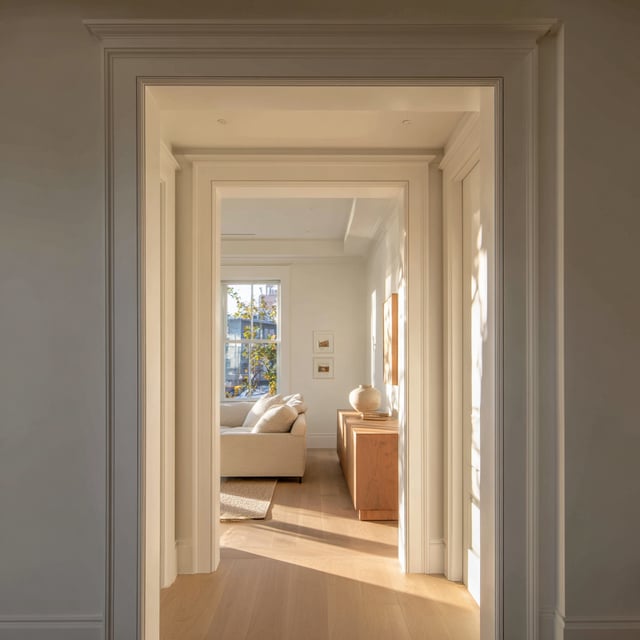
When privacy isn't required, between a living and dining room, a kitchen and family room, an entry and a hallway, the best version of "widening the doorway" is removing the door entirely. A cased opening is just trim around an opening. No slab, no swing, no hardware.
It costs less than a new door, gives more clearance than any wheelchair-accessible opening you'd otherwise frame, and almost always looks more architectural than the door it replaces. Designers have specified cased openings in higher-end homes for decades, but in standard residential work the assumption is that every opening needs a door. It doesn't. If you don't need acoustic separation, visual privacy, or a way to close pets in or out, the door is taking up budget and visual weight for no reason.
The cased opening pays off twice: cheaper to build and better-looking than the door it replaces would have been.
A widened doorway with a clunky transition strip underneath defeats half of what you just paid for. The eye reads the transition before the wider opening, and the space feels chopped up rather than expansive.
If the flooring on either side is the same material, run it continuously through the doorway with no T-strip. If you have to transition between materials, do it under the closed-door position rather than mid-opening. The transition strip is the kind of detail nobody mentions when the work is done well, and everybody mentions when it isn't.
A flush threshold matters past the look of the thing. For a wheelchair user, it's the difference between independent passage and getting stuck.
This applies to every door choice that comes with a widening project. Pocket doors, barn doors, French doors, and oversized single doors all live or die on their hardware.
Plan on $200 to $600 for serious pocket door hardware, $300 to $800 for considered barn door hardware. The hardware budget is small relative to the rest of the project, but it's where most of the look lives.
Not every doorway benefits from being wider. The opening into a hall closet, a powder room, or a utility room won't look better at 36 inches than at 28. The opening between your kitchen and family room, or at the top of a stair landing where someone first sees your living room, absolutely will.
When budget forces choices, prioritize doorways that frame something: a view, a window, a sightline through the house. Those openings borrow light from the rooms they connect, and a wider one borrows more. A widened doorway between a bright south-facing kitchen and a darker family room can change how the family room feels at every hour of the day.
Treat this as a budget-allocation rule, not a style preference. Spending $4,000 to widen one strategic doorway will do more for the house than spending $1,000 each on four doorways nobody looks at.
Mismatched casing is the giveaway that a doorway is a retrofit. Widening a door frame means widening everything around it: the jamb, the casing, the reveal. If the rest of your home has a specific casing profile, the new opening should match it exactly. Slightly different width, slightly different sheen, slightly different reveal, all of it reads as patched.
If you're upgrading the casing as part of the project, upgrade it consistently across the room or floor. A 6-inch flat Craftsman casing on the new opening with skinny colonial casing on adjacent doors looks accidental. Wider doorways generally look better with substantial casing (5 to 7 inches) than with skinny trim that makes the opening look stretched.
If accessibility is the reason you're widening a doorway, the rules change. Generous-looking on paper isn't the same as workable in practice.
This trips up almost every first-time accessibility renovator. ADA guidelines call for 32 inches of clear opening, measured between the face of the door (when open 90 degrees) and the stop on the opposite jamb. A 36-inch nominal door, the size most people picture as "wheelchair accessible," gives roughly 33.5 inches of actual clear width once you account for door thickness and hinge geometry.
A 32-inch nominal door does not meet the 32-inch clear width requirement. If the doorway is more than 24 inches deep, the requirement increases to 36 inches of clear width.
For a wheelchair user, 36 inches of clear opening (a 40-inch door, or offset hinges on a 36-inch door) is meaningfully more comfortable than the 32-inch minimum. The minimum gets you past inspection. Day to day, you'll want more room than that.
Full ADA technical guidance is available at ada.gov and access-board.gov. It's worth reading the door section directly if you're planning a serious accessibility renovation.
Before opening a wall, look at swing-clear (offset) hinges. They pivot the door fully out of the opening when open and add roughly 1.5 to 2 inches of clear width to an existing doorway. A pair runs $40 to $90, and installation is a 20-minute job. For a doorway sitting at 30.5 inches of clear width and needing 32, offset hinges may be the only intervention required.
Offset hinges won't turn a 24-inch doorway into something a wheelchair can pass through. But for borderline-tight openings, they're the cheapest accessibility win available.
A widened doorway with a half-inch threshold bump still doesn't work for many wheelchair users. ADA standards on threshold height:
For exterior doors, the threshold question often becomes a grading question. If the exterior surface is below the interior floor by more than half an inch, you need a ramp, a graded transition, or a lowered exterior surface. None of these are afterthoughts. They need to be designed alongside the doorway widening, not bolted on later.
A 36-inch doorway doesn't help if the hallway leading to it is 30 inches wide, or if there's a tight turn before the bedroom that no wheelchair can negotiate. The ADA accessible route standard calls for 36 inches of continuous clear width, with brief reductions to 32 inches at doorways permitted for short stretches.
Before committing to a specific doorway, walk (or roll) the whole route from the front door to the bedroom. Identify the tightest point. If the bedroom doorway is 30 inches but the hallway leading to it is 28, widening the doorway alone won't solve the problem.
Widening a hallway is expensive when you can do it at all. Contractors quote $30,000 to $40,000 to gain a single foot of hallway width once you factor in moving cabinets, doorways, electrical, and structural elements above. Sometimes the right answer is reconfiguring which rooms get used for what, rather than widening a path the house wasn't built to accommodate.
The smallest accessibility upgrade and one of the most consequential. Lever handles are operable with a closed fist, an elbow, or a forearm, which matters for anyone with limited hand strength, arthritis, or wet hands carrying groceries. They're also standard in higher-end residential design and most European homes, so they don't telegraph "accessibility modification." If you're going to specify them, specify them throughout the home. The widened doors shouldn't be the only ones with levers.
The contractor you hire is the person who has to figure out what's actually inside the wall once it's open. A good one will tell you what's worth doing before they pick up a hammer.
Block Renovation matches homeowners with vetted local contractors who compete for the project, with every scope reviewed by Block experts to catch missing line items before you sign. Tell Block about the doorway you're planning, and the area's best builders will bid on it.
Remodel with confidence through Block

Connect to vetted local contractors
We only work with top-tier, thoroughly vetted contractors

Get expert guidance
Our project planners offer expert advice, scope review, and ongoing support as needed

Enjoy peace of mind throughout your renovation
Secure payment system puts you in control and protects your remodel


Renovate confidently with Block
Easily compare quotes from top quality contractors, and get peace of mind with warranty & price protections.
Structural Changes
How to Close an Open Concept Floor Plan
07.11.2026
Structural Changes
Cost to Enlarge a Window: What to Expect and Decide
06.15.2026
Structural Changes
Minimum Hallway Width: Residential Code Guide
06.03.2026
Flooring
Subfloor Replacement Costs and Processes
05.15.2026
.webp?width=640&name=Contractors_-_What_you_c_an_expect%20(2).webp)
Structural Changes
Duplex Conversion to Single Family Home: A Practical Guide
05.11.2026