




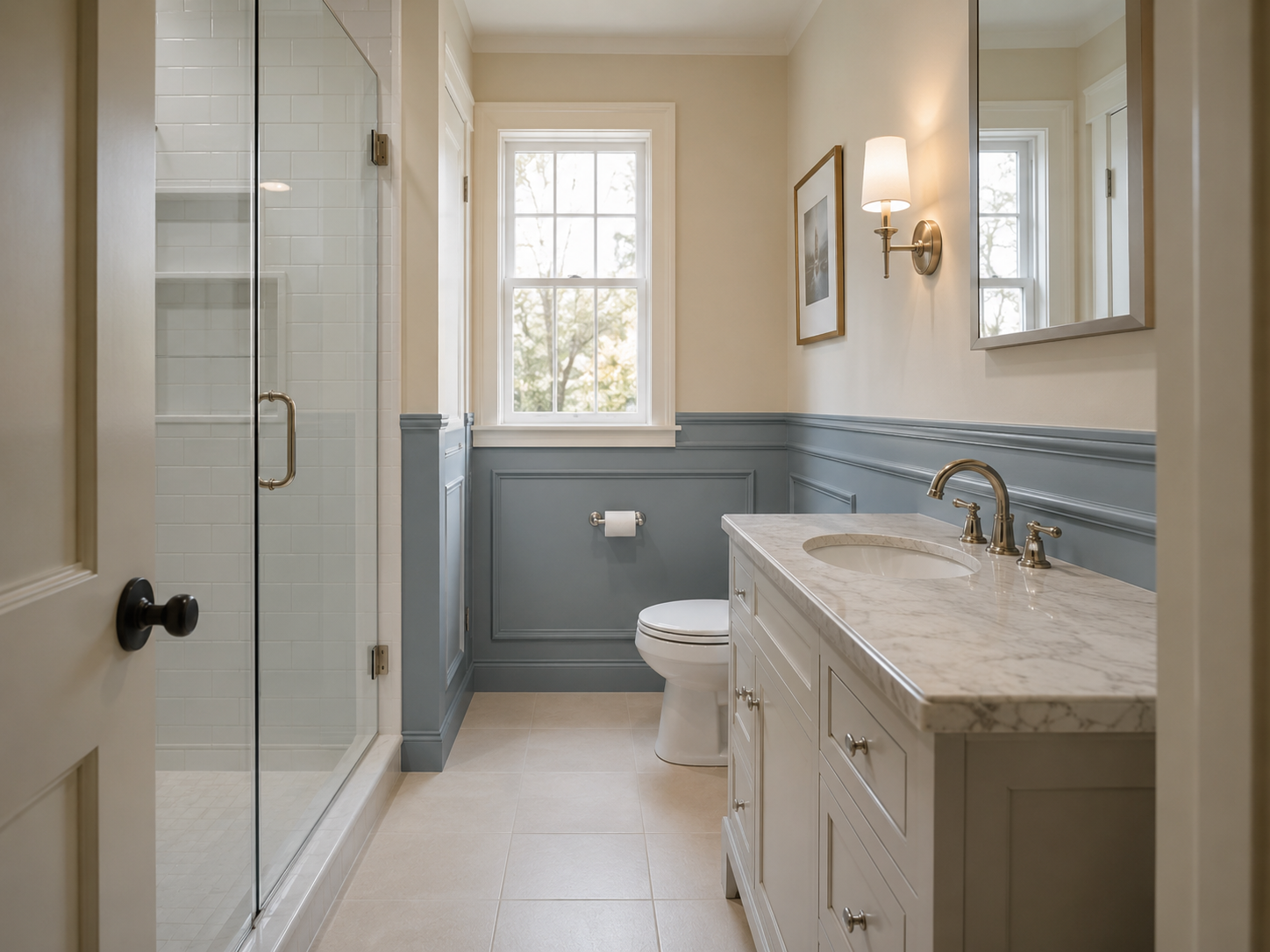
Paint & Color
Two Tone Bathroom Walls: 15 Ideas & Where to Split
08.14.2026
05.06.2026


In This Article
Gray walls with dark hardwood floors have been a default pairing in American homes for at least a decade, and there's a reason it stuck around. It reads as grounded and architectural, and it ages better than whatever palette is trending this year. A room built on gray walls and dark hardwood floors doesn't need much to feel finished, which is part of why so many homeowners reach for it in the first place.
The risk is what happens when the supporting choices don't show up. Two dark elements stacked together, walls and floors, can absorb light fast and leave a room feeling dim and closed-in regardless of how much sunlight the windows actually let in. Restraint cuts both ways. The palette that feels grounded in one home can feel impersonal in another, more like a model unit than a place anyone actually lives in. What separates a sophisticated version of dark hardwood floors with gray walls from a generic one is everything you add on top of it.
Dark hardwood floors carry either a warm undertone (red, brown, gold) or a cool one (ebony, espresso with a slight gray cast), and your wall color has to acknowledge whichever you're working with. Warm grays with a hint of brown flatter brown-toned woods, while cooler grays hold up better against ebony or near-black floors. Most rooms with gray walls and dark hardwood floors that feel off have a clash between the wall undertone and the floor undertone, even if the homeowner can't name what's wrong.
The trap to avoid here is reaching for greige as a safety choice. Homeowners often land on it because someone told them warm grays work better with wood floors, and greige feels like the lowest-risk version of that advice. The result tends to be walls that read as dirty beige in daylight and muddy brown at night, too wishy-washy to make a real impact in either direction. If you want gray, commit to gray with a clear undertone, whether that's a cool blue-gray, a warm brown-gray, or a true neutral. The committed version always reads as more intentional than the hedged one.
Hold paint chips directly on the floor in real daylight before committing to a gallon, because a gray that looks perfect on the chip can shift toward blue, green, or violet once it's next to your specific floor.
A neutral palette only works when there's something in the room worth looking at, and dark hardwood floors with gray walls function best as the canvas rather than the subject. Whatever you place against them becomes the entire visual story.
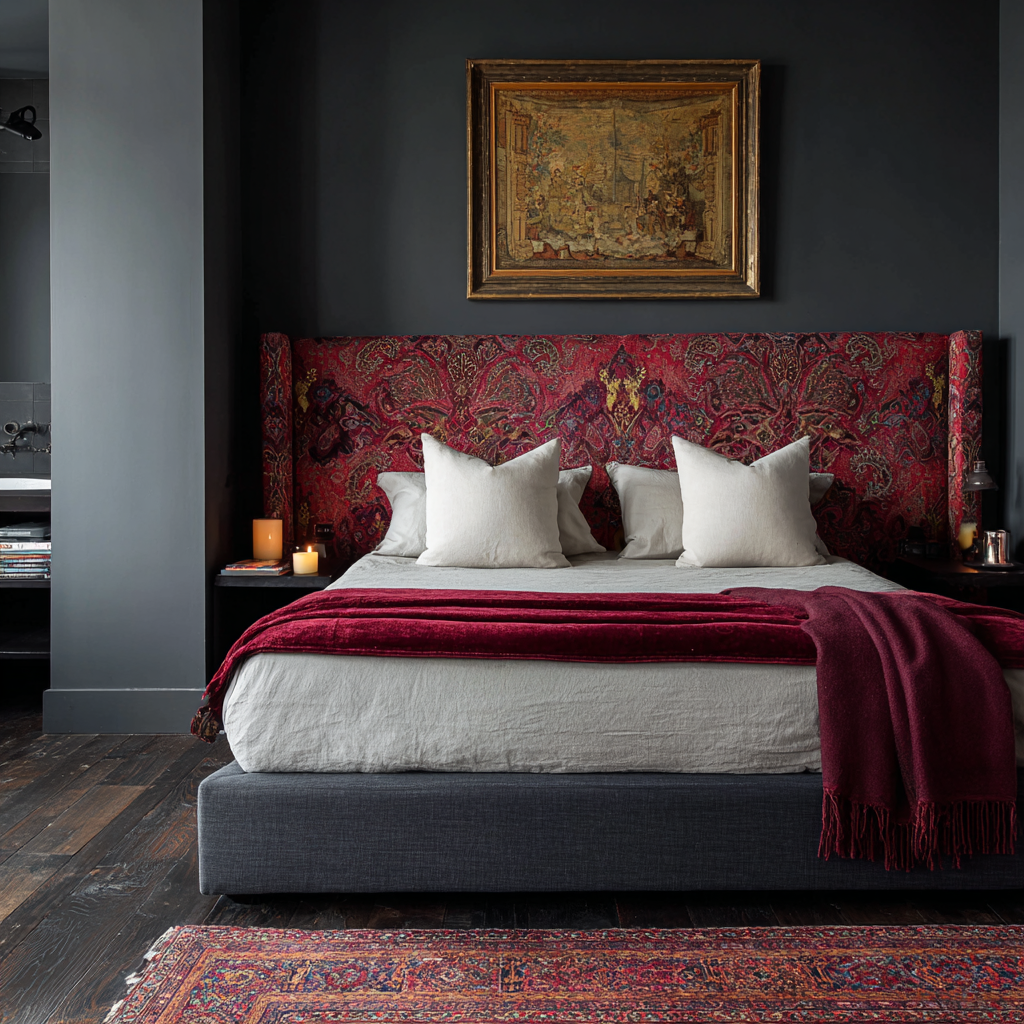
Saturated reds work especially well against charcoal walls because they read as warm without going pastel. It's why patterned headboards, velvet throws, and Persian rugs keep showing up in dark-walled bedrooms. You don't need a four-figure antique to pull this off, either; a single emerald velvet chair against a paneled gray wall does the same kind of structural work in a sitting area.
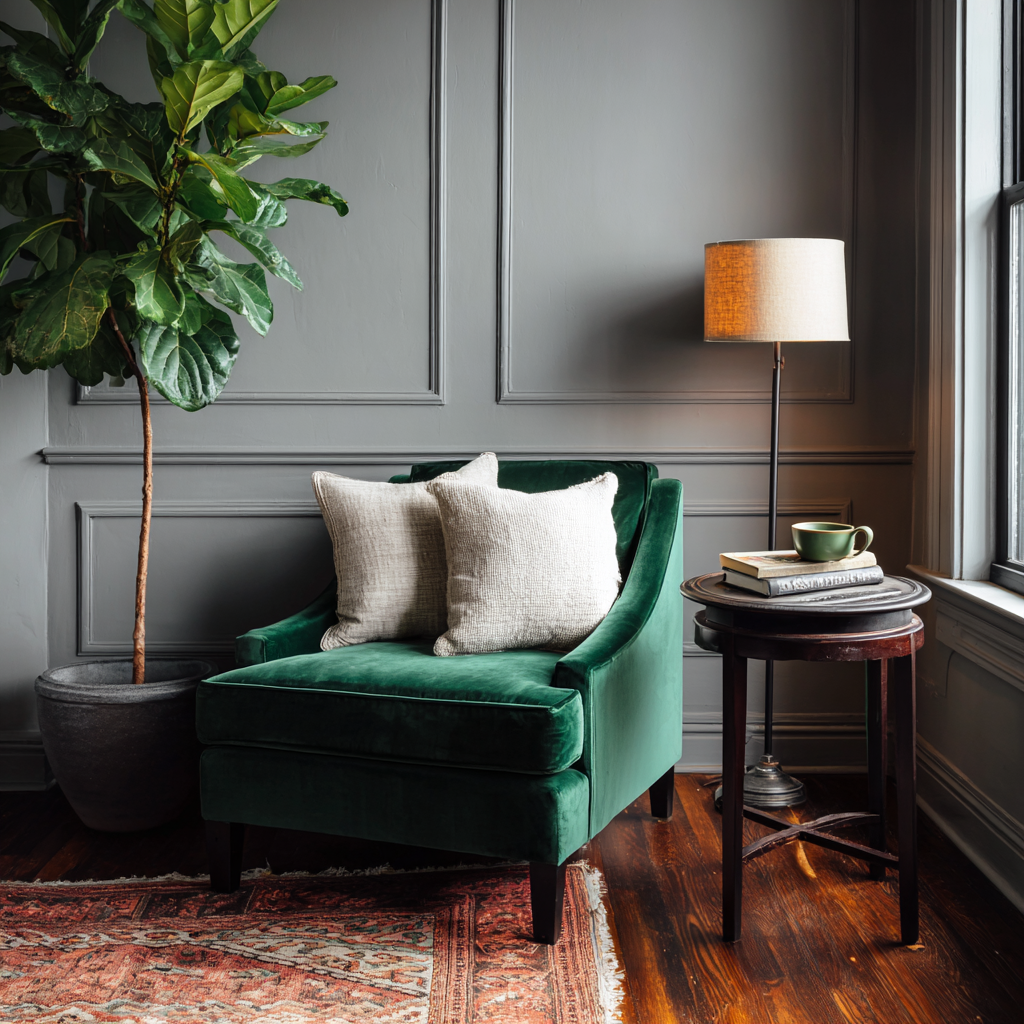
The principle is the same in both cases. One saturated piece carries the room, and everything else stays quiet.
gray walls and dark hardwood floors stack two heavy elements on top of each other, and without a visual break the room can start to feel like it's pressing in. White ceilings, baseboards, window casings, and door frames create that break, and the resulting contrast is what reads as intentional rather than oppressive.
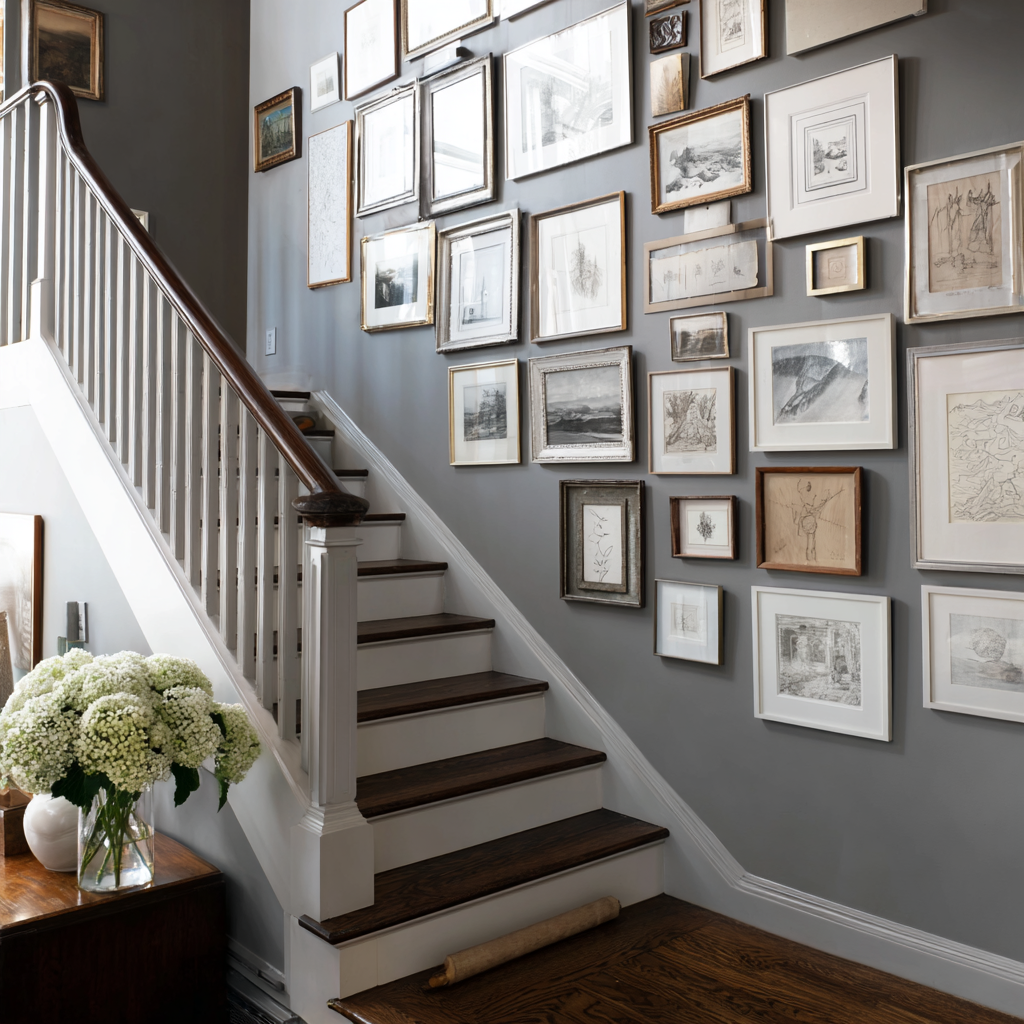
Stairwells are where this principle matters most because the eye has to travel up and down the space, not just across it. Bright white risers and balusters cut through the medium gray wall and dark treads, giving the climb a clear architectural rhythm and keeping the gallery wall feeling curated rather than crowded.
Cool grays plus dark floors can tip industrial fast. Metal finishes are the fastest fix. Antique brass, aged gold, and warm bronze pull the palette back toward warmth, while polished chrome and nickel amplify the cooler tones already present in the gray.
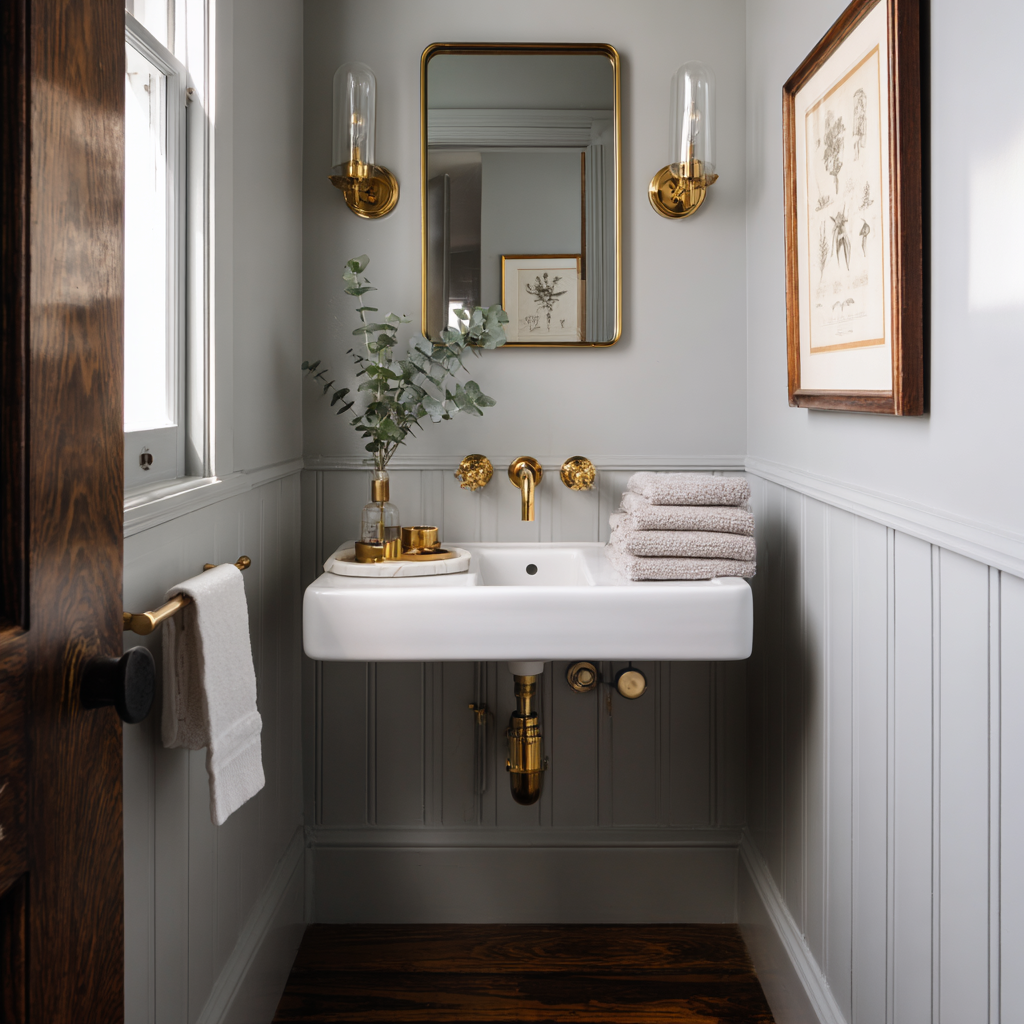
In smaller rooms like powder rooms and entryways, where the metal fixtures take up a disproportionate share of the visual field, this choice carries even more weight. Brass sconces, faucets, and mirror frames will carry most of the personality in a small bathroom or entryway. Get those right and the rest of the styling has less work to do.
The fastest way to ruin a room with gray walls and dark hardwood floors is to light it with a single overhead fixture and a 4000K bulb. The walls go flat, the floors look muddy, and the whole space takes on the same fluorescent quality as a dentist's waiting room. Dark palettes need light from multiple sources at multiple heights, not one bright source from above.
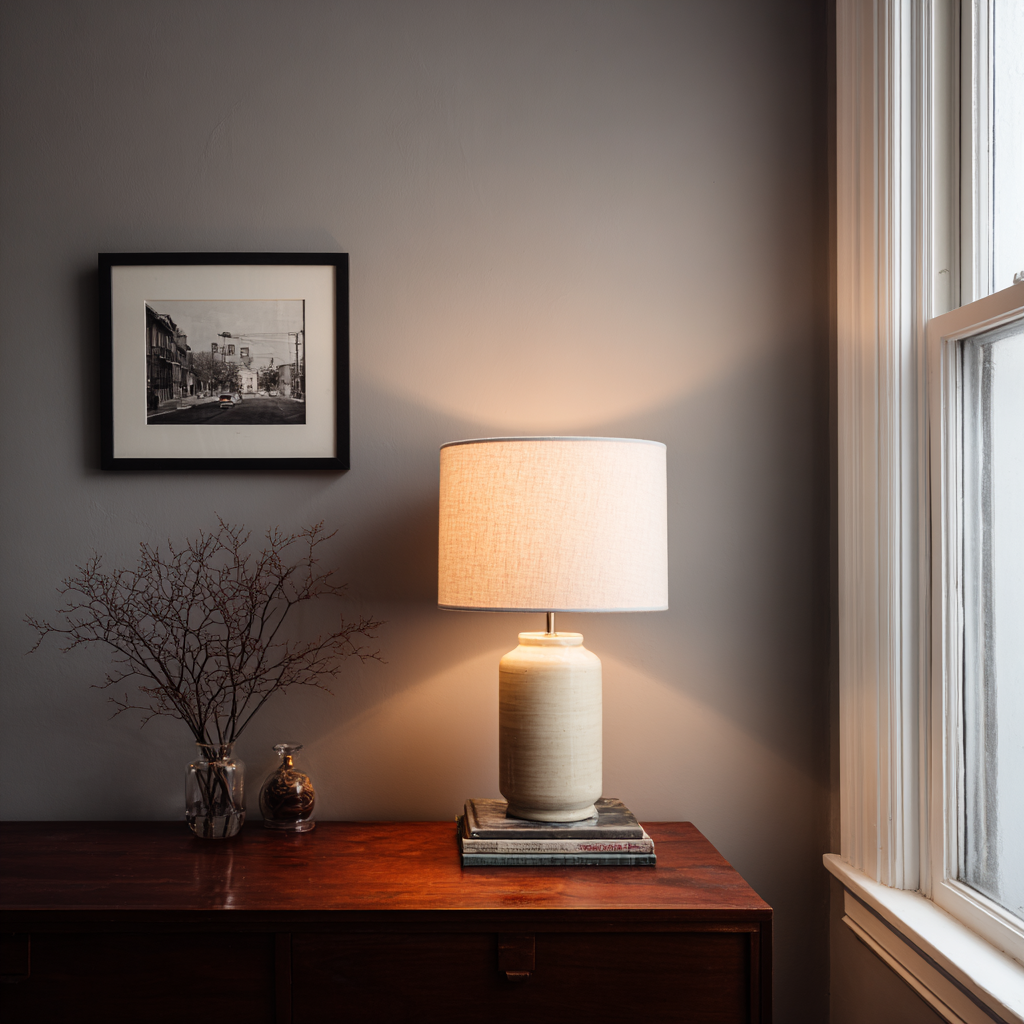
The general rule is at least three light sources in any room where you spend real time: an overhead, something at table or eye level (a table lamp, a sconce, a pendant), and something low (a floor lamp at couch height, an arc lamp, a reading light). The layered effect keeps the walls from going dark in the corners and gives the dark floor visible variation across the room. A single overhead light flattens everything it hits.
Bulb temperature matters even more than fixture count. Stick to 2700K for living spaces and bedrooms, where the warm yellow tone makes gray walls read as soft and inviting rather than steely. 3000K works for kitchens and bathrooms where you want a slightly crisper light without going clinical. Anything above 3500K is a mistake in this palette. Cool white and daylight bulbs strip the warmth out of the walls, expose every undertone you didn't want to see, and make even a perfectly chosen gray look like the inside of an office building. The bulb sticker is doing more work than most homeowners realize.
A dark floor doesn't require every other wood surface in the room to match it, and rooms that try to coordinate every wood tone often end up feeling flat. Honey oak, walnut, and teak furniture against ebony floors creates depth that single-tone rooms can't replicate.
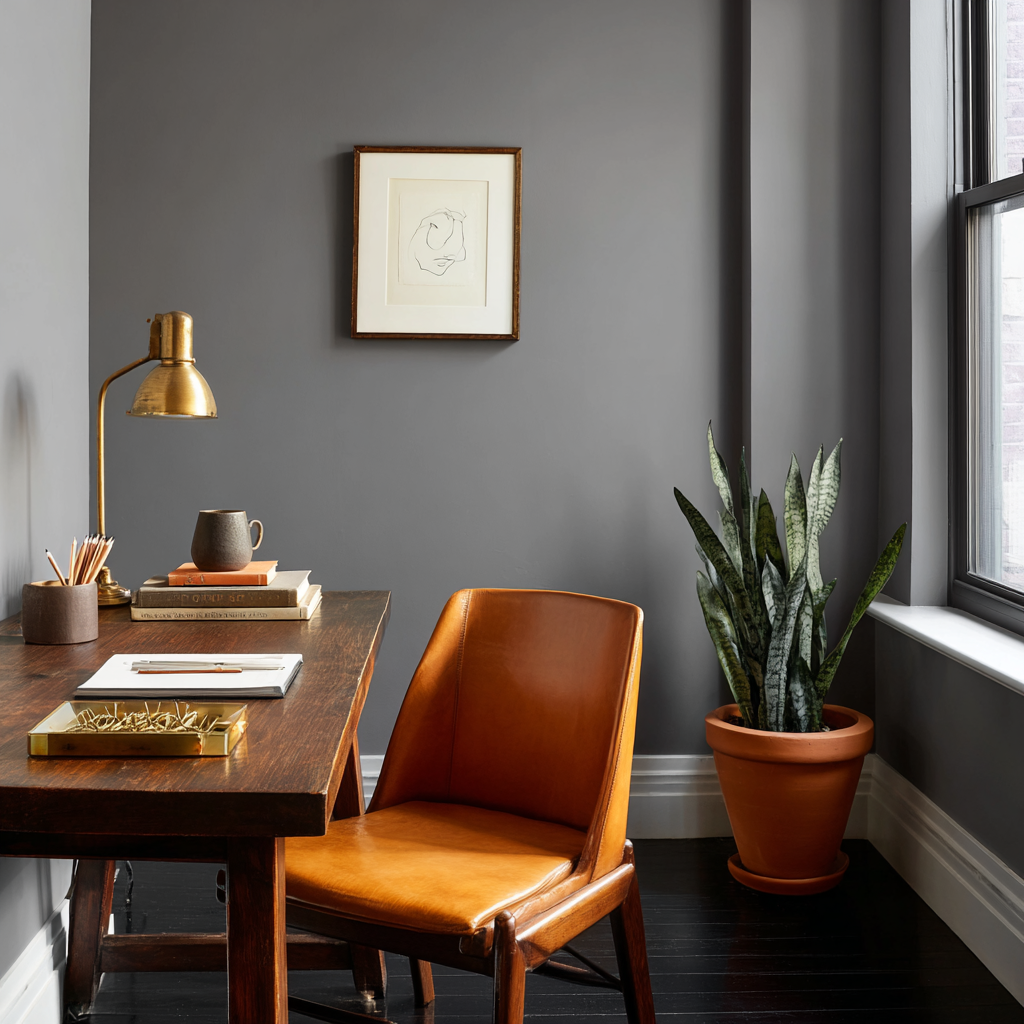
The trick is to make the contrast feel deliberate. A warm wood desk pulled up to near-black floors looks intentional when the rest of the room supports the choice with other warm tones, like a cognac leather chair or a terracotta planter. The same desk in a room full of mismatched cool tones would just look like the floors were a mistake.
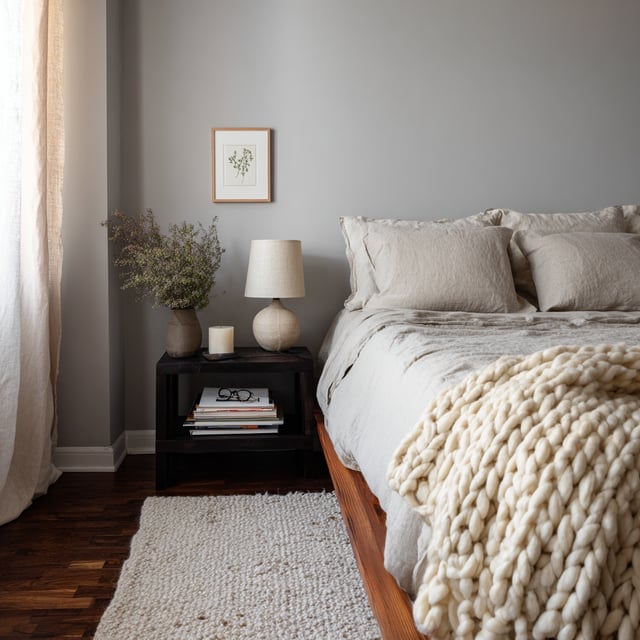
Dark hardwood floors absorb a significant amount of visual weight, and a cream, ivory, or oatmeal rug is the most direct way to lift the room back up. A light rug breaks up the dark floor plane and makes the wood read as a deliberate frame around the room rather than the whole floor.
The opposite move, a charcoal or near-black rug, almost always disappears into the floor and wastes the chance to add contrast in the part of the room that needs it most.
When the color palette is restrained, texture does the work that color usually does. Boucle, chunky knit, jute, woven leather, raw ceramic, and slubby linen each add quiet variety without adding color noise, and a room that combines several of them ends up feeling layered and lived-in even with only three or four actual colors in play.
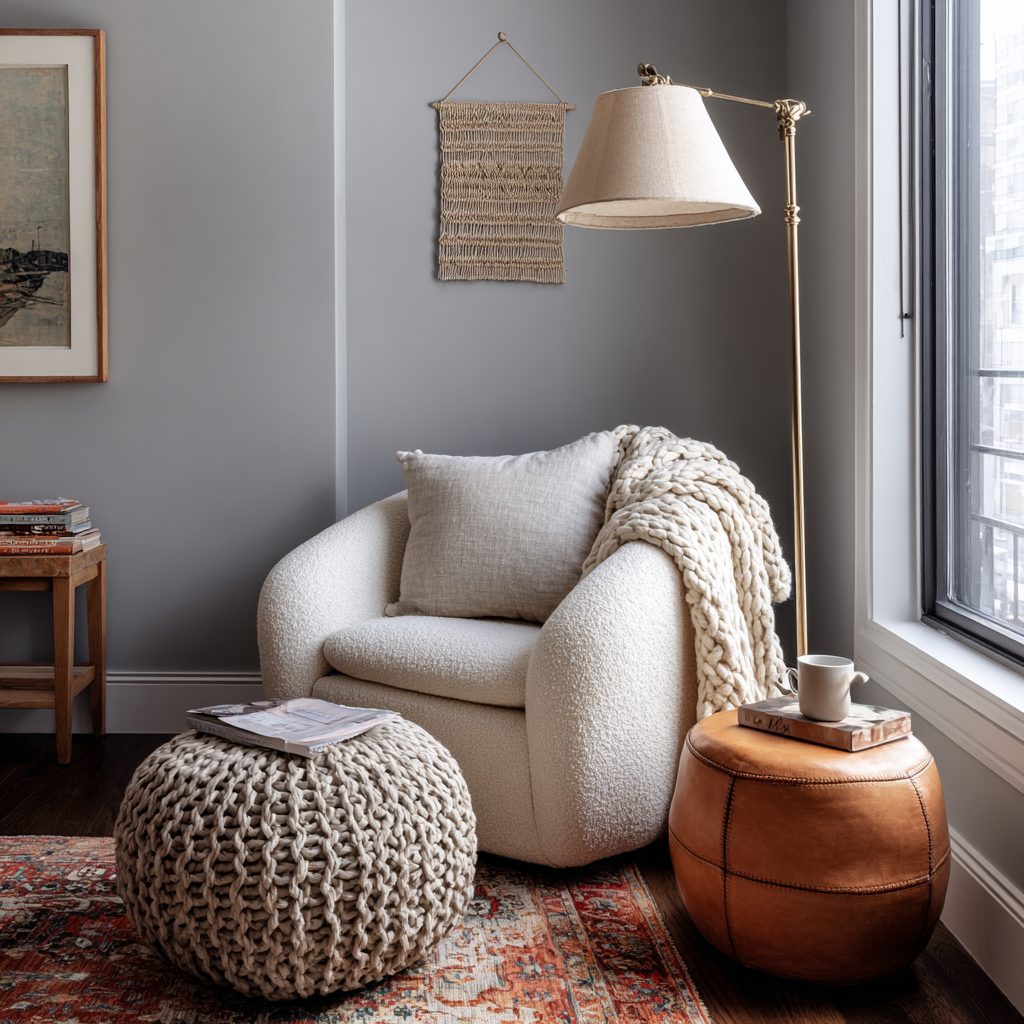
This is also where rooms with gray walls and dark hardwood floors tend to either succeed or fail. A leather sofa, a lacquered table, and a glass lamp will read cold against a gray wall every time. Swap two of those for something nubby or woven and the room warms up immediately, even though the colors haven't changed. If you’re applying this design principle to your kitchen, pair gray cabinets with a backsplash and/or countertop that show real personality.
Lighter grays belong in smaller or low-light rooms, and pushing into mid-tone or charcoal in a tight space with one window is the fastest way to make a room feel like a submarine. Larger sun-flooded spaces can absorb deeper grays without the walls pressing in, but smaller spaces almost always benefit from staying on the lighter end of the spectrum.
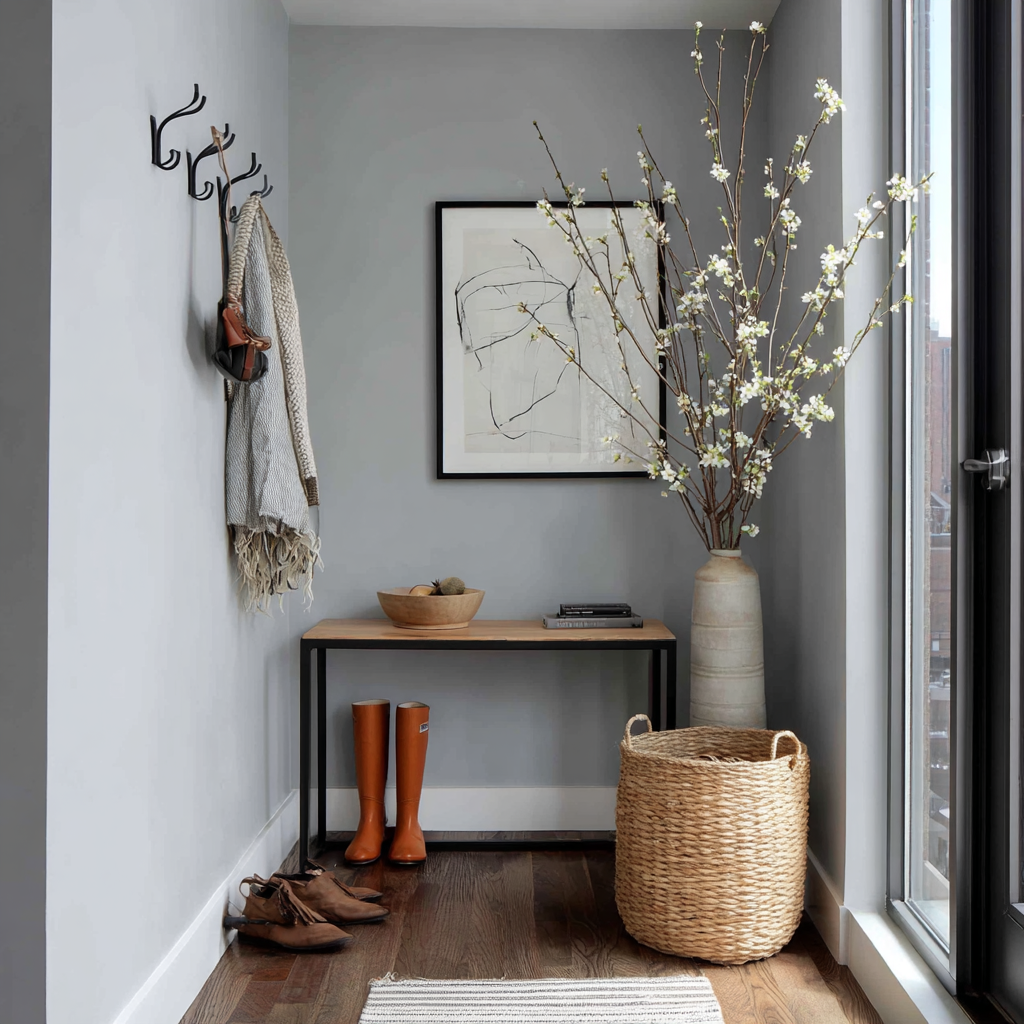
Entryways and narrow hallways are particularly sensitive to this, because they're already short on natural light and visual breathing room. A pale gray paired with dark hardwood floors in a hallway stays airy because the wall color was chosen with the dimensions of the space in mind.
The design ideas above assume the floors are in good condition, which isn't always the case in older homes or recent purchases. A few things worth knowing if your gray-wall plan involves new or refinished hardwood:
The order of operations also matters on a renovation that touches both floors and walls. Floors should be refinished or installed before walls are painted, not the other way around, because sanding throws fine dust across every surface in the room and freshly painted walls will need touch-ups if they're done first.
Block Renovation's free Renovation Studio is built for exactly this kind of decision-making, where the success of the finished space depends on a handful of finishes working together rather than any single hero choice. Homeowners can design a room, see it rendered with their actual gray paint colors, floor stains, trim, and lighting choices, and get a real-time cost estimate before any contractor walks through the door.
For a project pairing gray walls with dark hardwood floors specifically, the Studio is useful because it lets you test undertone combinations, sheen levels, and rug placement against your real dimensions and natural light. The renders update as you swap materials, so the cost of changing your mind during planning is a few clicks rather than a few thousand dollars in change orders during construction.
Once the design is settled, Block matches each project with vetted local contractors who compete for the work with expert-reviewed scopes, and payments are released in stages as the project progresses rather than upfront. Homeowners ready to take the next step can start in the Renovation Studio or get matched with contractors directly through Block.
Remodel with confidence through Block

Connect to vetted local contractors
We only work with top-tier, thoroughly vetted contractors

Get expert guidance
Our project planners offer expert advice, scope review, and ongoing support as needed
Enjoy peace of mind throughout your renovation
Secure payment system puts you in control and protects your remodel


Renovate confidently with Block
Easily compare quotes from top quality contractors, and get peace of mind with warranty & price protections.
Paint & Color
Two Tone Bathroom Walls: 15 Ideas & Where to Split
08.14.2026
Cabinets
Brown Cabinets With White Countertops: Design Guide
06.04.2026
Paint & Color
Wall Colors for Light Wood Floors: Grays, Whites & More
05.13.2026
Paint & Color
Gray Walls with Dark Hardwood Floors: Pull Off the Look
05.06.2026
.png?width=640&name=Moody%20Dining%20Room%20Painted%20Ceiling%20Walls%20(2).png)
Paint & Color
Painting Ceilings the Same Colors as the Walls: Pros & Cons
04.22.2026