




ADUs
Detached ADU Cost: What You'll Really Pay
06.19.2026
04.08.2026


.webp?width=640&name=u5821215421_Micro_ADU_kitchenette_Apartment_Therapy_editorial_d8cc79be-7fac-46a9-96b2-ae8f11243a2b_1%20(1).webp)
In This Article
Studio ADUs are where people first convince themselves that building an ADU is simple. One room, a kitchen along one wall, a bathroom in the corner, somewhere to sleep. The footprint is small. The concept is legible. What could go wrong?
Quite a bit, as it turns out. A studio is the hardest ADU configuration to get right, precisely because there is nowhere to hide a bad decision. Every design choice is visible from everywhere else in the space. The result of getting it wrong isn't just a room that photographs awkwardly. It's a unit someone struggles to live in, or one a tenant moves out of after six months.
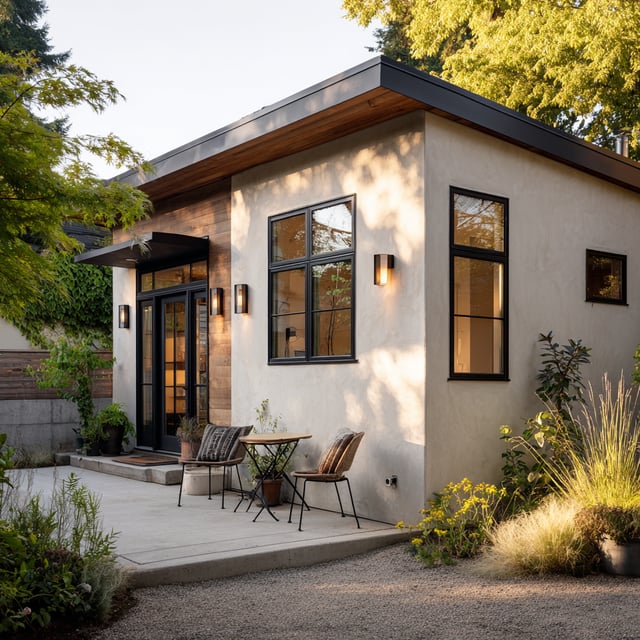
The term "studio shed ADU" often refers to prefab or modular backyard units, factory-built structures that arrive on a truck and are installed on a prepared foundation. Companies like Mighty Buildings, Cover, and Studio Shed offer models in the 200 to 400 square foot range, and the appeal is real: faster timelines, predictable costs, and designs that have already been value-engineered for small-space living.
The catch is that prefab doesn't mean permit-free or foundation-free. A studio shed ADU still needs a site-prepared foundation, utility connections for water, sewer, and electrical, and permits, all of which apply regardless of whether the structure was built in a factory or on site. Once those fixed costs are added to the unit price, the all-in cost of a prefab studio ADU frequently lands in the same range as a comparable site-built unit. The timeline advantage is real; the cost savings are often overstated.
Most homeowners start planning a studio ADU by looking at floor plan layouts. The more consequential question, and one that should come first, is where on the lot the studio will sit and which direction it will face.
Placement determines something that no interior design choice can fully compensate for: how much natural light the unit gets. A studio positioned at the north end of a deep lot, sitting in the shadow of the main house for most of the day, will feel dim regardless of how it's designed. White paint and large windows help. They don't fix a fundamentally dark orientation.
Placement also has direct budget implications. Utility connections, specifically water, sewer, and electrical, are typically priced per linear foot of trenching, and long runs get expensive fast. In some markets, trenching costs run up to $200 per linear foot for complex or extended connections. A studio at the back of a 150-foot-deep lot could require 100 feet or more of trenching, adding $15,000 to $20,000 to the utility connection budget before framing begins. Moving the studio 30 feet closer to the main house can change that number substantially. This conversation is worth having with a contractor before design fees accumulate around a placement that was never fully evaluated.
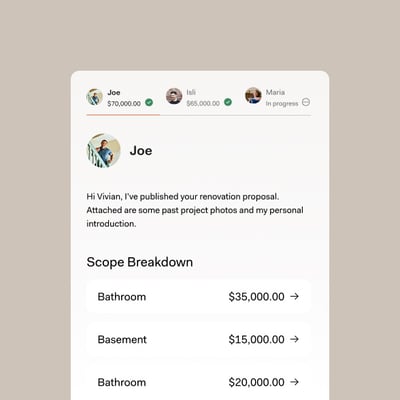
Compare Proposals with Ease
In a conventional house, you walk through the front door and into a hallway or entry. You put things down, shift mental gears, and transition from outside to inside. In a studio ADU, you open the door and you're already home: standing in your kitchen, looking at your unmade bed. There's no transition.
For occasional guests, this doesn't matter much. For someone living in the space full-time, the absence of any kind of entry sequence is a small daily friction that adds up. A covered porch that precedes the main door, a partial screen wall that creates visual separation before you enter, or a 4-by-6-foot vestibule carved into the footprint gives the occupant somewhere to land before they're fully inside. Most studio floor plans don't solve this. It's worth asking a designer to address it before the layout is finalized.
The gap between a 350-square-foot studio with 9-foot ceilings and one with standard 8-foot ceilings is not subtle. Vertical space changes how a room breathes and how it feels to stand in. Pushing for 9 feet minimum, or going vaulted where zoning allows, is often worth more than adding 40 or 50 square feet of floor area.
Higher ceilings also open up the possibility of a skylight, which in a studio where wall space for windows is limited by fences, neighboring structures, or privacy setbacks, can be transformative. VELUX is the dominant brand and effectively sets the market standard for residential skylights. A fixed VELUX skylight, sealed with no ventilation capability, runs $3,000 to $5,000 installed in 2025, including labor, flashing, and interior finish work. An operable "Fresh Air" model, which opens to ventilate the space, runs $3,200 to $5,900 for a manual version and $4,350 to $7,250 for the electric model with a rain sensor that closes automatically.
The ventilating version earns its cost in a studio. A sealed unit with no through-breeze can feel stuffy by afternoon in warmer months. An operable skylight functions as a passive ventilation stack: warm air rises and exits through the top while cooler air is drawn in below. Architect Martin Fenlon used exactly this approach in a 350-square-foot Los Feliz studio ADU above a garage, combining large double-glazed windows with an operable VELUX skylight that passively cooled the space without mechanical ventilation. The studio cost $220,722 all in. The skylight wasn't a luxury add-on. It was doing climate work the mechanical system didn't need to cover.
The problem with an open floor plan in a studio ADU is that sleeping and living occupy the same sightline all day. Someone working from home looks at the desk from bed and looks at the bed from the desk. The space gradually stops feeling like somewhere to live and starts feeling like a room that also has a kitchen. A sleeping zone with some visual separation, whether a partial wall, a tall bookshelf used as a divider, a curtained nook, or a raised platform, solves this without making the rest of the space feel closed. The main living area keeps its openness. The sleeping area gets enough enclosure that whoever lives there can actually rest in it.
This is also where Murphy beds deserve a more honest assessment than they usually get. In ADUs used primarily as guest suites or vacation rentals, a Murphy bed makes real sense. Folding it up during the day keeps the room from feeling permanently given over to sleeping. For a full-time resident, folding the bed every single morning is a friction point that doesn't feel like a reasonable trade-off six months in. A fixed bed, well-positioned, built into a sleeping alcove with storage integrated below it, is almost always the better solution for someone who actually lives there.
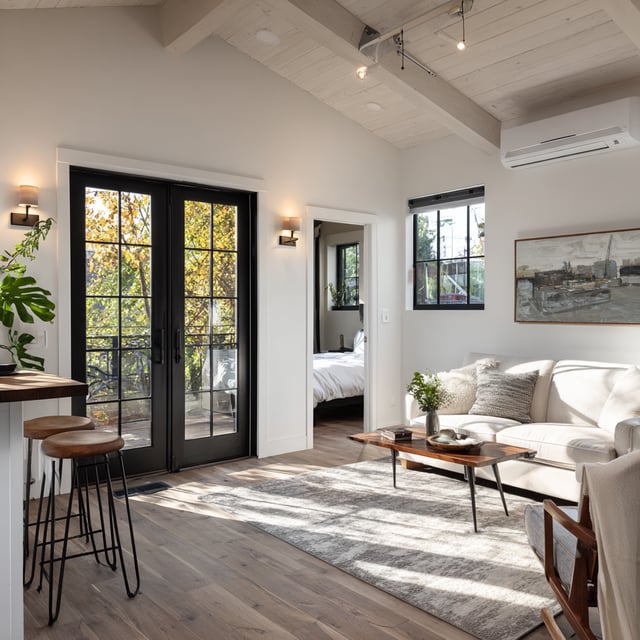
In a standard home, the kitchen is one room among several. In a studio ADU, it's often just a wall, sometimes a corner, that has to function as the kitchen for someone's actual daily life. The appliance choices made at this scale have a bigger impact on how the space feels than they do in a larger layout, because there's no other room to retreat to when the kitchen is in the way.
A 30-inch range, 36-inch refrigerator, and full-width dishwasher don't belong in a studio ADU. Apartment-scale appliances exist for exactly this situation. A 24-inch refrigerator (Bosch makes a well-regarded model with a bottom freezer that runs $1,000 to $1,400; Beko offers a more affordable entry point at a similar footprint) gives a single occupant or couple what they actually need without dominating the wall. A 24-inch range keeps the cooktop and oven in one compact unit for $500 to $2,000 depending on finish and fuel type.
The dishwasher is where the most interesting compact option lives. An 18-inch dishwasher handles the load a single occupant generates without the spatial cost of a standard 24-inch unit. The Bosch 300 Series 18-inch is the workhorse of this category, retailing around $700 to $900. An even more space-efficient alternative is the Fisher & Paykel single DishDrawer, a drawer-style unit that slides open like a cabinet and sits flush with surrounding cabinetry. It holds six to eight place settings, runs quietly, and fits almost anywhere a standard cabinet would, retailing $1,000 to $1,500. It costs more than a basic 18-inch dishwasher, but in a studio where the kitchen is also the living room, how it looks closed matters as much as how it works open.
For HVAC, studio ADUs are a strong case for ductless mini-splits. Running ductwork through a small structure with no attic space to spare is expensive and invasive. A single-zone mini-split heats and cools the entire open space from one wall-mounted unit; a 9,000 BTU model handles 300 to 400 square feet comfortably. Mitsubishi and Fujitsu are the premium brands in this category. All-in installed costs for a single-zone unit run $2,500 to $4,500, with Mitsubishi typically at the higher end and Fujitsu offering comparable performance at a modest discount. Both are significantly quieter than the budget alternatives, which matters in a studio where noise carries to every part of the space.
The studios that feel cramped after six months of occupancy have one thing in common: storage was treated as a furniture problem. A few bookshelves, a closet organizer, an ottoman with a lift-top. None of it was planned before the walls went up.
The studios that work have storage solved in the floor plan itself. Floor-to-ceiling built-in cabinets along one wall. A window seat with deep compartments beneath it. Under-bed storage integrated into a platform frame. These decisions have to happen during design, not after move-in. A useful test before finalizing any studio floor plan: trace on the drawing where a week of groceries would go, where luggage would live between trips, where cleaning supplies would be kept. If those questions don't have clear answers in the drawings, storage hasn't been solved.
Every ADU project, regardless of size, carries a set of fixed costs that don't change based on how large the unit is. A concrete slab foundation runs $10,000 to $15,000 whether the building on top of it is 250 square feet or 450. Utility connections cover a fixed distance from existing service lines regardless of how small the structure is. Design fees and permits don't scale down because you're building a studio instead of a one-bedroom. Combined, these costs commonly total $40,000 to $70,000 before framing begins, which is why the per-square-foot cost of a small studio is often higher, not lower, than that of a larger ADU.
California's housing crisis has pushed both ADU interest and ADU costs higher than almost anywhere else in the country. A detached studio ADU in most California markets runs $120,000 to $250,000 all in. Bay Area and Los Angeles projects regularly land toward the top of that range, driven by higher labor costs and more complex permitting environments. Solar panels are required on new construction in most jurisdictions. Title 24 energy compliance documentation is mandatory. Fire sprinkler requirements apply in certain cities. None of these are unusual once you know to expect them, but they add cost that doesn't exist in most other states.
One provision worth knowing: under California's SB 13, ADUs of 750 square feet or smaller are exempt from development impact fees. In cities where those fees run $5,000 to $20,000, this exemption is a real financial advantage that most studio ADUs automatically qualify for. Click here to learn about top California ADU builders.
Texas doesn't have a statewide ADU law, which means regulations are set city by city and the experience of building a studio ADU varies considerably depending on where you are. In Houston, which has no traditional zoning, permit fees typically run $2,500 to $7,500 and the approval process tends to be more straightforward than in most major California cities. Dallas is more restrictive: entire neighborhoods must opt into an ADU overlay district before accessory units are permitted on individual lots, which limits where you can build. San Antonio has gone the other direction entirely, offering its Casita Incentives Pilot Program, which provides no-interest forgivable loans, fee waivers, and permit-ready plans for qualifying projects.
Austin occupies its own category. Demand has driven construction costs closer to California levels in some parts of the market, with studio ADUs typically running $125,000 to $200,000 all in. The rest of Texas is generally more affordable. For a comparable detached studio in Houston or a mid-sized Texas market, expect $80,000 to $150,000, depending on finishes and site conditions. The absence of solar mandates, lower labor costs in most markets, and simpler permitting structures outside of Austin account for most of the gap.
Across every market, site conditions are the biggest variable most homeowners underestimate. A sloped lot can add 10 to 25 percent to the foundation and site prep portion of the budget. A studio at the far end of a long lot costs more to connect to utilities than one closer to the main house. If you have an existing structure on the lot, a detached garage or a storage building, converting it rather than building new from scratch consistently delivers the most cost-effective path to a studio ADU. The existing foundation, walls, and roof absorb a large portion of what would otherwise be fixed costs, even when the interior needs a complete gut renovation.
Block Renovation connects homeowners with vetted, licensed contractors who have built ADUs across a range of sizes, types, and local regulatory environments. Block's matching process is based on your specific project, site, and location. Once matched, you receive detailed proposals, expert scope review, and progress-based payments that protect your investment throughout construction. Every contractor in the Block network carries a one-year workmanship warranty.
Remodel with confidence through Block

Connect to vetted local contractors
We only work with top-tier, thoroughly vetted contractors

Get expert guidance
Our project planners offer expert advice, scope review, and ongoing support as needed

Enjoy peace of mind throughout your renovation
Secure payment system puts you in control and protects your remodel


Renovate confidently with Block
Easily compare quotes from top quality contractors, and get peace of mind with warranty & price protections.
ADUs
Detached ADU Cost: What You'll Really Pay
06.19.2026
Garage
1-Bedroom Garage Apartment Floor Plans | Block
06.11.2026
ADUs
2 Bedroom ADU Floor Plans: 4 Layouts Compared | Block
05.27.2026
ADUs
1000 Sq Ft ADU Floor Plans and Costs | Block Renovation
05.26.2026
ADUs
1 Bedroom ADU Floor Plans: Four Layouts
05.26.2026