

Two-Story Sunroom Additions: Costs & What They Actually Take

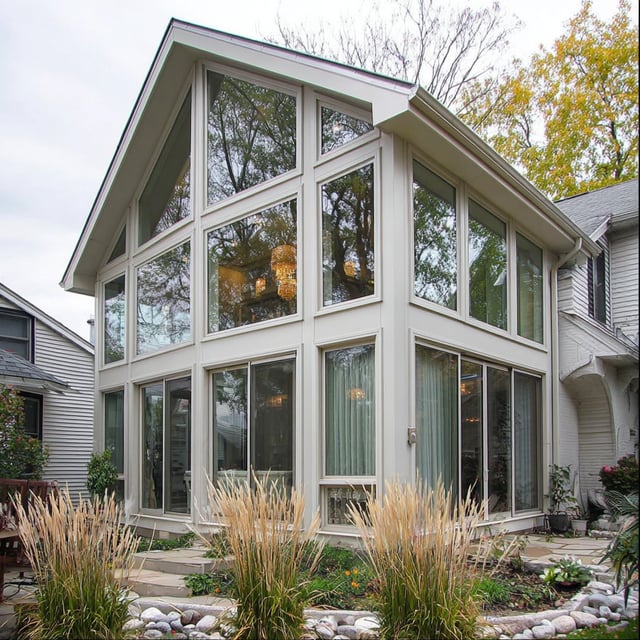
A two-story sunroom addition with large windows and a white exterior, surrounded by tall ornamental grasses.

In This Article

    A two-story sunroom addition looks, from the outside, like a single-story sunroom with another one stacked on top. That description is technically accurate and almost completely useless for planning. The construction reality is closer to a small two-story home addition with most of the walls made of glass. Foundation, framing, glazing, mechanical systems, permits, resale value: every decision changes.

    What you're actually building

    A two-story sunroom is a vertically stacked addition with extensive glazing on both levels. The lower level usually functions as a living room, dining area, or sitting room. The upper level becomes a bedroom, home office, library, or open loft.

    The three configurations you'll see most often:

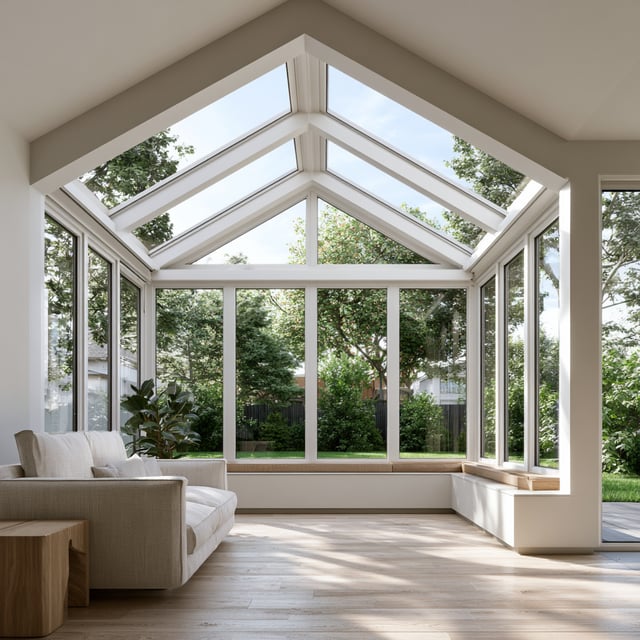
    • Cathedral or vaulted. The lower level is open to the roof and the upper level is a partial loft or balcony. Dramatic, but it's really one large room with a mezzanine.
    • Fully stacked. A finished floor sits between levels, creating two distinct rooms. More square footage, more conventional in feel, more expensive.
    • Conservatory style. Ornate framing in aluminum, steel, or wood, often with a glass roof on the upper level. Highest cost, most demanding to engineer.

    Pick the configuration before anything else. A cathedral with a mezzanine is structurally simpler and cheaper than a fully stacked layout. A glass-roofed conservatory in a snow-load region is its own engineering project.

    Renovate with confidence every step of the way

    Step 1: Personalize Your Renovation Plan

    Step 2: Receive Quotes from Trusted Contractors

    Step 3: Let Us Handle the Project Details
    Get Started

    The foundation question comes first

    Before any other step in planning your two-story sunroom addition, you must first answer: can the site actually support this? Two floors of framing, glazing, finishes, furniture, snow on the roof, and people add up to real load.

    A single-story sunroom can sit on a slab or piers. A two-story addition almost always needs a frost-depth footing, crawlspace, or full basement extension tied into the existing foundation. Where the existing house has a basement, the new foundation has to match its depth and tie into the existing wall. Poor soil, sloped lots, or high groundwater push costs up quickly. Existing patios or decks on the planned site get demolished.

    Three site conditions that often kill the project or force a redesign:

    • Setback constraints. Many municipalities require side and rear setbacks of 5 to 25 feet. A two-story addition is often pushed close to the property line, where it may not legally fit.
    • Existing utilities. Sewer, gas, water, and electrical service lines under the planned footprint have to be relocated. Easements may make this impossible.
    • Foundation incompatibility. When the existing house sits on a slab, adding a basement-depth foundation next to it requires careful engineering to avoid undermining the original structure.

    Get a structural engineer to walk the site before committing to any design. The fee, usually $500 to $2,000, is the best money you can spend early.

    Tying into the existing house is the part most people underestimate

    Where the new structure meets the old one is the highest-risk junction in the project. A two-story sunroom addition has to:

    • Connect to the existing wall structurally without compromising the original framing. The wall often needs reinforcement, especially when you're cutting large openings into it for doorways or pass-throughs on both floors.
    • Match the existing roofline, or transition cleanly into it. Mismatched rooflines look bolted-on, which hurts both aesthetics and resale value.
    • Maintain a watertight envelope at every flashing point. The second-story roof-to-wall connection is where leaks most often develop, and it's the hardest junction to repair after the fact.
    • Align floor heights between the addition and the existing house. A 4-inch step between rooms on the second floor is a constant annoyance and a code issue.


    Glass is the defining material decision

    A two-story sunroom addition can have anywhere from 300 to 800 square feet of glass. Pick the wrong spec and you'll either freeze in winter or roast in summer.

    The variables that matter:

    • Pane count. Double-pane is standard, triple-pane costs 30 to 50% more. The upgrade cuts heat loss meaningfully in cold climates and reduces noise. On the upper floor where heat traps, triple-pane often pays for itself.
    • Low-E coatings. Thin metallic layers tuned for cold climates (let solar heat in, keep interior heat from escaping) or hot climates (block solar heat). The wrong coating for your climate will make the space miserable.
    • Solar heat gain coefficient (SHGC). The fraction of solar energy that passes through the glass. Lower numbers around 0.25 to 0.35 work for hot, sunny climates. Higher numbers from 0.40 to 0.55 suit cold climates where you want passive solar warmth.
    • Frame material. Thermally broken aluminum, fiberglass, and clad wood all perform well. Standard aluminum without a thermal break conducts heat aggressively and causes condensation, so avoid it for any conditioned space.
    • Tempering and laminating. Building codes require these treatments for most large glass panels and any panel near a door or stairway. Laminated glass is also the impact-rated standard in hurricane zones.

    Expect glazing to run $50 to $100 per square foot installed for standard double-pane low-E, and $150 to $400 per square foot for high-performance or specialty glass. On a 600-square-foot glass package, that's a $30,000 to $90,000 line item.

    HVAC has to be designed in, not added later

    A two-story sunroom addition is one of the hardest spaces to keep comfortable. Stack effect sends hot air up to the upper level, glass loses or gains heat far faster than insulated walls, and direct sun on south or west glazing can spike interior temperatures by 15 to 25 degrees in an afternoon.

    What works:

    • Zoned HVAC, with the upper and lower levels on independent thermostats. Non-negotiable for fully stacked layouts. The temperature gap between floors will be 10 degrees or more by mid-afternoon.
    • Mini-split heat pumps. Often the right choice for additions because they don't require extending existing ductwork. A multi-zone outdoor unit with separate heads on each floor runs $5,000 to $12,000 installed.
    • Radiant floor heating on the lower level. It combats cold air pooling at the floor near glass walls. Roughly $10 to $25 per square foot, but the most effective way to make a glass-walled room feel warm in winter.
    • Ceiling fans on both levels. They're cheap, effective, and they help break up thermal stratification between the two floors.
    • Operable windows and a roof vent or skylight on the upper level. Stack-effect ventilation in shoulder seasons. Saves running the AC much of the year in temperate climates.

    What doesn't work: extending the existing forced-air system without a load calculation. Most existing residential HVAC systems are sized for the existing house with no margin. Add 600 square feet of mostly-glass space without recalculating, and both the new and existing rooms will feel off.

    Permits, code, and the appraisal question

    A two-story sunroom is a permitted, inspected, code-compliant addition. There is no version of this project that avoids the permit process. Expect:

    • Architectural and structural drawings, usually stamped by a licensed engineer or architect.
    • Zoning review for setbacks, lot coverage, and height limits.
    • Building permits with multiple inspections covering foundation, framing, electrical, mechanical, insulation, and final.
    • Energy code compliance, which in many states now means meeting specific U-factor and SHGC limits on all glazing.
    • A property tax reassessment after completion.

    Permit costs vary widely by jurisdiction, from a few hundred dollars to several thousand. Approval timelines are typically 4 to 12 weeks, plus another 1 to 4 weeks if zoning variances are required.

    A sunroom only counts as official square footage if it has a permanent foundation, is connected to the home's HVAC system, and is built to the same structural standards as the rest of the house. Three-season rooms with no climate control typically appraise at 25 to 75% of standard per-square-foot value. Four-season conditioned rooms appraise at full value. The gap is often $50,000 or more on a 400-square-foot space.

    National data shows sunrooms recoup roughly 30 to 55% of project cost at resale, with four-season conditioned rooms doing meaningfully better. Warm-climate markets see higher returns. Cold-climate markets see lower ones.

    Two-story sunroom cost ranges

    Two-story sunroom addition costs are most reliably expressed per square foot of total floor area across both levels:

    • Builder-grade construction: $150 to $250 per square foot. Standard glazing, basic interior finishes, minimal site work.
    • Mid-range construction: $250 to $400 per square foot. Quality low-E glass, zoned HVAC, and well-finished interiors.
    • High-end conservatory-style: $400 to $700+ per square foot. Premium framing, triple-pane or specialty glass, fully integrated mechanical systems.

    For a 12-by-16 fully stacked addition at 384 square feet total, that's roughly $60,000 to $270,000 depending on quality tier. A 16-by-20 at 640 square feet runs $100,000 to $450,000.

    Hidden costs that catch homeowners off guard:

    • Electrical panel upgrades when existing service can't handle the added HVAC load, typically $2,000 to $5,000.
    • Drainage and grading work to manage runoff from the new roof, typically $1,500 to $8,000.
    • Landscape restoration after construction, typically $2,000 to $15,000.
    • Property tax increases from the assessed value bump after completion.

    When a two-story sunroom is the right call

    A two-story sunroom addition is the right project for some homes and the wrong project for others.

    When it makes sense

    • You need real programmed square footage on both floors. Bedroom upstairs and living space downstairs, or office plus sitting room. The two-story format earns its cost when both levels have a defined use.
    • Your site can structurally support it. Adequate setbacks, compatible foundation conditions, and no major utility relocations.
    • You're budgeting for a full home addition, not a sunroom kit. This is a $100,000 to $450,000 project at typical scale.
    • You want light and views on both floors of the house. This is what justifies the cost over a conventional addition. Without it, build the addition.

    When it doesn't

    • The goal is just extra square footage at the lowest price. A conventional insulated addition is cheaper per square foot and easier to condition.
    • Your existing HVAC system is already maxed out and you don't want to upgrade it. The new space will pull comfort from the rest of the house.
    • You're expecting a sunroom kit experience and timeline. Two-story sunrooms typically take 3 to 6 months of construction, not weeks.

    Finding the right contractor through Block Renovation

    The success of a two-story sunroom addition depends more on the contractor than on any other single decision. Get the wrong one and the foundation, the tie-in, and the mechanical systems all become change orders six months in.

    Block matches homeowners with vetted local contractors who have experience with the specific scope of work involved. For a two-story sunroom addition, that means general contractors who routinely build full additions, not specialty sunroom installers.

    What Block does for projects at this scale

    • Vetted contractor matching. Thousands of homeowners have renovated with Block, working with contractors screened for licensing, insurance, references, and project quality.
    • Competitive bidding on a clear scope. The best contractors in your area compete against a defined scope of work. Every quote covers the same line items, so the comparison is real.
    • Upfront in-depth scope review. Block's experts and AI-enabled tools review each contractor proposal to catch missing line items, vague allowances, and red flags before you sign.
    • Progress-based payments. No direct payment to contractors. You pay Block, Block releases funds in stages tied to approved milestones, and contractors stay on schedule.

    Two-story sunroom additions are not easy projects. They're worth doing when the site, the budget, and the contractor all line up. Skip any one of those and the math turns against you fast.

    Remodel with confidence through Block

    Happy contractor doing an interview

    Connect to vetted local contractors

    We only work with top-tier, thoroughly vetted contractors

    Couple planning their renovation around the Block dashboard

    Get expert guidance

    Our project planners offer expert advice, scope review, and ongoing support as needed
    Familty enjoying coffee in their newly renovated modern ktchen

    Enjoy peace of mind throughout your renovation

    Secure payment system puts you in control and protects your remodel

    Get Started