



Home Addition
Building Kitchen Additions: Costs & Design
08.21.2026
05.04.2026


In This Article
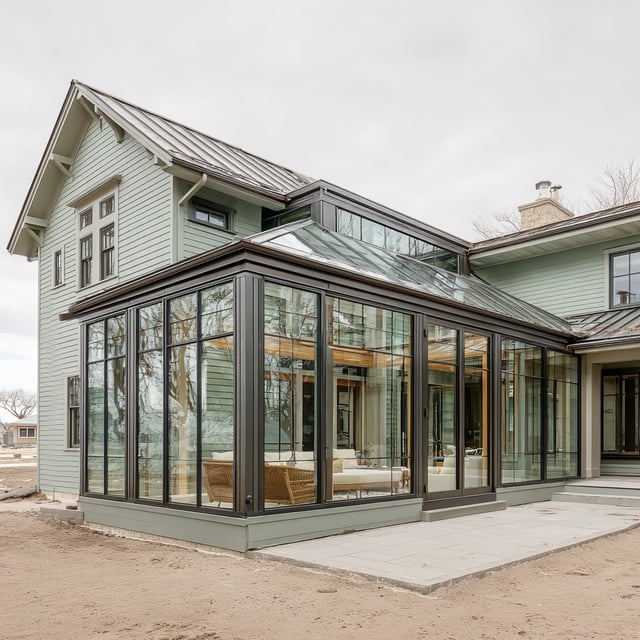
A 200 square foot solarium with a glass roof, four-season insulation, and a frost-wall foundation in a cold-winter climate will run somewhere between $60,000 and $90,000 by the time the last inspector signs off. It's also a number that surprises people who started their research thinking solariums were a budget-friendly way to add square footage.
A solarium and a sunroom get used interchangeably in casual conversation, but they're genuinely different builds. Knowing which one you actually want is the first step toward an accurate budget.
|
Element |
Sunroom |
Solarium |
|
Roof |
Conventional (shingled, metal, or insulated panels) |
Glass, tempered or laminated |
|
Walls |
Large windows in framed walls |
Floor-to-ceiling glass on most or all sides |
|
Natural light |
High |
Maximum, including overhead |
|
Insulation |
Standard for four-season builds |
Specialized low-E glass and thermal breaks required |
|
Climate control |
Standard HVAC extension usually works |
Dedicated mini-split or zoned system typically needed |
|
Structural engineering |
Conventional framing |
Custom engineering for glass roof loads |
|
Best use case |
Year-round living space that feels like the rest of the house |
Greenhouse-like room, plant collections, stargazing, maximum daylight |
|
Maintenance demands |
Comparable to any addition |
Periodic resealing, glass cleaning, more attention overall |
|
Build complexity |
Moderate |
High |
The short version: a sunroom is an addition with a lot of windows. A solarium is a glass enclosure that happens to be attached to your house. They look similar in a brochure, but they live very differently.
A solarium addition costs $30,000 to $100,000 on average, with most projects landing between $300 and $800 per square foot. That's higher than a standard sunroom renovation because a solarium has glass walls and a glass roof, which requires specialized framing, tempered or laminated panels, and engineering that a conventional addition skips.
Here's how the range breaks down by type:
The biggest cost drivers are size, glass quality, foundation work, and whether you're building three-season or four-season. Going from three to four-season typically adds $5,000 to $15,000, and in any climate with real winters, it's worth it. A three-season room you can only use eight months a year is a worse investment than a four-season room you actually live in.
The roof is the whole game. A glass roof is not just a sunroom with extra glazing on top. It needs structural engineering for snow loads, tempered or laminated panels rated for impact, and seam detailing that keeps water out for decades.
Specifically, the roof drives cost in four ways:
In a place with real winters, the roof structure alone can cost more than the walls.
Renovate with confidence every step of the way
Step 1: Personalize Your Renovation Plan
Step 2: Receive Quotes from Trusted Contractors
Step 3: Let Us Handle the Project Details

Most online estimators give you a per-square-foot number that covers framing, glass, and basic labor. The full project cost is usually 25% to 40% higher than that number once you add everything in.
If you're building on an existing patio or deck, you might save thousands. You also might not. Many existing patios aren't structurally adequate to support a four-season addition, and discovering that mid-project adds $5,000 to $10,000 in unplanned spending. A pre-build engineering inspection is cheap insurance.
For new foundations, expect:
These line items rarely make it into the dream-stage budget:
Running power for lighting and outlets, plus extending heating and cooling into the new room, adds $1,500 to $4,000. For a four-season solarium, mini-split systems are usually the right call because extending your existing HVAC into a glass-walled room can overload an already-sized system.
Build cost is one number. Ownership cost is another, and it's bigger than people expect. Here's what shows up in the years after.
A glass-roofed room is essentially a greenhouse. Without serious low-E coatings, exterior shades, or active cooling, a south-facing solarium in summer can hit 110°F even with the air conditioning running.
Solving it costs money up front. The line items:
A four-season room is not just like the rest of the house, no matter what the brochure suggests. Maintaining comfortable temperatures in an all-glass enclosure costs significantly more in monthly energy bills than the equivalent square footage of a regular addition. Design for it now. Retrofitting shading and ventilation into a finished glass room is miserable and expensive.
Adding finished, heated square footage triggers a reassessment in most municipalities. A $60,000 solarium might add $600 to $1,500 a year to your tax bill depending on local millage rates. Over 15 years of ownership, that's $9,000 to $22,500 in recurring cost that almost no cost guide mentions.
Some insurers treat glass roofs as higher risk and either charge more or require specific construction standards. A few won't cover hail damage to glass roof panels at all without a separate rider.
Call your carrier before you sign a contract. The conversation takes ten minutes and can save you from a surprise after the project is done.
Solariums are notoriously prone to leaks at the seams over time. Many owners end up resealing every 5 to 10 years, with costs ranging from $500 for minor reseal work to $5,000+ for partial reglazing on a larger room.
This is solvable with the right glass spec, the right installer, and the right maintenance schedule. It's also rarely mentioned by sales reps. Ask any solarium contractor for a written maintenance schedule before you commit, and budget for it the way you'd budget for repainting an exterior every decade.
Single-pane glass roofs in cold climates produce dramatic interior condensation, sometimes literal indoor rain in the morning. Properly specified double or triple-pane glass with the right thermal break solves this, but the spec adds cost up front.
If a contractor quotes you a solarium without specifying the glass type, ask. The difference between standard and high-performance glass might be $5,000 on the build but the difference between a comfortable room and a room you can't use in winter.
A 200 square foot solarium sounds spacious until you furnish it. That's roughly 14 feet by 14 feet, and once you put in a sofa, a couple of chairs, and a side table, you've used most of the room.
Many homeowners build their solarium and then wish they'd gone 50% larger. Going from 200 to 300 square feet adds maybe 30% to total cost (most of the fixed costs stay fixed), but often doubles the room's usefulness. If you're already committed to the project, the marginal cost of more space is the best value in the entire build.
Rough sizing guide:
Walk the dimensions in your yard with stakes and string before you sign anything. The footprint always feels smaller in real space than it does on a floor plan.
Prefab solarium kits advertise prices around $10,000 to $20,000, but the price tag doesn't include anything that turns the kit into a usable room.
By the time you add foundation, permits, electrical, HVAC, site prep, and installation labor, you're often at $40,000 or more. And the structure is generally lower quality than a custom build at the same total price, with thinner glass, weaker framing, and seams that are more prone to leaking over time.
Kits can work for budget-conscious three-season builds if you have a contractor who's installed that specific kit before. They almost never deliver on the advertised "total project" price, and the gap between the kit cost and the all-in cost is the single biggest source of sticker shock in this category.
Solariums aren't the design statement they were twenty years ago. The trend has shifted toward indoor-outdoor rooms with conventional roofs and large sliding or folding glass walls that fully open to a patio. To some buyers, a fully glazed solarium with a glass roof now reads less like an upgrade and more like a 1990s addition that dates the rest of the house.
This is worth knowing before you build, not after. If you're staying in the home for the long haul, daily enjoyment matters more than what the next buyer thinks. But if you're building partly with resale in mind, talk to a local agent before you commit to a traditional glass-roof design. In some neighborhoods, an insulated roof with skylights and operable glass walls will hold its value better than the full solarium, even though the upfront cost lands in a similar range.
The room you build today is the room someone else will eventually walk through. Worth at least asking the question before the glass goes up.
A solarium addition isn't a project you hand to whoever's available. It sits at the intersection of framing, structural engineering, glazing, and weatherproofing, and the gap between a contractor who's done a dozen of them and one who's done their first is enormous. A general contractor who builds beautiful kitchens may never have detailed a glass roof seam, sized a steel ridge beam for snow load, or specified the right thermal break for a panel that has to handle 100 degrees of temperature swing in a single day.
Block Renovation matches your project with vetted local contractors who compete for the job, and you can filter for the ones who've completed solarium and glass-roof work specifically. Every scope is reviewed by Block experts to catch missing line items and red flags early, which on a solarium usually means flagging vague glass specs, missing flashing details, or HVAC plans that won't keep up with afternoon sun. Payments are released to the contractor as work progresses, not upfront, so the incentive stays pointed at finishing the job right.
Remodel with confidence through Block

Connect to vetted local contractors
We only work with top-tier, thoroughly vetted contractors

Get expert guidance
Our project planners offer expert advice, scope review, and ongoing support as needed
Enjoy peace of mind throughout your renovation
Secure payment system puts you in control and protects your remodel

Renovate confidently with Block
Easily compare quotes from top quality contractors, and get peace of mind with warranty & price protections.
Home Addition
Building Kitchen Additions: Costs & Design
08.21.2026
Outdoor Spaces
Board and Batten with Brick - Perfecting This Look
08.19.2026
Outdoor Spaces
Deck Remodeling: Costs, Materials, and Structure
08.09.2026

Cost
20x20 Room Addition Cost: What to Budget in 2026
07.28.2026
Outdoor Spaces
Sunroom Roof and Glass Types: Finding the Right Style
07.13.2026