




Cost
20x20 Room Addition Cost: What to Budget in 2026
07.28.2026
05.01.2026


In This Article
A second story bump out sounds like the obvious move when you need more upstairs space without a full addition. Then you start pricing it. You get more square footage without the cost of a full second-story build, you usually keep your yard intact, and the project moves faster than a ground-up addition. But bump outs follow the same building codes as full additions. The codes don't care that the project is small.
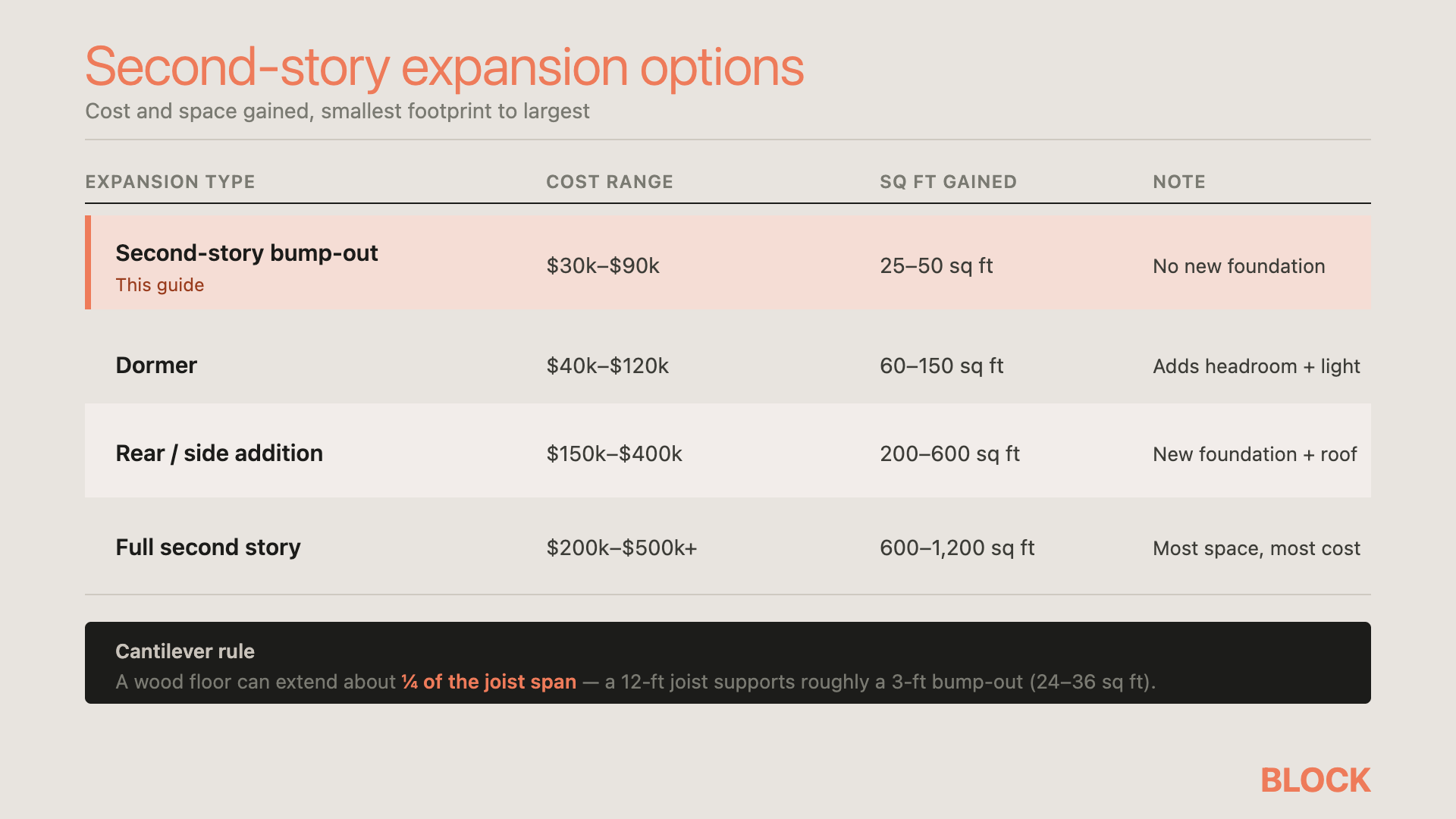
The defining feature of a second story bump out is that it cantilevers off the existing structure, usually two to three feet beyond the footprint of the first floor. Some jurisdictions allow up to four. Past that, you're typically looking at posts, piers, or a foundation extension, which moves the project out of bump out territory and into addition territory.
For a 12-foot-wide bedroom wall, a two-foot bump out adds roughly 24 square feet. A three-foot bump out across the same wall adds 36. That's not a new room. It's the difference between a primary bedroom that fits a king bed with nightstands and one where you've been sleeping with a dresser blocking the closet.
If you're trying to add a full bedroom, a home office, or a meaningful living area, a bump out is almost certainly the wrong tool. Where it shines:
If your wishlist is bigger than that, you're looking at a dormer or a full addition.
A simple cantilevered bump out, two to three feet deep across a 10 to 12 foot wall, with standard finishes and no plumbing, typically lands between $20,000 and $45,000. That includes framing, sheathing, siding to match the existing house, roofing tie-in, insulation, drywall, electrical, and trim.
Add a bathroom and the number jumps. A bump out that incorporates a new or expanded bathroom usually runs $50,000 to $90,000, sometimes higher depending on tile selections, fixture quality, and whether you're rerouting plumbing stacks. Plumbing on a second floor adds real cost because you're working above finished space and any leak risk has to be engineered out.
A larger or more complex bump out, four feet deep, supported by a structural extension below, or with significant exterior work like new windows, custom siding details, or a roof reframe, can reach $75,000 to $150,000.
A few cost drivers homeowners often underestimate:
A cantilever depends on the existing floor framing extending past the wall below it. Most residential floor joists are sized to span between supporting walls, not to project meaningfully beyond them.
The general rule is that you can cantilever a wood-framed floor about one-fourth the length of the joist's interior span. If your floor joists span 12 feet inside the house, you can typically cantilever about three feet without engineering changes. If they span eight feet, you're closer to two.
A few practical implications:
The structural engineer is the most important hire on the project, and the first one you should make. A $500 to $2,500 stamped drawing tells you whether your bump out is even possible before you spend a dollar on design or pick up a paint chip. Joist direction, joist span, header capacity, foundation load: the engineer answers all of it in one site visit. Skipping this step and relying on a contractor's read often ends with a framing inspection that fails, $15,000 already spent on demo and design, and a wall that turns out to need engineering changes nobody priced in. Most municipalities require engineered plans for any cantilevered addition on a second floor anyway, so get the drawings ASAP.
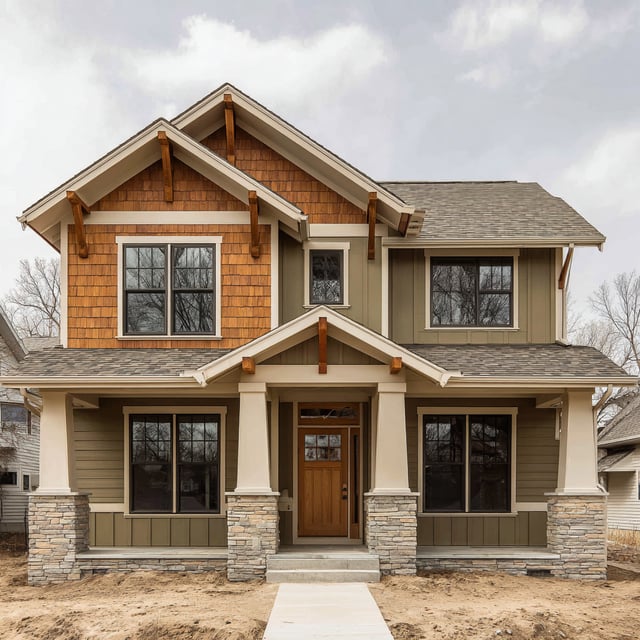
A bump out you can see is a bump out that failed. The whole point is that it should disappear into the original house, read as something that was always there, and stop drawing the eye the moment it's done. A poorly designed one reads as exactly what it is: an afterthought stuck onto the side of a house. The difference is almost entirely in the details.
The most common visual mistakes:
For homes with strong architectural character like Victorians, mid-century moderns, Craftsmans, the bar is higher. A bump out on a 1920s Tudor that doesn't reproduce the original eave detail, casement window proportions, and stucco texture will look wrong forever. On these homes, custom millwork, masonry matching, and historically appropriate windows can add 30 to 50% to the project cost. Get the matching number specifically and in writing before you sign anything.
For more recent construction with vinyl siding and standard windows, the aesthetic stakes are lower and matching is more forgiving. The bump out can read as part of the original house if the proportions and roofline are handled well.
One detail worth fighting for: the bump out's roof should tie into the existing roof in a way that looks intentional. A small gable that mirrors a gable elsewhere on the house. A shed roof that aligns with an existing eave height. A roofline that follows the logic of the original design rather than fighting it. This is often where the difference between a $40,000 and a $55,000 bump out shows up, and it's almost always worth the spend. Either commit to the matching budget or don't do the project. A bump out that "almost" matches is worse than no bump out at all.
Design a Home That’s Uniquely Yours
Block can help you achieve your renovation goals and bring your dream remodel to life with price assurance and expert support.
Get Started
Even though a second story bump out doesn't touch the ground, it counts as an addition for permitting purposes in most jurisdictions. That means you're dealing with the full permit package: structural drawings, energy code compliance, sometimes a survey, and inspections at framing, insulation, and final.
Zoning is where bump outs sometimes hit walls that homeowners didn't see coming:
The permitting process typically takes four to twelve weeks before construction can start, depending on jurisdiction. In dense urban markets like New York, San Francisco, and Boston, plan for the longer end of that range and sometimes beyond.
Bump outs take longer than contractors quote. Almost always.
An optimistic timeline is four months from contract signing to final walkthrough. But in truth, real-world bump out projects run six to nine months from first conversation to keys-in-hand. The difference is the gap between phase estimates and what happens when those phases collide with weather delays, inspector backlogs, and the inevitable mid-project change order that requires a revised drawing and a re-review.
A typical project breaks down roughly like this:
Anyone quoting a project that's much faster than that is either overpromising or planning to skip steps you'll pay for later.
The construction phase will involve opening the exterior wall, which means tarping and weatherproofing for two to three weeks while the home is partially exposed. Most contractors schedule this for spring through fall in colder climates. And even though the work is concentrated on one upstairs room, the noise, dust, and crew presence affect the whole house.
Compare Proposals with Ease
A second story bump out is the right tool when you have a specific, modest space problem on your second floor and the existing structure can support a small extension. Primary bedroom feels cramped. Bathroom can't fit a tub. Closet is too small. The wall you'd bump out faces a side yard or rear yard with room to spare, and the house's architecture can absorb a small extension without looking off.
It's the wrong tool when you need substantial new square footage, when the wall you'd bump out is at a setback line, when the floor framing runs the wrong direction, or when the cost of matching existing materials makes the project economically equivalent to a larger, more impactful addition. In those cases, a dormer, a full second-story addition, or a rear extension will deliver more value per dollar.
Compare the alternatives:
A bump out wins on cost per project, not cost per square foot. If you're paying $1,500 per square foot for a small bump out and $400 per square foot for an addition, the addition is the better deal mathematically. The bump out only makes sense if 30 square feet is genuinely all you need.
Before signing a contract, get clear answers to these questions:
Get at least three quotes. Compare the project scopes line by line. The lowest number is rarely the clearest picture of what the job actually involves, and on a project where matching details determines whether the result looks right, you want a contractor whose scope reflects that level of care.
Finding that contractor is where most second story bump outs succeed or fail. The framing is straightforward for a crew that's done a dozen of them and full of expensive surprises for one that hasn't. Ask to see photos of bump outs they've completed on homes similar in age and style to yours, talk to those homeowners, and get a sense of how they handled the inevitable surprises.
Block Renovation's contractor network is built for this. Every contractor is licensed, insured, vetted for past work, and matched to projects based on the specific type of renovation involved, not just zip code. For a bump out, that means contractors with cantilever experience, structural engineering relationships already in place, and a track record on the kind of detail work that makes a small addition disappear into the rest of the house.
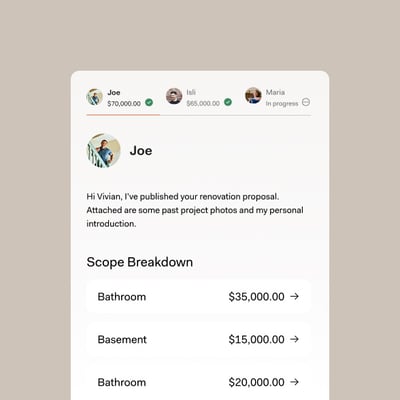
Tell Block about your project once and qualified contractors in your area compete for it. Each quote comes with a scope that's been reviewed by Block's experts and AI tools to catch missing line items, header upgrades, roof tie-in reframing, siding match allowances, the HVAC extensions that aren't really extensions, before you sign anything. Payments run through Block's progress-based system, so contractors are paid as work is completed and approved, not upfront. And every contractor in the network carries a one-year workmanship warranty.
Remodel with confidence through Block
Connect to vetted local contractors
We only work with top-tier, thoroughly vetted contractors

Get expert guidance
Our project planners offer expert advice, scope review, and ongoing support as needed
Enjoy peace of mind throughout your renovation
Secure payment system puts you in control and protects your remodel


Renovate confidently with Block
Easily compare quotes from top quality contractors, and get peace of mind with warranty & price protections.
Cost
20x20 Room Addition Cost: What to Budget in 2026
07.28.2026
Home Addition
Bump Out Addition Cost, Ideas & Planning Guide
07.08.2026
Cost
2026 Home Addition Cost Guide: Per Square Foot & ROI
07.07.2026
Home Addition
How to Plan a Home Addition: Process and Timeline
07.01.2026

Home Addition
Family Room Addition Ideas - Know Your Options
05.28.2026