



Kitchen
A Galley Kitchen Remodel in NYC - Adding a Breakfast Bar
07.02.2026
04.13.2026


In This Article
You know the kitchen. Honey oak everywhere, raised panel doors, a countertop that has seen better decades, and lighting that makes everything look slightly beige. Maybe it functions fine. Maybe it has functioned fine for twenty years. But every time you walk in, you feel the gap between the kitchen you have and the kitchen you actually want.
The 1980s kitchen is one of the most common renovation starting points in the country, and for good reasons that often get overlooked in the rush to gut everything. The cabinet boxes from that era tend to be solid. The layouts are usually practical. The bones, as contractors like to say, are typically worth keeping. What makes these kitchens feel dated is almost always the surfaces, the materials, and the way the space relates to the rest of the home.
This guide covers what actually drives the transformation in a 1980s kitchen renovation: what to keep and what to let go, and before-and-after examples that show the range of what is possible, from targeted refreshes to full gut renovations.
Not everything in a 1980s kitchen needs to go. Deciding what to keep versus what to replace is one of the most important planning conversations you will have, and it has a direct effect on your budget.
The before-and-afters below span a range of scopes, from opening up a closed layout to targeted refreshes that kept the footprint entirely intact. Each one is paired with what drove the transformation, so you can see not just what changed, but why it worked.
![[IMAGE: BEFORE: Closed oak kitchen with built-in peninsula, arched window above sink, white coil-burner range, large beige floor tiles, and honey oak raised-panel cabinets throughout. AFTER: Same kitchen with peninsula removed, replaced by a dramatic marble waterfall island with dark walnut base. White upper cabinets and custom painted range hood. Wide-plank hardwood floors running continuously into the now-visible dining room. Pendant lighting over the island.]](https://www.blockrenovation.com/hs-fs/hubfs/1980s%20Kitchen%20Before-After-2.png?width=2816&height=1536&name=1980s%20Kitchen%20Before-After-2.png)
Before: A functional but closed-off layout that treated the kitchen as a separate room. After: One wall removed, and the entire ground floor changes.
Builders in the 1980s tended to treat the kitchen as a utility room. Peninsulas were common. Half-walls created choke points. The kitchen was a place to cook, not a place to be.
Removing a non-structural wall or peninsula is the highest-impact change available in most 1980s kitchens. It brings in light from adjacent rooms, allows a proper island with seating to replace a closed peninsula, and makes the entire floor feel larger without adding a single square foot. In the “before” above, the kitchen is perfectly functional. In the after, it is the center of the home.
![[IMAGE: BEFORE: U-shaped kitchen with uniform honey oak raised-panel cabinets on uppers and lowers, floral-pattern vinyl floor in beige and cream, white coil-burner range, top-mount refrigerator, and standard stainless drop-in sink. AFTER: Same U-shape with deep walnut flat-front lower cabinets and warm white upper cabinets, both with slim bar pulls. Farmhouse apron sink beneath subway tile backsplash with tight horizontal joints. Wide-plank hardwood floors. Globe pendant over counter space.]](https://www.blockrenovation.com/hs-fs/hubfs/1980s%20Kitchen%20Before%20and%20After.png?width=2816&height=1536&name=1980s%20Kitchen%20Before%20and%20After.png)
Before: Uniform oak from floor to ceiling. After: Two-tone cabinets, a farmhouse sink, and hardwood floors that feel like a different decade entirely.
Oak cabinets with raised-panel doors are the single most recognizable marker of a 1980s kitchen. They are not bad cabinets. Many of them are structurally excellent. But the warm orange tone and the ornate door profile do more to date a kitchen than almost any other element.
The most cost-effective approach is to keep the boxes and replace only the doors and drawer fronts. When paired with new hardware and a fresh coat of paint on the interior, it reads as a full cabinet renovation from across the room.
If you do replace everything, the two-tone approach shown here earns its popularity. A darker wood tone on the lower cabinets ground the room; a lighter painted upper keeps it from feeling heavy. The contrast also does something that uniform oak never could: it makes the kitchen feel designed.
![[IMAGE: BEFORE: U-shaped kitchen with uniform honey oak raised-panel cabinets on uppers and lowers, floral-pattern vinyl floor in beige and cream, white coil-burner range, top-mount refrigerator, and standard stainless drop-in sink. AFTER: Same U-shape with deep walnut flat-front lower cabinets and warm white upper cabinets, both with slim bar pulls. Farmhouse apron sink beneath subway tile backsplash with tight horizontal joints. Wide-plank hardwood floors. Globe pendant over counter space.]](https://www.blockrenovation.com/hs-fs/hubfs/Gemini_Generated_Image_33cz6733cz6733cz.png?width=2816&height=1536&name=Gemini_Generated_Image_33cz6733cz6733cz.png)
Before: Pattern everywhere, none of it coordinated. After: The same instinct for color and material, executed with intention.
The 1980s were not afraid of color or pattern. They were just not always selective about it. Wallpaper that covered the ceiling, countertops tiled in two colors, cabinets in a warm honey tone surrounded by even warmer walls. The instinct was not wrong. The execution often was.
There is a growing direction in kitchen design that takes the era's love of color seriously but replaces the scattershot approach with something more deliberate. Terracotta, deep green, warm brass, and natural stone are not rejections of the 1980s. They are refinements of it. The result can feel simultaneously of the moment and rooted in something older, which is exactly the quality that makes a kitchen feel personal rather than trend-driven.
This approach works best when you commit to the palette fully. One retro-inspired element surrounded by generic finishes produces a confused result. When the ceiling, the counters, the range, and the floor all speak the same language, the room holds together in a way that feels considered rather than decorated.
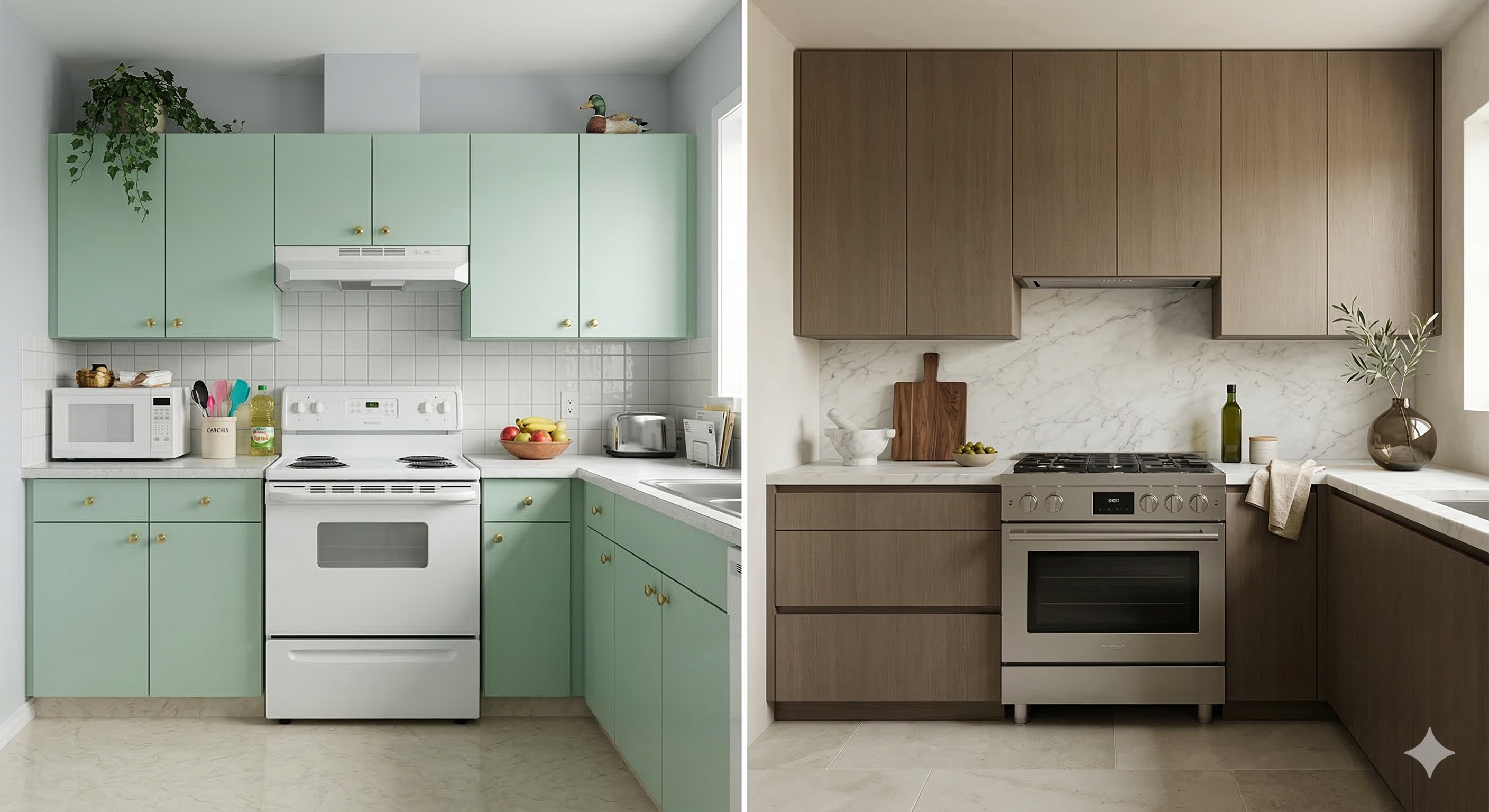
![[IMAGE: BEFORE: Kitchen with yellow-painted raised-panel cabinets running to standard upper height, leaving a gap to the ceiling occupied by a floral wallpaper border strip. Duck decoy and trailing ivy on top of upper cabinets. Beige coil-burner range. AFTER: Floor-to-ceiling flat-front cabinets in a light blonde oak tone filling the entire wall. Two flanking glass-front uppers. Marble counters. Stainless professional range and integrated hood.]](https://www.blockrenovation.com/hs-fs/hubfs/Gemini_Generated_Image_17pen817pen817pe.png?width=2816&height=1536&name=Gemini_Generated_Image_17pen817pen817pe.png)
Before: The gap above the cabinets, and everything that lived in it. After: Clean line from floor to ceiling.
The gap between the top of the upper cabinets and the ceiling is one of the subtler but most persistent signals of a 1980s kitchen. Standard upper cabinet height stopped well short of the ceiling in most homes of that era, leaving a shelf-like space that collected dust, baskets, and the kind of decorative objects that never quite had another home.
Extending cabinets to the full ceiling height adds real storage, makes the room feel taller, and eliminates a visual interruption that the eye has to navigate every time it crosses the room. In smaller kitchens, it can actually make the space read as larger by encouraging the eye upward. In homes with slightly irregular ceilings, a filler panel or crown detail handles the transition cleanly.
![[IMAGE: BEFORE: Narrow galley kitchen with peach walls, honey oak cabinets on both sides, mirrored tile backsplash, tiled countertops in cream, and a pink-and-white checkerboard vinyl floor running the length of the galley. Rooster wall decor. AFTER: Same galley footprint with warm greige plaster walls and ceiling, dark grey-toned oak flat-front cabinets on both sides, honed concrete counters with integrated trough sink, and large-format limestone tiles in warm ivory covering the floor with barely visible joints. High-output gas range.]](https://www.blockrenovation.com/hs-fs/hubfs/Gemini_Generated_Image_sl6zzysl6zzysl6z.png?width=2816&height=1536&name=Gemini_Generated_Image_sl6zzysl6zzysl6z.png)
Before: The checkerboard floor announces the decade before anything else does. After: Large-format limestone tiles and the room transforms.
The floor of a 1980s kitchen is often where the decade announces itself most loudly. Checkerboard vinyl in pastels, small-format ceramic in cream or beige, linoleum with a busy repeat pattern. These floors resist every attempt to modernize the space around them because they pull the eye down and backward, to a specific moment in time that the rest of the renovation is trying to move past.
New flooring changes how the entire room reads. It affects perceived size, the warmth of the light, and whether the space feels coherent or assembled from different eras. In the galley above, switching from the pink-and-white checkerboard to large-format limestone tiles is as transformative as the cabinet swap. The room did not get bigger. It just stopped fighting itself.
Large-format tiles, anything 24 inches or larger on at least one side, are one of the strongest choices for 1980s kitchen updates. Fewer grout lines means a calmer backdrop. Wide-plank hardwood or engineered wood is equally strong, particularly in kitchens that open to a living or dining space where you want the flooring to flow without interruption.
![[IMAGE: BEFORE: Compact U-shaped kitchen with beige-toned oak raised-panel cabinets, gap between upper cabinets and ceiling, backsplash of smaller cream tiles with clearly visible grout lines, and laminate countertops in matching beige. White coil-burner range. White top-freezer refrigerator. Lived-in counters with dish rack and grocery list on the fridge. AFTER: Same footprint with warm blonde flat-front cabinets extending fully to the ceiling. Large-format stone-look backsplash tile with almost invisible joints. Warm white quartz counters. Same white range and refrigerator, but surrounded by materials that make them feel deliberate.]](https://www.blockrenovation.com/hs-fs/hubfs/Gemini_Generated_Image_i5qujwi5qujwi5qu.png?width=2816&height=1536&name=Gemini_Generated_Image_i5qujwi5qujwi5qu.png)
Before: Small tiles, wide grout lines, and the visual busyness that comes with them. After: Large-format tile and the room quiets down.
Tile was used generously in 1980s kitchens. On backsplashes, on countertops, sometimes on floors. The grout lines between small tiles are part of what gives these kitchens their characteristic busyness, and over time, those grout lines discolor and resist cleaning in ways that make the space look perpetually dingy regardless of how recently it was scrubbed.
Switching to large-format tile dramatically reduces the number of joints in the room. A 24-by-48-inch slab-look porcelain on a backsplash can read almost as a continuous surface when installed with rectified edges and minimal spacing. The visual effect is a cleaner, calmer backdrop that lets your cabinets and countertops carry the room.
This is also one of the more accessible transformations available. If your cabinet boxes are solid and your layout works, replacing tile surfaces alongside new cabinet fronts and hardware can achieve a result that reads as far more complete than the budget required.
![[IMAGE: BEFORE: L-shaped kitchen with honey oak raised-panel cabinets, full backsplash of large cream tiles with wide grout joints running from counter to cabinet bottom, laminate counters in matching cream, standard drop-in stainless sink, and linoleum flooring. Calendar on wall. Ziploc box on counter. Room absorbs light rather than reflecting it. AFTER: Same L-shape with white shaker cabinets extending to full ceiling height. White subway tile backsplash with tight grey grout in clean horizontal stack. White quartz counters. Undermount sink with brushed nickel faucet. Large-format pale grey floor tiles. The unchanged window now floods a room that actually receives the light.]](https://www.blockrenovation.com/hs-fs/hubfs/1980s%20Kitchen%20Before-After-3.png?width=2816&height=1536&name=1980s%20Kitchen%20Before-After-3.png)
Before: A kitchen that absorbed every bit of light the window offered. After: The same window, but now the room works with it.
1980s kitchens tend to feel dark. This is not always about how much light comes in. It is about what happens to that light once it enters the room. Honey oak absorbs light. Cream laminate does the same. Yellowed grout lines scatter it. Fluorescent ceiling fixtures cast a flat, directionless light that makes a room feel smaller rather than brighter.
The fix is almost never structural. White or off-white cabinets reflect light back into the room. Quartz and marble counters bounce it upward. A subway tile or large-format backsplash in white or light stone does the same across the full wall behind the range and sink.
Hardware and fixtures matter more here than people expect. Brushed nickel, polished chrome, and unlacquered brass all reflect light in ways that painted or matte finishes do not. Swapping the faucet and cabinet pulls adds relatively little to a renovation budget and does a lot to finish the effect.
![[IMAGE: BEFORE: U-shaped oak kitchen with tile countertops in cream grid, coil-burner electric range, cream backsplash with horizontal border strip, standard drop-in sink, and a small ceramic owl on the counter. AFTER: Same footprint, completely transformed. High-gloss black flat-front cabinets from counter height to ceiling on all three walls. Large-format black floor tile with subtle sheen. White marble slab counters and full-height backsplash. Black undermount sink and matte black faucet. Stainless range hood above cook zone.]](https://www.blockrenovation.com/hs-fs/hubfs/1980s%20Kitchen%20Before-After.png?width=2816&height=1536&name=1980s%20Kitchen%20Before-After.png)
The same U-shaped footprint. The same window. Everything else reconsidered from the floor up.
The before-and-after above makes a point worth sitting with: your 1980s kitchen does not have to become a slightly better version of itself. The footprint you have is a starting point, not a constraint. High-gloss black cabinets, a marble slab backsplash, and a matte black sink are not obvious moves in a kitchen that started with cream tile and coil burners. But they work, and they work because someone took the time to imagine the space differently before committing to it.
Block’s free tools let you visualize your kitchen in a completely different direction, test layouts and materials, and see real-time cost estimates that update as you make decisions. It is built for the planning phase, when the best time to change your mind is before anything comes down.
A 1980s kitchen renovation can mean a lot of different things depending on your goals, your budget, and what is actually behind your walls. Some projects are targeted and fast. Others involve structural changes, permit processes, and coordination across multiple trades. The contractor you choose matters as much as the materials you select.
Block Renovation matches homeowners with vetted, licensed contractors who are selected based on your specific project, location, and goals. Every contractor in Block's network passes a multi-step vetting process that includes license verification and workmanship reviews. You receive up to four competitive proposals with detailed line-item scopes, and your project planner helps you compare them before you commit to anything. No guesswork about who is walking into your home or whether the quote you received reflects the actual scope of work.
Remodel with confidence through Block

Connect to vetted local contractors
We only work with top-tier, thoroughly vetted contractors

Get expert guidance
Our project planners offer expert advice, scope review, and ongoing support as needed
Enjoy peace of mind throughout your renovation
Secure payment system puts you in control and protects your remodel

Renovate confidently with Block
Easily compare quotes from top quality contractors, and get peace of mind with warranty & price protections.
Kitchen
A Galley Kitchen Remodel in NYC - Adding a Breakfast Bar
07.02.2026
Kitchen
Adding a Pass Through Window to Your Kitchen
06.12.2026
Kitchen
Retro Kitchen Design Ideas: 7 Modern Renovations
05.18.2026
Kitchen
L-Shaped Kitchen Layouts & Designs: 6 Floor Plans
05.13.2026
Kitchen
Closet to Pantry Conversion: Ideas, Costs, and Tips
05.04.2026