



Bathroom Floor Plans
Single Wall Bathroom Layout: Pros, Cons, and Tips
07.22.2026
04.27.2026


In This Article
A 7x9 bathroom remodel runs $20,000 to $40,000 for a mid-range project. Where you land in that range comes down to your finishes and your layout. The layout is the harder choice. Every floor plan in this footprint is a series of trade-offs: double vanity or soaking tub, separate shower or generous floor space. You can usually have three of those four. Not all four.
This guide walks through four 7x9 bathroom layouts that work, what each one trades away, and where your renovation budget goes line by line.
A 7x9 bathroom gives you 63 square feet of floor area. Once you account for clearances (the empty space required in front of a toilet, the swing of a door, the step-out from a shower), the usable arrangement gets tighter than the raw number suggests.
Standard fixture footprints to keep in mind:
In a 7x9 footprint, you can usually pick three of the following four: double vanity, separate tub, separate shower, generous floor space. The plans below show different ways to make that choice.
This layout puts a corner shower in one back corner, a double vanity along the long wall opposite the door, and the toilet tucked behind a partial privacy wall by the entrance. No tub.
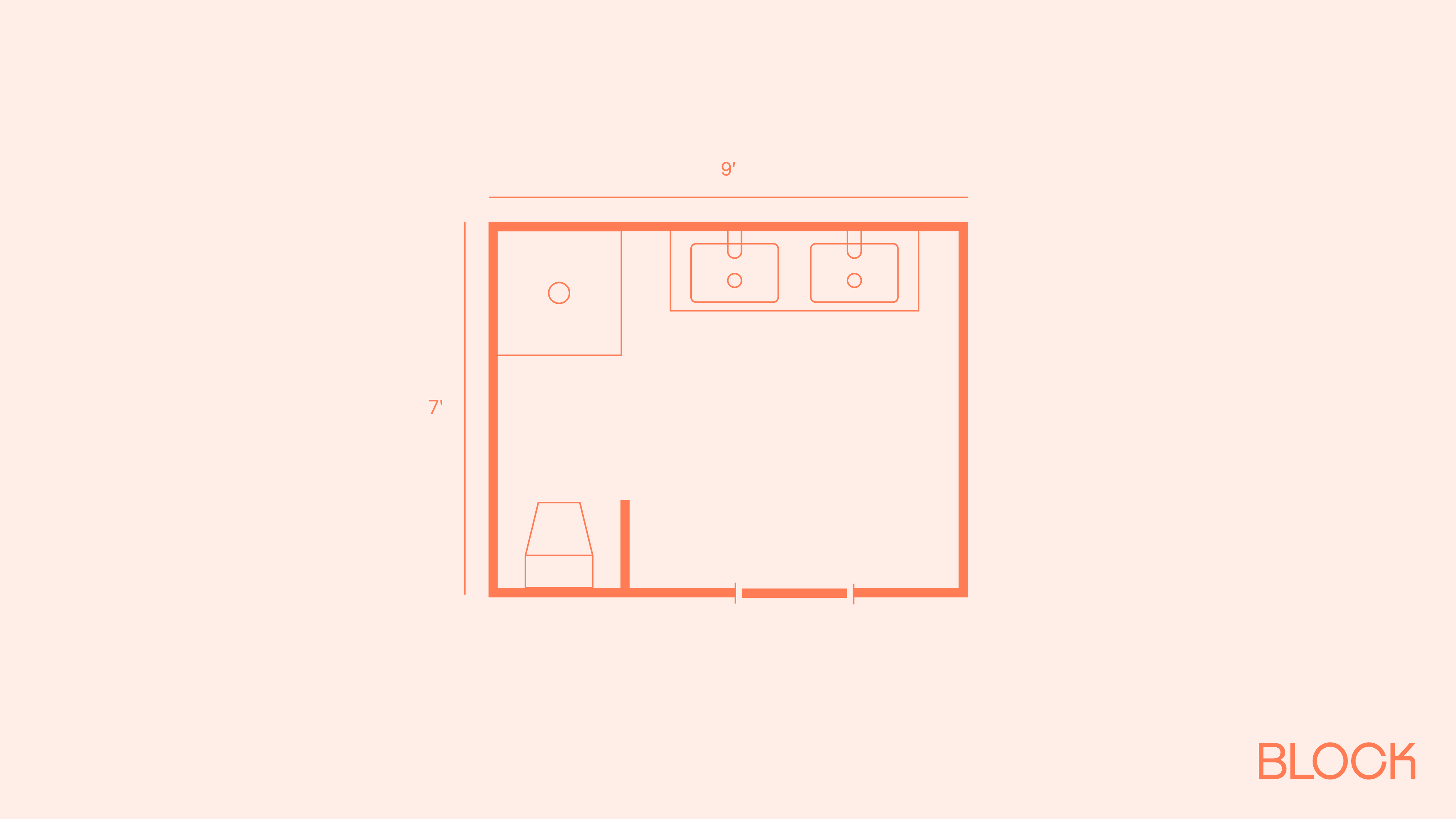
It is the most realistic primary bathroom for two people sharing the morning routine. Skipping the tub frees up enough wall length for two sinks, which is the single biggest quality-of-life upgrade for couples. The privacy wall lets one person use the toilet while another brushes their teeth without a direct line of sight. The catch is that the plan only works if there's already a tub elsewhere in the home, or if no one in the household actually wants one.
A long, freestanding-style tub anchors one short wall. The toilet sits opposite the door behind a privacy partition. A double vanity runs along the wall facing the tub.
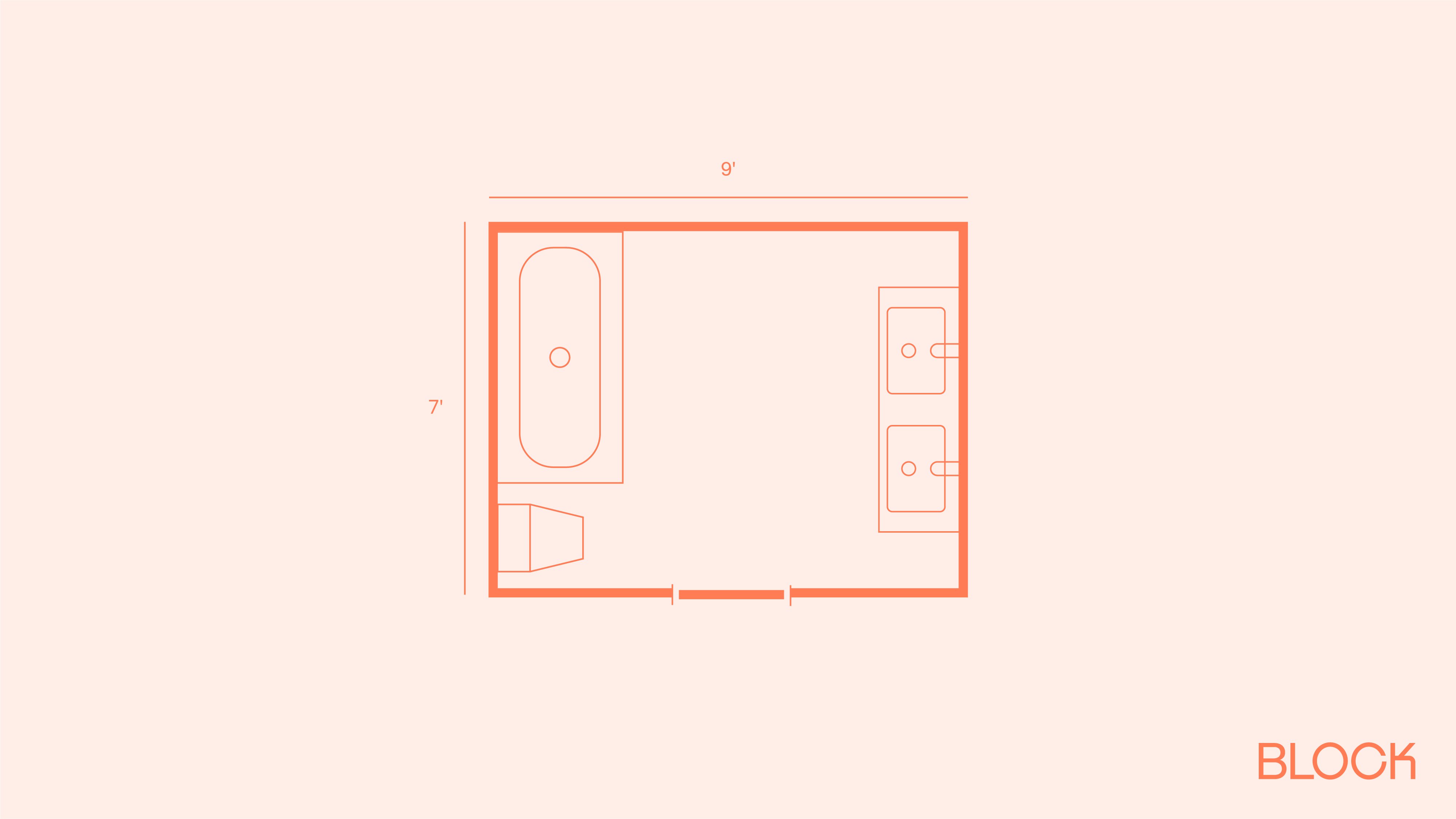
This is the most photogenic 7x9 layout. The tub becomes the focal point you see from the doorway, and the symmetry of the room reads as larger than its dimensions suggest. The trade is real: there's no separate shower. You shower in the tub or you don't have one. Skip this layout if the tub would mostly be a resale-value checkbox. At this footprint, an unused tub is a $5,000 piece of furniture.
The door enters from the short wall instead of the long one. A double vanity runs along the bottom long wall. The tub sits along the top long wall. The toilet is partitioned off near the door.
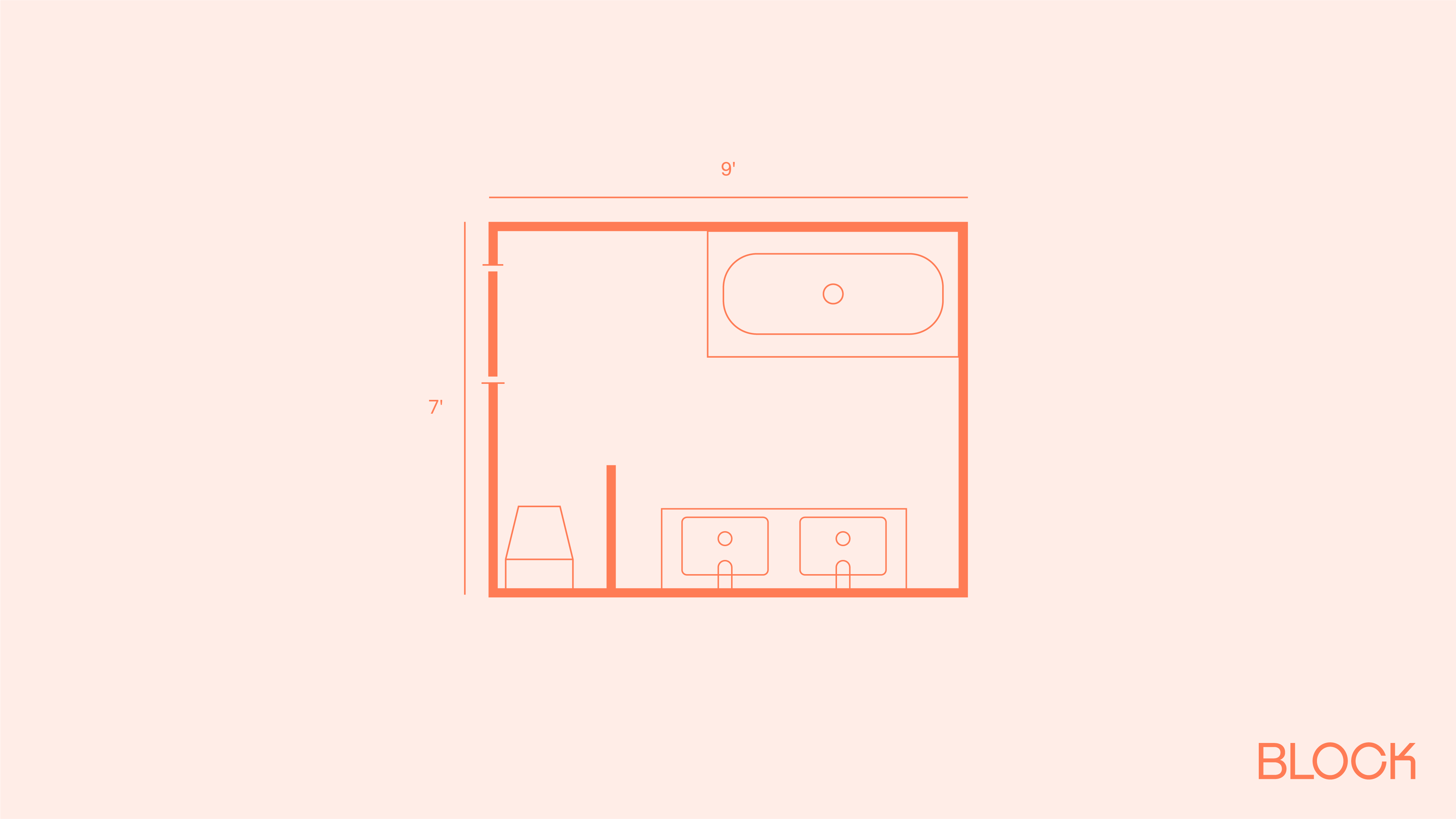
Side entry is a useful variation when the bathroom sits off a primary bedroom and the door placement isn't flexible. The scenario where this comes up most often: primary suites where the bedroom is entered from the side wall rather than the foot of the bed. It also creates a longer sightline through the room when the door is open, which makes the space feel calmer and bigger than the floor plan suggests on paper.
Yes, you can fit a separate shower, a soaking tub, a toilet, and a double vanity into 63 square feet. This plan does it by stacking the tub and a separate shower along one short wall, running the double vanity along the opposite short wall, and tucking the toilet into the upper corner.
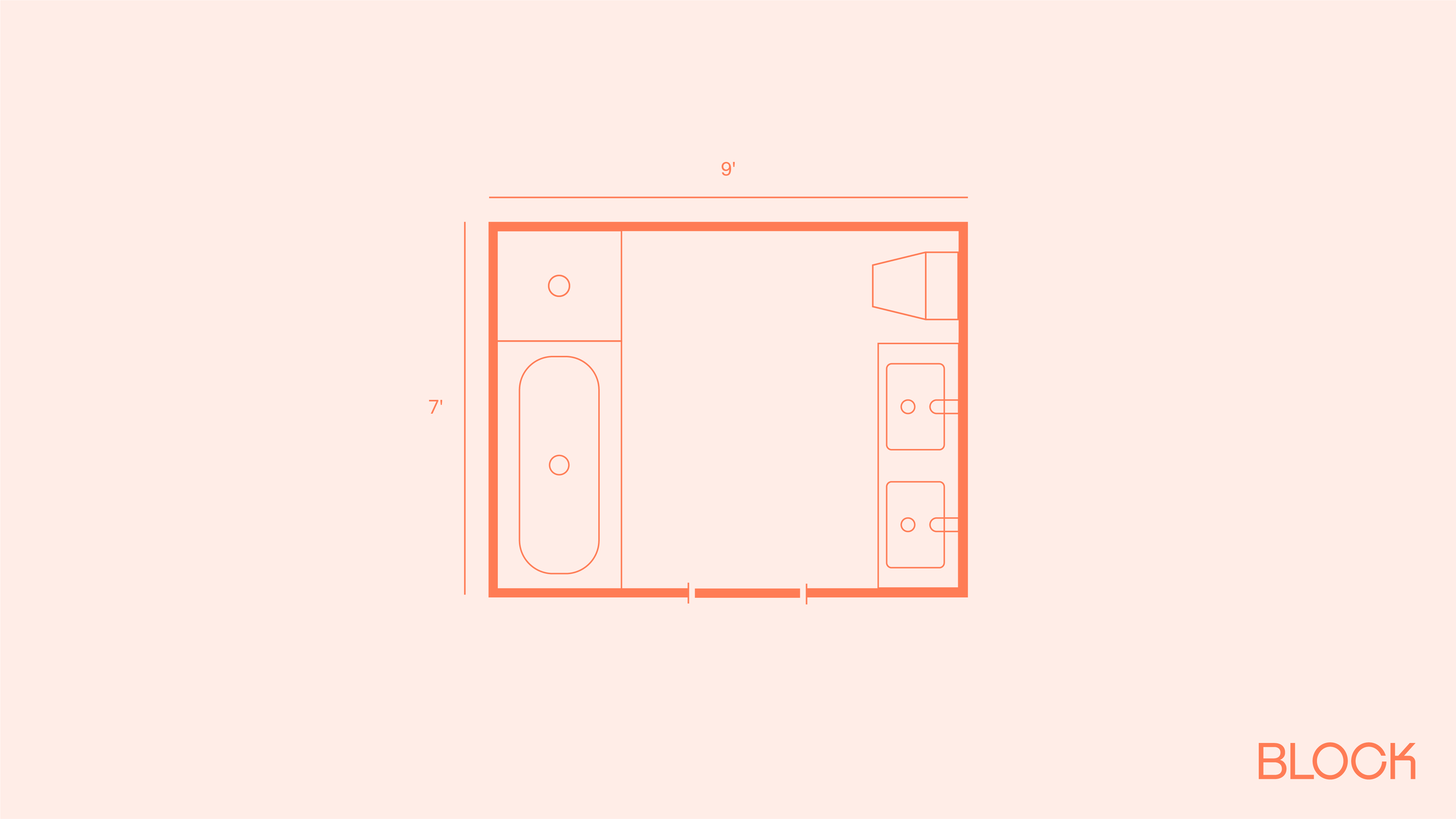
This is the maximalist plan. Every fixture is sized to its minimum, and the walking aisle between them stays tight. Be honest about whether you'll actually use both the tub and the shower. If you don't take baths now, you won't start because you remodeled, and the tub will sit unused. Realistically, even with mid-range finishes, this is a $40,000-plus renovation.
A mid-range 7x9 bathroom remodel typically lands between $20,000 and $40,000. A higher-end version with custom tile, premium fixtures, and a freestanding tub can run $50,000 or more.
Geography matters too. The same scope of work in a major metro (New York, San Francisco, Boston) often runs 30% to 50% higher than in a mid-sized city, mostly because of labor rates and permit costs.
The cost line items split into two groups. Some scale with the room's square footage. The rest depend on the fixtures and finishes you pick, regardless of how big the bathroom is.
These items use more material and more labor in a larger bathroom. A 7x9 footprint runs leaner on both, which is the upside of a tighter floor plan.
Tearing out the old bathroom (tile, vanity, tub, fixtures, drywall) is the first labor cost on the project. For a 7x9 footprint, demo runs about $1,000 to $3,000 depending on what is coming out and how much subfloor or wall repair is needed underneath. If the renovation includes moving walls or relocating the door, add $500 to $2,000 for new framing.
Tile is the line item with the widest cost range in the project. Material runs $2 to $30 per square foot. Installation labor runs another $10 to $20 per square foot, more for intricate patterns or large-format tile that requires extra prep.
For a 7x9 bathroom with floor tile and a tiled shower or tub surround, expect to tile roughly 100 to 150 square feet total. That puts you in the $2,500 to $8,000 range, with most mid-range packages landing in the $4,000 to $5,500 band.
Click here to read more about tiling costs.
A toilet costs what a toilet costs. A double vanity is a double vanity. A 7x9 footprint won't lower your bill on the items below, though your fixture and finish choices certainly will.
If the new layout keeps every fixture in its current location, plumbing costs stay on the low end of that range. Every fixture that moves (a relocated toilet, a tub that swaps positions with a shower) adds $500 to $1,500 in plumbing labor and materials.
A new tub installation runs $1,000 to $2,500 in labor on top of the tub itself. A walk-in shower with a tile pan and glass enclosure runs $3,000 to $7,000 fully built, depending on the tile spec and the glass thickness.
Bathrooms require GFCI outlets, dedicated circuits for things like heated floors, and proper venting for the exhaust fan. Most 7x9 remodels include new vanity sconces, an overhead fixture, sometimes a shower light, an updated exhaust fan, and at least one or two new outlets. Plan on $800 to $2,500 for electrical, with radiant floor heating adding $1,500 to $3,000 on top of that.
Stock vanities from a big-box store start around $400 to $800 for a single, $800 to $2,000 for a double. Semi-custom vanities run $1,500 to $4,000. Fully custom built-ins from a local cabinetmaker can run $5,000 or more.
Countertops add $300 to $2,000 depending on material. Quartz is the most common mid-range choice and runs about $60 to $100 per square foot installed. Marble and natural stone run higher, both in material cost and in long-term maintenance.
A standard two-piece toilet costs $200 to $600. A higher-end one-piece or wall-hung model runs $600 to $1,500. Installation labor is $200 to $400 if the rough-in stays in the same spot. Dig deeper into new toilet costs.
A standard alcove tub costs $400 to $1,500. A freestanding soaking tub runs $1,500 to $6,000 for the tub alone, sometimes more for cast iron or stone. Installation is $500 to $1,500 for a standard alcove install, more for a freestanding tub that requires floor-mounted plumbing or reinforced subfloor. Click here for more pricing info on new tub installation.
Most municipalities require permits for bathroom remodels that touch plumbing or electrical. Permit costs vary widely by location but typically run $300 to $1,000 for a project of this size. Skipping permits creates problems at resale and can void homeowner's insurance coverage on the work.
Across the full project, labor typically accounts for 40% to 65% of the total budget. The higher end is more common when the layout changes, when multiple trades are involved, and when the tile work is detailed. A $30,000 bathroom remodel will usually break down to $12,000 to $20,000 in labor and $10,000 to $18,000 in materials and fixtures.
Compare Proposals with Ease
Four categories tend to surprise homeowners on a 7x9 bathroom remodel:
The plans above are a starting point, not a prescription. Our free tools lets you visualize your bathroom, swap fixtures, and see real-time cost estimates before you talk to a contractor. As you change finishes (tile, vanity material, fixture brands), the estimate updates dynamically, so you can see how each decision moves the budget.
The Studio also generates personalized renders of your space, which helps with two things: aligning everyone in the household before construction starts, and walking into a contractor conversation with a clear scope instead of a vague wishlist.
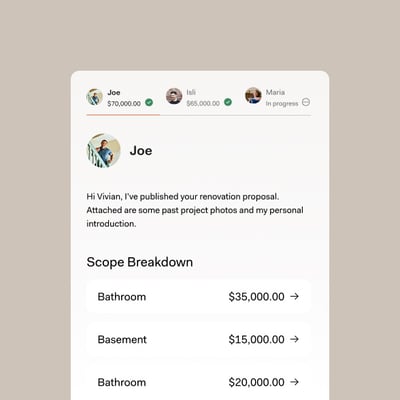
Once your plan is solid, you can have your area's best contractors compete for your project. Block matches you with vetted local pros who quote on the same detailed scope, so you can compare proposals line by line instead of guessing what is included.
Every scope gets reviewed by Block experts before you commit, which catches missing line items and red flags early. After you hire, payments are released in stages tied to project milestones, so contractors stay incentivized to keep the work on schedule.
If something comes up after the project wraps, every contractor in the Block network provides a one-year workmanship warranty.
Remodel with confidence through Block
Connect to vetted local contractors
We only work with top-tier, thoroughly vetted contractors

Get expert guidance
Our project planners offer expert advice, scope review, and ongoing support as needed
Enjoy peace of mind throughout your renovation
Secure payment system puts you in control and protects your remodel

Renovate confidently with Block
Easily compare quotes from top quality contractors, and get peace of mind with warranty & price protections.
Bathroom Floor Plans
Single Wall Bathroom Layout: Pros, Cons, and Tips
07.22.2026
.jpg?width=640&name=5301c89b-3165-4f83-af34-a6b02eaa6c48%20(2).jpg)
Bathroom Floor Plans
Long, Narrow Bathroom Floor Plans: Layouts That Work
07.21.2026
.jpg?width=640&name=2a430d6c-5cf0-4596-9a89-601f3d2d6391%20(7).jpg)
Bathroom Floor Plans
Square Bathroom Floor Plans & Layout Tips
07.18.2026
Bathroom Floor Plans
300 Sq Ft Bathroom: 7 Large Master Bath Layouts
06.05.2026
Bathroom Floor Plans
100 Square Foot Bathroom Layout: Make It Work
06.02.2026