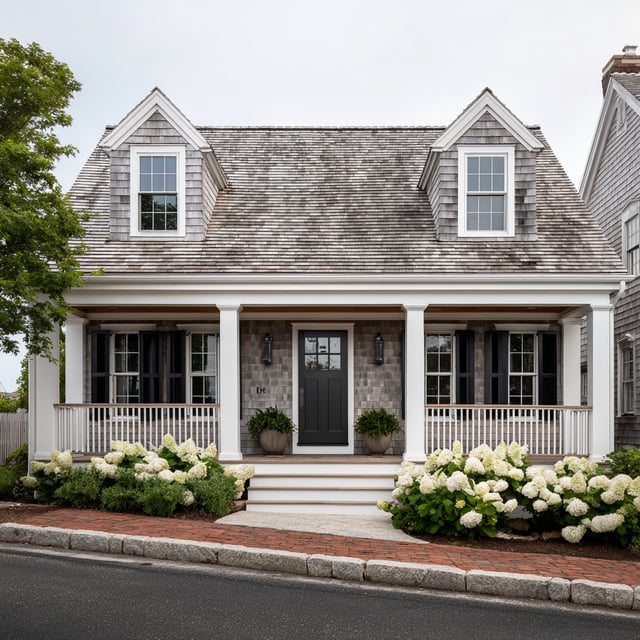
Here's something most people don't know before they start this project: Cape Cod homes were never designed to have front porches. Unlike Southern or Colonial styles where a porch feels like an obvious extension of the architecture, a Cape Cod porch is genuinely an addition—and the home's structure doesn't make it easy.
That's not a reason to abandon the idea. A well-designed porch can do a lot for a Cape Cod, both aesthetically and practically. But it does mean that the decisions you make upfront matter more than they would on almost any other home style. Get them right and the porch looks like it grew there naturally. Get them wrong and you end up with something that feels grafted on, or worse, a roof that cuts across your first-floor windows and darkens the inside of your house.
This guide walks through what makes Cape Cod porch additions different, which design choices drive cost, and what a realistic budget looks like.
Why Cape Cod homes make porch additions tricky
To understand the challenge, you have to understand what a Cape Cod is built around. The steep roof pitch, typically 8 to 10 inches of rise for every 12 inches of run, was designed specifically for New England winters. It sheds snow efficiently and keeps load off the structure. The eave line sits low, often just a foot or two above the tops of the first-floor windows. There are minimal overhangs, by design. Early Cape Cod builders discovered that large overhangs in cold climates created ice dams, so they pulled the roofline tight to the wall.
That low eave line is the central problem with adding a porch. On most home styles, a porch roof ties into the eave cleanly and there's plenty of clearance. On a Cape Cod, attach a porch roof to that same eave and you can easily find yourself with a structure that's too low to walk under comfortably, blocks natural light from the windows it sits above, or looks disproportionate to the house, like a hat pulled too far down over the face. Homeowners on renovation forums have used exactly that comparison, and it's an apt one.
The good news is that experienced contractors who know Cape Cod architecture have developed approaches that work around this constraint. Understanding those approaches is the starting point for planning your project.
The two main approaches: roofline extension vs. separate porch roof
Most successful Cape Cod porch additions use one of two structural strategies, and the choice between them is the most consequential design decision you'll make.
- Roofline extension. The cleanest solution architecturally is to extend the existing roofline outward, framing the porch roof as a continuation of the home's main slope. This approach avoids the low-eave problem because the porch roof starts higher up on the structure, giving you proper headroom below. It also tends to look the most intentional because the porch and the house share the same geometry. The tradeoff is cost: this is a structurally involved intervention that typically requires opening up the existing roof framing and tying new framing in carefully. On a Cape Cod with dormers, it also requires planning around those existing features.
- Separate porch roof. A standalone porch roof that ties into the facade below the eave line is less expensive and less structurally complex, but it requires more careful proportioning. A shed-style roof with a modest slope can work well on a smaller, partial-width porch or a portico over the entry. A gabled porch roof that echoes the home's pitch tends to look better than a flat or low-slope shed roof, but adds cost. The risk with any standalone porch roof is that it reads as added rather than integrated, particularly if the pitch or the trim details don't match what's already there.
How your specific Cape affects your options
Not all Cape Cods are the same, and the configuration of your home has a real effect on what's possible.
- Full Cape. A full Cape has a centered front door with two windows on each side, giving the facade a balanced, symmetrical look. This is the easiest configuration to add a porch to because the symmetry gives you natural options: a full-width porch, a partial porch centered on the entry, or a portico directly above the door. Any of these can work if the proportions are handled carefully.
- Half Cape. A half Cape has the door positioned to one side, with windows only on the other. This asymmetrical layout complicates full-width porch additions because a porch that spans the entire facade tends to emphasize the off-center entry rather than balance it. A porch on the door side only, or a centered portico, typically reads better. This is a case where the specific design solution matters even more than it does on a full Cape.
- Three-quarter Cape. Positioned between the two, the three-quarter Cape has the door slightly off-center with windows unevenly distributed. Similar considerations apply as with the half Cape: full-width additions require more design thought, and a centered approach to the entry often works best.
- Cape Cods with dormers. Dormers on the front face of a Cape Cod introduce additional complexity for porch additions. A porch roof that ties into the facade below the dormers can visually compete with them, or in the case of a roofline extension, require careful integration so the two elements read as cohesive. If your home has front dormers, your contractor needs to account for them explicitly in the design, not treat them as a detail to work out later.
The design decisions that drive cost the most
- Depth. The same rule applies here as with any porch addition: too shallow and the space isn't functional. Six feet feels like a vestibule. Eight feet is the practical minimum for actual use. The difference between a porch that becomes part of how you live and one that's decorative is almost always depth. The complication on a Cape Cod is that greater depth pushes the porch roof further from the house, which can create proportionality issues on a home that's already modest in height. Ten feet is generally the upper limit before the porch starts to visually overwhelm the facade.
- Width. A full-width porch spanning the entire facade works well on full Capes with the right proportions, but can easily overpower a smaller home. If the porch reads as bigger than the house behind it, something has gone wrong. On a typical Cape Cod, a porch that covers roughly half to two-thirds of the facade often strikes the right visual balance, particularly when centered on the entry. A portico covering just the door and a few feet to each side is the most contained option and tends to work on all Cape Cod configurations.
- Roof style and pitch. The porch roof should match the pitch of the main house as closely as possible, or be deliberately lower and shed-style in a way that reads as intentional. A porch roof that's pitched higher than the main house looks immediately wrong. One that's pitched lower but matches the trim and material choices can work. A gable over the entry that echoes the home's roofline is a widely-used and reliable choice: it adds architectural interest without competing with the main structure.
- Materials. Cape Cod homes are typically clad in cedar shingles or clapboard siding, and the porch should match. A porch built in a different material or color reads as added. Cedar shingles weather to a silver-gray over time, which is part of their appeal, but if your existing siding is weathered and the new porch siding is fresh, you'll have a visible mismatch for several years until the new material catches up. This is worth discussing with your contractor before you commit to materials.
- Snow load and structural requirements. Cape Cod homes exist predominantly in northern climates, and any porch addition in those markets needs to be designed for snow load. That means heavier structural framing, more robust column footings, and a roof pitch that sheds snow effectively. These requirements add cost but are non-negotiable in cold climates. A porch that isn't engineered for snow load is a liability, not an improvement.
A realistic look at what a Cape Cod porch addition costs
Adding a front porch to a Cape Cod typically falls into one of three ranges.
- $12,000–$28,000. A portico or partial-width covered entry with a simple gabled or shed roof, pressure-treated decking, basic columns, and standard railings. Achievable when scope is contained and the structural solution is straightforward.
- $28,000–$55,000. A fuller-width porch with a more carefully integrated roofline, quality decking, columns and railings that match the home's character, and finishing details like beadboard porch ceilings and lighting. This is where most well-executed Cape Cod porch projects land.
- $55,000–$80,000+. Projects that involve a roofline extension, more complex structural work, premium materials like composite decking or natural hardwood, or homes in high-cost labor markets like coastal New England. Cape Cod homes in Massachusetts, specifically, often sit at the higher end of national estimates because of regional labor rates and code requirements.
Labor accounts for 50–65% of total cost, and the structural complexity of tying a porch into a steep Cape Cod roofline makes skilled carpentry more central here than it would be on a simpler project. The difference between a contractor who has done this before and one who hasn't shows up in both the finished product and the budget, because problems that experienced contractors anticipate become expensive surprises in less experienced hands.
What catches Cape Cod owners off guard
- The window problem. This is the most common issue on Cape Cod porch additions and the one that causes the most mid-project headaches. A porch roof that ends up blocking or shading first-floor windows isn't just an aesthetic issue. It changes how the interior of your home feels year-round. The fix, once framing is underway, is expensive. Make sure your contractor has drawn out the sight lines before anything is built.
- Permit and zoning requirements. Permit requirements apply to any porch with a roof, and in New England especially, towns can have specific requirements around materials, setbacks, and design standards, particularly in historic areas. In coastal communities, you may also be in a flood zone that adds additional review. Budget for permit costs and, more importantly, for the time they take. Four to twelve weeks is common.
- Siding replacement on the affected facade. Adding a porch often means removing and replacing the siding where the new structure ties into the house. If your existing siding is cedar shingles, matching weathered material with new is nearly impossible. Most homeowners end up replacing the siding on the full front facade, which adds cost but results in a cleaner finished look.
- Electrical from the start. Porch lighting and an outdoor outlet are inexpensive to rough in while the project is active and significantly more expensive to add after the fact. Plan for them upfront.
Want to do more than merely add a porch to your home? Read our guides to Cape Cod additions and broader remodeling tips.
What changes beyond the curb appeal
Most homeowners come into this project focused on the exterior and come out of it talking about how the porch changed their relationship with the front of their house.
A covered entry makes daily life noticeably better in ways that are hard to anticipate. Packages have a place to land. You can set down groceries while you unlock the door. In a rainstorm, there's somewhere to stand. These aren't glamorous selling points, but they accumulate. On a deeper level, a porch gives a Cape Cod a presence it didn't have before. The home stops being a facade you walk past and becomes a place with a threshold, somewhere that registers as a destination.
From a resale standpoint, a well-executed porch addition on a Cape Cod holds its value well, particularly in markets where outdoor living space is limited and the exterior character of a home matters to buyers. A porch that looks like it belongs there tells a story about the care that went into the home.
Getting the right contractor for the job
The window problem, the roofline integration, the snow load requirements: these are the kinds of issues that an experienced contractor catches in the planning phase and an inexperienced one discovers mid-project. Cape Cod porch additions are not technically the most complex renovation, but they require specific familiarity with how these homes are structured and what goes wrong when the proportions aren't handled carefully.
Block Renovation connects homeowners with thoroughly vetted, licensed contractors who have direct experience with exterior additions and the structural work that Cape Cod architecture requires. You can compare proposals side by side, review past projects, and move forward knowing your contractor has already been evaluated for quality and fit.

Written by
Cheyenne Howard
Cheyenne Howard
Cheyenne Howard is a Project Planner at Block Renovation who brings a thoughtful, organized approach to renovation planning. With a strong attention to detail and experience supporting a wide range of projects, she works closely with clients to create a smooth and positive planning experience.