Most carport to garage conversion projects land between $15,000 and $25,000. The cheapest jobs come in around $10,000. The most expensive ones cross $35,000 once you add insulation, drywall, conditioning, and a finished interior. That spread is wide because the cost is driven almost entirely by what you already have, not what you want to build.
Understanding cost line items
A carport to garage conversion is really five jobs stacked together, and your existing structure determines how many of them you can skip.
- Slab work: $0 to $8,000. An existing slab in good shape costs you nothing here, but a decorative pour, cracked slab, or one missing proper footings has to come out and get repoured. A new 20x20 slab with footings runs $4,000 to $8,000 depending on region.
- Demolition: $0 to $3,000. Wood-framed carports often get incorporated into the new structure with no demo needed, but metal prefab carports or anything in poor condition has to come out before framing starts. Removal and disposal typically runs $1,000 to $3,000, with the upper end driven by how much of the slab and roofing has to go with it.
- Framing and walls: $3,000 to $7,000. This covers three walls of stick framing with sheathing and exterior cladding to match the house. Costs run higher when the existing carport posts can't be incorporated into the wall structure and you're framing from scratch.
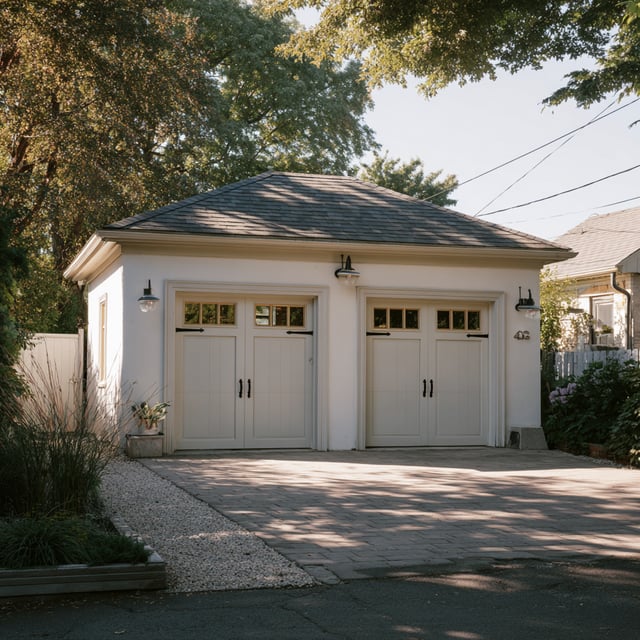
- Garage door and opener: $1,500 to $4,500. A basic insulated steel door with a chain-drive opener sits at the low end of this range. A carriage-style door with windows and a belt-drive opener pushes the upper bound.
- Electrical: $1,500 to $4,000. This covers outlets, lighting, and the opener circuit, plus a sub-panel if the existing house panel is full. EV charging adds another $800 to $2,000, and most homeowners want it.
- Permits, inspections, and the entry door: $800 to $2,500. Permits range wildly by jurisdiction. The pedestrian door from the garage to the house has fire-rating requirements that drive up the spec.
- Insulation and drywall: $3,000 to $6,000. Optional for a bare-bones garage, but most homeowners add it to make the space usable in summer and winter.
Heating or cooling adds another $2,000 to $5,000 for a mini-split, plus $1,500 to $3,000 for proper insulation in the ceiling and slab edge.
Three structural conditions that keep the carport-to-garage cost under $18,000
When all three of these are true, the existing structure absorbs most of the slab and framing costs, and the project lands at $12,000 to $18,000 for an enclosed garage with a door, electrical, and permits.
- The carport is attached to the house with a roof tied properly into the existing roofline. Detached carports are buildable, but the project starts looking more like a standalone garage build. An attached structure also lets you run electrical and HVAC off the existing house systems, which keeps utility costs low.
- The slab is at least 4 inches thick, reinforced, and in good condition. A contractor can confirm this with a core sample or by checking permit records.
- The carport is wood-framed, not metal prefab. Wood posts can be incorporated into wall framing, while metal posts almost never can. Wood also accepts standard fasteners, sheathing, and siding without specialty connectors. Metal carports usually have to be demolished entirely and rebuilt as a stick-framed structure, even when the roof and slab are sound.
Five conditions that push the project past $25,000
- Metal or aluminum prefab carport. The structure is rarely worth saving, and a demo-and-rebuild costs $20,000 to $35,000, which is most of the way to a new detached garage.
- Bad slab. A bad slab is one that's thinner than 4 inches, lacks rebar or wire mesh reinforcement, has significant cracking, or sits on poorly compacted base. Garage code typically requires a 4-inch reinforced slab on compacted gravel with perimeter footings to support the wall loads. Demo and repour adds $4,000 to $8,000 and several days to the schedule.
- Cantilevered or post-free designs. Adding walls changes the load path on the roof, which means an engineer's stamp plus $1,500 to $3,000 in fees, on top of whatever structural reinforcement they spec.
- Conditioned and finished interior. Insulation, drywall, mini-split, and finished floor add $6,000 to $12,000 on top of the shell.
- HOA design review or zoning variance. Setbacks that don't allow enclosure of the existing footprint mean a variance application and possibly a redesign, which translates to months of delay and $1,000 to $5,000 in soft costs.
How appraisers and buyers value the converted space
Appraisers treat carports and garages as different categories. A converted garage typically adds more to appraised value than the carport it replaced, but recovery varies a lot by region.
- Northeast and Midwest: Garage additions typically recover 60 to 80% of project cost, since buyers in cold climates expect a garage and discount homes without one.
- Sunbelt and warm-climate markets: Recovery drops to roughly 40 to 60%. Carports are widely accepted in Florida, Arizona, and Texas, so the value gap a buyer will pay for is smaller.
- High-end markets: The variable that matters most is what the comps look like. If every other house on the block has a garage, yours becomes the outlier and recovery skews higher regardless of climate.
How long the project takes from permit to final inspection
A clean conversion (good slab, attached wood-framed carport, no zoning issues) takes four to six weeks from permit issue to final inspection. Add two to four weeks if the slab needs replacing. Add anywhere from one to four months on the front end for permitting, depending on the jurisdiction. The permitting timeline is what most homeowners miss when they pick a start date.
A five-question check to estimate your project's bracket
Before you call a contractor, you can rough out which end of the range you're in by checking five things.
- Is the carport attached to the house with a roof tied into the existing roofline?
- Is the existing slab at least 4 inches thick, free of major cracks, with footings at the perimeter?
- Is the structure wood-framed, not metal or aluminum?
- Do your setbacks and HOA rules allow enclosure of the current footprint without a variance?
- Is the existing roof rated for more than snow and dead load, meaning it can handle insulation and a finished ceiling without reframing?
Five yeses puts you in the $12,000 to $18,000 range for a basic conversion. Three or four yeses puts you at $18,000 to $25,000. Two or fewer means you're either looking at a $25,000 to $35,000+ project or you should consider tearing the carport down and building a proper garage from scratch. The math often works out similar at that point, and you end up with a structure designed as a garage instead of one retrofitted into being one.
When to convert and when to tear down and rebuild
The math on conversion versus a ground-up build is closer than most homeowners expect. A new detached single-car garage typically runs $20,000 to $40,000, and a basic attached build lands around $16,000 to $35,000. If your conversion is heading toward $25,000 with structural reinforcement, slab work, and roof modifications, you're already in tear-down-and-rebuild territory. The deciding factor is what your existing structure can absorb without forcing compromises on the finished garage.
Convert when the existing structure does most of the heavy lifting for you. That typically means a wood-framed carport attached to the house, a sound 4-inch reinforced slab, an existing roof tied into the home's roofline, and setbacks that allow enclosure without a variance.
Signs it's ultimately better to tear down your carport to build a garage anew:
- The carport is metal or aluminum prefab. The structure rarely accepts standard wall framing, and trying to retrofit it leaves you with a garage that looks like a converted carport. Demo and rebuild gets you a real garage for similar money.
- The slab is cracked, undersized, or missing perimeter footings. Once you're paying $4,000 to $8,000 to demo and repour, you've eliminated the main cost advantage of converting.
- The roof needs reframing or replacement. Carport roofs are often built for dead load only and can't carry the added weight of insulation, drywall, and the structural tie-ins that walls require. Reframing approaches the cost of a new roof.
- You want a different size or layout. Conversion locks you into the existing footprint. If you've outgrown a single-car carport and want a two-car garage, or if the carport sits in the wrong spot for how you actually use the property, you're rebuilding either way.
- More than two of the structural conditions in the previous section fail. Once you're stacking slab work plus framing replacement plus roof work, the conversion savings disappear and you're paying retrofit prices for a compromised result.
When you're on the fence, get one bid for conversion and one for new construction. The price gap usually answers the question, and the contractors will flag structural issues you'd otherwise hit mid-project.
Articles to help shape your new garage design
- How Much Does it Cost to Build a Garage? Worth reading if your existing carport is too compromised to convert and a ground-up garage build is the better path, since the cost structure shifts meaningfully when you start from scratch.
- Attached Garage vs. Detached Garage This guide weighs the trade-offs between sharing a wall with the house and standing alone in the yard, including the roughly 10 to 15% cost difference and the resale impact in suburban markets. Useful before a conversion if you're deciding whether to keep the original footprint or relocate the structure to a different part of the lot.
- Garage Upgrade Ideas to Inspire Your Renovation A walkthrough of the upgrades that turn a basic enclosed garage into a workshop, gym, or organized storage hub, including LED shop lighting, slatwall systems, and overhead racks. Each upgrade gets paired with practical guidance on when it makes sense for smaller versus larger garages. Useful for planning the interior buildout before drywall goes up, since some upgrades are cheaper to rough in during the conversion than to retrofit later.
- Ideas for an Enclosed Breezeway from the Garage to the House A guide to connecting a detached or semi-detached garage to the main house through an enclosed passage that can double as a mudroom, laundry room, or sunroom. Costs run from $15,000 for a basic enclosure of an existing covered passage up to $150,000+ for a fully finished, climate-controlled space with plumbing. Particularly relevant if your carport sits between the house and a detached garage, or if the conversion creates an awkward exterior path you'd rather enclose.
- Materials for Garage Floors A comparison of epoxy, polyaspartic, polyurea, and other coating systems, with notes on durability against road salt, freeze-thaw cycling, and oil stains.
How Block helps you find the right contractor for your carport to garage conversion
The price ranges in this article are national averages. Actual quotes vary by region, contractor, and the specifics of your structure. Three quotes is the minimum, and the cheapest bid is often the one missing line items that come back as change orders. Compare scopes line by line, not just the totals. The clearest picture of where your budget is going matters more than the lowest number on the page.
Block matches you with vetted local contractors who've actually done carport conversions, so the bids come from people who know what to look for in your existing structure. Block experts review every scope to catch missing line items and red flags before you sign, and progress-based payments keep contractors accountable through the project.

Written by
Cheyenne Howard
Cheyenne Howard
Cheyenne Howard is a Project Planner at Block Renovation who brings a thoughtful, organized approach to renovation planning. With a strong attention to detail and experience supporting a wide range of projects, she works closely with clients to create a smooth and positive planning experience.









.webp?width=640&name=u5821215421_A_renovated_attached_garage_interior_used_for_dai_be957847-8779-47d0-80bc-5a7ad148320e_0%20(1).webp)