




Working with Contractors
Is a Property Renovation Company Worth the Cost?
06.24.2026
04.15.2026


In This Article
A restaurant's lighting does more work than almost any other design element in the room. It tells guests how long to stay, how much to spend, and how to feel about the food in front of them. Research on dining environments has consistently found that dimmer, warmer restaurant lighting encourages longer visits and higher average checks, sometimes by 15 to 20 percent. Brighter, cooler light speeds people up and pushes them toward the door.
Yet lighting remains one of the most underfunded line items in a restaurant buildout or refresh. Operators routinely dedicate 2 to 3 percent of their total project budget to lighting when 8 to 12 percent would be closer to appropriate.
Color temperature describes whether light appears warm (amber/yellow) or cool (blue/white). Lower Kelvin numbers produce warmer light; higher numbers skew cooler. For commercial restaurant lighting, the relevant range is roughly 2200K to 4000K:
Getting this single spec right matters more than the fixture you choose. A fine dining space at 4000K feels clinical. A café at 2200K feels like a cave at noon.
CRI measures how accurately a light source renders colors compared to natural sunlight, on a scale of 0 to 100. For any restaurant lighting design, you want a CRI of 90 or above. Anything lower makes food look dull and skin look sallow. This is especially important in open kitchens and at the pass, where the visual appeal of plated food is part of the experience.
Every well-lit restaurant uses three layers working together:
Ambient lighting provides the overall illumination level for the room. Recessed downlights, cove lighting, and indirect fixtures typically handle this layer.
Task lighting serves functional needs: enough brightness for servers to read tickets, for guests to read menus, and for bartenders to see what they are pouring. Pendants over tables and focused spots behind the bar are common task sources.
Accent lighting draws attention to architectural features, artwork, bottle displays, or specific textures. Wall washers, track lights, and LED strips usually fill this role.
The balance between these three layers is what separates a restaurant that feels intentional from one that feels like a showroom or a storage unit.
A restaurant at 11:30 a.m. and a restaurant at 8:30 p.m. are two completely different businesses, and the lighting should reflect that shift. Programmable dimming systems allow you to set timed presets so the restaurant lighting transitions automatically as the day progresses. Lunch service can run brighter and more energized; dinner service can drop to something warmer and more intimate. This is one of the highest-value, lowest-cost upgrades any restaurant can make, and almost nobody executes it well.
Quick-service restaurants need lighting that keeps energy high, supports fast decision-making, and encourages efficient table turnover. Guests should feel comfortable enough to enjoy their meal but not so settled that they camp out for an hour.
QSR spaces typically perform best between 3000K and 3500K. This range feels bright and clean without veering into the harsh fluorescent territory that older fast-food chains are still trying to escape. Brightness should be higher than in full-service restaurants, generally around 200 to 300 lux at table level.
The biggest design opportunity in QSR is at the ordering counter and the menu display. Focused accent lighting on the menu board and the point of sale draws the eye exactly where you want it, reducing decision fatigue and keeping the line moving.
For seating areas, recessed LED downlights remain the workhorse. But the trend toward fast-casual concepts with higher design ambitions (think sweetgreen, Cava, or Dig) has pushed operators to add a layer of decorative pendants or linear suspended fixtures that give the space personality without slowing the pace.
If your QSR has an open kitchen or an exposed prep line, task lighting in that zone does double duty: it helps staff work safely and gives guests visual reassurance about the cleanliness going into their food.
Avoid uniformly bright, flat lighting with no variation. That is the old fast-food playbook, and it reads as cheap even when the buildout is not. A single row of identical recessed cans across the entire ceiling will make any space feel institutional. Add at least one contrasting layer: a pendant cluster over the communal table, a lit shelf behind the counter, or warm cove lighting around the perimeter.
For a QSR or fast-casual space of 1,500 to 3,000 square feet, plan on $15,000 to $40,000 for a full restaurant lighting package including fixtures, controls, and installation. Simple recessed layouts with minimal decorative elements land at the lower end. Concepts with higher design standards and programmable dimming push toward the upper range.
Coffee houses, bakeries, juice bars, and other casual sit-downs occupy a unique middle ground. They need to feel inviting enough that someone wants to sit down with a laptop for two hours, but visually interesting enough that someone popping in for a quick espresso still notices the space.
Most cafés land between 2700K and 3000K, warm enough to feel comfortable during long stays but bright enough that pastry cases and baked goods look appetizing. The bakery display case itself deserves special attention: LED strip lighting with a CRI of 95 or higher will make croissants and cakes look golden and rich, while lower-CRI options can make them look gray.
Cafés benefit enormously from a mix of natural and artificial light. If you have large windows, your artificial lighting plan should complement daylight during the morning and compensate for its absence in the evening. This is another strong case for a dimming system with daypart presets.
The pendant-over-the-counter moment is where many cafés make their biggest visual statement. A single bold fixture, something sculptural or made from an unexpected material, can define the identity of the space. It is also where the Edison bulb instinct tends to kick in, so resist it. The exposed-filament-on-a-cord look has been the default "design-forward" restaurant lighting move for over a decade, and it now reads as a decision that wasn't really made. A hand-blown glass pendant or a woven fiber shade will photograph better and age better.
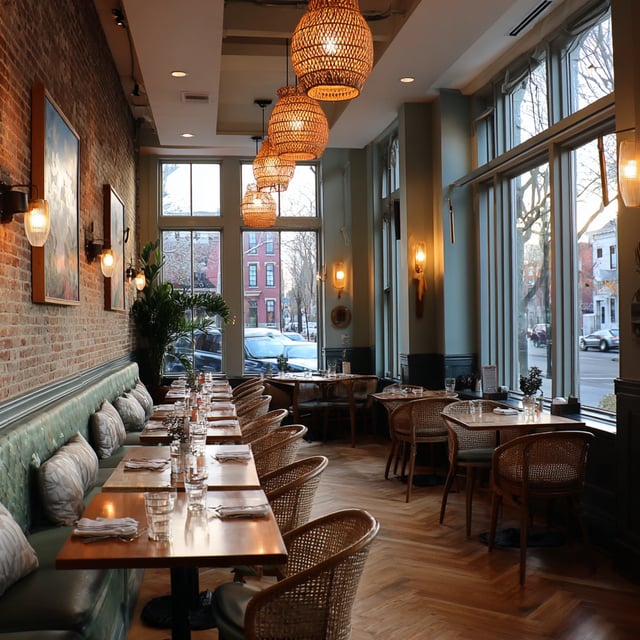
Wall sconces and table lamps in seating areas create pockets of warmth that make guests feel like they have their own corner, even in a small room. Overhead ambient light sets the room, sconces add personality at the perimeter, and task lighting (display case spots, reading lamps) handles function.
Avoid relying on a single overhead source. One pendant or one row of track lights will create harsh shadows and bright spots. Cafés look best with multiple low-intensity sources distributed throughout the space, creating an even but varied glow.
A café of 800 to 2,000 square feet should expect to spend $12,000 to $35,000 on lighting, accounting for a mix of decorative pendants, recessed or track ambient lighting, display case illumination, and basic dimming controls.
Fine dining lighting has one job above all others: make guests feel special. The room should feel intimate, the food should look its best, and faces across the table should be flattered.
Fine dining rooms typically operate between 2400K and 2700K, noticeably warmer than other restaurant types. Brightness at the table should be moderate, roughly 100 to 150 lux, enough to read a menu and see the plate but low enough to feel private.
Candlelight has been the gold standard for centuries. Real candles sit around 1800K to 2000K, which is why they make skin look warm and food look rich. The goal with electric restaurant lighting in a fine dining context is to get close to that warmth without going so dim that guests need a phone flashlight to read the wine list.
This is the category where indirect and architectural lighting have the most dramatic impact. Cove lighting (LED strips hidden in ceiling recesses or crown molding) washes the ceiling with a soft glow that makes the room feel taller and removes the visual clutter of exposed fixtures. The light is felt but its source is hidden.
For tables, the current direction favors focused, low-wattage pendants or recessed adjustable spots that create a pool of light on the table surface without illuminating the entire room. The table becomes a stage, and everything beyond it falls into soft shadow.
Wall sconces are having a strong moment in fine dining, particularly designs that can be repositioned to highlight specific artwork or architectural features. Look for fixtures with adjustable heads or directional shades that let you refine the light's focus after installation. Back-of-house and service areas should be on a separate circuit and ideally a separate dimming zone so the kitchen's brightness does not bleed into the dining room during service.
Avoid any fixture that calls attention to itself over the food and the guests. The era of the oversized chandelier as the centerpiece of a fine dining room is fading. The strongest fine dining lighting plans make the fixtures nearly invisible, letting the quality of light do the work rather than the decorative hardware.
Also avoid mixing color temperatures within the dining room. A 2700K pendant next to a 3500K recessed can will create a visual discord that undermines cohesion, even if guests cannot articulate why something feels off.
Expect $40,000 to $120,000 or more for a fine dining space of 2,000 to 5,000 square feet. This includes architectural integration (cove lighting, millwork-integrated LEDs), high-CRI fixtures, a programmable control system, and decorative accent pieces. Custom fixtures from artisan studios can push the budget further, but they also give a restaurant a visual identity that mass-produced options cannot replicate.
Breweries, sports bars, and other nightlife venues have the widest range of lighting needs of any restaurant category because the lighting is an active part of the entertainment, not a backdrop to it. A cocktail lounge needs to feel dark and magnetic. A sports bar needs clear visibility on screens and at the bar top. A dance-oriented club needs programmable, high-energy light that moves with the music.
For cocktail lounges and upscale bars, aim for 2200K to 2700K. This is warmer than most restaurant lighting setups, and deliberately so. Research on bar environments confirms that warmer illumination around 2500K encourages guests to relax and stay longer, which directly correlates with higher per-person spending.
For high-energy nightclubs, color temperature becomes less relevant because much of the lighting will be dynamic RGB or RGBW systems that shift color throughout the night. The ambient base layer in non-performance areas (entryway, bathrooms, VIP seating) should still lean warm, around 2700K.
The bar itself is the single most important lighting zone in any nightlife venue. Backlighting the bottle display (LED strips behind translucent shelving or within the back bar cabinetry) makes the spirits collection visually prominent and gives bartenders enough light to work quickly. Under-bar lighting along the foot rail or beneath the bar top overhang creates a glow that defines the bar's shape and draws guests toward it without brightening the overall room.
Table-level light sources for lounge seating (battery-operated LED candles, small rechargeable table lamps) let groups see each other and their drinks without raising ambient brightness.
Clubs with active dance floors need DMX-controlled moving heads, LED wash lights, and strobes, all programmable through a lighting console. This requires a dedicated lighting designer or technician, separate from whoever designs the ambient lighting for the rest of the venue. The two systems should be zoned independently so the DJ booth's energy does not overwhelm the bar and lounge areas. Safety matters too: walkways, stairs, and bathroom corridors need recessed LED floor strips or low-profile step lighting to prevent accidents without breaking the mood.
Avoid a single lighting mode for the entire venue. A bar that looks the same at 6 p.m. happy hour as it does at midnight is leaving energy on the table. Programmable scenes that shift automatically as the evening progresses keep the atmosphere feeling alive.
Also avoid the temptation to go completely dark. The moodiest lounges still have enough light for guests to find their seat, read a menu, and see each other's faces. Total darkness reads as disorienting, not sophisticated.
A cocktail lounge or upscale bar of 1,500 to 3,500 square feet should plan on $30,000 to $75,000 for a complete commercial restaurant lighting package, including decorative fixtures, backlighting, accent strips, and a dimming system.
Nightclubs of 3,000 to 8,000 square feet with a dedicated dance floor face a steeper outlay: $50,000 to $150,000 for performance lighting (moving heads, wash lights, strobes, DMX control) alone, on top of the ambient and architectural lighting in non-performance zones.
If you are refreshing an existing space rather than building from scratch, the scope of work changes your budget significantly.
The vendors you find in most restaurant supply catalogs are fine for commodity fixtures. If you want your space to feel considered, these mid-market commercial lighting suppliers bring a different point of view.
A restaurant lighting redesign touches electrical, carpentry (for cove and millwork integration), and often ceiling work. It benefits from a general contractor who can coordinate the trades and keep the timeline on track, especially if you are trying to complete the work without shutting down for weeks.
Block Renovation pairs businesses with qualified, vetted contractors who have experience managing commercial renovation projects. If you are planning a restaurant lighting refresh or a broader buildout, Block can connect you with professionals matched to your project type and location, with transparent pricing and scope reviews to help you avoid surprises before the first wire is pulled.
Build your business with confidence

Renovate confidently with Block
Easily compare quotes from top quality contractors, and get peace of mind with warranty & price protections.
Working with Contractors
Is a Property Renovation Company Worth the Cost?
06.24.2026

Commercial
Commercial Remodeling in San Diego by Neighborhood | Block Renovation
04.27.2026
Commercial
Commercial Remodeling and Buildouts in Dallas-Fort Worth | Block Renovation
04.24.2026
Commercial
2026 Restaurant Design: 11 Trends Defining the Industry
04.24.2026

Commercial
Restaurant Remodel Regulations Checklist
04.21.2026