



Garage
How to Convert a Garage Into a Living Space: Costs, Steps, and Ideas
08.09.2026
.png?width=640&name=u5821215421_A_clean_modestly_sized_garage_interior_showcasing_eaf83865-97e9-4ba5-8d94-db271c50fb1d_0%20(1).png)
04.02.2026


In This Article
Dallas is a city of big garages and ambitious homeowners, and the two go together naturally. Across the sprawling single-family neighborhoods that define DFW — from the Craftsman bungalows of the M Streets and Lakewood to the three-car attached garages of Frisco and McKinney — the garage is rarely treated as an afterthought. It absorbs sporting equipment, serves as a workshop, provides storm shelter during tornado season, and, in the newer suburbs, makes up a significant portion of a home's streetscape. Dallas homeowners are also increasingly practical about renovations: the market rewards improvements that combine durability with curb appeal, and a well-executed garage upgrade can meaningfully move the needle on both. At the same time, Dallas's extreme weather swings — from triple-digit summer heat to periodic ice storms — add material specifications to any project that a less climate-challenged city might not require.
Turn your renovation vision into reality
Get matched with trusted contractors and start your renovation today!
Find a Contractor
Dallas's renovation market is active and competitive, with contractor availability and material costs influenced by the city's sustained construction boom and a labor market that has remained tight across the trades. Costs for garage work vary significantly between Dallas proper and the outer suburbs, with inner-city projects often carrying higher labor rates due to access complexity and older structure conditions.
Garage door replacement is the most commonly requested garage project in the Dallas market, and with good reason: older doors on Craftsman and ranch-era homes in East Dallas, Oak Cliff, and North Central Dallas are often at end of life, and the improvement in curb appeal and energy performance is immediate. A standard insulated steel door for a two-car garage runs $1,200 to $3,200 installed in the Dallas market, while carriage-house style composite or wood doors popular in historic neighborhoods like Lakewood and Junius Heights run $3,500 to $7,000. Texas does not mandate wind-rated doors the way Florida does, but selecting a door with a steel reinforcement brace is increasingly popular in DFW given the region's tornado exposure. The most important cost variable is the age of the existing opening: doors on historic homes are often non-standard sizes, which adds fabrication time and cost.
Epoxy and polyaspartic floor coatings are in consistent demand across the Dallas market, with two-car garage installations running $1,200 to $3,500 for standard colors and $2,000 to $4,500 for custom flake or metallic finishes. Dallas's climate creates a specific challenge for floor coatings: the combination of hot summers and occasional winter freezes causes concrete slabs to move significantly over time, and that movement translates into cracks that need addressing before any coating goes down. Surface grinding and crack repair add $300 to $700 to most projects in this market but are essential for long-term coating adhesion. Many homes in the older neighborhoods of East Dallas and Oak Cliff have original concrete slabs that have been patched and repaired over decades; a thorough assessment of slab condition before committing to a premium coating is money well spent.
Dallas's rapid EV adoption — driven by a tech-sector workforce concentrated in Plano, Allen, and the Telecom Corridor — has made EV charger installation one of the fastest-growing garage upgrade requests in the DFW market. A Level 2 NEMA 14-50 outlet installation runs $400 to $800 when the panel has capacity; a dedicated 240V circuit with EVSE (Electric Vehicle Supply Equipment) installation runs $800 to $2,000. In older Dallas homes where the original electrical panel is at or near capacity, adding a sub-panel to handle garage loads costs an additional $1,500 to $3,500. Texas's deregulated electricity market means energy rates and time-of-use pricing vary significantly by provider, which some homeowners are incorporating into their smart charger specifications to reduce operating costs. Lighting upgrades — typically replacing fluorescent shop lights with LED high-bay fixtures — run $400 to $1,200 and are often bundled with EV charger installations since an electrician is already on-site.

“Underestimating renovation costs leads to painful decisions mid‑project. Running out of funds causes delays and rework.”
Dallas's garage styles span nearly a century of residential construction, from the compact detached structures behind its historic bungalows to the front-dominant multi-car garages of its most ambitious new-build communities. Each era brings distinct renovation opportunities and constraints.
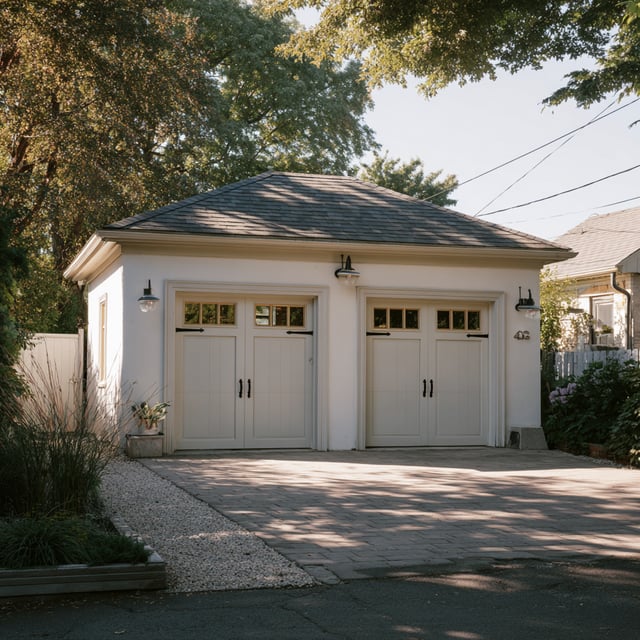
The Craftsman bungalow is one of Dallas's most beloved residential styles, concentrated in historic neighborhoods like the M Streets, Lakewood, Junius Heights, and Kessler Park in Oak Cliff. Nearly all of these early-20th-century homes were built with a detached single-car garage accessed from the alley, a configuration that reflects both the era's urban planning norms and the relatively modest lot sizes of infill Dallas neighborhoods. These structures are typically wood-framed, 12 to 18 feet wide, and built without insulation, vapor barriers, or electrical service.
Renovating these garages requires navigating Dallas's conservation district guidelines in designated neighborhoods, which restrict exterior alterations that would be out of character with the original architecture. Interior improvements — electrical, insulation, flooring — are generally unconstrained. The alley-access configuration makes these garages attractive conversion targets for workshops or studio space, and the ADU regulations in Dallas have been progressively updated to make habitable conversions more feasible in recent years. A thorough structural assessment is the right starting point; wood framing in Dallas's climate is susceptible to termite damage and moisture-related rot at the sill plate and base of walls.
Dallas's postwar suburban expansion produced vast quantities of ranch-style homes across neighborhoods like Lake Highlands, Preston Hollow, and through the inner suburbs of Carrollwood and Richardson. These homes feature attached one- or two-car garages with interior access, typically built with masonry or wood-frame construction and original doors that are well past their functional life. The lots tend to be generous, and these homes sit on a foundation type — slab or pier-and-beam — that meaningfully shapes renovation options for the garage floor.
The renovation priority on these properties is usually updating the door and improving insulation, both of which have a direct impact on the energy performance of the adjacent living space. Dallas summers are as demanding as they come in the continental U.S., and a poorly insulated shared wall between a garage and a living room is a constant source of cooling load. Pier-and-beam foundations, common in older Dallas neighborhoods, create a crawl space situation under the garage floor that should be inspected for moisture and leveling issues before any flooring upgrade.
The northern suburbs of Dallas — Plano, Frisco, McKinney, Allen, and their continuing expansion northward — are defined in part by larger homes with prominent three-car garages that occupy much of the street-facing facade. These garages are typically built with drywall-finished interiors, pre-wired for 110V outlets, and insulated doors as standard, reflecting buyer expectations in the new-build market. They run 30 feet or wider in many configurations, giving homeowners meaningful space to work with for organization and utility.
The renovation conversation in these spaces centers on organization systems, flooring, and EV infrastructure. Ceiling heights of 10 feet or more are common, which makes overhead storage racks a high-value addition. Custom cabinet systems, wall-mounted slatwall, and epoxy flooring are the standard upgrade package in this segment of the market. HOA approval for exterior changes is nearly universal in these communities, but interior upgrades — including flooring, cabinets, and electrical — typically fall outside HOA jurisdiction in most governing documents.
Renovate with confidence every step of the way
Step 1: Personalize Your Renovation Plan
Step 2: Receive Quotes from Trusted Contractors
Step 3: Let Us Handle the Project Details

Dallas's real estate market is competitive and buyer expectations run high, particularly in the suburbs where like-for-like comparisons between homes are easy to make. The right garage upgrades return meaningful value at resale while delivering day-to-day utility improvements that justify the investment regardless of when you sell.
These Block Renovation guides offer additional detail for Dallas homeowners planning a garage project, from ground-up construction to material selection.
Block Renovation connects Dallas homeowners with thoroughly vetted local contractors handpicked for the project's scope and style. Every contractor undergoes insurance verification and reference reviews through a rigorous multi-step vetting process. A dedicated Project Planner provides expert guidance through proposals, timelines, and contractor selection at no cost.
Block manages payments through a secure, progress-based system ensuring contractors are paid as work gets done. Every project scope is reviewed by renovation experts and AI-enabled tools to spot gaps and minimize change orders. Every contractor in the Block network provides a workmanship warranty.
Remodel with confidence through Block

Connect to vetted local contractors
We only work with top-tier, thoroughly vetted contractors

Get expert guidance
Our project planners offer expert advice, scope review, and ongoing support as needed
Enjoy peace of mind throughout your renovation
Secure payment system puts you in control and protects your remodel

Renovate confidently with Block
Easily compare quotes from top quality contractors, and get peace of mind with warranty & price protections.
Garage
How to Convert a Garage Into a Living Space: Costs, Steps, and Ideas
08.09.2026
Garage
Garage Roof Replacement: Costs, Materials, and Timing
07.26.2026
Remodeling
Cinder Block Garage Cost: Prices by Size & Material
07.23.2026
.webp?width=640&name=u5821215421_A_renovated_attached_garage_interior_used_for_dai_be957847-8779-47d0-80bc-5a7ad148320e_0%20(1).webp)
Cost
Garage Remodel Costs in 2026: Makeovers to Conversions
07.07.2026
Garage
1-Bedroom Garage Apartment Floor Plans | Block
06.11.2026