




Cost
20x20 Room Addition Cost: What to Budget in 2026
07.28.2026
06.24.2026


In This Article
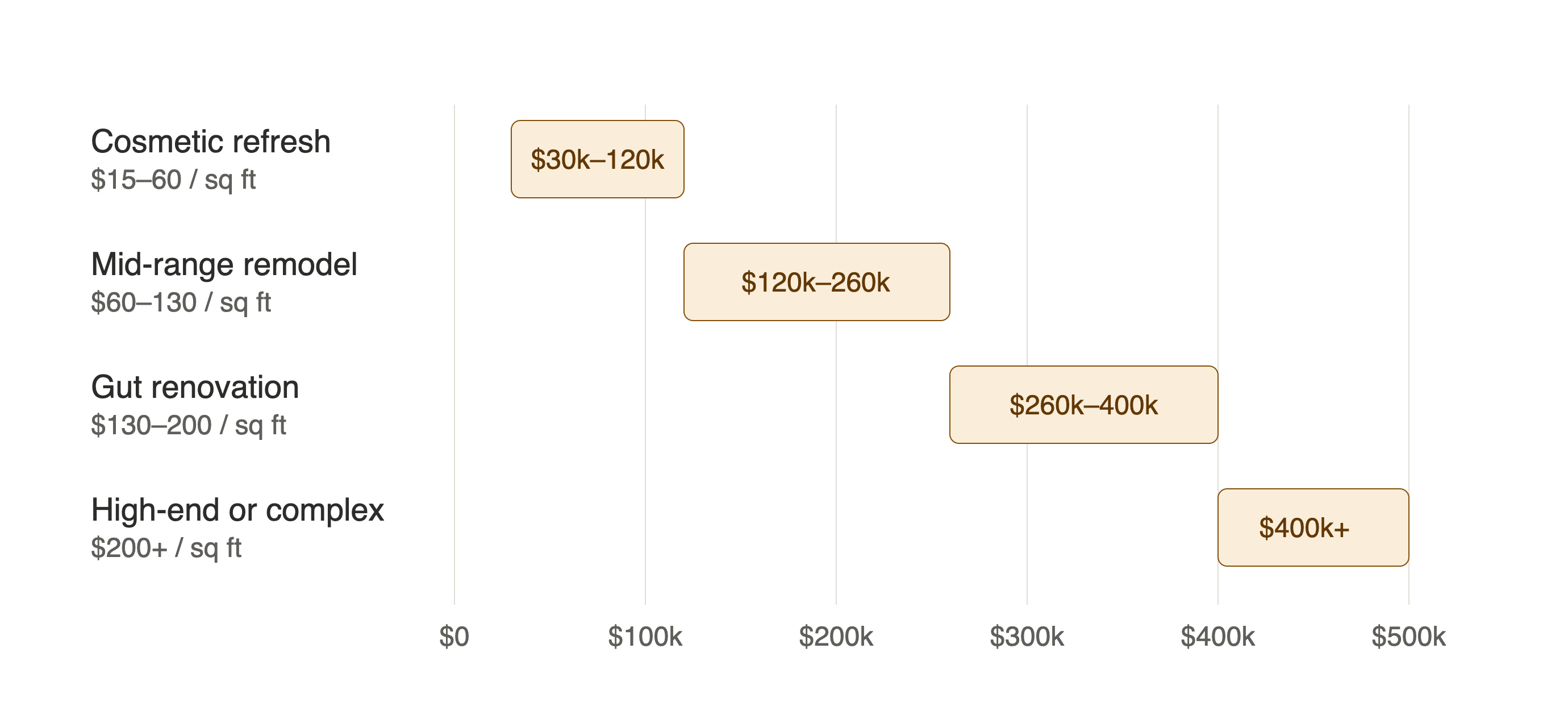
Ask a few people what a whole-house renovation costs and the answers won't come close, because "renovation" can mean fresh paint and new fixtures or a house taken down to the studs and rebuilt. For a 2,000-square-foot home, that runs from about $30,000 for a cosmetic refresh to $400,000 or more for a full gut, or $15 to $200+ per square foot. Scope is what moves your number along that range: how much you change, what the house needs behind its walls, and the finishes you pick.
Those are planning ranges for remodeling an entire house, the kind you budget around before a contractor ever sees it. What follows breaks the number down by scope, size, and systems, plus the hidden costs homeowners run into once the walls are open.
The fastest way to size your budget is by renovation type. What you're doing to the house drives the cost more than how big it is, so the table below starts there: typical per-square-foot ranges and what a 2,000-square-foot home runs at each level.
|
Renovation type |
Typical cost per square foot |
Example cost for 2,000 sq. ft. |
|
Cosmetic refresh |
$15 to $60 |
$30,000 to $120,000 |
|
Mid-range remodel |
$60 to $130 |
$120,000 to $260,000 |
|
Gut renovation |
$130 to $200 |
$260,000 to $400,000 |
|
High-end or complex |
$200+ |
$400,000+ |
What each level covers:
These are planning ranges drawn from Block Renovation's project data and recognized cost databases, useful for early budgeting rather than as a contractor quote. 2026 pricing stays highly local: labor availability, permitting timelines, material choices, financing costs, and the condition of the existing home all affect the final number. Get a scoped estimate before you commit. For specific footprints, see remodeling a 2,000-square-foot house and 3-bedroom house renovation cost.
Two estimates for the same house can differ by tens of thousands of dollars because they cover different things. Knowing the standard line between included and excluded work lets you compare quotes on equal footing.
Usually included in a renovation estimate:
Often quoted separately or excluded:
Before you compare two numbers, ask each contractor which of these items the price includes. A low estimate that leaves out permits, design, and appliances is not actually lower once you add them back.
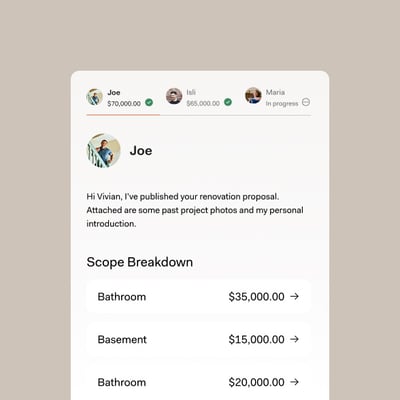
Compare Proposals with Ease
Per-square-foot averages are the horoscope of renovation budgeting. They read like precision but predict almost nothing about your specific house, since condition, layout, systems, and market swamp the average. The same project can run well above or below a national figure, and a few factors raise costs in specific markets:
Block has location pages for major metros where these factors hit hardest, so a homeowner in New York City or Los Angeles can see how local conditions shape pricing and contractor availability.
Square footage sets a baseline, but the work happening inside those walls is what sets the final number. These are the areas that move a whole-house budget the most. The ranges below price each area on its own, so they will not add up to a whole-house total, which also carries demolition, general labor, and overhead across every room.
|
Cost area |
Most costly elements |
Typical cost range |
|
Kitchen |
Cabinetry, countertops, appliances, plumbing, tile |
$25,000 to $75,000+ |
|
Bathrooms |
Plumbing, waterproofing, tile, fixtures, ventilation |
$15,000 to $40,000 per bath |
|
Flooring |
Material grade and subfloor repairs |
$3 to $18 per sq. ft. |
|
Windows and doors |
New units, reframing, historic matching |
$500 to $2,500 per window |
|
Electrical |
New panel, rewiring, added circuits |
$4,000 to $15,000 |
|
Plumbing |
Moving fixtures, replacing supply and drain lines |
$4,000 to $15,000 |
|
HVAC |
New system, added zones, ductwork |
$7,000 to $15,000 |
|
Structural work |
Removing load-bearing walls, foundation repair |
$5,000 to $50,000+ |
|
Exterior work |
Roofing, siding, grading |
$8,000 to $40,000+ |
|
Permits and design |
Drawings, engineering, permit fees |
$1,500 to $15,000+ |
Kitchens and bathrooms carry the highest cost per square foot, which is why they deserve their own budgets. Block covers them in depth in its guides to kitchen remodel cost, bathroom remodeling cost, and remodeling costs per square foot by room. Finish level then multiplies everything above: the same kitchen costs far more in custom cabinetry and imported tile than in stock materials.
Two homes of the same size can carry very different budgets, because what you do to a house drives the cost more than its square footage.
A cosmetic refresh updates surfaces without touching the structure or systems: paint, flooring, light fixtures, hardware, and minor bath updates like replacing tired carpet. At $15 to $60 per square foot, it is the most affordable level, $30,000 to $120,000 on a 2,000-square-foot home. It is all you need when the layout and mechanicals are sound.
Mid-range work goes deeper into the rooms you use most. A typical project replaces kitchen cabinets, updates one or two bathrooms, lays new flooring, and refreshes lighting, sometimes with a wall moved to open up a space, plus limited plumbing and electrical updates. At $60 to $130 per square foot, a 2,000-square-foot home lands at $120,000 to $260,000, a clear upgrade without the disruption of a full gut.
A gut renovation takes the house down to the studs and rebuilds. The work includes:
At $130 to $200 per square foot, a 2,000-square-foot gut runs $260,000 to $400,000, depending on finishes and how much structural work the rebuild uncovers. It makes sense when a home needs new mechanicals, has a layout that no longer works, or carries enough deferred maintenance that piecemeal fixes would cost more over time.
Premium finishes, structural work, additions, and historic properties push past standard gut rates to $200+ per square foot and $400,000 or more on a 2,000-square-foot home. Older and historic homes are the hardest to price up front, since unknown conditions behind the walls, lead and asbestos testing, custom detailing, and stricter permitting all add cost after work begins. Here, the square footage matters far less than what inspection and demolition reveal.
The specific surprise varies, but in a house built before 1980 the costs behind the walls are certainties you haven't priced yet. Budget remediation and structural fixes as line items from the start.
Design a Home That’s Uniquely Yours
Block can help you achieve your renovation goals and bring your dream remodel to life with price assurance and expert support.
Get Started
At about $50 per square foot, $100,000 on a 2,000-square-foot home sits at the top of a cosmetic refresh and the bottom of a mid-range remodel. It will not gut the house, so the real question is where the money goes. Three ways to spend the same budget:
This option touches every room at the cosmetic level, with nothing taken back to the studs.
The whole house feels current, but the layout, windows, and systems stay exactly as they are.
This option puts most of the budget into the two rooms that drive daily use and resale.
Two rooms come out beautifully, while the other baths, bedrooms, and systems wait for a later phase.
This option spends on the systems and structure that keep an older house safe, with finishes last in line.
On an older home, the bones can eat most of the $100,000, which is why the finishes that show wait their turn.
Knowing what each scope costs is only half the decision. The other half is what to spend it on, and that depends on how long you plan to stay.
The upgrades least likely to pay off at resale are usually the most personal ones. Julie Upton, a realtor and resource-efficient home specialist, sees it often:

The biggest one is often highly customized luxury renovations that are meaningful to the owner but not necessarily valuable to the next buyer. Examples include very expensive specialty appliances, custom built-ins that only work for one lifestyle, elaborate outdoor kitchens, ultra-high-end closet systems, or luxury bathroom features that do not match the price point of the home.
If this is the house you intend to keep, build it for the life you actually live. Resale still matters, but let it inform your choices instead of dictating them.
Not sure how to begin your renovation?
Get free, expert guidance from a dedicated Block Project Planner who can help you navigate proposals, timelines, contractor selection, and more.
Book A Free Consultation
Flip or forever, the budget holds only if you plan for what nobody quoted. Build these costs in from the start, especially on an older home or any project that opens walls.
Set aside 10 to 20% of the total budget as a contingency, and lean toward the higher end for older homes. For a $200,000 renovation, that is $20,000 to $40,000 held in reserve for the things you cannot see until demolition starts. If a 20% contingency breaks your budget, you don't have the budget yet. Block's guide to planning a renovation budget walks through how to size that cushion.
If you can afford to do everything in one stretch, do it. All at once is the cheaper way to renovate a whole house, because you set up the job, run demolition, and pull permits one time instead of paying for each again every time a crew comes back. You also live through the mess once instead of for years.
Phasing is the compromise people make when cash flow won't cover the whole project up front, and that is a fair reason to do it. The trap is sequencing. Finish a room, then crack open its new walls a year later to reach the plumbing behind them, and you have paid for that work twice, which erases the savings phasing was supposed to buy.
Systems, structural changes, and anything that touches multiple rooms have to come first, with kitchens, baths, and finishes after. A contractor or design-build team can map the order before you start, so the savings don't evaporate the first time something has to be redone. Block's overview of renovation phases and timelines lays out how the stages fit together.
Two things decide whether a whole-house renovation stays on budget: a scope written in enough detail to price accurately, and the right contractor to build it. Block matches your project with vetted local contractors, runs every scope through an expert review to catch missing line items before they turn into change orders, and releases payments only as approved work gets done. Tell Block your renovation details once, and contractors in your area compete for the project.
Remodel with confidence through Block

Connect to vetted local contractors
We only work with top-tier, thoroughly vetted contractors

Get expert guidance
Our project planners offer expert advice, scope review, and ongoing support as needed

Enjoy peace of mind throughout your renovation
Secure payment system puts you in control and protects your remodel


Renovate confidently with Block
Easily compare quotes from top quality contractors, and get peace of mind with warranty & price protections.
Cost
20x20 Room Addition Cost: What to Budget in 2026
07.28.2026
Remodeling
Cinder Block Garage Cost: Prices by Size & Material
07.23.2026
Cost
2026 Bedroom Remodel Cost Guide: Average Price, Tips & ROI
07.22.2026
Cost
Attic Renovation Costs in 2026: Finish or Convert an Attic
07.20.2026

Cost
Cost to Finish a Basement in 2026: Prices & Estimates
07.17.2026