







Working with Contractors
Angi vs. Thumbtack: Which Is Better for Renovations?
08.02.2026
10.28.2024



In This Article
Block Renovation's 2026 How America Renovates survey found that 30% of renovators named finding a trustworthy contractor as their top barrier to starting a project, ahead of cost and timeline. That ranking is worth remembering before you negotiate with a contractor. The contractor you choose shapes the outcome of your remodel far more than any discount you squeeze out of the first bid, so knowing how to negotiate with a contractor starts with that choice and works toward a fair price from there.
To negotiate with a contractor, start with a clear scope, get several itemized bids, and compare them line by line. From there, ask about adjusting scope, materials, timing, or payment terms before you request a blanket discount. A fair agreement with a qualified contractor who can deliver the work well matters more than the lowest number on the page.
The lowest bid is rarely the full story. Two quotes for the same bathroom can differ by thousands of dollars because one contractor included demolition, debris disposal, and permits while the other left them out. A price only tells you something once you know what sits behind it.
When you compare contractors, weigh scope, planning, communication, materials, insurance, licensing, timeline, and how the project will be managed day to day. A bid that looks cheap can get expensive fast through change orders, delays, and corners cut on prep work you can't see.
Contractor selection should not come down to price alone. Kevork Bardakjian, managing director of Bianco Design Build, makes the case for weighing a contractor's preparation and project management as heavily as the bottom-line number.

"Choosing the right contractor is not simply choosing the cheapest one. A strong contractor provides realistic pricing, proper planning, clear communication, and experienced project management. Successful projects are built on trust and preparation from the start."
Negotiation starts before a single quote lands in your inbox. The clearer your project is on paper, the easier it is for contractors to bid accurately, and the less room there is for surprises later.
Before you reach out, pull together:
Before you talk numbers with anyone, get a realistic cost range for your project type, location, and scope using Block's Renovation Studio and the renovation cost estimator. It also helps to plan your renovation budget and set a contingency before you start comparing bids.
A good rule of thumb is to get at least three quotes, then compare the scopes line by line so you can see where your budget actually goes. A vague lump-sum estimate is almost impossible to negotiate fairly, because you can't tell what's included.
It helps to know what the documents mean, since contractors use these terms differently:
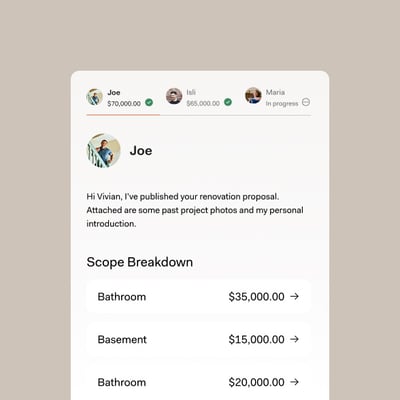
Comparing contractor quotes gets harder when every proposal is formatted differently. Block matches homeowners with vetted local contractors and has experts review each scope to catch missing line items and red flags before you sign.
Renovate with confidence every step of the way
Step 1: Personalize Your Renovation Plan
Step 2: Receive Quotes from Trusted Contractors
Step 3: Let Us Handle the Project Details

The figures below are hypothetical examples for a mid-range bathroom remodel, not real project data. Use them as a template for your own comparison.
|
Bid item |
Contractor A |
Contractor B |
What to ask |
|
Demolition and disposal |
$1,800 |
$2,400 |
Does this include debris removal and protecting the rest of the home? |
|
Tile labor |
$3,200 |
$2,600 |
What square footage, pattern, and wall prep are included? |
|
Fixtures |
$2,500 allowance |
$1,500 allowance |
Which specific fixtures are assumed at this allowance? |
|
Vanity and cabinetry |
$1,900 |
$2,300 |
Stock, semi-custom, or custom, and which brand? |
|
Plumbing and electrical |
$3,500 |
$3,100 |
Are licensed subs and required permits included? |
|
Contractor fee (overhead and profit) |
Included in line items |
15% added |
Is the fee built in or added on top? |
|
Permits |
Included |
Excluded |
Who pulls permits and schedules inspections? |
|
Estimated total |
$12,900 all-in |
$13,685 plus permits |
Is this the final number, or will fees and permits be added? |
Notice what happens at the bottom. Contractor B looked cheaper on a few line items, but once the 15% fee and excluded permits are counted, B ends up costing more. That's the reason to compare all-in totals and ask what each price actually covers.
Knowing local ranges keeps you grounded. Block's kitchen remodel cost guide and bathroom remodel cost guide break down 2026 costs by scope and finish level, so you can tell a reasonable bid from an outlier.
Renovation cost calculator
Start with a realistic budget
Get an initial estimate based on your space and project details.
Plenty of a quote is open to discussion, as long as you're negotiating for value and clarity rather than just a smaller number.
|
Negotiable item |
How to approach it |
|
Scope |
Ask what can be removed, phased, or simplified. |
|
Materials |
Ask for good, better, and best options at different price points. |
|
Timing |
Ask whether flexible scheduling or off-season work changes the price. |
|
Allowances |
Clarify or adjust the amounts set for fixtures, tile, hardware, and finishes. |
|
Payment schedule |
Ask to tie payments to completed milestones. |
|
Change-order process |
Agree in advance on markup and written approval. |
|
Warranty terms |
Confirm what's covered and for how long. |
Some things aren't line items to trim. They're what keeps your project legal and properly insured, and cutting them to save money tends to cost far more later.
Always confirm a contractor's license and insurance before signing. A quick contractor license check and a request for a current certificate of insurance protect you if something goes wrong on site.
Compare Proposals with Ease
Most contractors expect some back-and-forth. Asking well, with respect and specifics, gets better results than pushing for a flat discount. Use these as starting points and swap in your own numbers.
"I like your proposal and I'd be comfortable working with you, but the price is above my target budget. Are there changes to scope, materials, or timing that could bring this closer to $X without compromising the quality of the work?"
"I'm reviewing a few itemized proposals so I can understand the differences clearly. Could you help me see what's included in your price that may not show up in the other estimates?"
"Could you break this out by labor, materials, allowances, permits, and contractor fee, so I can compare your proposal more accurately?"
"Are there alternative materials or finishes that would lower the cost while still giving me a durable result?"
"Can we tie payments to completed milestones, with the final payment due after the punch list is finished?"
"Before we sign, can we agree on how change orders will be priced, and require written approval before any extra work begins?"
Value engineering means bending the budget without dropping the quality, usually by adjusting your own choices rather than squeezing the contractor's margin.
The two biggest savings have nothing to do with materials. The first is leaving the bones alone. Every time you move a toilet, a sink, a shower, or a wall, you pull in several trades at once, plumbing, demolition, framing, sometimes electrical, and that adds up faster than almost any finish decision. Keep the existing layout and a surprising share of the budget stays put. The second is timing your decisions. Lock your finish selections before anyone starts demo, because a change made mid-project can mean a change order, a re-order with its own lead time, and tearing out work that's already done. Late changes are some of the most expensive things that happen on a job.
After that, the savings are in what you spec. Semi-custom cabinetry gets you most of the look of fully custom for a good deal less. In-stock materials cost less than special orders and skip the wait. A straight-set tile layout installs faster and cheaper than herringbone or an intricate mosaic. And if it still doesn't all fit, phase the work: do the must-haves now and leave the extras for a later round rather than stretching this project thin.
There's also savings in how you group the work. Victoria Mansa, a senior sales manager at Block, points out that bundling smaller projects with a larger one can stretch your budget.

"Think about all of the projects that you'd like to tackle in the renovation at once. Typically our contractors can coordinate smaller side projects at the same time to save you money."
If you're weighing which upgrades are worth it, the renovation value calculator shows how different choices affect resale.
Most contractors are straightforward. A few patterns are worth noticing, not because they always mean trouble, but because they're a signal to slow down, ask more questions, or get another bid.
Before you sign, make sure the agreement covers:
Rules on deposits, lien waivers, and cancellation rights vary by state, so confirm the specifics with your local consumer protection agency or licensing board.
Block was built around the parts of renovation that tend to go wrong: unclear vetting, unpredictable pricing, and payment risk. In practice, that looks like:
You can start planning for free with Block's Renovation Studio, or get matched with vetted contractors when you're ready to compare real bids. Here's how Block works from planning to final walkthrough.
Remodel with confidence through Block

Connect to vetted local contractors
We only work with top-tier, thoroughly vetted contractors

Get expert guidance
Our project planners offer expert advice, scope review, and ongoing support as needed
Enjoy peace of mind throughout your renovation
Secure payment system puts you in control and protects your remodel

Renovate confidently with Block
Easily compare quotes from top quality contractors, and get peace of mind with warranty & price protections.
Working with Contractors
Angi vs. Thumbtack: Which Is Better for Renovations?
08.02.2026

Working with Contractors
Remodeling Projects That Don't Require Permits by State
07.25.2026

Working with Contractors
Is a Property Renovation Company Worth the Cost?
06.24.2026
Working with Contractors
What Renovation Experts Do Behind the Scenes
06.18.2026

Working with Contractors
Find the Right Gut Renovation Contractor For Your Project
06.11.2026