---
title: "Ranch Home Additions: Ideas, Costs, and What to Expect"
description: Dive into the pros, cons, and costs of different addition options for ranch homes, including bump-outs and new garage builds.
image: https://www.blockrenovation.com/hubfs/Planning%20a%20Ranch%20Home%20Addition_%20Ideas%2c%20Costs%2c%20and%20What%20to%20Expect.jpg
---
[Skip to content](https://www.blockrenovation.com/guides/ranch-home-additions-ideas-costs-and-what-to-expect#main-content)
[](https://www.blockrenovation.com?hsLang=en)
- How It Works
- [How Block Works](https://www.blockrenovation.com/how-it-works)
- [Home Renovations](https://www.blockrenovation.com/home-renovations)
- [New Construction](https://www.blockrenovation.com/new-construction)
- [Commercial Projects](https://www.blockrenovation.com/commercial-projects)
- [Block Protections](https://www.blockrenovation.com/block-protections)
- [Reviews](https://www.blockrenovation.com/reviews)
- [Design Services](https://www.blockrenovation.com/design-services)
- [Trade Program](https://www.blockrenovation.com/trade-program)
- [Gallery](https://www.blockrenovation.com/customer-gallery)
- Project Guides
- By Room
- [Kitchen](https://www.blockrenovation.com/guides/cost/kitchen-remodel-cost)
- [Bathroom](https://www.blockrenovation.com/guides/cost/bathroom-remodel-cost)
- [Bedroom](https://www.blockrenovation.com/guides/the-complete-guide-to-bedroom-remodel-costs)
- [Living Room](https://www.blockrenovation.com/guides/the-cost-of-a-living-space-remodel)
- [Basement](https://www.blockrenovation.com/guides/the-complete-guide-to-basement-remodel-costs)
- [Attic](https://www.blockrenovation.com/guides/the-complete-guide-to-attic-renovation-costs)
- [Garage](https://www.blockrenovation.com/guides/the-complete-guide-to-garage-remodel-costs)
- [Sunroom](https://www.blockrenovation.com/guides/sunroom-renovation-ideas-cost-more)
- [Laundry Room](https://www.blockrenovation.com/guides/a-complete-guide-to-laundry-room-addition-and-remodel-2026)
- [Mudroom](https://www.blockrenovation.com/guides/custom-mudroom-additions-costs-design-ideas)
- Bigger Projects
- [Home Addition](https://www.blockrenovation.com/guides/understanding-the-costs-of-a-home-addition)
- [In-Law Suite](https://www.blockrenovation.com/guides/building-in-law-suite-ideas)
- [Guest House](https://www.blockrenovation.com/guides/how-much-does-it-cost-to-build-or-remodel-a-guest-house)
- [Deck Remodel](https://www.blockrenovation.com/guides/ultimate-guide-to-deck-remodeling-in-2026)
- [Custom Home Build](https://www.blockrenovation.com/guides/most-cost-effective-homes-to-custom-build)
- The Block Way
- [A Renovation Planning Guide](https://www.blockrenovation.com/guides/the-block-way-of-renovating)
- [Custom Home Building Guide](https://www.blockrenovation.com/guides/the-block-way-custom-home-building-process)
- [Read the Latest Articles](https://www.blockrenovation.com/guides/page/1)
- Budgeting & Planning
- Budgeting
- [Calculating Room Addition Costs](https://www.blockrenovation.com/guides/how-to-calculate-the-cost-of-a-room-addition)
- [Kitchen Countertop Replacement Costs](https://www.blockrenovation.com/guides/how-much-does-replacing-kitchen-countertops-cost-in-2025)
- [Kitchen Backsplash Costs](https://www.blockrenovation.com/guides/kitchen-backsplash-costs-installation-materials-more)
- [Kitchen Flooring Costs](https://www.blockrenovation.com/guides/cost/how-much-does-new-flooring-cost-in-a-kitchen)
- [Rerouting Plumbing Costs](https://www.blockrenovation.com/guides/rerouting-plumbing-costs-other-faqs)
- [Shower Installation Costs](https://www.blockrenovation.com/guides/cost/shower-installation-costs)
- [Tub Installation Cost](https://www.blockrenovation.com/guides/how-much-to-install-a-new-tub-bathtub-installation-cost-breakdown-tips)
- Size Guides
- [Minimum Bathroom Sizing](https://www.blockrenovation.com/guides/design/minimum-bathroom-size-maximize-small-space)
- [Minimum Laundry Room Sizing](https://www.blockrenovation.com/guides/laundry-room-sizing-guide-minimums-averages-more)
- [Minimum ADU Sizing](https://www.blockrenovation.com/guides/adu-sizing-smallest-typical-dimensions)
- Additions & Conversions
- [Ranch Home Additions](https://www.blockrenovation.com/guides/ranch-home-additions-ideas-costs-and-what-to-expect)
- [Master Suite Over Garages](https://www.blockrenovation.com/guides/master-suite-additions-over-garage-cost)
- [Dormer Addition Cost](https://www.blockrenovation.com/guides/building-a-dormer-addition-cost)
- [Garage to Master Suite Conversion](https://www.blockrenovation.com/guides/garage-to-master-bedroom-suite-conversion)
- [Garage Expansions](https://www.blockrenovation.com/guides/garage-expansions-ideas-addition-practicalities)
- [Read the Latest Articles](https://www.blockrenovation.com/guides/page/1)
- Tools
- [Renovation Studio](https://www.blockrenovation.com/renovation-planning)
- [AI Remodel Planner](https://www.blockrenovation.com/renovation-planning)
- [Kitchen Remodel Visualizer](https://www.blockrenovation.com/tools/kitchen-remodel-visualizer)
- [Kitchen Cabinet Visualizer](https://www.blockrenovation.com/tools/kitchen-cabinet-visualizer)
- [Bathroom Remodel Visualizer](https://www.blockrenovation.com/tools/bathroom-remodel-visualizer)
- [Basement Remodel Visualizer](https://www.blockrenovation.com/tools/basement-remodel-AI-designer)
- [Estimate Remodeling Costs](https://www.blockrenovation.com/tools/calculate-renovation-cost-estimations)
- [Renovation Value Calculator](https://www.blockrenovation.com/tools/roi-calculator)
- [Basement Finishing Estimator](https://www.blockrenovation.com/tools/basement-finishing-estimator-planner)
- [Kitchen Remodel Cost Estimator](https://www.blockrenovation.com/tools/kitchen-remodel-cost-estimator-checklist)
[Log In](https://www.blockrenovation.com/login?hsLang=en) [Get Started](https://www.blockrenovation.com/planner/route?hsLang=en)
[Guides](https://www.blockrenovation.com/guides)
- Block Renovations
- [Working with Block](https://www.blockrenovation.com/guides/tag/working-with-block)
- [Case Studies](https://www.blockrenovation.com/guides/tag/case-study)
- [Block Contractors](https://www.blockrenovation.com/guides/tag/contractors)
- Project Planning
- [Planning & Logistics](https://www.blockrenovation.com/guides/tag/planning-logistics)
- [Cost](https://www.blockrenovation.com/guides/tag/cost)
- [Timelines](https://www.blockrenovation.com/guides/tag/timelines)
- [Working with Contractors](https://www.blockrenovation.com/guides/tag/working-with-contractors)
- Ideas & Inspiration
- [Design](https://www.blockrenovation.com/guides/tag/design)
- [Cleaning](https://www.blockrenovation.com/guides/tag/cleaning)
- [Paint & Color](https://www.blockrenovation.com/guides/tag/paint-color)
- [How To & DIY](https://www.blockrenovation.com/guides/tag/how-to)


[](https://www.blockrenovation.com?hsLang=en)

Guides
- Block Renovations
- [Working with Block](https://www.blockrenovation.com/guides/tag/working-with-block)
- [Case Studies](https://www.blockrenovation.com/guides/tag/case-study)
- [Block Contractors](https://www.blockrenovation.com/guides/tag/contractors)
- Project Planning
- [Planning & Logistics](https://www.blockrenovation.com/guides/tag/planning-logistics)
- [Cost](https://www.blockrenovation.com/guides/tag/cost)
- [Timelines](https://www.blockrenovation.com/guides/tag/timelines)
- [Working with Contractors](https://www.blockrenovation.com/guides/tag/working-with-contractors)
- Ideas & Inspiration
- [Design](https://www.blockrenovation.com/guides/tag/design)
- [Cleaning](https://www.blockrenovation.com/guides/tag/cleaning)
- [Paint & Color](https://www.blockrenovation.com/guides/tag/paint-color)
- [How To & DIY](https://www.blockrenovation.com/guides/tag/how-to)


[Get Started](https://www.blockrenovation.com/planner/route?hsLang=en)
- Learn About Block
- How It Works
- [How Block Works](https://www.blockrenovation.com/how-it-works)
- [Home Renovations](https://www.blockrenovation.com/home-renovations)
- [New Construction](https://www.blockrenovation.com/new-construction)
- [Commercial Projects](https://www.blockrenovation.com/commercial-projects)
- [Block Protections](https://www.blockrenovation.com/block-protections)
- [Reviews](https://www.blockrenovation.com/reviews)
- [Design Services](https://www.blockrenovation.com/design-services)
- [Trade Program](https://www.blockrenovation.com/trade-program)
- [Gallery](https://www.blockrenovation.com/customer-gallery)
- Project Guides
- By Room
- [Kitchen](https://www.blockrenovation.com/guides/cost/kitchen-remodel-cost)
- [Bathroom](https://www.blockrenovation.com/guides/cost/bathroom-remodel-cost)
- [Bedroom](https://www.blockrenovation.com/guides/the-complete-guide-to-bedroom-remodel-costs)
- [Living Room](https://www.blockrenovation.com/guides/the-cost-of-a-living-space-remodel)
- [Basement](https://www.blockrenovation.com/guides/the-complete-guide-to-basement-remodel-costs)
- [Attic](https://www.blockrenovation.com/guides/the-complete-guide-to-attic-renovation-costs)
- [Garage](https://www.blockrenovation.com/guides/the-complete-guide-to-garage-remodel-costs)
- [Sunroom](https://www.blockrenovation.com/guides/sunroom-renovation-ideas-cost-more)
- [Laundry Room](https://www.blockrenovation.com/guides/a-complete-guide-to-laundry-room-addition-and-remodel-2026)
- [Mudroom](https://www.blockrenovation.com/guides/custom-mudroom-additions-costs-design-ideas)
- Bigger Projects
- [Home Addition](https://www.blockrenovation.com/guides/understanding-the-costs-of-a-home-addition)
- [In-Law Suite](https://www.blockrenovation.com/guides/building-in-law-suite-ideas)
- [Guest House](https://www.blockrenovation.com/guides/how-much-does-it-cost-to-build-or-remodel-a-guest-house)
- [Deck Remodel](https://www.blockrenovation.com/guides/ultimate-guide-to-deck-remodeling-in-2026)
- [Custom Home Build](https://www.blockrenovation.com/guides/most-cost-effective-homes-to-custom-build)
- The Block Way
- [A Renovation Planning Guide](https://www.blockrenovation.com/guides/the-block-way-of-renovating)
- [Custom Home Building Guide](https://www.blockrenovation.com/guides/the-block-way-custom-home-building-process)
- [Read the Latest Articles](https://www.blockrenovation.com/guides/page/1)
- Budgeting & Planning
- Budgeting
- [Calculating Room Addition Costs](https://www.blockrenovation.com/guides/how-to-calculate-the-cost-of-a-room-addition)
- [Kitchen Countertop Replacement Costs](https://www.blockrenovation.com/guides/how-much-does-replacing-kitchen-countertops-cost-in-2025)
- [Kitchen Backsplash Costs](https://www.blockrenovation.com/guides/kitchen-backsplash-costs-installation-materials-more)
- [Kitchen Flooring Costs](https://www.blockrenovation.com/guides/cost/how-much-does-new-flooring-cost-in-a-kitchen)
- [Rerouting Plumbing Costs](https://www.blockrenovation.com/guides/rerouting-plumbing-costs-other-faqs)
- [Shower Installation Costs](https://www.blockrenovation.com/guides/cost/shower-installation-costs)
- [Tub Installation Cost](https://www.blockrenovation.com/guides/how-much-to-install-a-new-tub-bathtub-installation-cost-breakdown-tips)
- Size Guides
- [Minimum Bathroom Sizing](https://www.blockrenovation.com/guides/design/minimum-bathroom-size-maximize-small-space)
- [Minimum Laundry Room Sizing](https://www.blockrenovation.com/guides/laundry-room-sizing-guide-minimums-averages-more)
- [Minimum ADU Sizing](https://www.blockrenovation.com/guides/adu-sizing-smallest-typical-dimensions)
- Additions & Conversions
- [Ranch Home Additions](https://www.blockrenovation.com/guides/ranch-home-additions-ideas-costs-and-what-to-expect)
- [Master Suite Over Garages](https://www.blockrenovation.com/guides/master-suite-additions-over-garage-cost)
- [Dormer Addition Cost](https://www.blockrenovation.com/guides/building-a-dormer-addition-cost)
- [Garage to Master Suite Conversion](https://www.blockrenovation.com/guides/garage-to-master-bedroom-suite-conversion)
- [Garage Expansions](https://www.blockrenovation.com/guides/garage-expansions-ideas-addition-practicalities)
- [Read the Latest Articles](https://www.blockrenovation.com/guides/page/1)
- Tools
- [Renovation Studio](https://www.blockrenovation.com/renovation-planning)
- [AI Remodel Planner](https://www.blockrenovation.com/renovation-planning)
- [Kitchen Remodel Visualizer](https://www.blockrenovation.com/tools/kitchen-remodel-visualizer)
- [Kitchen Cabinet Visualizer](https://www.blockrenovation.com/tools/kitchen-cabinet-visualizer)
- [Bathroom Remodel Visualizer](https://www.blockrenovation.com/tools/bathroom-remodel-visualizer)
- [Basement Remodel Visualizer](https://www.blockrenovation.com/tools/basement-remodel-AI-designer)
- [Estimate Remodeling Costs](https://www.blockrenovation.com/tools/calculate-renovation-cost-estimations)
- [Renovation Value Calculator](https://www.blockrenovation.com/tools/roi-calculator)
- [Basement Finishing Estimator](https://www.blockrenovation.com/tools/basement-finishing-estimator-planner)
- [Kitchen Remodel Cost Estimator](https://www.blockrenovation.com/tools/kitchen-remodel-cost-estimator-checklist)
1. [Home](https://www.blockrenovation.com?hsLang=en)
2. [Guide](https://www.blockrenovation.com/guides)
3. [All Articles](https://www.blockrenovation.com/guides/page/1)
4. Search
# Planning a Ranch Home Addition: Ideas, Costs, and What to Expect
Dive into the pros, cons, and costs of different addition options for ranch homes, including bump-outs and new garage builds.
By Block Renovation
05.28.2026
[](http://www.facebook.com/share.php?u=https%3A%2F%2Fwww.blockrenovation.com%2Fguides%2Franch-home-additions-ideas-costs-and-what-to-expect) [](https://www.instagram.com/blockrenovation) [](http://www.linkedin.com/shareArticle?mini=true&url=https%3A%2F%2Fwww.blockrenovation.com%2Fguides%2Franch-home-additions-ideas-costs-and-what-to-expect) [](http://pinterest.com/pin/create/button/?url=https%3A%2F%2Fwww.blockrenovation.com%2Fguides%2Franch-home-additions-ideas-costs-and-what-to-expect&media=https://4612653.fs1.hubspotusercontent-na1.net/hubfs/4612653/Planning%20a%20Ranch%20Home%20Addition_%20Ideas%2c%20Costs%2c%20and%20What%20to%20Expect.jpg)
In This Article
Ranch homes are a classic American style, prized for their single-level living, open layouts, and easy connection to the outdoors. As families grow or needs change, many homeowners look to expand their ranch style house with additions.
This guide covers the most popular ranch home additions, including cost estimates, return on investment, and practical planning tips—so you can make informed decisions and create a home that fits your life.
Turn your renovation vision into reality
Get matched with trusted contractors and start your renovation today!
[Find a Contractor](https://www.blockrenovation.com/planner/route?hsLang=en)

## Quick practical tips to guide your ideas
| **Second-story reset** | Many ranch homes were never engineered for a second floor. A $175,000 addition can trigger foundation reinforcement, full roof reframing, new HVAC equipment, and panel upgrades before drywall even starts. |
| --- | --- |
| **Bump-outs beat additions** | An extra 3-5 feet off a kitchen often fixes the real problem for $10,000-$35,000. Jumping straight to a $150,000 addition is common when the issue is circulation, not square footage. |
| **Unfinished plans inflate bids** | Undefined layouts leave contractors pricing assumptions instead of scope. Once appliance loads, plumbing runs, or HVAC capacity get finalized, the “cheap” estimate disappears into change orders. |
Adding a Porch to Your Ranch Home
A front porch addition is one of the most popular ways to enhance a ranch home’s curb appeal and functionality. Porches create a welcoming entry, provide outdoor living space, and can even help with energy efficiency by shading windows and doors. The cost of a [front porch addition](https://www.blockrenovation.com/guides/adding-a-front-porch-to-a-ranch-home-before-after?hsLang=en) to a ranch home typically ranges from $15,000 to $40,000, depending on size, materials, and whether you opt for a simple covered stoop or a full wraparound porch. Higher-end designs with custom railings, stonework, or integrated lighting can push costs higher.
A well-designed porch can recoup 60–80% of its cost at resale, and it often makes the home more attractive to buyers. Beyond financial ROI, a porch can improve daily life by offering a place to relax, entertain, or simply enjoy the outdoors. However, it’s important to consider whether your yard has the square footage to spare; ranch homes already have a large footprint, which means that adding a porch may further reduce usable outdoor space and impact your landscaping or garden areas.
You’ll want the roofline and exterior finishes to flow seamlessly with the rest of the house, so the addition feels like it’s always been there. Because ranch homes often have low-pitched roofs, you may need custom framing or tweaks to gutters and drainage to make everything work. It’s also worth thinking about how the new porch will tie into your existing walkways and landscaping, so the whole space feels connected and inviting.
The timeline for a porch addition is usually 4–8 weeks, depending on complexity and weather. Permitting is typically straightforward, but it’s wise to check local zoning rules for setback requirements or restrictions on covered structures.
## 
## Adding a garage to your ranch home
Garage additions to ranch style homes are a practical upgrade, offering secure parking, storage, and even workshop space. [Costs for a new attached or detached garage](https://www.blockrenovation.com/guides/the-complete-guide-to-garage-remodel-costs?hsLang=en) typically range from $35,000 to $80,000, depending on size, finishes, and whether you include features like insulation, finished interiors, or extra storage lofts. Two-car garages are the most common, but single-car and three-car options are also possible.
The ROI for a garage addition is generally high, with many projects recouping 60–70% of their cost at resale. In areas where off-street parking is limited or winters are harsh, a garage can be a major selling point.
When [planning a garage addition](https://www.blockrenovation.com/guides/garage-expansions-ideas-addition-practicalities?hsLang=en) for your ranch home, consider how it will connect to the main house. Attached garages are often more convenient but may require reconfiguring existing rooms or entryways. [Detached garages](https://www.blockrenovation.com/guides/attached-garage-vs.-detached-garage?hsLang=en) offer more flexibility in placement but may require additional driveway work.
The timeline for a garage addition is typically 2–4 months, including permitting, site preparation, foundation work, framing, and finishing. Permitting can be more involved if you’re adding living space above the garage or building close to property lines.
> [View this post on Instagram](https://www.instagram.com/reel/DN8yf4WDOXy/?utm_source=ig_embed&utm_campaign=loading)
>
> [A post shared by Block Renovation (@blockrenovation)](https://www.instagram.com/reel/DN8yf4WDOXy/?utm_source=ig_embed&utm_campaign=loading)
## Adding a bump-out to your ranch home
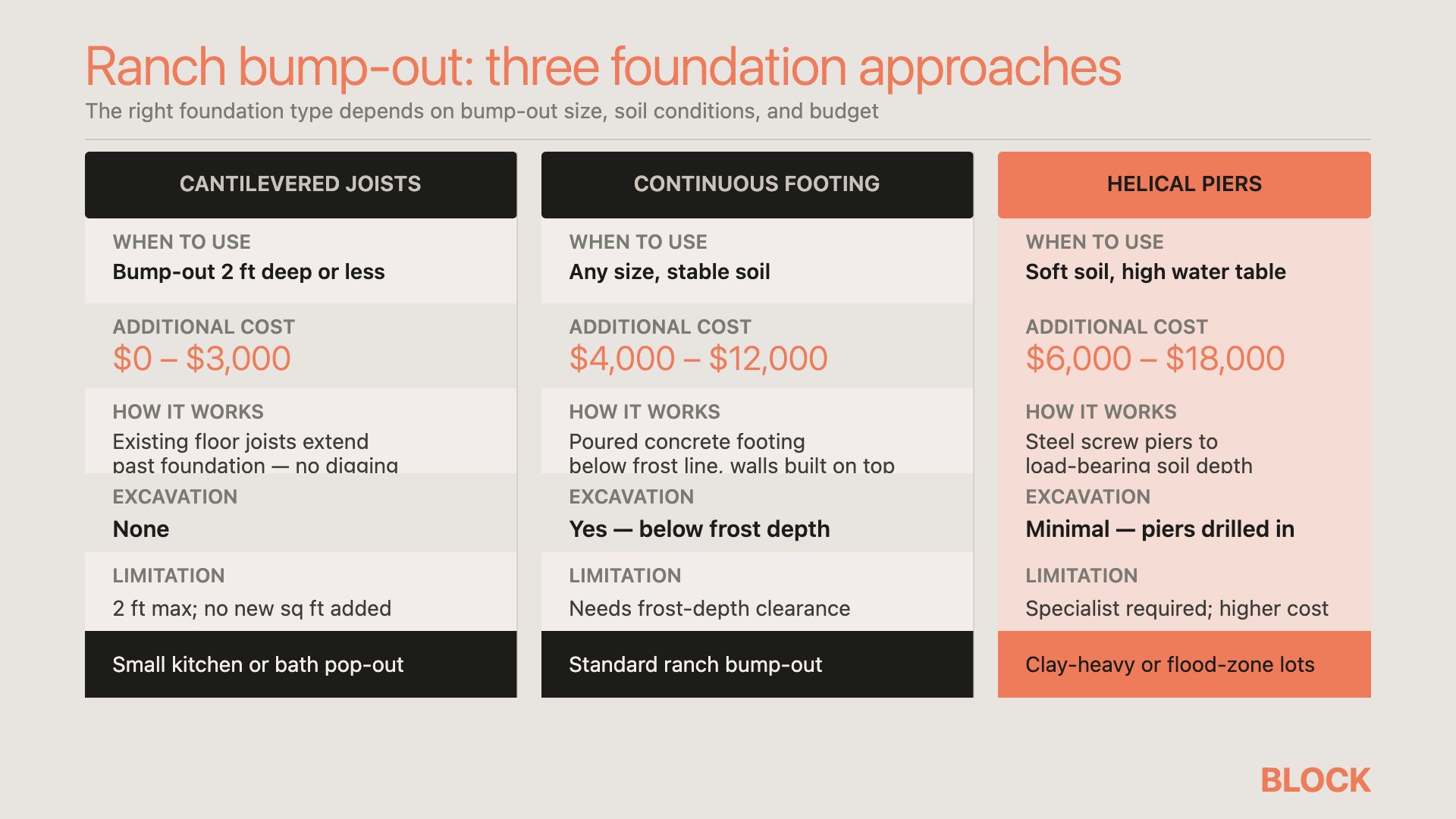
A bump-out is a small-scale addition that extends a room by a few feet, often to enlarge a kitchen, bathroom, or living area. Bump-outs are popular for ranch homes because they add valuable space without the cost or complexity of a full addition. Typical costs range from $10,000 to $35,000, depending on the size, finishes, and whether plumbing or structural changes are needed.
The ROI for a bump-out depends on how the new space is used. Expanding your [ranch home’s kitchen](https://www.blockrenovation.com/guides/ranch-home-kitchen-remodeling?hsLang=en) or adding a breakfast nook can be especially valuable, as these are high-traffic areas that appeal to buyers.
If this specific type of addition best aligns with your ideas, the next step is to determine which kind of bump out best suits your ranch home.
| **Type** | **Best for** | **Pros** | **Cons** |
| --- | --- | --- | --- |
| **Cantilever** (no foundation) | Kitchen extension, breakfast nook, small living-area expansion | No foundation work; fastest build; minimal permit complexity | Limited to 2-3 ft of extension; can't support heavy loads like tile or stone; underside is visible and needs cladding |
| **Slab-on-grade** | Bedroom, family room, or office addition on a slab-on-grade ranch | Matches the foundation type of most postwar ranches; cheaper than crawlspace; flat-lot friendly | Hard to run new plumbing or electrical beneath the floor; cold floors without proper insulation; transition cracks at the joint tend to show |
| **Crawlspace** | Bathroom or kitchen bump-outs where plumbing matters | Easy access for pipes and wiring; integrates cleanly with older ranches that already have crawlspaces; better long-term maintenance access | More excavation than slab; needs vapor barrier and ventilation; cost climbs faster than expected |
| **Full foundation** | 6+ ft bump-outs, or any extension on a ranch with a basement | Strongest structural integration; supports any room type and any finish; can gain basement square footage if extended downward | Most expensive option; major excavation; waterproofing requirements; longest timeline |
| **Bay or box window** | Adding light and openness to a kitchen sink area or dining nook | Cheapest option; usually permit-free; adds character without committing to a structural addition | Zero added floor space; really a window upgrade, not a bump-out in the structural sense |
The typical costs of each ranch home addition option:
- **Cantilever (no foundation):** $10,000-$20,000
- **Slab on-grade:** $15,000-$30,000
- **Crawlspace:** $20,000-$35,000
- **Full foundation:** $30,000-$50,000+
- **Bay or box window:** $3,000 - $8,000
The timeline for a bump-out is usually 4–8 weeks, depending on the scope of work and weather conditions. Permitting is generally straightforward, but you’ll need to ensure the addition complies with local setback and lot coverage rules.
[Learn more about cantilevered bump out additions](https://www.blockrenovation.com/guides/cantilevered-bump-out-addition-when-it-makes-sense?hsLang=en)
## Adding a new wing to your ranch home
A new wing for your ranch home is a larger-scale addition that [can add bedrooms](https://www.blockrenovation.com/guides/adding-a-bedroom-to-your-house-ideas-how-to?hsLang=en), a family room, a home office, or even a guest suite. This type of project significantly increases living space and can transform how you use your home. Costs for a new wing typically start around $80,000 and can exceed $200,000 for larger or more complex designs, especially if you’re adding bathrooms or specialty rooms.
**Several factors shape a new wing's design:**
- The foundation needs to tie cleanly into the existing footprint
- The roofline has to integrate with the home's low-pitched profile rather than fight it
- Horizontal proportions matter; a wing that overpowers the original silhouette will look wrong
- Circulation between new and existing rooms should be planned before walls go up
- Electrical, plumbing, and HVAC capacity may all need upgrading to handle the added load
The timeline for a new wing is typically 4–8 months, including design, permitting, site work, construction, and finishing. Permitting can be more complex for larger additions, especially if you’re building close to property lines or in areas with strict zoning rules.
Renovate now, pay later
Achieve the space you're looking for today, while financing it over time with our trusted partner.\*
\*Not available in NYC
[Learn More](https://figure.com/blockrenovation)
## Adding a second story to your ranch home
A 2nd story addition on a ranch home is a major undertaking, but it can double your living space without expanding your home’s footprint. Costs for a second story addition typically range from $175,000 to $350,000 or more, depending on the size, finishes, and structural work required. This project often involves reinforcing the foundation, reframing the roof, and updating utilities to support the new level.
According to Quinn Babcock, licensed contractor and partner, "The best way to control costs is to clearly define your design intent early. When the layout, fixtures, and finishes are specified upfront, contractors can build more accurate budgets and avoid surprises later. From there, you can adjust materials or fixtures to better align with your budget. It’s also important to understand where your home’s systems are located before designing an addition. Ask questions like whether the new space can easily tie into existing electrical, plumbing, or HVAC systems, or if new equipment such as a larger HVAC unit, upgraded electrical panel, or additional water heating capacity will be required."
The ROI for a second story addition can be strong, especially in neighborhoods where land is limited or multi-story homes are common. Adding bedrooms, bathrooms, or a master suite upstairs can make your home more appealing to families and increase its resale value.
The timeline for a second story addition is typically 6–12 months, including design, engineering, permitting, demolition, construction, and finishing. Permitting is more involved due to the structural changes, and you may need to work with both an architect and a structural engineer. Early planning and clear communication are essential for a successful outcome.
## Practical tips for planning your ranch home addition

One of the biggest issues I've seen in additions is poor connection between the new structure and the existing house, sometimes structurally, sometimes with weatherproofing, and sometimes just in basic floor and roof alignment.
Maksim Sauchanka, Owner, BMR Belmax Remodeling
The transition zone Maksim Sauchanka of [BMR Belmax Remodeling](https://belmaxremodeling.com/) describes is where most ranch additions quietly fail, and the failures cluster around a handful of predictable problems. As he noted to the Block Renovation team, “A project can look fine at first glance and still have major problems where the new work meets the old work. That transition area is where shortcuts show up fast.”
- **The roof tie-in.** Ranches typically have low-pitched roofs, often 3:12 or 4:12, which leaves much less working room where the new roof meets the old. A botched tie-in is the single most common source of post-addition leaks and the easiest place to spot lazy work: awkward flashing, ridge alignment that's off by an inch, or a sudden pitch change that announces "addition" from the curb.
- **Slab vs. crawlspace at the joint.** Many postwar ranches sit on slab foundations. If your bump-out or wing is built on a different foundation type, the floor transition is where you'll feel it: cold spots, slight elevation changes, and over time, separation cracks. Matching the existing foundation is usually the right call. Where that's impossible, a properly insulated transition and an expansion joint matter more than whatever flooring goes on top.
- **Electrical capacity.** Original ranches from the 1950s through 70s often have 60–100 amp panels. That was plenty for the original house; it is not plenty for the original house plus a new wing with another bathroom, a mini-split, and an induction range. A panel upgrade typically runs $2,500–$5,000 on its own and gets forgotten in early budgets.
- **The idea of matching an older ranch exterior is mostly a lie.** Brick, siding, and roofing from fifty-plus years ago either no longer exist or have weathered enough that even an "exact match" reads as wrong. The best contractors don't pretend otherwise. They source salvage where it matters most (usually the street-facing facade) or design the addition to read intentionally, with a contrasting material that announces itself rather than failing to blend.
- **The horizontal-line problem.** Ranch homes are defined by long, low silhouettes. The fastest way to ruin one is to drop an addition on top or off the side that ignores those proportions. A steep gable wing on a long ranch reads as a hat on a hat. Good additions extend the existing rooflines or stay deferential to them. The strongest moves are usually keeping the new ridge at or below the original and carrying the existing fascia line across the addition, so the eye reads one continuous roofline rather than two glued together.
**Sometimes the right move is an ADU.** Many states have loosened ADU rules in recent years. If your zoning allows it, a detached accessory dwelling unit can deliver the same square footage with none of the tie-in risk, plus rental potential. Dig deeper into this possibility with [our guide to minimum ADU sizing](https://www.blockrenovation.com/guides/adu-sizing-smallest-typical-dimensions?hsLang=en).

"When the layout, fixtures, and finishes are specified upfront, contractors can build more accurate budgets and avoid surprises later."
Quinn Babcock, Licensed contractor and partner, Limited Addition
The quality of your ranch home addition depends heavily on the person building it.
At Block, we connect you with contractors who check every box: proven craftsmanship, a track record of reliability, and hands-on experience with [renovating ranch-style homes](https://www.blockrenovation.com/guides/ranch-home-remodeling-ideas-to-inspire-your-next-renovation?hsLang=en).
We work with homeowners from Westchester, NY, to Fremont, CA, pairing you with someone who understands your local codes, climate, and expectations. With Block overseeing the process, you can start your addition knowing you have a skilled, trusted professional guiding every step.
Remodel with confidence through Block

Connect to vetted local contractors
We only work with top-tier, thoroughly vetted contractors

Get expert guidance
Our project planners offer expert advice, scope review, and ongoing support as needed

Enjoy peace of mind throughout your renovation
Secure payment system puts you in control and protects your remodel
[Get Started](https://www.blockrenovation.com/planner?hsLang=en)
Renovate confidently with [Block](https://www.blockrenovation.com?hsLang=en). Easily compare quotes from top quality contractors, and get peace of mind with warranty & price protections. Learn about [Block's editorial process](https://www.blockrenovation.com/editorial-policy?hsLang=en).

Written by Block Renovation
Block Renovation personalizes home remodeling with free AI-powered design tools and a vetted contractor network, helping homeowners plan, visualize, and build with confidence.

Renovate confidently with Block
Easily compare quotes from top quality contractors, and get peace of mind with warranty & price protections.
[Get Your Estimates](https://www.blockrenovation.com/planner/route?hsLang=en)
Thousands of homeowners have renovated with Block

4.5 Stars (100+)

4.7 Stars (100+)

4.5 Stars (75+)
[Read homeowner reviews](https://www.blockrenovation.com/reviews?hsLang=en)

See what homeowners have built with Block
[View project gallery](https://www.blockrenovation.com/customer-gallery?hsLang=en)
Renovate confidently
- Top quality contractors
- Warranty & price protections
- Expert resources
[Get Your Estimates](https://www.blockrenovation.com/get-started?hsLang=en)
[Get Your Estimates](https://www.blockrenovation.com/get-started?hsLang=en)
Renovate confidently with Block. Easily compare quotes from top quality contractors, and get peace of mind with warranty & price protections
- [Ask ChatGPT About Block](https://bit.ly/BlockRenovation)
- [FAQ](https://www.blockrenovation.com/faq)
- [Reviews](https://www.blockrenovation.com/reviews)
- [How It Works](https://www.blockrenovation.com/how-it-works)
- [For Contractors](https://www.blockrenovation.com/contractors)
- [Gallery](https://www.blockrenovation.com/customer-gallery)
- [Guides/Blogs](https://www.blockrenovation.com/guides)
- [Careers](https://www.blockrenovation.com/welcome/careers)
- [Tools](https://www.blockrenovation.com/tools)
- [](https://www.facebook.com/blockrenovation/)
- [](https://www.instagram.com/blockrenovation/)
- [](https://www.linkedin.com/company/blockrenovation/)
- [](https://www.pinterest.com/blockrenovation/)
Email
[sales@blockrenovation.com](mailto:sales@blockrenovation.com)
Learn more about renovating
Sign Up
[Refer a friend and get up to $1,200](https://www.blockrenovation.com/referral?hsLang=en)
© Block 2026
- [Terms of Use](https://www.blockrenovation.com/terms)
- [Privacy Policy](https://www.blockrenovation.com/privacy)
```json
{
"@context" : "https://schema.org",
"@type" : "BlogPosting",
"author" : {
"@type" : "Person",
"name" : "Block Renovation",
"url" : "https://www.blockrenovation.com/guides/author/block"
},
"dateModified" : "2026-06-25T19:13:54.007Z",
"datePublished" : "2026-05-28T16:09:18.000Z",
"headline" : "Ranch Home Additions: Ideas, Costs, and What to Expect",
"image" : [ "https://www.blockrenovation.com/hubfs/Planning%20a%20Ranch%20Home%20Addition_%20Ideas%2c%20Costs%2c%20and%20What%20to%20Expect.jpg" ],
"mainEntityOfPage" : {
"@id" : "https://www.blockrenovation.com/guides/ranch-home-additions-ideas-costs-and-what-to-expect",
"@type" : "WebPage"
},
"publisher" : {
"@type" : "Organization",
"logo" : {
"@type" : "ImageObject",
"url" : "https://www.blockrenovation.com/hubfs/block%20logo%20orange.jpg"
},
"name" : "Block Renovation"
}
}
```