




.jpg?width=640&name=Block%20Renovation%20-%20Gerrit%20-%20May%2026%2c%2020231442%20(1).jpg)
Apartment and Condos
How Much Does It Cost to Renovate a 1000 Sq Ft Condo?
08.28.2026
06.17.2026


In This Article
A well-organized 800 square foot apartment can do almost everything a larger one does. The catch is the word organized. At this size there's no room for wasted corners, awkward hallways, or a bathroom you have to cross the whole apartment to reach, because one bad decision eats space you don't get back.
That makes the floor plan the most important call you make, more than the finishes or the furniture. Getting it wrong is also the costliest to fix, since correcting a layout later means paying to move walls and plumbing.
Eight hundred square feet is close to the size of a typical newly built rental. The U.S. Census Bureau puts the median new built-for-rent multifamily unit at about 1,001 square feet, which leaves an 800 square foot apartment a little under that and squarely in normal one-bedroom territory. You have room for a real bedroom, a full kitchen, and a living area, with enough left over for one extra function: an office, a walk-in closet, or a dining table that seats guests.
The footprint here stays fixed at 32 by 25 feet. Within it, every layout makes the same set of choices about open space, private rooms, and storage. The two that matter most are where you put the walls and where the plumbing runs, because both decide what the apartment costs to build or change.
An interior wall costs money to frame, insulate, and finish. It also claims floor area and cuts the light on both sides. The layouts that feel largest at this size keep the public zone, meaning the kitchen, dining, and living, as one open room, and save the walls for the bedroom and bath where privacy earns them.
Plumbing is the single biggest swing in a small renovation budget. When the kitchen and bathroom sit close together, ideally sharing or backing onto one wall, the supply and drain lines stay short. Push them to opposite ends of the unit and the bill climbs with longer runs, more demolition, and more finish work to close everything back up. Moving a bathroom's plumbing can add $5,000 to $15,000 to a project before any finishes, which is why placement up front matters more than any single fixture you pick later.
The priciest way to divide up 800 square feet is to add a second bedroom and a second bath, which is the trade most people get wrong.
Renovate with confidence every step of the way
Step 1: Personalize Your Renovation Plan
Step 2: Receive Quotes from Trusted Contractors
Step 3: Let Us Handle the Project Details

Two bedrooms and two bathrooms make a tempting listing line, and in 800 square feet the result usually makes a worse home than a well-planned one-bedroom. Carve out a second bedroom and a second bath, and both bedrooms shrink toward the minimum while the extra bath splits your plumbing across the unit, raising the build cost for a room you may rarely use. A single 11 by 11 foot bedroom already sits at the small end of comfortable, and dividing that area in two pushes each room past it.
For most one and two person households, the better move is to spend that space on storage and comfort. A walk-in closet you reach every morning pays off in a way a spare bedroom rarely does, and a roomier bath keeps the whole apartment from feeling like a starter unit. The three layouts below show what that looks like in practice.
Each works within the same 32 by 25 foot footprint and keeps the living space open. What changes is which extra function gets the leftover room.
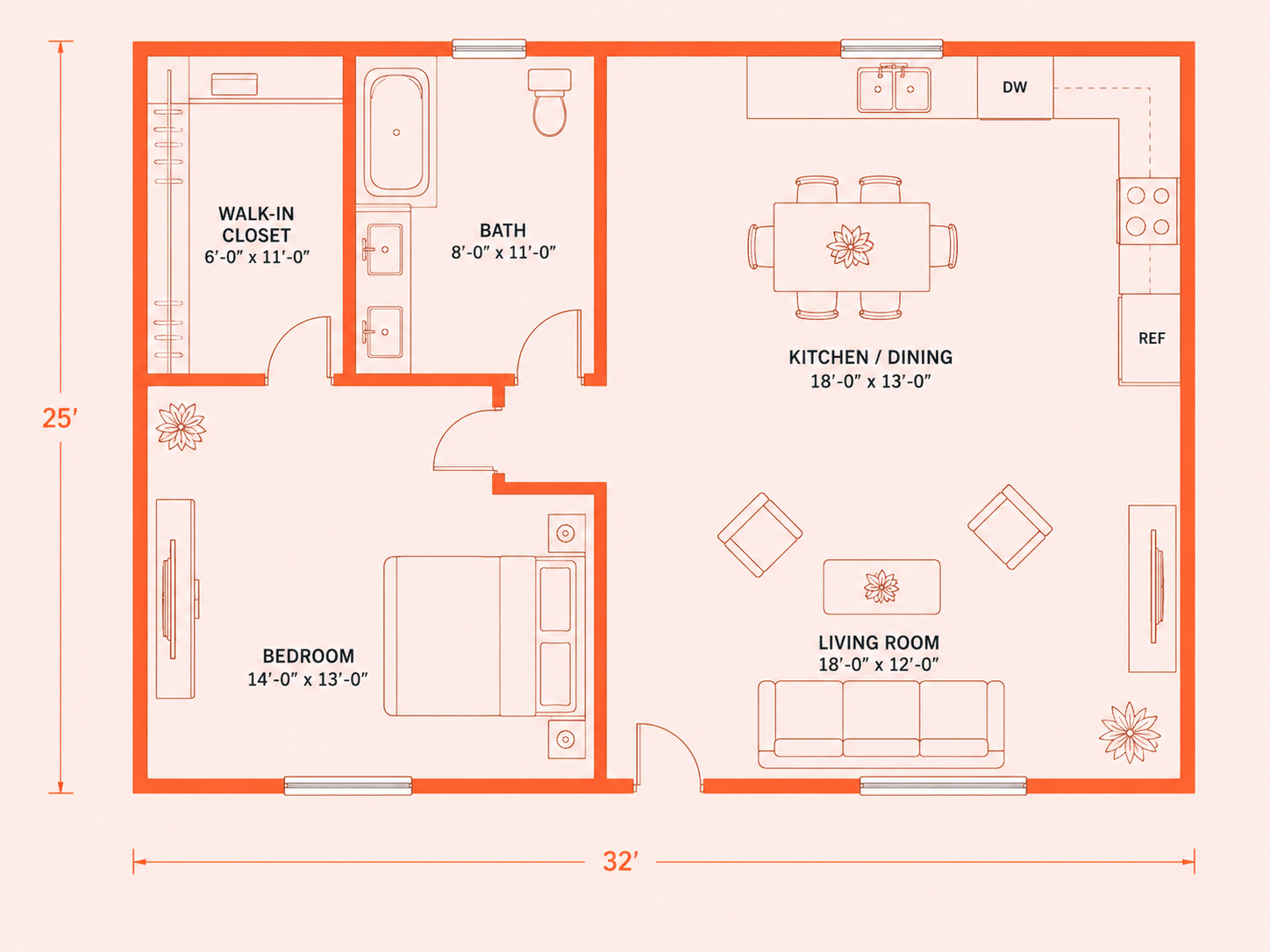
This one suits anyone who needs a real desk behind a door they can close. It carves out a 12 by 10 foot office without crowding the rest, partly because it keeps the bathroom small and central. A compact 5 by 8 foot bath sits right by the kitchen wall, which keeps the plumbing runs short. The kitchen, dining, and living stay open across the other half of the unit.
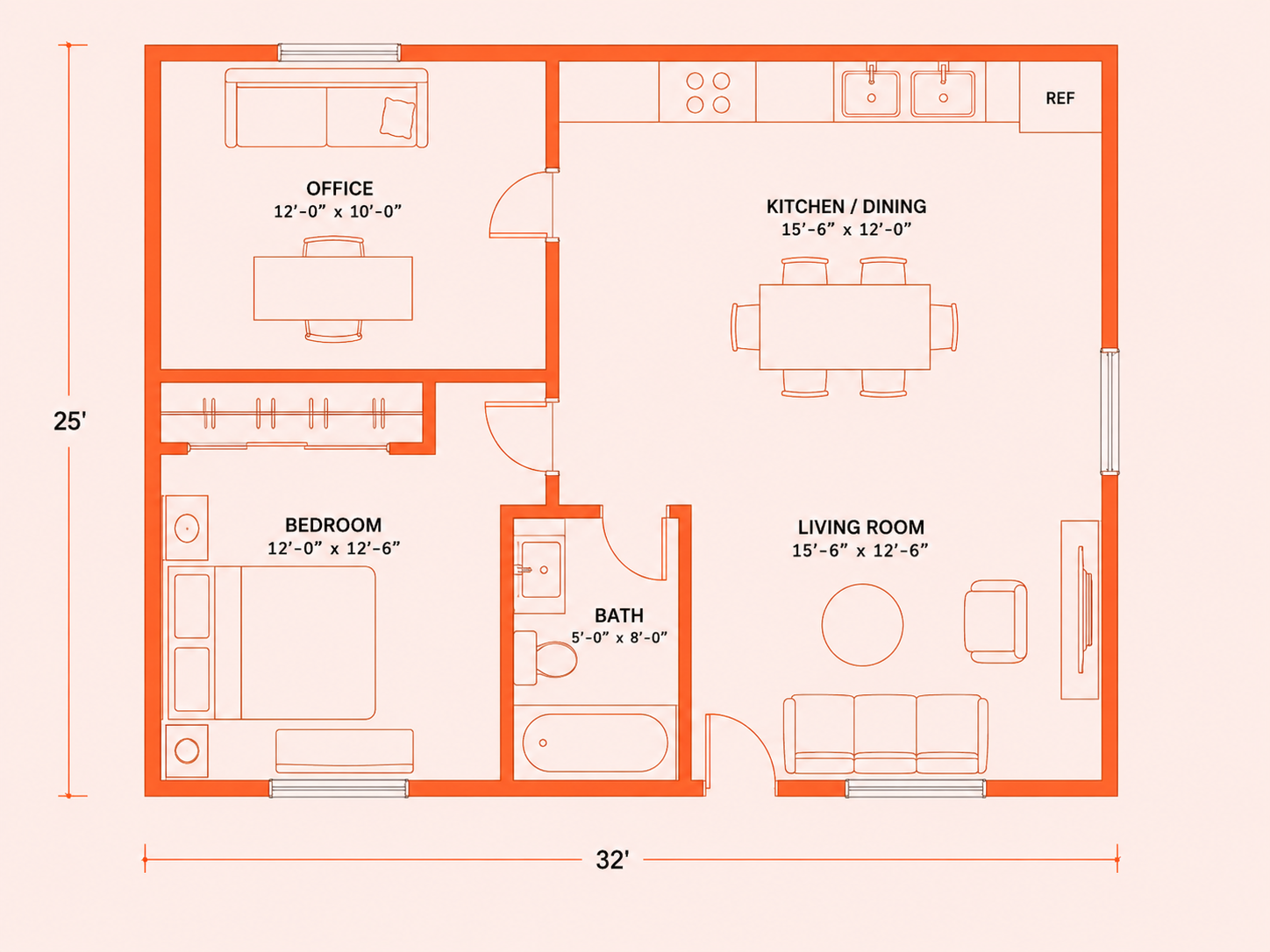
Here the second-bedroom space goes to a 6 by 11 foot walk-in closet and an 8 by 11 foot bathroom with a double vanity, alongside a generous 14 by 13 foot bedroom. For a couple or a single person who values storage and an easy morning routine over a spare room, this is the trade that pays off daily.
The closet and bath sit together on one side, leaving a large open kitchen and living area on the other. That grouping keeps the bathroom plumbing close to the kitchen wall, so even an upgraded bath with a double vanity stays affordable to build.
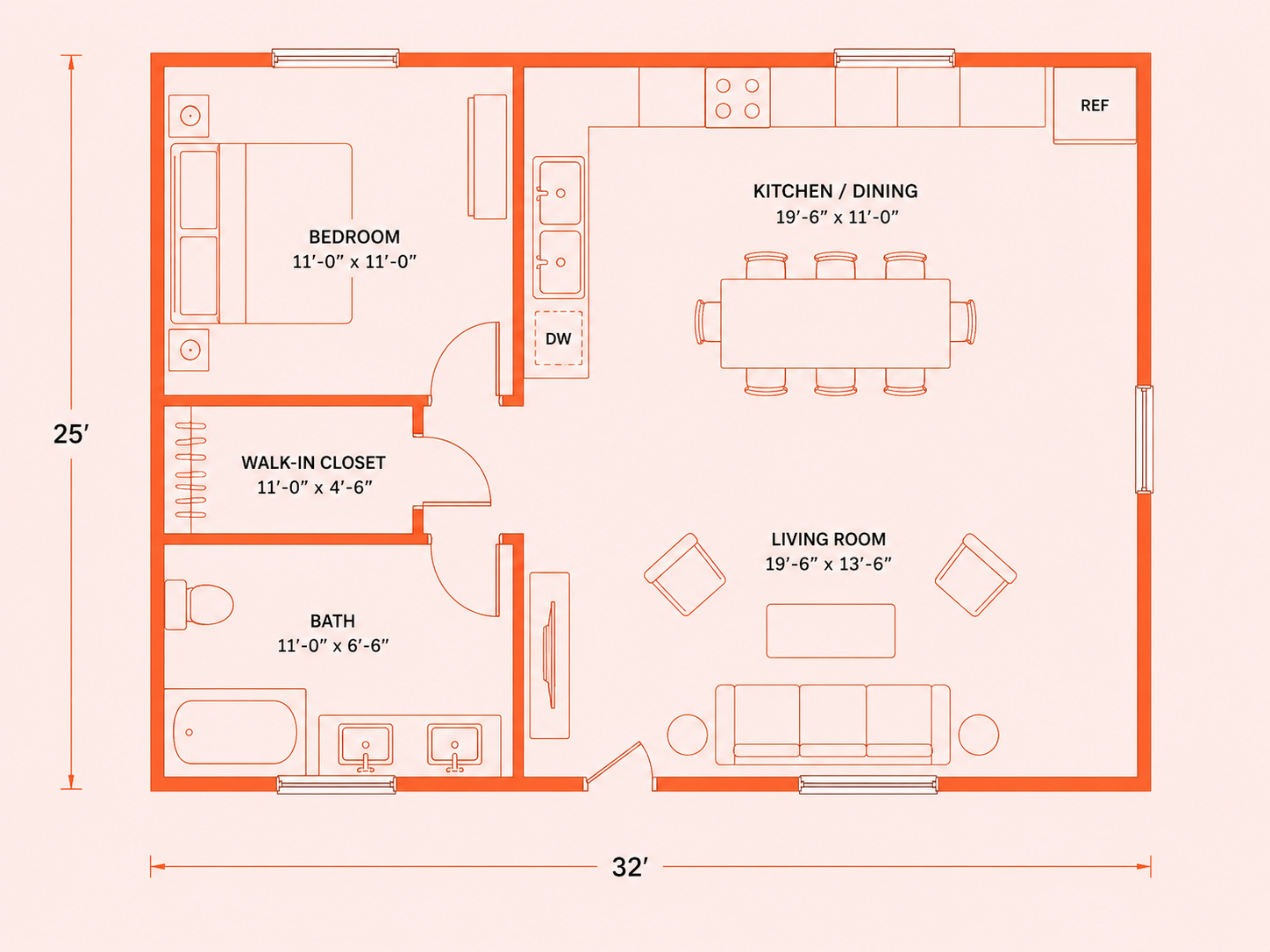
This layout gives the most floor area to the shared space, with a kitchen, dining, and living room that run nearly the full width of the unit. The bedroom is a tidy 11 by 11 feet, with a walk-in closet and full bath stacked beside it. The dining table here is drawn for eight, which is the catch worth watching: at this size a four-seater keeps the room from feeling crowded, with chairs to add on the nights you host.
Floor plans, including the ones above, tend to draw furniture large to fill the page, so a layout that looks roomy on screen can feel tight once real pieces move in. Measure the bed, the sofa, and the table you actually own before you trust a plan's open feel, and right-size anything built for a bigger home.
Beyond comfort, a room has to clear the building code's minimums to count as a bedroom at all. The International Residential Code requires a habitable room to be at least 70 square feet and at least 7 feet in any horizontal direction, with a ceiling at least 7 feet high. A space that dips below those limits won't pass inspection as a bedroom, which matters the moment you think about splitting a room or turning an office into a place to sleep.
Put the two together and you can size a room before you commit to a wall, checking that a bed fits with clearance and the floor still clears the 70 square foot minimum.
Turn your renovation vision into reality
Get matched with trusted contractors and start your renovation today!
Find a Contractor
Build the plan around these:
Leave these out unless you have a specific reason:
On paper an 800 square foot apartment is 800 square feet. In practice, wall thickness, structural columns, and mechanical chases trim the usable area, so the rooms run a little smaller than the labeled dimensions suggest. Knowing that before you fall for a plan saves disappointment later.
Some things usually stay put without major cost or approvals:
Other changes are reasonable to make:
Telling which walls carry weight and where the stacks run takes a trained eye, not a tape measure. A contractor who reads the plan before you commit can flag the changes that aren't possible as drawn, while they're still erasable lines instead of a redesign you've paid for.
Even the strongest layout depends on the contractor who builds it, which is where matching with the right pro pays off. Block connects you with vetted local contractors who compete for your project, so the quotes you receive are tied to a scope that experts have reviewed for missing line items and red flags before work starts. You can compare references, past projects, and costs side by side, and payments release in stages as the work gets done, so your contractor has every reason to stay on schedule.
Remodel with confidence through Block

Connect to vetted local contractors
We only work with top-tier, thoroughly vetted contractors

Get expert guidance
Our project planners offer expert advice, scope review, and ongoing support as needed

Enjoy peace of mind throughout your renovation
Secure payment system puts you in control and protects your remodel


Renovate confidently with Block
Easily compare quotes from top quality contractors, and get peace of mind with warranty & price protections.
Apartment and Condos
How Much Does It Cost to Renovate a 1000 Sq Ft Condo?
08.28.2026
Apartment and Condos
Condo Renovation Contractor, Costs & Design
06.26.2026
Apartment and Condos
Apartment Soundproofing: How to Reduce Noise at Home
06.25.2026
Apartment and Condos
800 Square Foot Floor Plans: How to Lay Out a Small Apartment
06.17.2026
Apartment and Condos
Studio Apartment Floor Plans to Maximize Functionality
05.28.2026