



Laundry Room
Bathroom Laundry Room Floor Plans: Narrow & Square | Block
07.12.2026
06.25.2026


In This Article
If your washer and dryer are stuck in a basement corner or a hall closet you squeeze past every time you do a load, the bathroom you already have is probably the cheapest square footage you'll find for them. Both run on the same plumbing: hot and cold supply, a drain, and a floor built to get wet. That overlap is why putting laundry in a bathroom usually costs far less than building a dedicated laundry room, which needs its own plumbing run from scratch. The catch is that a bathroom is a small, humid box, and adding a washer and dryer raises real questions about moisture, venting, and where it all physically fits.
This covers a few situations: adding machines to a full bath you already use, converting a powder room, and building a combined space into an addition. Condo and apartment owners face stricter rules on relocating plumbing, so check your building's requirements before you plan around them.
Both rooms run on the same infrastructure. A bathroom already has hot and cold supply, a drain, and a waterproofed floor, which are the exact things a washer needs to operate. Tapping into lines that are already in the wall is what keeps the cost down, because the expensive part of any laundry project is getting water and power to the spot, not the spot itself.
Space is the other half of it. Plenty of homes never had a good place for laundry, and the basement or garage you've been walking to is the result of that gap, not a real preference. The combo makes the most sense in a few specific situations:
Two years ago, Ohio homeowner Judy Anderson remodeled her laundry room into an extra bathroom with a designated closet for her washer and dryer. "The moment my husband suggested converting the space, it just clicked. We don't need a full room simply to wash clothes. The overall renovation went smoothly, but the biggest surprise was the extra plumbing needed to accommodate the toilet and shower. Waterproofing was another need we didn't anticipate. But it was all worth it."
How the machines fit comes down to how much wall and floor you can give them. Four arrangements cover most setups, from a closet-sized nook to a room built around the idea from the start.
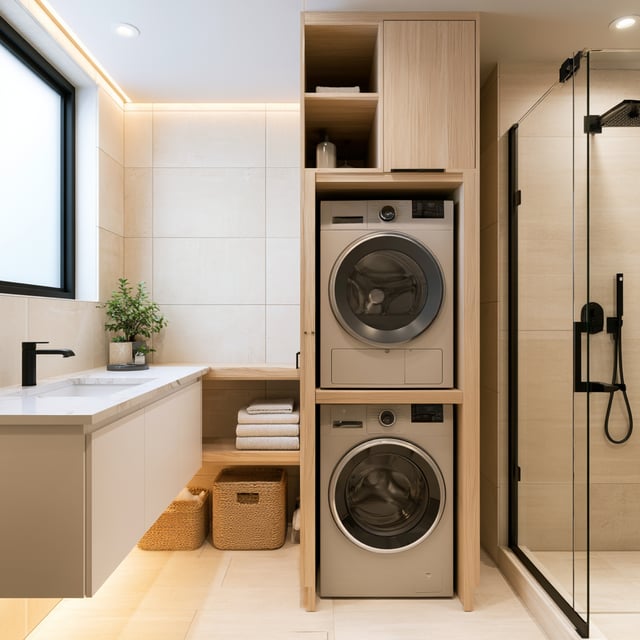
This is the most space-efficient option, and it fits the tightest bathrooms. A stacked electric unit measures about 27 to 30 inches wide and stands roughly 6 feet tall, so it slots into a former linen closet or a recess behind a bifold door. You give up some vertical storage, but you keep nearly all of your floor.
Side-by-side machines need around 60 inches of wall to sit comfortably, which makes them a fit for larger bathrooms and primary suites rather than powder rooms. Run a counter across the top and you get a folding station and extra storage too.
This layout also keeps both machines at waist height, which matters more than people expect when they load and unload several times a week. The cost is floor space, so measure your clearances before you commit.
Concealing the units behind a door or cabinetry keeps the room reading as a bathroom and muffles the noise of a spin cycle. Bifold or pocket doors work well because they don't swing into a tight room. Build in louvered panels or leave a gap at the top and bottom so air can still move through the enclosure.
For combined spaces being built from scratch, a wet room treats the whole floor as a waterproofed, drainable zone with a single central or linear drain. The shower, the washer, and the floor all share that waterproofing, which simplifies the build and handles splashes and overflow that would otherwise pool on a flat floor.
It's the most involved option up front, because the entire floor has to be tanked and sloped correctly. That makes it a better match for a new addition or a full gut than for a quick retrofit.
|
Configuration |
Minimum width |
Best for |
|
Stacked unit |
27 to 30 inches |
Tight full baths, closets |
|
Side-by-side |
About 60 inches |
Primary suites, large baths |
|
Concealed closet |
30 to 36 inches |
Keeping the room bathroom-first |
|
Wet room |
Varies by build |
New additions, full guts |
A washer can't share the sink's drain. It dumps a large volume of water in a hurry, so it needs its own connection, usually a standpipe: a vertical pipe with its own trap that the washer hose empties into. Code sets the dimensions. The standpipe has to rise 18 to 42 inches above the trap weir, and the trap itself sits 6 to 18 inches off the floor, which is why a recessed laundry box has to land at the right height when the wall is open. Supply is simpler but still dedicated: hot and cold valves at the machine, not a tee off the faucet.
There's a question to settle before any of that. Can the existing drain line carry the added flow? A line built for a sink and a tub may not keep up with a washer emptying at full speed, and an old or undersized one can back up. This is rough-in work, the behind-the-wall plumbing and wiring done before the finishes go on, and a contractor should look at it early. Fixing an undersized line after the wall is closed is exactly the kind of cost nobody plans for.
Renovate with confidence every step of the way
Step 1: Personalize Your Renovation Plan
Step 2: Receive Quotes from Trusted Contractors
Step 3: Let Us Handle the Project Details

Homeowners plan the unit placement to the inch and barely think about exhaust. Placement matters less than airflow here. A combined room can have the machines in exactly the right spot and still end up with mildew if the air can't carry the moisture out.
Three things add moisture at once:
Two systems clear it:
When that run is hard, say through a masonry wall or in an interior bathroom with no outside wall close by, a heat-pump or ventless dryer skips the duct entirely. These models condense the moisture internally, which is why code exempts them from the venting rules. Their cycles run longer than a vented dryer, but for a combined space with no clean vent path, that's usually the better call.
An electric dryer won't run on a regular outlet. It needs its own 30-amp, 240-volt circuit, the same class as a kitchen range, which usually means pulling new wire back to the panel. A gas dryer skips the heavy circuit. In its place you need a gas line to the machine and a standard 120-volt outlet for the controls.
The bathroom setting adds a wrinkle a laundry room doesn't. Recent code, the 2020 and 2023 NEC, now requires GFCI protection on laundry-area receptacles, the 240-volt dryer outlet included, and inspectors flag it often because the rule didn't exist a few years ago. The washer wants its own dedicated 20-amp circuit as well. One quirk to know going in: some front-load washers nuisance-trip a plain GFCI because of their electronic door locks, and a dual-function breaker usually settles it. And if your panel is already full, a new 240-volt circuit can mean a subpanel or a service upgrade, which costs far more than the outlet most people budgeted for.
Combining laundry and a bathroom touches enough systems that it almost always requires permits: plumbing for the new drain and supply, electrical for the circuit, and sometimes mechanical for the venting. Codes vary by city and county, and the inspection that comes with a permit is what protects you at resale, when an unpermitted bathroom or hookup can derail a sale or knock down your price.
Your local building department is the authority on what your project needs. A licensed contractor usually pulls the permits as part of the job, which is one more reason the work is hard to do piecemeal.
Most people price the washer and dryer, brace for that number, and then get caught by everything behind the wall. The machines are the predictable part. The plumbing tie-in, the 240-volt circuit, and the exterior vent run are where the real money goes and where most of the surprises turn up, so the price of the units tells you almost nothing about the price of the project.
As a representative picture, here is where the dollars tend to fall. Adding a washer and dryer to a full bath that already has the plumbing and a nearby circuit runs roughly $2,000 to $6,000 for the behind-the-wall work, before appliances. Push the plumbing a long distance, cut a vent through masonry, or upgrade an over-full electrical panel, and that climbs to $6,000 to $12,000 or more. A full conversion or a combined space built into an addition, with finishes, commonly comes in between $10,000 and $25,000.
Appliances sit on top of that. A stacked electric pair usually costs $1,000 to $2,500. A heat-pump or ventless unit, the kind that solves a hard venting problem, runs higher, about $1,500 to $3,500.
Whatever range you land in, set aside 10 to 20% of the total as a contingency. Opening a wall in an older home often turns up hidden plumbing, outdated wiring, or rot that has to be addressed before the new work goes in. On a $12,000 project, that's $1,200 to $2,400 held in reserve.
With the mechanical decisions made, the finishes are what keep the room from feeling like a utility closet with a toilet in it.
A combined laundry and bathroom pulls plumbing, electrical, and venting into one project, so the contractor doing the work matters more than the finishes you pick. Block matches you with vetted local contractors who have done this kind of job, runs an expert scope review to catch missing line items before they turn into change orders (the mid-project cost additions that catch homeowners off guard), and holds your payments until each stage is finished. You get peace of mind throughout a renovation that involves plumbing, power, and venting all at once.
Remodel with confidence through Block

Connect to vetted local contractors
We only work with top-tier, thoroughly vetted contractors

Get expert guidance
Our project planners offer expert advice, scope review, and ongoing support as needed
Enjoy peace of mind throughout your renovation
Secure payment system puts you in control and protects your remodel

Renovate confidently with Block
Easily compare quotes from top quality contractors, and get peace of mind with warranty & price protections.
Laundry Room
Bathroom Laundry Room Floor Plans: Narrow & Square | Block
07.12.2026
Laundry Room
Mudroom Laundry Room Ideas and Layouts | Block Renovation
07.10.2026
Cost
Laundry Room Addition & Remodel Costs (2026 Guide)
07.06.2026
Laundry Room
Laundry in a Bathroom: Smart Design Decisions
06.25.2026

Laundry Room
Laundry Room Sizing Guide - Minimums, Averages & More
04.23.2026