




Before and After
Kitchen Island Remodel: Before and After Inspo
06.26.2026
06.16.2026


In This Article
If every kitchen photo you save looks vaguely like the last one, modern farmhouse is probably why. The style became a default because it solves a real problem: it makes a kitchen feel warm and lived-in without giving up clean lines or modern function. That popularity created a second problem: the most copied version (white shaker cabinets, black hardware, a barn door, a wooden sign that says "Gather") now signals a trend more than a point of view.
The style blends two vocabularies that pull in opposite directions. The tension between them is the appeal. From the farmhouse side it takes natural wood, apron-front sinks, and visible craft; from the modern side, simple cabinet fronts, uncluttered counters, and restrained palettes.
Hold the rustic gestures to one or two strong doses against a calm, current backdrop and the room sits squarely in the style, while tipping further rustic slides the kitchen toward country kitsch.
The imagery below explores that balancing act: each before and after pairing is rendered inspiration, a dated kitchen reimagined to show a different way of getting the ratio right.
The traps show up in the same places: sliding barn doors, distressed finishes, word art above the range, open shelves styled with objects nobody cooks with. The sameness comes from buying the style as a kit. A kit looks the same in every house it lands in.
The versions that hold up start from the qualities worth borrowing in the first place:
Each pairing below applies that list to a different starting point. The results barely resemble each other.
Renovate with confidence every step of the way
Step 1: Personalize Your Renovation Plan
Step 2: Receive Quotes from Trusted Contractors
Step 3: Let Us Handle the Project Details
.png?width=1672&height=941&name=1%20%E2%80%94%20Bright%20Scandinavian%20Modern%20Farmhouse%20Kitchen%20(1).png)
A renovation that strips out everything original tends to produce a kitchen that could be anywhere. Keeping a single feature with real age, like exposed ceiling beams, gives the new finishes something to push against. It also spares you from buying character back later in the form of decor.
The same beams appear in both frames above. Only one room benefits from them. The before surrounds them with honey oak cabinetry and beige tile, so they register as one wood tone among many. The after drops the cabinetry to white and light oak, paints the island putty gray, and lightens the floor to blonde. With no other wood tone competing, the beams become the richest thing in the room.
The same logic applies to brick chimneys, original wide-plank floors, and deep window casings. Paint and cabinetry are easy to keep quiet, so the feature with history is the one worth designing around.
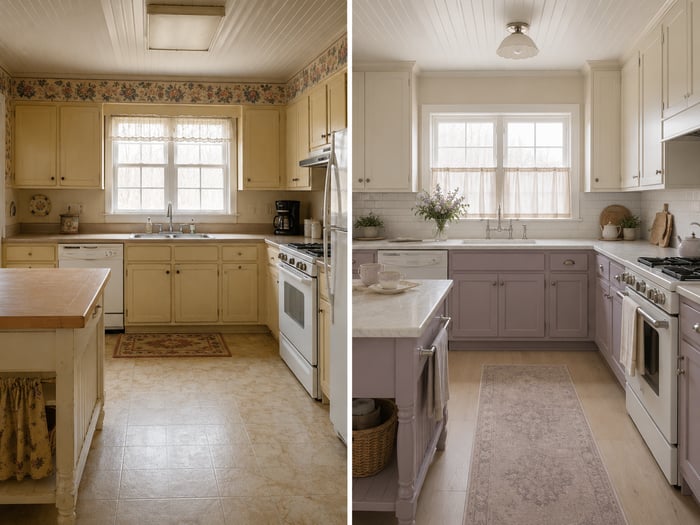
Color belongs in farmhouse kitchens more than the white-on-white version suggests, but it follows two rules here. The shade has to be desaturated, grayed down until it looks like it could have been mixed on site decades ago. And it works best in partial doses, carried by the lower cabinets and the island while cream or white keeps the upper half of the room light.
In the imagery above, dusty lavender lower cabinets contrast with the cream uppers. A marble-topped lavender island repeats the color. If the lavender were any richer or any more present, it'd overwhelm the kitchen. Grayed down and held to the lower third, it gives the room a personality the butter yellow it replaced never managed.
Sage, putty, mushroom, and grayed blue follow the same rules. If you're choosing between paint chips, the grayer one is usually the right call.
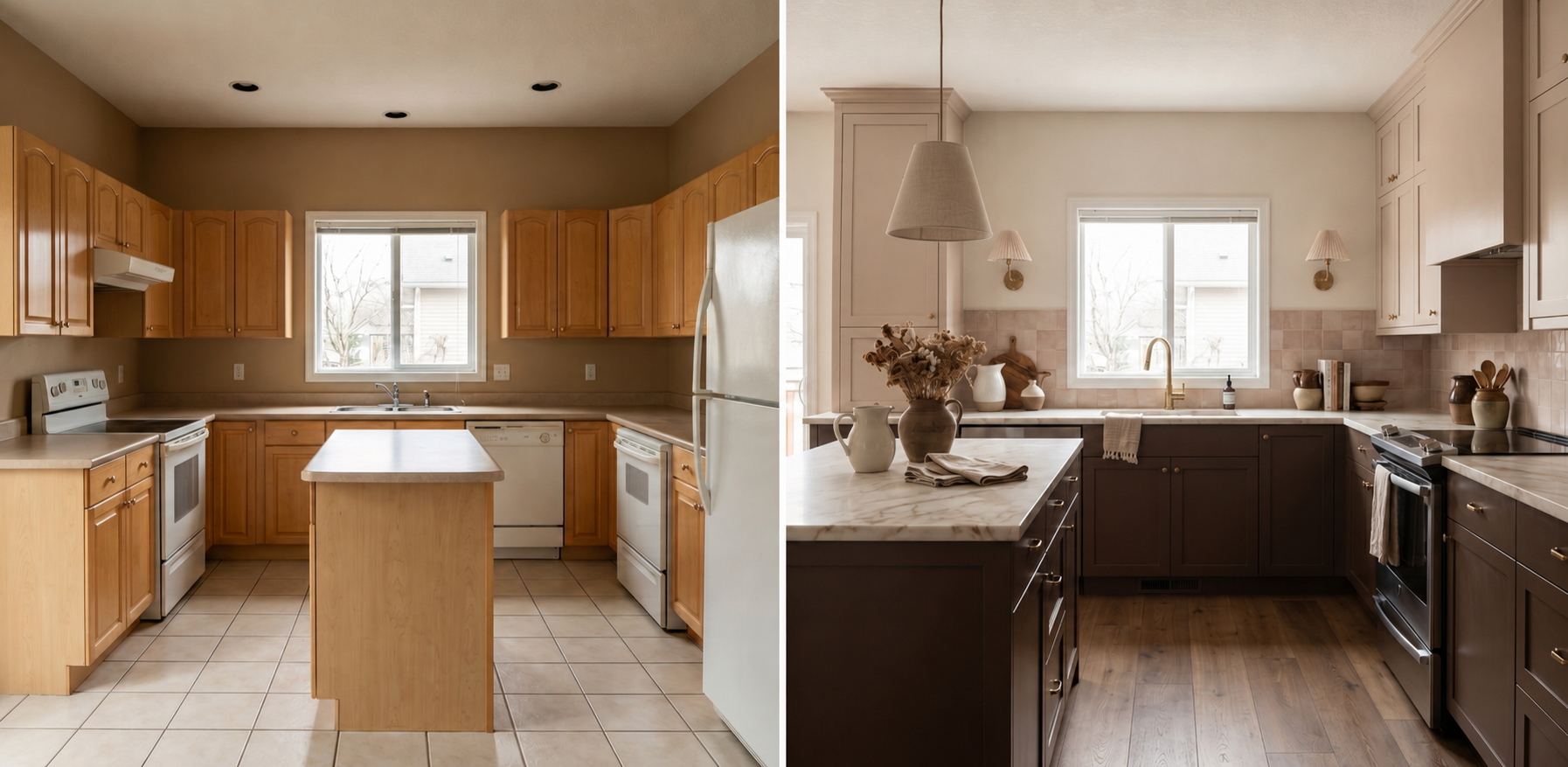
Pale kitchens can drift toward weightlessness, where every surface floats in the same value range. A darker run of lower cabinets anchors the room without making it heavy. As a bonus, it hides scuffs at the height where a kitchen takes its daily abuse.
Above, cocoa-brown lowers and a tall pantry hold the bottom of the room while blush tile and cream uppers keep the top soft, with unlacquered brass bridging the two. The anchoring is tonal rather than high-contrast: the cocoa sits close enough in warmth to the blush that the eye moves between them instead of stopping. The builder-tan before has nothing doing that grounding work.
The same idea can go much harder when the architecture supports it.
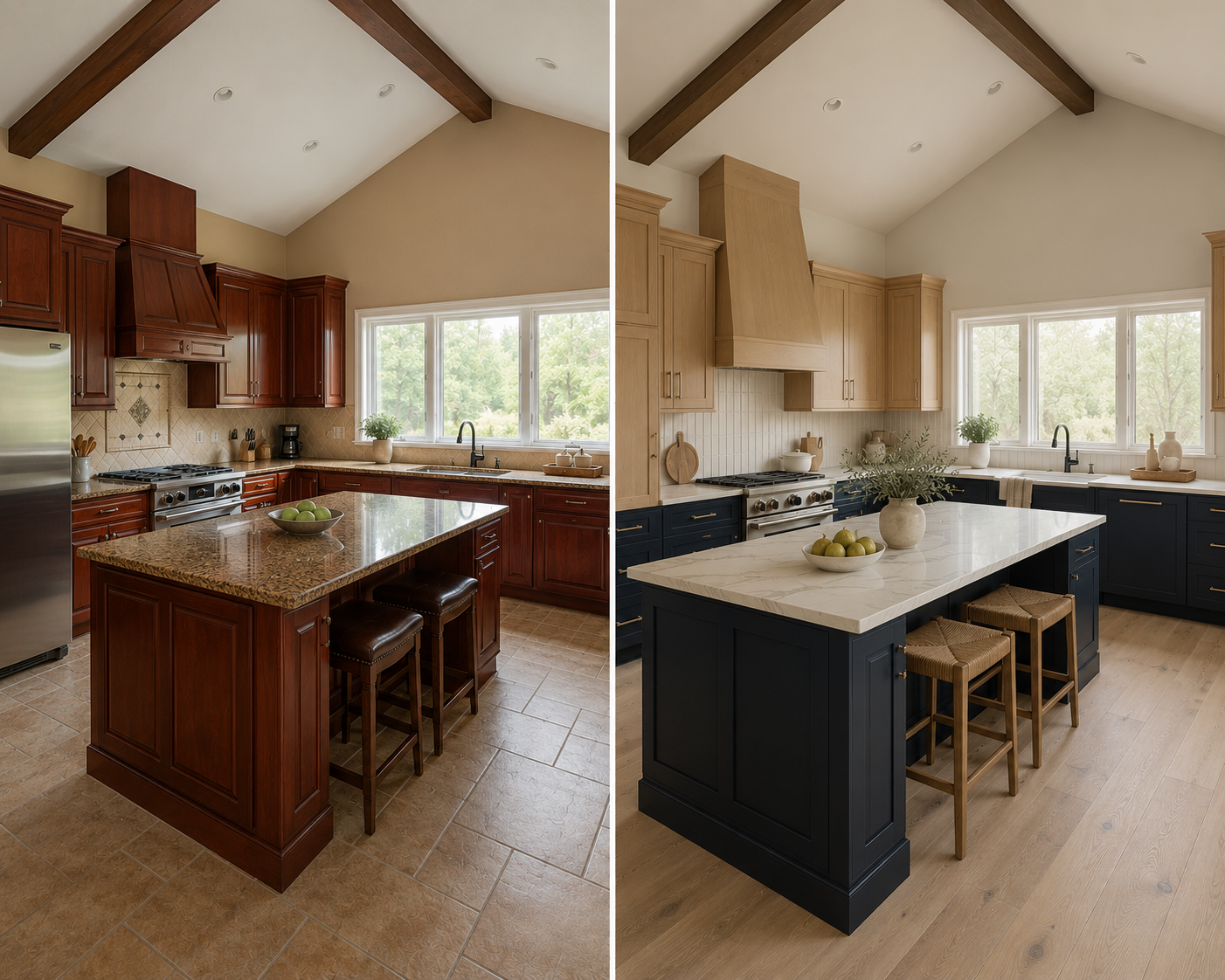
Vaulted ceilings, exposed beams, and oversized windows supply enough built-in warmth that the cabinetry can turn darker and cleaner than a flat-ceilinged kitchen could handle. Here, navy lowers and a navy island take the palette about as dark as farmhouse comfortably goes. The room absorbs it because everything overhead stays light. Pale oak uppers and a full-height oak hood carry the upper run, and white walls catch the daylight from the window wall. Swap the oak uppers for more navy and the same cabinets would close the room in; the vaulted ceiling is what buys the depth.
Deep green and charcoal behave the same way. All three pair best with pale oak and light floors rather than more dark wood.
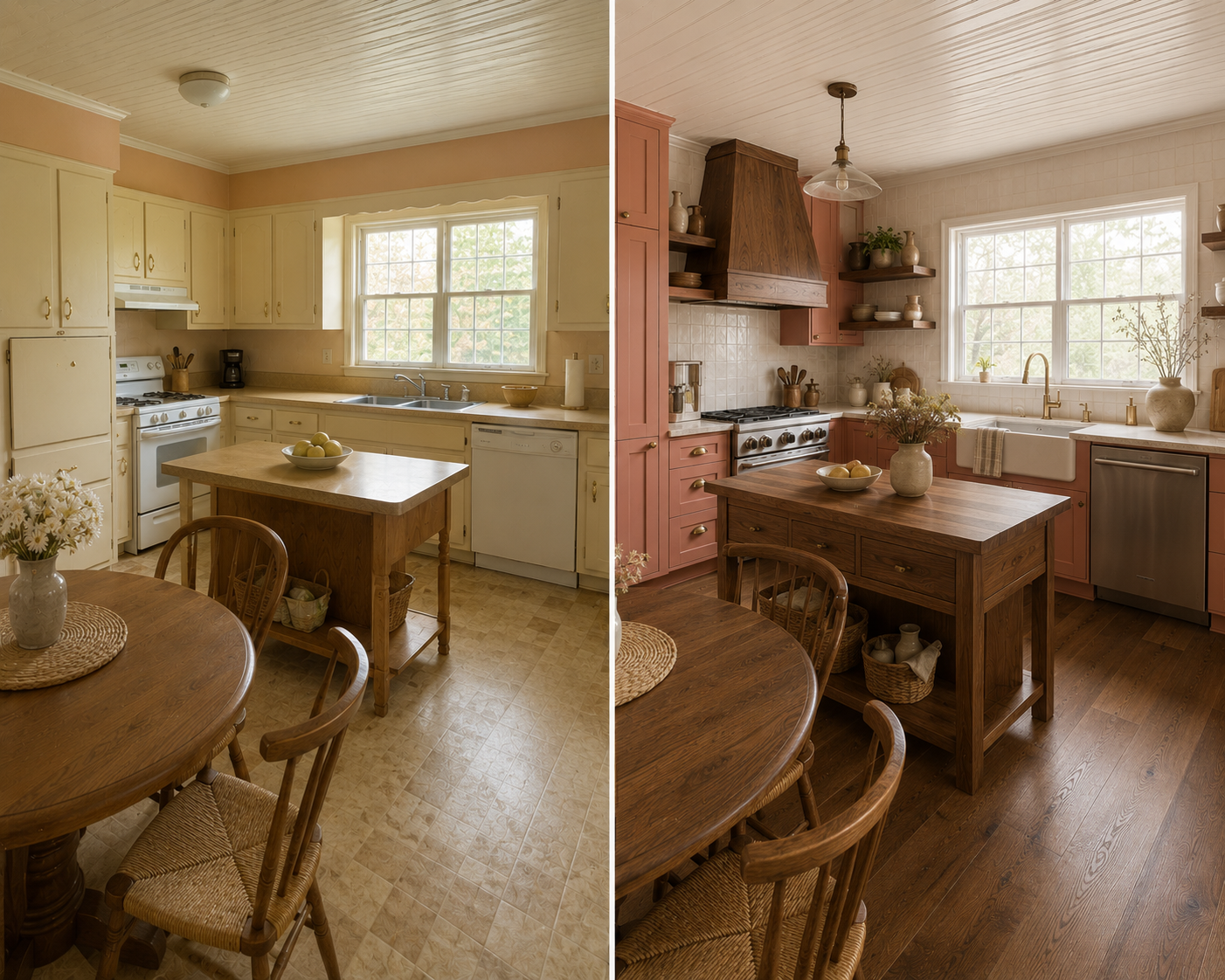
Not every kitchen should chase the big-island, open-concept version of this style. In a compact or older room, the renovation that works usually leans into the cottage scale, because the alternative is a small room dressed up as a large one and falling short of both.
The beadboard ceiling, round oak table, and furniture-style island all survive in the pairing above. The update comes through color and weight instead. Dusty coral cabinets pick up brass cup pulls, a walnut butcher block holds the center, and open shelving flanks a stained-wood hood. Each choice fits the café scale; a slab island and a grid of recessed cans would make the same square footage feel like a consolation prize.
Furniture-style islands, freestanding hutches, and visible hinges tend to come from salvage and antique sources rather than cabinet catalogs, so kitchens built around them rarely look mass-produced.
At the other end of the scale, some kitchens have nothing wrong with their layout: the island sits where it should, the window lines up over the sink, and the room still feels twenty years old. Finishes date faster than floor plans.
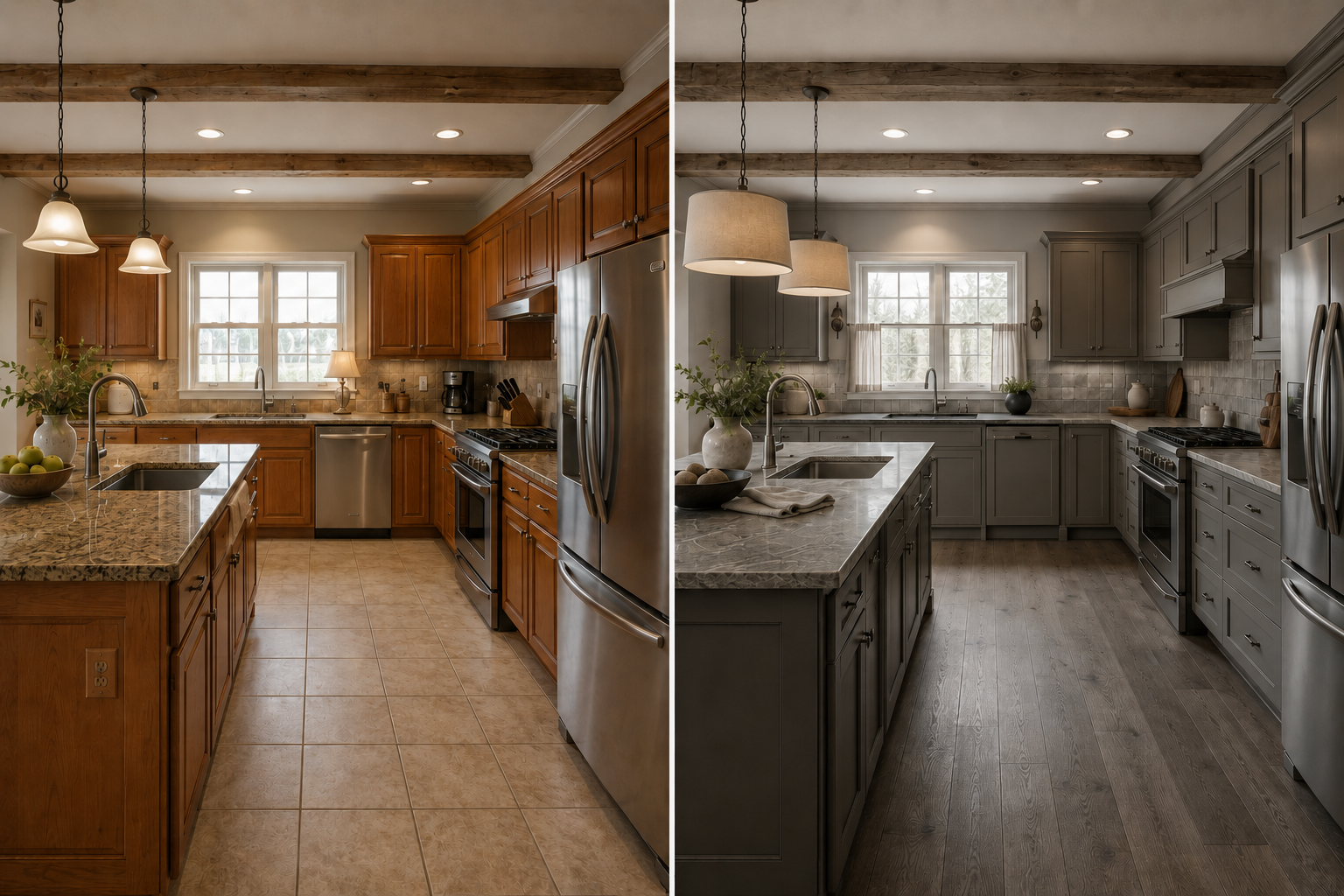
In the pairing above, the rustic beams, window placement, island location, and recessed lighting all stay put. The room still changes completely. Layered gray cabinetry replaces the orange-toned wood, gray-washed plank covers the beige tile, and the busy granite gives way to a quieter veined stone.
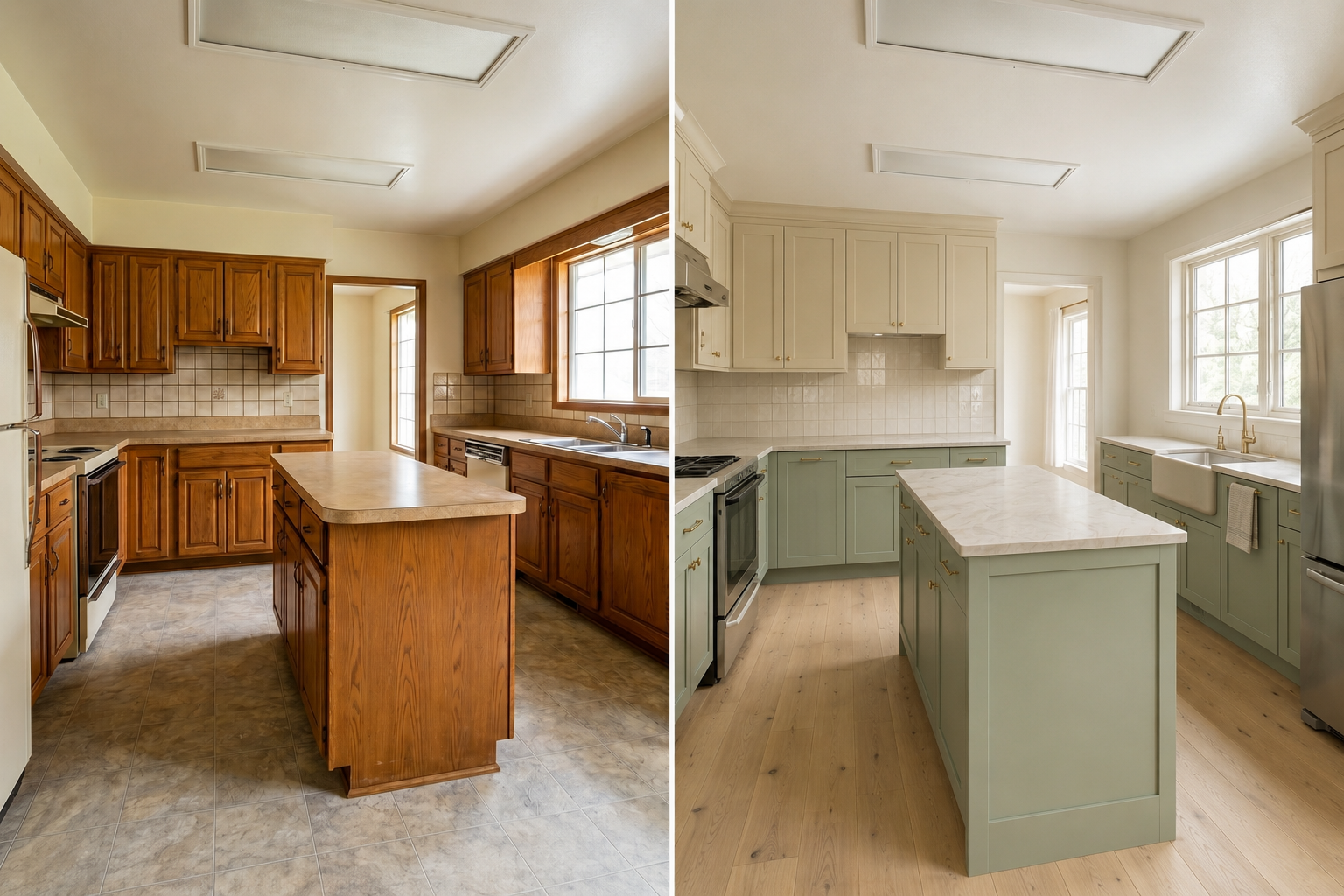
Strip the style down to its load-bearing parts and the list gets short: soft color, natural materials, clean cabinet fronts, warm metal. Everything past that list is optional, and most of what dates a farmhouse kitchen comes from the optional layer: the barn door, the artificially distressed island, the sign that names the room you're standing in.
The room above runs entirely on the short list: muted pistachio lowers under cream uppers, simple brass hardware, pale counters, and a white apron-front sink. There's no shiplap, no signage, and no faux-aged finish anywhere, and yet the room is still feels “farmhouse.” If you like this particular look, read our guide to two-tone cabinetry.
Choosing a palette is the easy half of a kitchen renovation. The harder half is finding a contractor who can refinish or replace cabinetry cleanly, run new flooring, vent a real hood, and protect a beadboard ceiling or original beams while everything beneath them changes. Block matches each project with vetted local contractors who bid competitively on the same expert-reviewed scope, so the quotes you compare describe the same work. Payments are released in stages as the project progresses. Block's team stays available from planning through the final walkthrough.
Remodel with confidence through Block

Connect to vetted local contractors
We only work with top-tier, thoroughly vetted contractors

Get expert guidance
Our project planners offer expert advice, scope review, and ongoing support as needed
Enjoy peace of mind throughout your renovation
Secure payment system puts you in control and protects your remodel

Renovate confidently with Block
Easily compare quotes from top quality contractors, and get peace of mind with warranty & price protections.
Before and After
Kitchen Island Remodel: Before and After Inspo
06.26.2026
Before and After
Modern Farmhouse Kitchen Renovations Before and After
06.16.2026
Before and After
Limewash Brick Before and After: Photos and What to Know
06.10.2026
Before and After
Budget Small Kitchen Remodel: Before and After Ideas
06.08.2026
Before and After
Mid-Century Modern Exterior Before and After Ideas
06.04.2026