




Stairs
Staircase Remodel Ideas to Enhance Your Home
07.05.2026
07.05.2026


In This Article
The best staircase ideas are not always the biggest ones. Paint can change the mood. A runner can add softness. A half-wall, storage door, or new railing can make the stairwell feel like part of the home’s architecture instead of a pass-through that never got enough attention.
Some of these updates are mostly cosmetic. Others belong in a contractor-led scope, especially when they involve railings, glass panels, built-in storage, or changes to the stair structure. Regardless, refreshing your stairs' aesthetic can help make your home's interior feel more intentional on the whole.
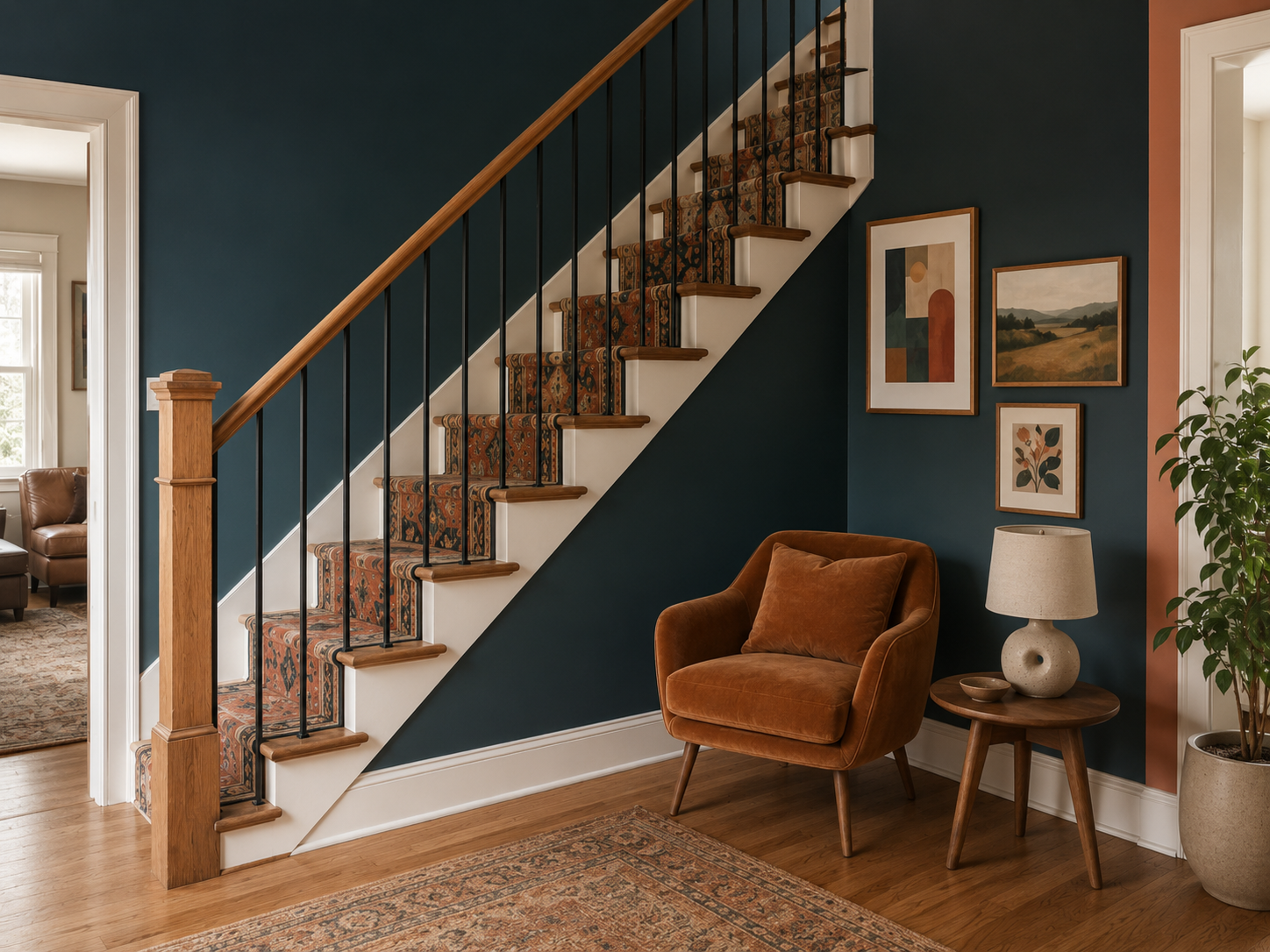
The black balusters set the tone here, and against the deep blue-green wall they make the whole stair run feel crisper. The wood rail and patterned runner keep that contrast from going cold. This works best on a staircase that already has good bones and just needs more contrast. Stairs are full of repeating lines, so when the balusters, runner, and handrail all show enough definition, the repetition starts to feel deliberate instead of busy. The chair and art nearby help too, since they tie the stairwell to the room rather than letting it sit on its own.
Budget around $3,000 to $8,000 for new black balusters, a runner, wall paint, and professional installation. A paint-and-runner version stays near the low end, while replacing railing parts, refinishing wood, or adding custom metalwork moves it up.
The detail that matters most here is safety. Baluster spacing, handrail height, and rail connections all have to meet code, so if the existing railing is coming out, have a contractor handle the rebuild rather than treating it as a finish swap.
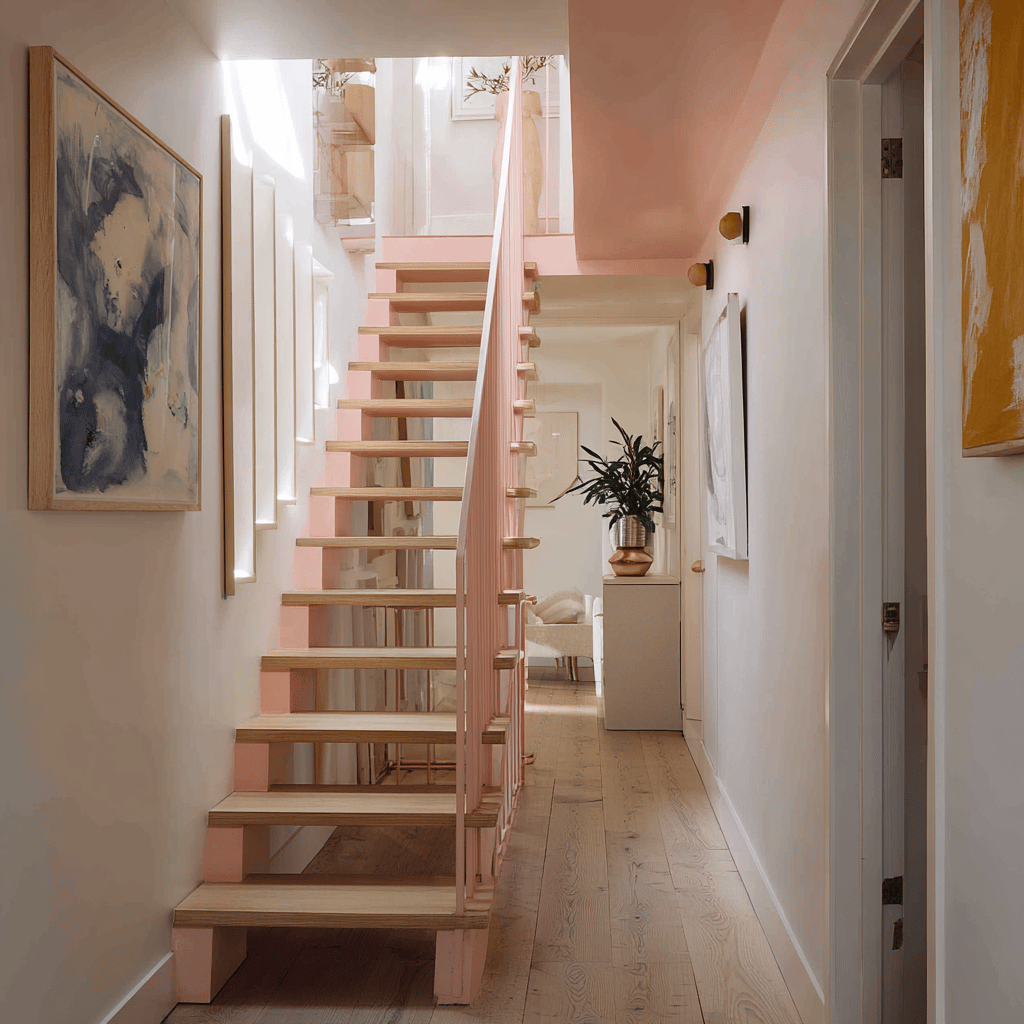
Color does not have to cover a whole stairwell to make a point. Here the pink sits on the structure itself and lets the treads stay warm and natural, so the result feels playful without taking over. It stays livable because the color is contained: a single painted element, whether a stringer, riser, or railing, can carry the entire space as long as the surrounding walls stay quiet.
A finish update like this usually runs $600 to $2,500 for prep, primer, and paint on the stair structure. That covers painting what is already there, not rebuilding a standard staircase into a floating one.
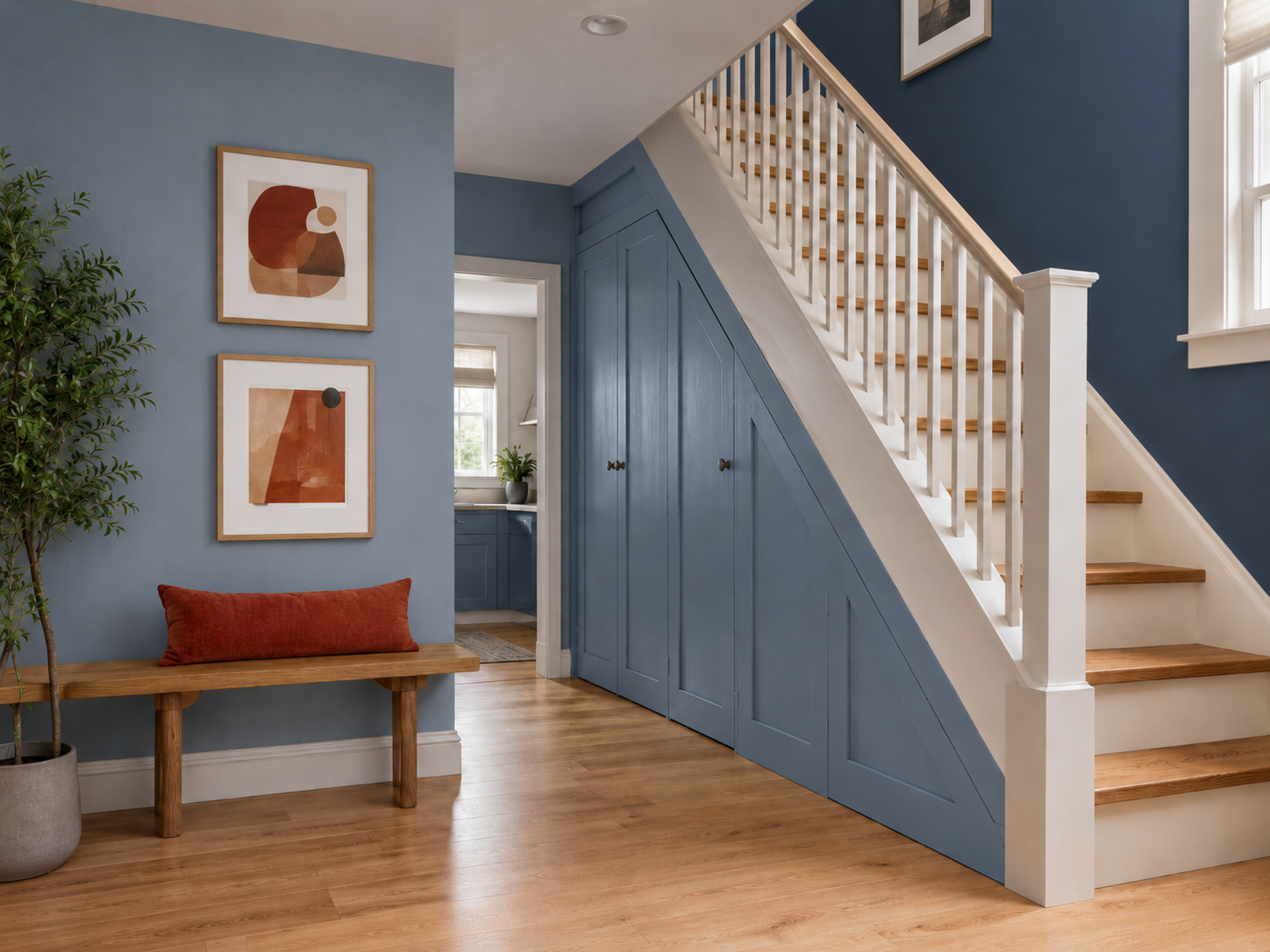
Open under-stair cubbies sound practical right up until they fill with shoes, bags, and things nobody meant to leave there. Paneled doors solve the same storage problem and keep the clutter out of sight. The dusty blue here helps: it lets the doors blend into the lower wall so they feel built in rather than tacked on, while the white railing and wood treads stay light above.
Most projects like this land between $2,000 and $8,000 for framed under-stair doors, simple cabinetry, hardware, and trim. Stock or semi-custom doors keep the cost down, while custom drawers, interior lighting, and detailed millwork push it higher.
Before you plan door sizes, find out what is behind that wall. The space under a staircase often contains wiring, plumbing, HVAC, or framing, so have a contractor open and inspect it first.
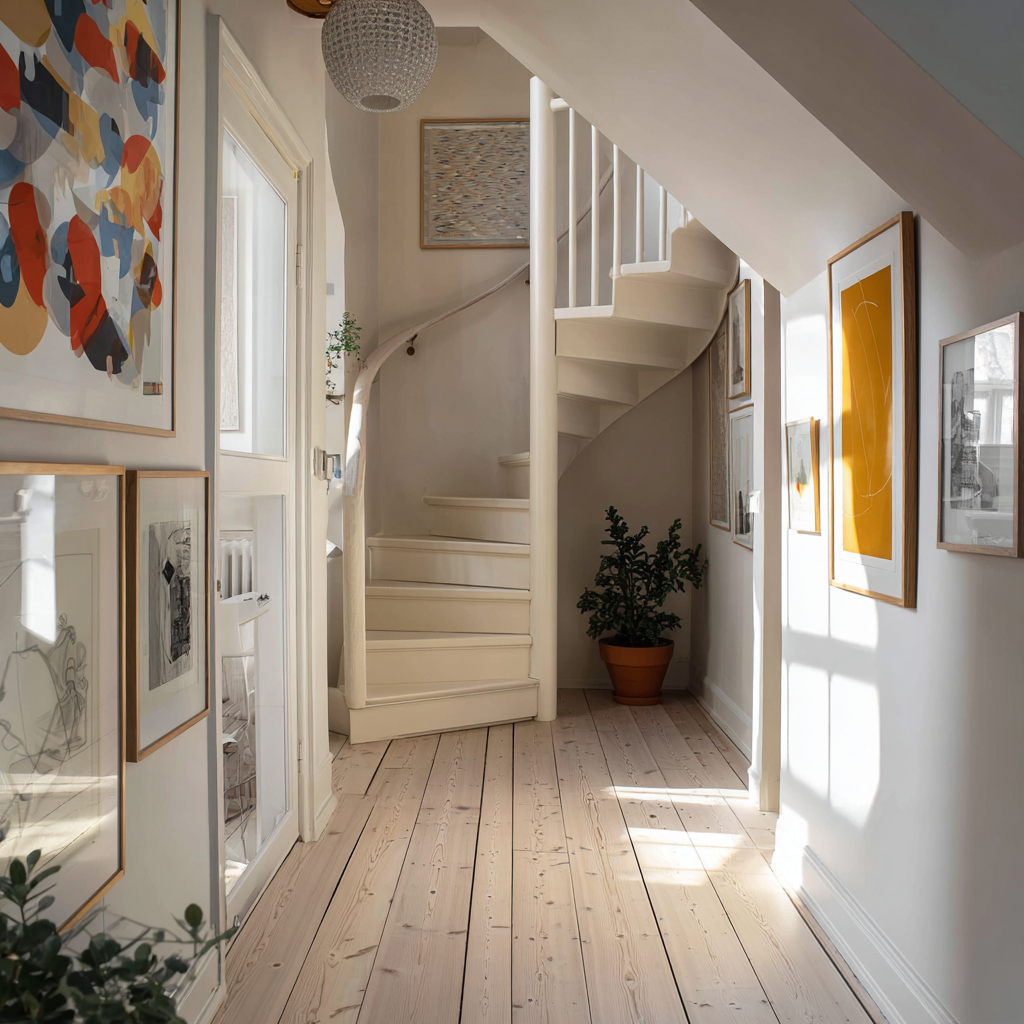
A compact, curved, or unusually shaped stair can dominate a small hallway. Painting it the same color as the surrounding walls softens that outline so the staircase stops competing with everything around it, and a monochrome stairwell tends to feel larger because the eye takes it in as one surface instead of catching on every rail and tread. With the structure quieted down, art, plants, and daylight have room to add warmth.
Plan on roughly $600 to $2,000 to paint the stair structure, walls, trim, and railing in one coordinated color, more if the stairs need heavy sanding or specialty paint for high-contact areas. White is the obvious choice, though warm ivory, soft mushroom, or a barely-there blue gives the same continuous effect with more personality.
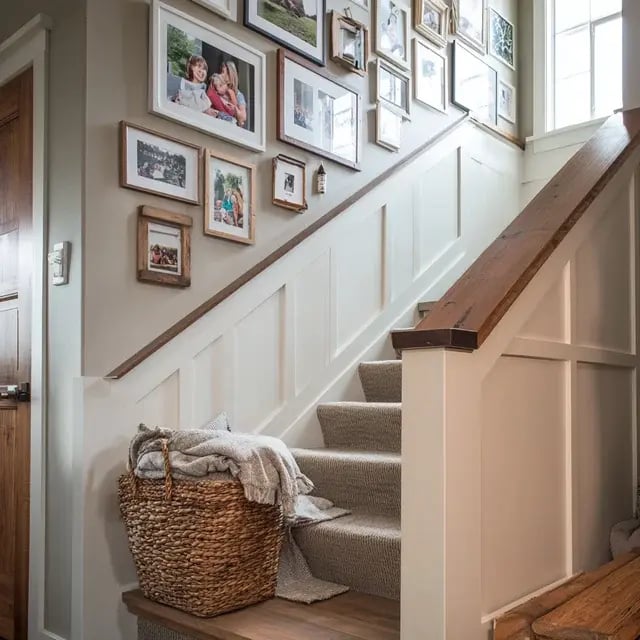
A half-wall gives the side of a staircase some weight, and adding molding makes it feel like it has always been part of the house. It is a good middle path in homes where a glass railing would feel too sharp and a row of standard spindles would feel too expected. The solid base grounds the stairs while the molding keeps the side from going flat, and it gives a gallery wall a real backdrop, so the frames sit on something solid instead of floating on a bare wall.
Expect a wide $2,500 to $7,500 for the half-wall, trim carpentry, molding, rail cap, paint, and finish work. Adding molding to a half-wall that already exists costs far less than building a new wall or reworking the stair opening.
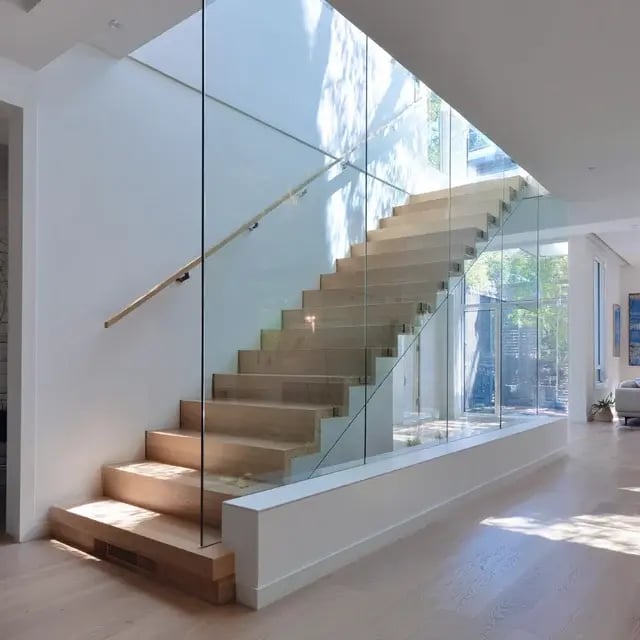
Glass railings make the most sense when the stairwell is already part of an open, modern space. In that setting a solid railing chops up the room, while glass keeps the sightline moving, so the staircase stays present without dividing everything visually around it. Done well, it leaves a lighter stairwell with more visible floor, wall, and daylight.
This is a bigger commitment than paint or a runner. The panels need precise measurements, the hardware has to fit the stair structure, and the finished run has to look clean from every angle, which is why interior glass railing projects often cost $6,000 to $18,000 depending on linear footage, glass thickness, mounting style, and the number of stair turns.
Glass is unforgiving. It still has to meet guardrail and handrail requirements, and it shows fingerprints, dust, and any installation flaw far more readily than wood or metal, so price it with a specialist rather than as a cosmetic swap.
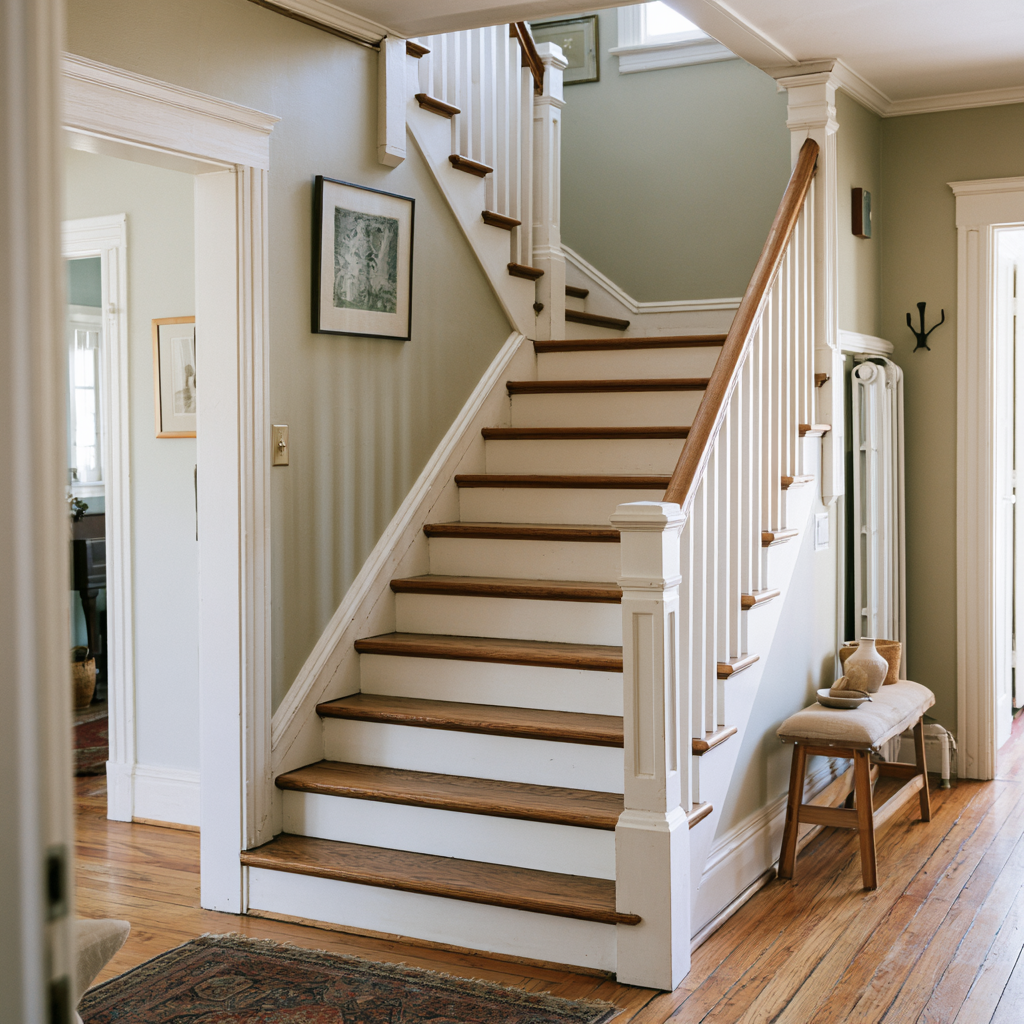
Sometimes the stairs are fine and it is the entry around them that feels tired. The fix is usually cosmetic: clean up the finishes, warm up the wood, and leave the familiar shape alone. A wood handrail, fresh white risers, a soft wall color, and a quiet rug nearby can make the whole area feel cared for without turning it into a design statement, which suits a home that already leans classic.
A refresh at this level runs about $1,000 to $4,500 for repainting risers and trim, refinishing the handrail or treads, and updating the decor nearby, rising if the treads need full sanding, staining, and sealing.
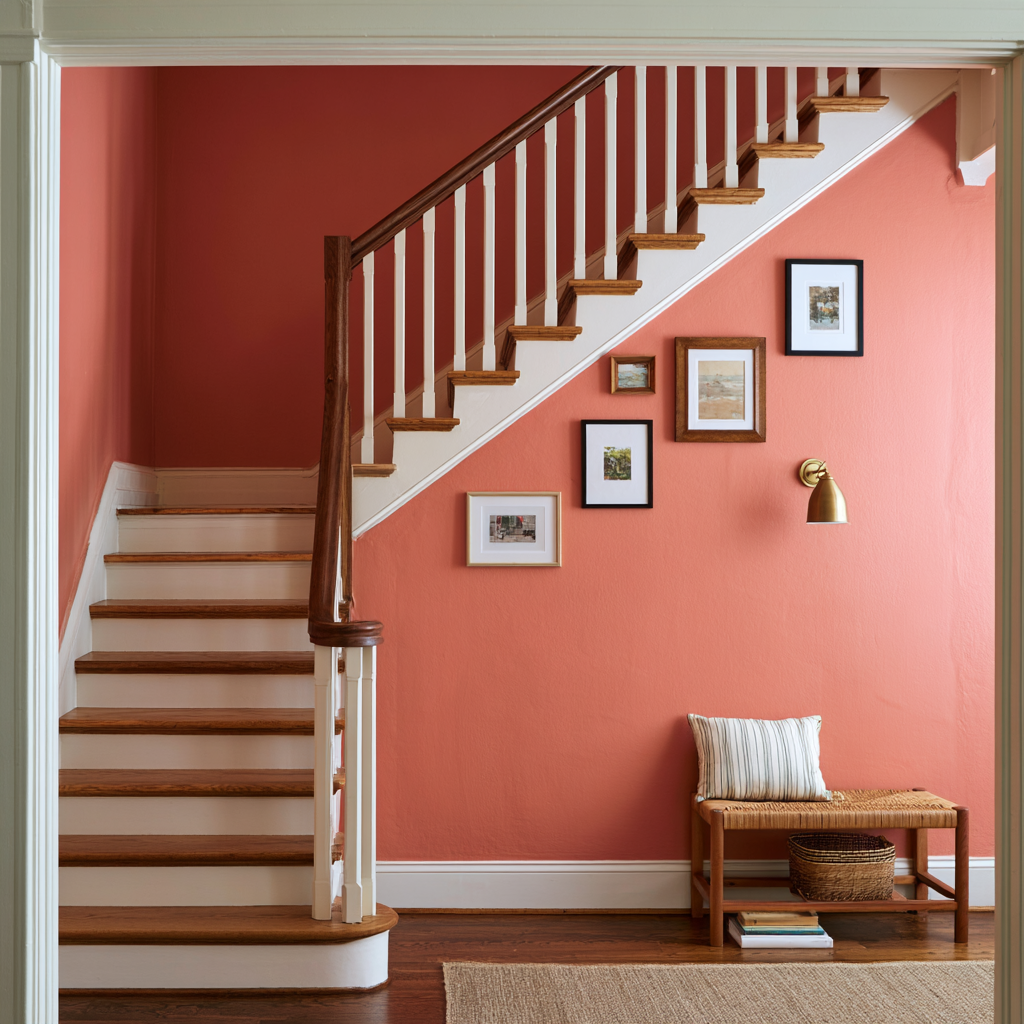
The wall under a staircase is the easiest place to take a risk with color. It is contained enough to feel low-stakes and visible enough to change the whole landing. Here the coral gives the area energy without asking the railing or treads to change a thing, the white trim keeps it crisp, and the wood rail keeps it from turning sweet. Because the furniture stays slim and off to one side, the color carries the space.
Painting the stair wall, touching up trim, adding a sconce, and styling the landing usually costs $600 to $2,000, plus labor if the sconce needs new wiring. If the staircase feels bland but is structurally sound, this is a low-risk place to begin, since wall color is much easier to undo than railing, storage, or millwork.
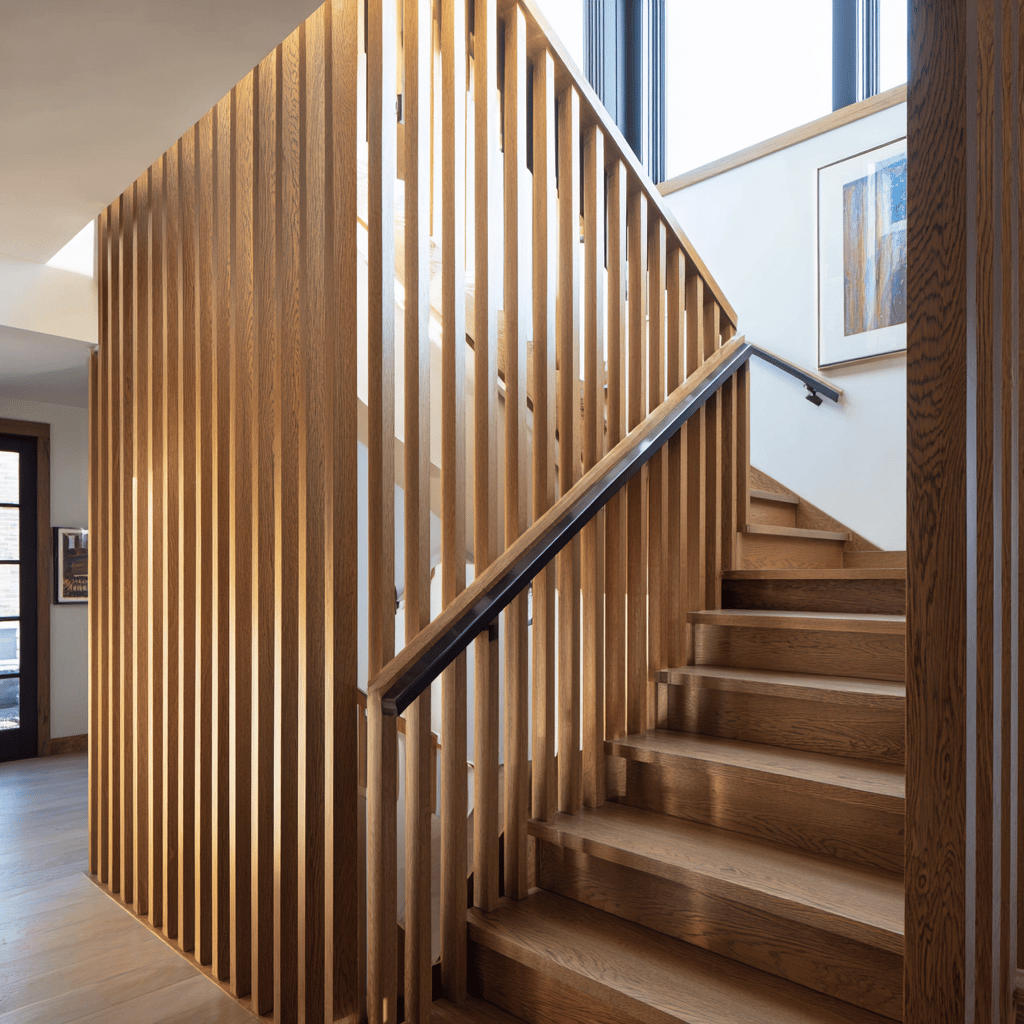
Vertical wood slats give a stairwell some separation without a full wall. They add rhythm and warmth to an open space while still letting light and sightlines through. Because they are so visible, the details have to stay calm: the wood tone should connect to the floor or nearby trim, the spacing should look intentional, and the top and bottom connections should be clean. Get any of that wrong and the feature starts to look like a cheap screen.
Custom slat dividers tend to run $3,500 to $12,000 depending on height, length, wood species, finish, and how involved the installation is. A short, straight screen costs much less than a full-height divider wrapping a stair opening.
This one carries a safety question. If the divider sits near an open stair edge, it may have to meet the same requirements as a guardrail, and wide gaps between slats can create a fall risk or simply make the whole thing look unfinished.
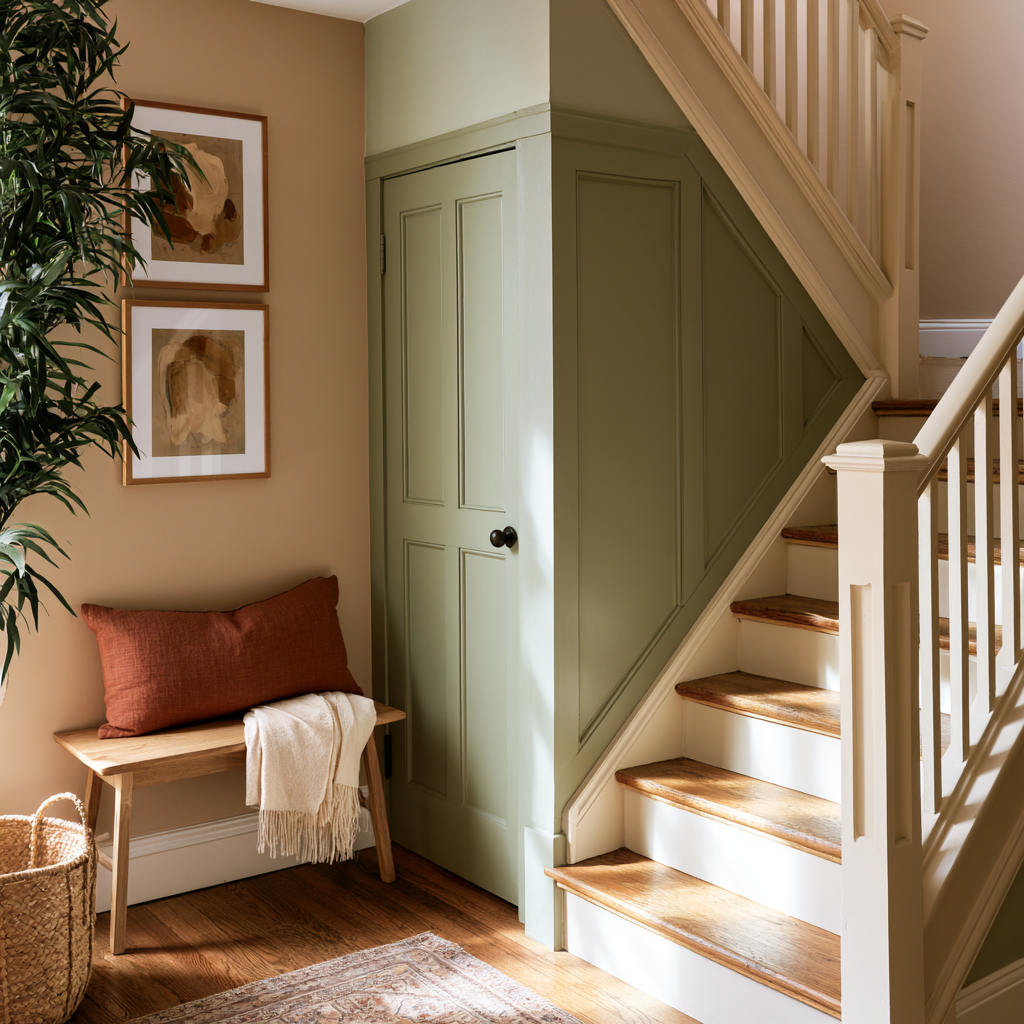
Color is what makes built-in storage feel designed rather than merely useful. The muted green here ties the under-stair door to the surrounding paneling, so the whole lower run looks intentional. In a small home, that buys you storage and structure without crowding the path with furniture. The bench and art soften the corner while staying clear of the stair approach, which is exactly what a tight space needs.
Repainting the surround, refreshing the doors, updating hardware, and handling light trim repairs usually costs $1,500 to $5,500. If the under-stair doors are already there, paint and new hardware alone can keep you near the low end.
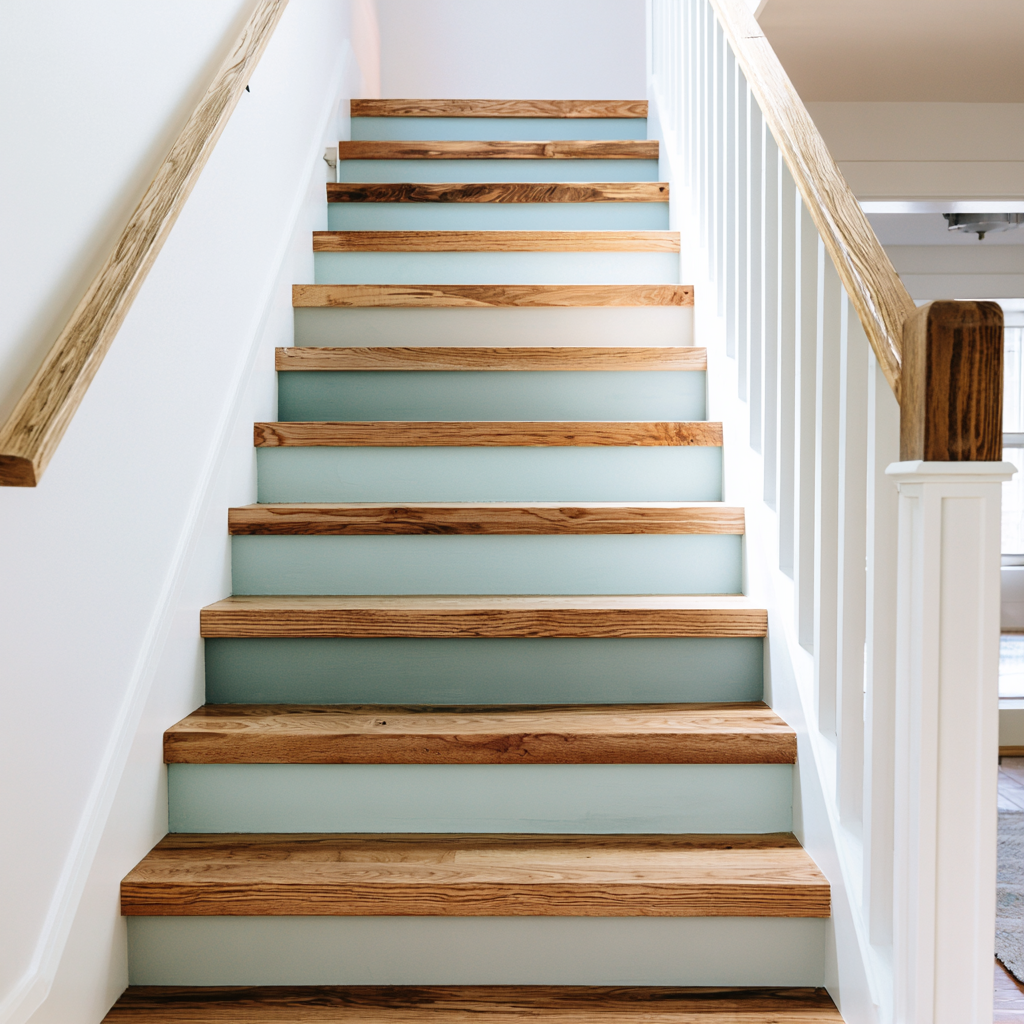
Painted risers give you color in small, repeatable bands while the treads stay natural wood, so the stairs still feel familiar underfoot and the view from the bottom gets a lift. The pale blue-green here works because it is fresh without being loud, and it gives the white trim and wood rail something to play against. In a narrow stairwell, that small amount of contrast is often enough.
Painting risers usually costs $400 to $1,200 for sanding, priming, and finish coats, more if the risers are damaged, glossy, or covered in old paint that needs extra prep. Durability is the catch. Risers get kicked and scuffed constantly, so use a hard trim paint, let it cure fully, and skip very flat finishes that show every mark.
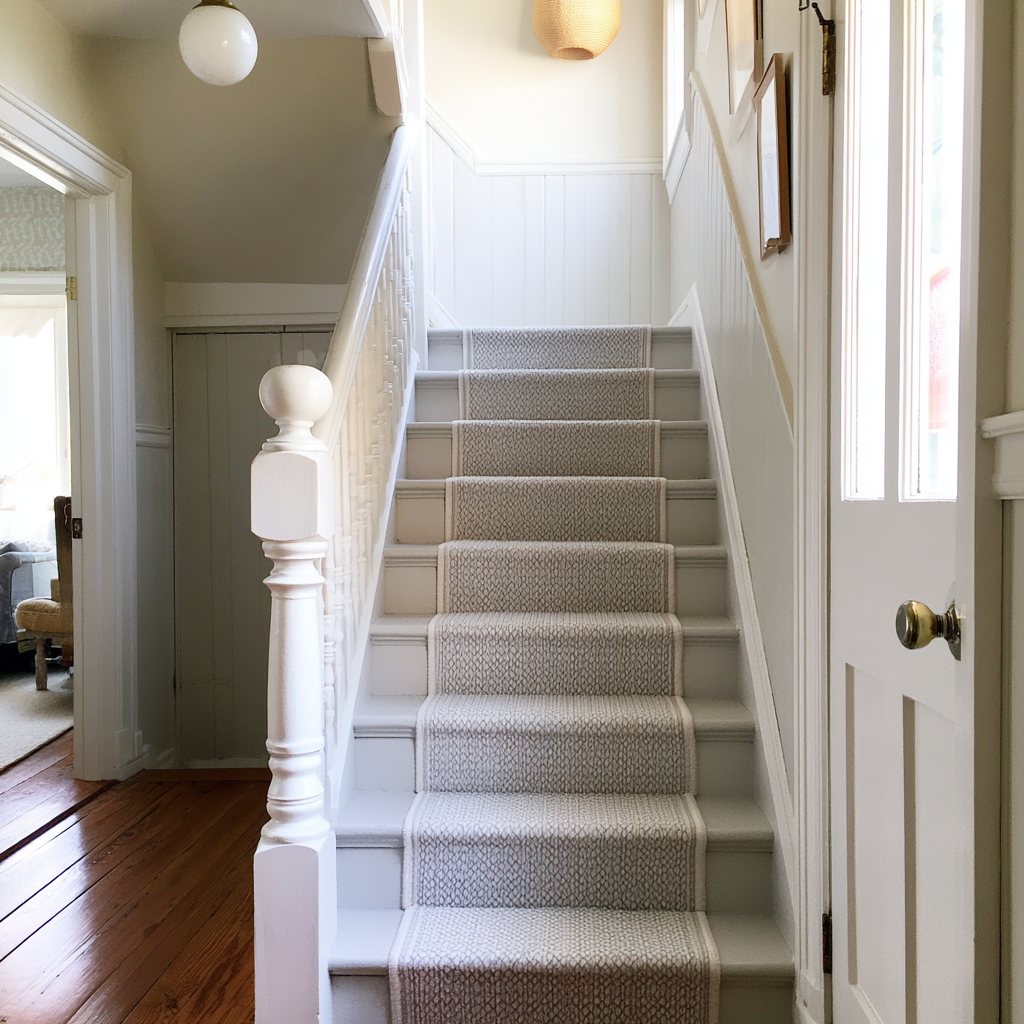
Texture is the quiet way to make a stairwell feel finished. A runner adds pattern and softness underfoot while lower-wall paneling gives the surrounding walls some depth, and together they warm up the space without leaning on a bold paint color. The pairing is also practical. The runner adds comfort and traction, and the paneling protects the lower wall where hands, bags, and pets are constantly brushing past.
A runner, its installation, lower-wall paneling, trim, and paint generally come to $2,000 to $6,000, with material choice driving the range, since wool runners and custom paneling cost more than basic carpet and simple beadboard.
Pay close attention to how the runner is installed. It has to be secured on every tread, because loose edges, poor alignment, or thick material bunching at the stair nose can turn a soft detail into a trip hazard.
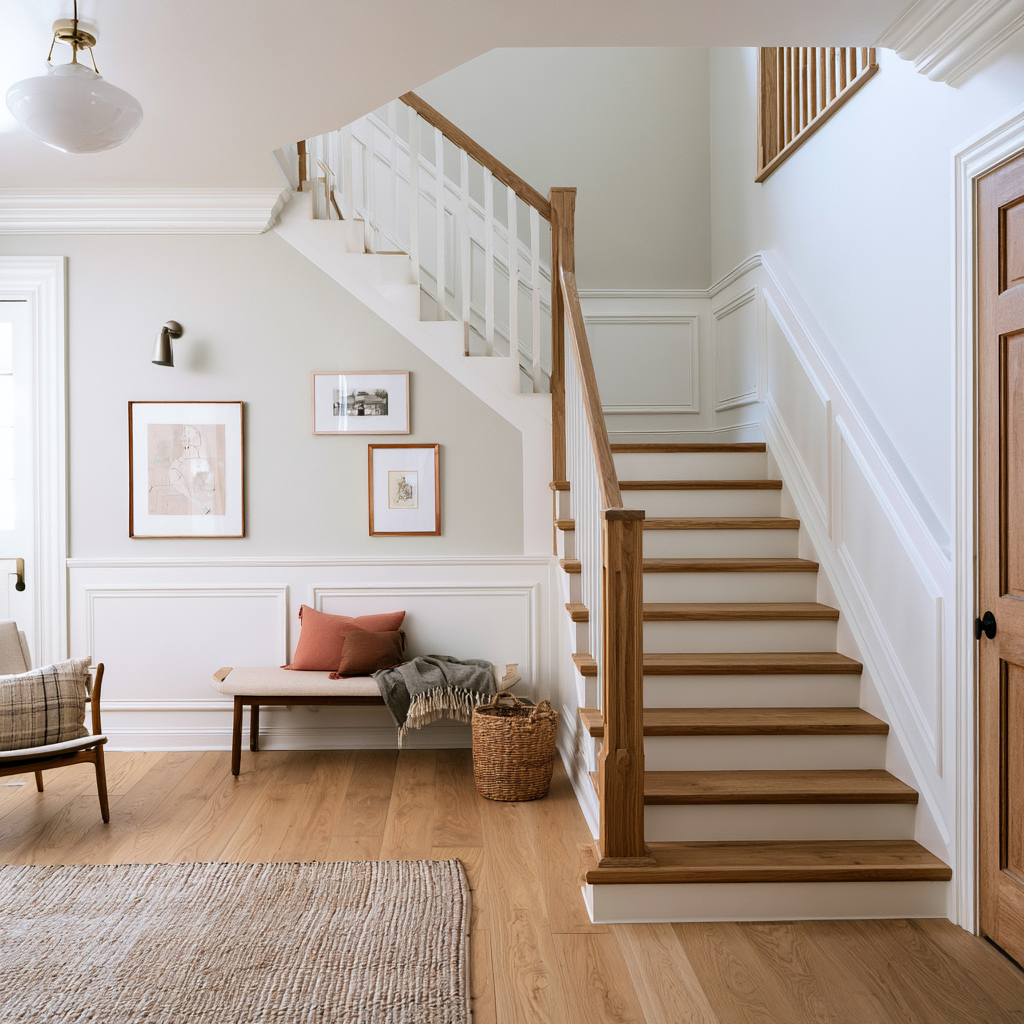
A plain stair wall can make an entire entry feel unfinished even when the stairs themselves are in good shape. Molding fixes that by giving the wall some proportion, and scale is the thing to get right: a few large, simple rectangles usually feel calmer than a grid of small boxes, especially on a sloped wall. Once the molding is up, the rest of the stairwell can stay quiet, because the wall already carries enough structure.
Picture-frame or panel molding around a stair wall tends to cost $1,500 to $5,000 for the trim carpentry, caulking, primer, and paint. A straight wall comes in lower than a stairwell with turns, landings, or uneven plaster. The one habit to resist is over-styling around the new trim, since a bench, a rug, and a piece or two of art usually finish the space, while anything more can make it feel formal fast.
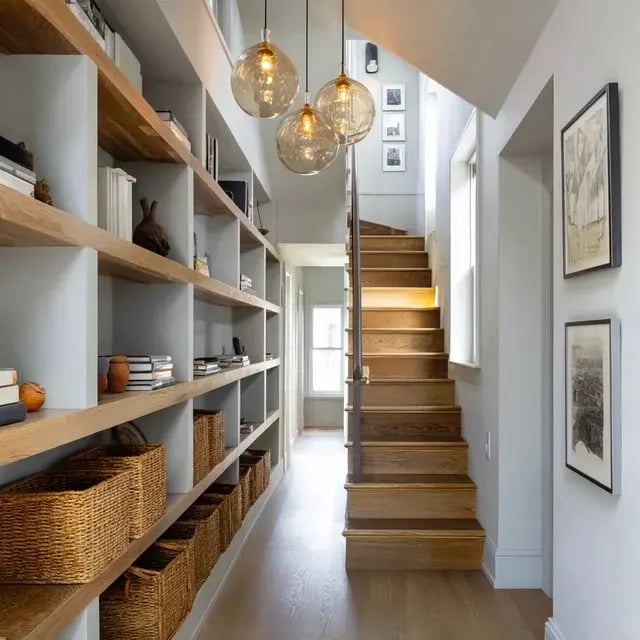
Even a narrow stair hall has a usable wall beside it. Built-in shelving puts that wall to work as storage, display, and lighting without setting furniture in the walking path, which is why it suits attic stairs, basement stairs, and long hallways so well. Baskets catch the small things that drift around a house, open shelves give books and ceramics a real home, and the stair path stays clear while the hallway stops feeling empty.
Built-ins along a stair wall can run $4,000 to $15,000 depending on size, materials, lighting, and whether the design includes doors or drawers. Open shelving usually costs less than closed cabinetry with integrated electrical.
Measurement matters more than styling here. Built-ins that project too far make a narrow stair hall feel cramped, so keep the shelves shallow enough that baskets, books, and decor never reach into the stair approach.
A staircase update can be as small as fresh paint on the risers or as involved as new railings, lighting, and structural work, and the bigger the project, the more it helps to work with a contractor who has priced this kind of thing before. Block Renovation matches homeowners with vetted local contractors and lines up their quotes side by side, so the scope is clear before anyone cuts into a wall.
Clarity counts most on a staircase, where the finished space has to look right and stay safe under daily use. With Block, you can compare bids, review the scope line by line, and get an expert read on the details that affect safety and structure before work begins.
Remodel with confidence through Block
Connect to vetted local contractors
We only work with top-tier, thoroughly vetted contractors

Get expert guidance
Our project planners offer expert advice, scope review, and ongoing support as needed
Enjoy peace of mind throughout your renovation
Secure payment system puts you in control and protects your remodel

Renovate confidently with Block
Easily compare quotes from top quality contractors, and get peace of mind with warranty & price protections.
Stairs
Staircase Remodel Ideas to Enhance Your Home
07.05.2026
Stairs
Under-Stairs Office & Desk: Design and Prep | Block
07.03.2026
.jpg?width=640&name=images%20(2).jpg)
Stairs
Stairs Remodeling: Cost, Ideas & What to Expect
05.21.2026

Stairs
Staircase Type Comparison: Find Your Perfect Style
01.15.2026
Stairs
Staircase Renovation Costs & Remodeling Tips
01.14.2026