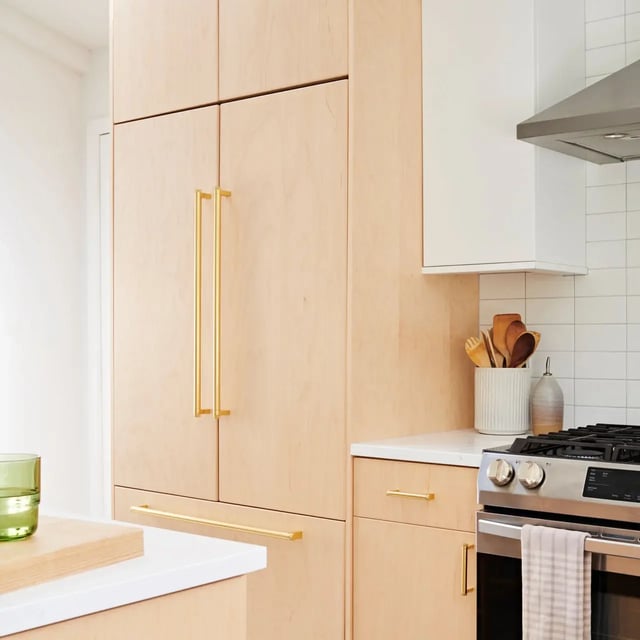
The most common types of kitchen countertops are quartz, granite, marble, quartzite, laminate, butcher block, solid surface, soapstone, porcelain (also sold as sintered stone), concrete, stainless steel, tile, and recycled glass. Quartz leads the market and covers about half of new installations, but the right material for your remodel depends on budget, maintenance tolerance, cooking habits, and the look you want the kitchen to hold for the next 15 or 20 years.
This guide compares all 13 kitchen countertop options on cost, durability, and upkeep, then helps you narrow the list to the one that fits how you actually cook and live.
Different types of countertops at a glance
The table below summarizes costs across every material in this guide. All cost ranges reflect installed prices per square foot, and they vary by market, slab selection, fabrication, edge profile, sink cutouts, installation complexity, and contractor availability. Stone and quartz are also sold by the slab, so a small kitchen can still pay for a full slab plus cutting waste.
|
Countertop type
|
Typical installed cost
|
Best for
|
|
Quartz
|
$50 to $150 per sq ft
|
Low-maintenance everyday kitchens
|
|
Granite
|
$40 to $140 per sq ft
|
Durability with natural variation
|
|
Marble
|
$60 to $150+ per sq ft
|
Classic veining in lighter-use kitchens
|
|
Quartzite
|
$70 to $200 per sq ft
|
Marble looks with more hardness
|
|
Laminate
|
$20 to $60 per sq ft
|
Tight budgets
|
|
Butcher block
|
$40 to $100 per sq ft
|
Warm, natural prep surfaces
|
|
Solid surface
|
$35 to $120 per sq ft
|
Integrated sinks and invisible joints
|
|
Soapstone
|
$70 to $120 per sq ft
|
Heat resistance and aged character
|
|
Porcelain/ sintered stone
|
$55 to $120 per sq ft
|
Thin profiles and outdoor durability
|
|
Concrete
|
$65 to $135 per sq ft
|
Custom shapes and industrial style
|
|
Stainless steel
|
$80 to $225 per sq ft
|
Serious cooks and modern kitchens
|
|
Tile
|
$10 to $50 per sq ft
|
Budget projects and easy spot repairs
|
|
Recycled glass
|
$50 to $125 per sq ft
|
Colorful, sustainable surfaces
|
13 types of kitchen countertops compared
Each material below follows the same format: pros, cons, cost, maintenance, who it suits, when to avoid it, and a closing note where one earns its place.
Quartz countertops
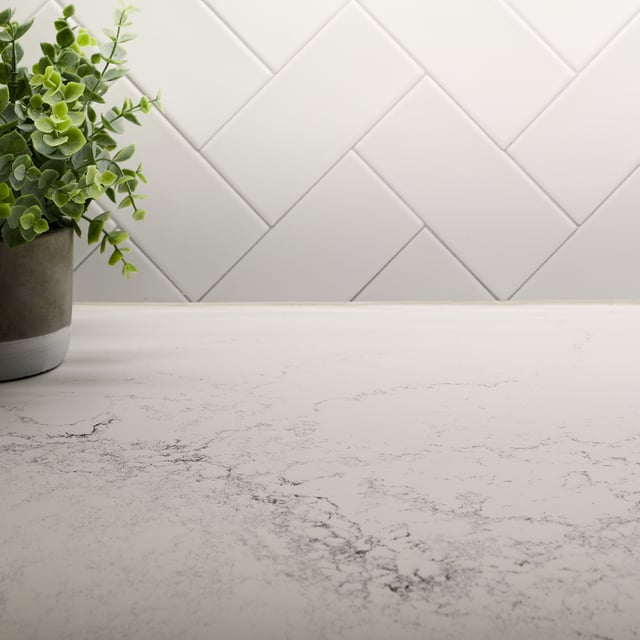
Quartz tops more new American kitchens than any other material, and despite the name, it is an engineered product rather than quarried stone. Manufacturers combine roughly 90% crushed natural quartz with resins and pigments, then press the mixture into slabs. Caesarstone, Cambria, and Silestone are all brands of engineered quartz, so treat their names as pattern catalogs rather than separate countertop types.
That manufacturing process explains both of quartz's defining traits. The resin makes the surface nonporous, so it resists stains without ever being sealed. Don't assume that toughness extends to heat, though. The same resin that blocks stains softens under high temperatures, and a pan straight off the burner can scorch or discolor the surface permanently.
- Pros: Quartz resists stains and scratches and never needs sealing. Patterns stay consistent from showroom slab to installed counter, and convincing marble look-alikes cost far less than the real thing.
- Cons: The resin binder limits heat tolerance, so trivets are mandatory. Some homeowners also find the uniformity too perfect next to the variation of granite or quartzite.
- Cost: $50 to $150 per square foot installed. Premium veined patterns and jumbo slabs sit at the top of that range.
- Maintenance: Soap, water, and a soft cloth.
- Best for: Busy kitchens where stain resistance matters more than natural stone pedigree.
- Avoid it if: You regularly set hot cookware directly on the counter. Quartz also fades under UV light, so skip it for outdoor kitchens.
- Remodel note: In the quartz vs. granite decision, quartz usually wins on upkeep and consistency while granite wins on heat tolerance and one-of-a-kind slabs. If you love a marble look without marble maintenance, compare marble-look quartz against natural quartzite before committing.
Granite countertops
Granite is igneous rock cut straight from the quarry, which makes every slab one of a kind. Patterns range from quiet grays and whites to dramatic blues, golds, and greens, and the material has served as shorthand for an upgraded kitchen for three decades.
It is also one of the most forgiving natural stones to live with. Granite handles hot pans, resists scratching, and with modern sealers, upkeep takes minutes a year.
- Pros: Granite tolerates heat, knives, and daily wear better than almost any natural stone. No two slabs match, which appeals to homeowners who want real geological character.
- Cons: Granite is porous and needs periodic sealing to resist stains. Slabs are heavy, repairs require a professional, and bold patterns can overwhelm a small kitchen.
- Cost: $40 to $140 per square foot installed.
- Maintenance: Resealing roughly once a year, though many modern sealers last several years. A water-drop test tells you when it is time: if water soaks in rather than beading, reseal.
- Best for: Cooks who want natural stone that can take real abuse.
- Avoid it if: You want pattern consistency or zero upkeep. And don't buy from a small sample: the pattern you fall for in the showroom can look entirely different across a full slab, so pick the actual slab before fabrication.
- Remodel note: Visit the stone yard in person and view full slabs in natural light. Small samples hide the scale of granite's movement.
Marble countertops
Marble is metamorphosed limestone, and it remains the most visually distinctive material in the premium category. Carrara, with soft gray veining on white, is the entry point. Calacatta and Statuario, with bolder veining on brighter backgrounds, cost considerably more.
Marble is also, honestly, high maintenance. It scratches more easily than granite, stains when spills sit, and etches when acids touch it. Lemon juice, vinegar, wine, and tomato sauce all leave dull marks in a polished finish within minutes, and sealing won't save you here: sealer slows staining, but acids react with the stone surface itself. Designers and homeowners keep choosing it anyway, because marble develops a patina over decades that engineered materials cannot copy.
- Pros: Nothing else looks quite like real marble. It stays cool to the touch, which bakers value for rolling dough, and a honed finish ages more gracefully than a polished one.
- Cons: Marble scratches, stains, and etches more easily than nearly every other countertop material. Etching, the dull spot acid leaves in the polish, cannot be wiped away and takes professional refinishing to remove.
- Cost: $60 to $150 per square foot installed. Carrara anchors the low end, while Calacatta and Statuario can climb past $250.
- Maintenance: Regular sealing and fast cleanup of anything acidic. Plan on resealing once or twice a year in a working kitchen.
- Best for: Lighter-use kitchens, baking stations, and homeowners who like a lived-in surface. A marble island paired with quartz perimeter counters is a popular compromise.
- Avoid it if: You expect the counters to look flawless in five years. A high-traffic family kitchen will mark polished marble no matter how careful everyone tries to be.
- Design tip: Choose a honed (matte) finish over polished if etching worries you. Etch marks show far less when there is no gloss to interrupt.
Quartzite countertops
Quartzite naturally gets confused with quartz because of their similar names. But don't be fooled; they're surprisingly different. Quartz is engineered in a factory, while quartzite is formed underground, consisting of sandstone that heat and pressure compressed into a stone harder than most granite. Many slabs carry the soft veining of marble, which is why quartzite keeps coming up for homeowners who want the marble look in a kitchen that actually gets used.
- Pros: Quartzite pairs marble-style veining with serious hardness. It handles heat well and resists the scratching and etching that mark real marble.
- Cons: It is one of the pricier natural stones, and its hardness makes fabrication slow and expensive. It is also porous, so it still needs regular sealing.
- Cost: $70 to $200 per square foot installed. Dramatic, marble-like slabs command the highest prices.
- Maintenance: Sealing once or twice a year and routine cleaning in between.
- Best for: Homeowners torn between marble and quartzite who want the look without the upkeep. It also suits resale-minded remodels, since buyers respond well to natural stone.
- Avoid it if: The budget is tight or your fabricator has little quartzite experience. Some slabs marketed as quartzite are softer mixed stones, so ask the supplier to verify with a scratch or acid test.
- Remodel note: Entry-level Carrara marble often costs less than quartzite, so the marble vs. quartzite decision usually comes down to durability rather than price. Compare slabs of both side by side before assuming you need true marble.
Laminate countertops
Laminate has carried a dated reputation since the 1980s, and modern product lines have mostly outgrown it. If you haven't looked at laminate since then, look again: Formica and Wilsonart now print convincing stone, wood, concrete, and matte looks onto resin-bonded sheets over a particleboard core. From across the room, a well-chosen pattern passes for stone at a fraction of the price.
- Pros: Laminate is the most affordable countertop material by a wide margin. Installation is fast, patterns are nearly unlimited, and replacing it years later costs little.
- Cons: Heat, deep scratches, and moisture at the seams all cause permanent damage. A scorch mark or swollen seam stays for the life of the counter.
- Cost: $20 to $60 per square foot installed. Premium textured finishes top the range and still undercut every slab material.
- Maintenance: Daily cleaning and basic caution. Keep standing water away from seams and keep hot cookware on trivets.
- Best for: Tight budgets, rentals, and kitchens that may be remodeled again within a decade.
- Avoid it if: Hot pans routinely move straight from burner to counter. Undermount sinks are also tricky, since most laminate cores swell on contact with water.
- Design tip: Choose a matte or textured finish over gloss. Texture hides minor scratches and makes stone-look patterns far more convincing.
Butcher block countertops
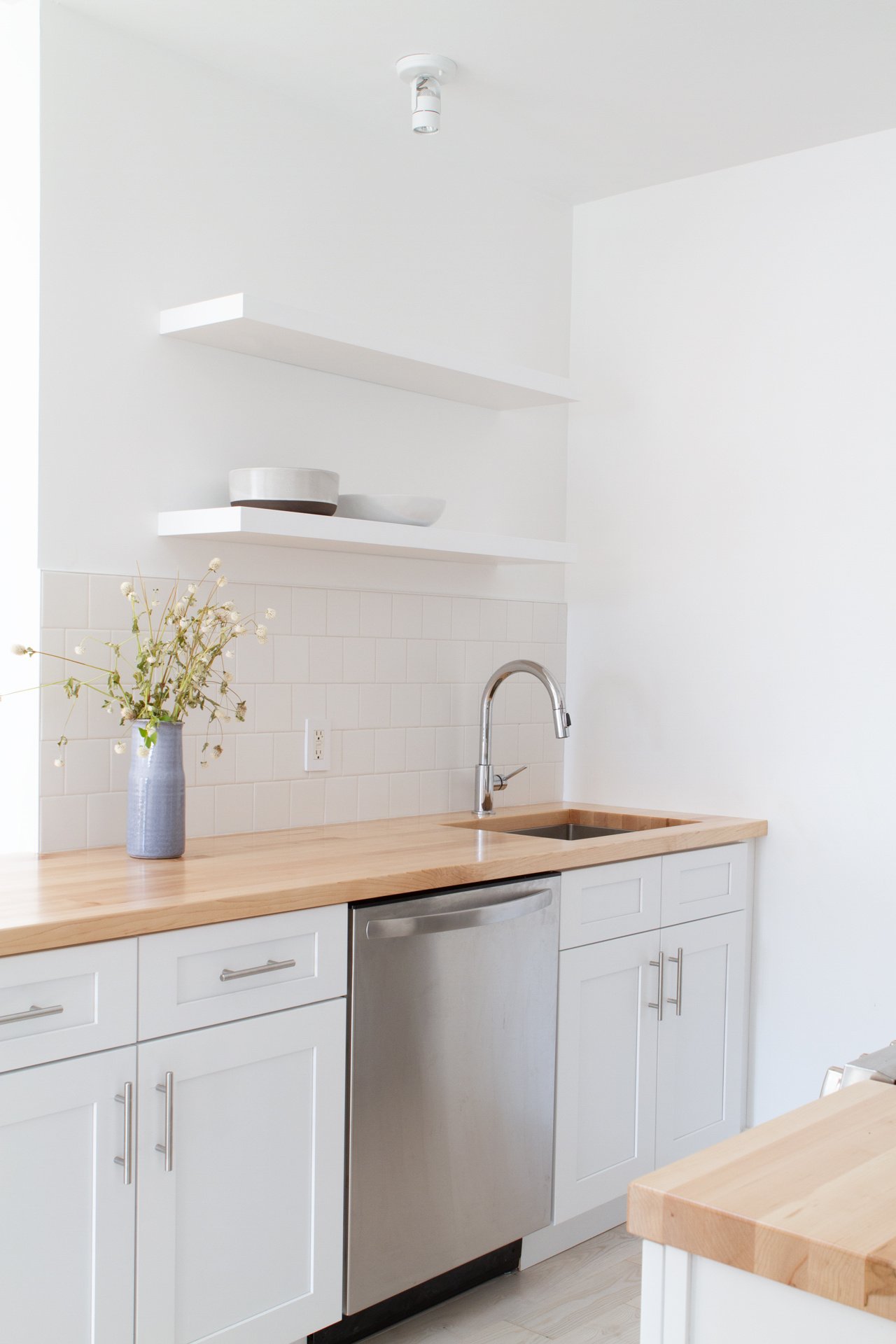
Butcher block is strips of hardwood, usually maple, oak, walnut, or cherry, glued into a slab. It brings a warmth into the kitchen that no stone matches, it is quiet under dishes, and it doubles as a forgiving prep surface.
Most homeowners worry about knife marks, and those sand out easily. Worry about water instead. Moisture around sinks, dishwashers, seams, and poorly sealed edges causes swelling, dark staining, and eventually splitting, so the sealing job matters more than the wood species.
- Pros: Wood warms a kitchen visually and physically, and minor damage sands out. A walnut island top can be refinished several times over its life.
- Cons: Water exposure causes swelling, darkening, and splitting, especially near sinks. Wood also dents, and unsealed sections stain quickly.
- Cost: $40 to $100 per square foot installed. Maple sits at the budget end, while walnut and exotic species cost considerably more.
- Maintenance: Depends on the finish. Oiled tops need food-grade mineral oil monthly, while film finishes like polyurethane or marine-grade sealers need less attention but rule out chopping directly on the surface.
- Best for: Islands, baking areas, and kitchens that want warmth against painted cabinets. Many homeowners pair a wood island with stone perimeter counters.
- Avoid it if: The counter surrounds an undermount sink and you won't commit to marine-grade sealing and immediate wipe-downs. The sink edge is the most common failure point for wood counters.
- Remodel note: Decide before installation whether the top is a display surface or a working cutting surface. The answer determines the finish, and switching later means sanding everything down.
Solid surface countertops
Solid surface is acrylic or polyester resin blended with minerals and formed into sheets, and Corian is the brand most homeowners know. The material's main advantage shows at the joints: installers glue sections together and sand the connections until they disappear, which allows long runs, gentle curves, and sinks molded directly into the counter.
- Pros: Joints sand down until they vanish, and sinks can be integrated into the counter itself. Scratches and burns can also be sanded out, which few materials allow.
- Cons: The surface scratches more easily than stone and tolerates little heat. A pan off the stove can leave a permanent mark.
- Cost: $35 to $120 per square foot installed. That places it between laminate and mid-range quartz.
- Maintenance: Soap and water, with no sealing ever. Light scratches buff out with an abrasive pad.
- Best for: Homeowners who want an integrated sink and no joints to clean.
- Avoid it if: Heat tolerance or a natural stone look tops your list. Up close, solid surface looks like what it is, a uniform synthetic.
- Design tip: Matte, light colors hide scratches best. Dark, glossy solid surface shows every mark.
Soapstone countertops
Soapstone is a talc-rich natural stone in shades of gray, green-gray, and charcoal that darkens as it ages. It is dense and completely nonporous, so it never needs sealing, and it tolerates direct heat better than almost anything else in this guide. Colonial American kitchens used it for exactly that reason, and it still suits both farmhouse and modern designs.
The catch is softness. Soapstone scratches and dents under daily use, though most marks rub out with mineral oil or fine sandpaper.
- Pros: Soapstone never needs sealing and accepts hot cookware directly on the surface. Its matte, stone-soft look fits vintage and modern kitchens alike.
- Cons: It scratches and dents more easily than granite or quartzite. Color choices stay within a narrow gray-to-charcoal band.
- Cost: $70 to $120 per square foot installed. Limited quarry sources keep prices from dipping much lower.
- Maintenance: Optional mineral oiling to keep the natural darkening even. Skip the oil and the patina develops in patches before evening out on its own.
- Best for: Cooks who set pans down without thinking and homeowners drawn to aged surfaces. It is also a favorite in historic renovations.
- Avoid it if: Scratches and dents will bother you rather than blend in. Anyone who wants a bright or colorful counter should look elsewhere, since soapstone stays dark.
- Design tip: Ask the fabricator for an oiled sample and an untreated sample. The stone darkens dramatically with oil, and the final shade surprises some homeowners.
Porcelain and sintered stone countertops
Porcelain slabs and sintered stone (Dekton and Neolith are the brands you will see most) are made by compressing mineral powders under extreme heat and pressure. The result is one of the hardest, most stable surfaces available: heat-proof, UV-stable, stain resistant, and thin enough to install at 6 to 12 millimeters. It is currently the fastest-growing countertop category in the U.S. market. One clarification, since the name misleads: these are large-format slabs, a different product from the porcelain tile covered below.
- Pros: Porcelain resists heat, UV, stains, and scratches, and it never needs sealing. It works outdoors, and the thin slabs can extend up walls or across cabinet faces to match.
- Cons: Many slabs carry a surface-printed pattern, so cut edges may not show the veining running through. Chipped edges are hard to repair, and inexperienced fabricators can crack slabs during cutting.
- Cost: $55 to $120 per square foot installed. Thicker slabs and full-body veining cost more.
- Maintenance: Daily cleaning and nothing else.
- Best for: Low-maintenance kitchens, outdoor kitchens, and modern designs with slim counter profiles. It also suits homeowners who want a matching full-height backsplash.
- Avoid it if: Your area lacks fabricators experienced with the material. Installation expertise matters more here than with granite or quartz.
- Design tip: Ask whether the pattern is full-body or surface-printed before choosing an edge profile. A mitered edge hides printed-edge issues on waterfall islands.
Concrete countertops
Concrete countertops are cast to order, either in place or in a fabricator's shop, which makes them the most customizable option in this guide. Integral drainboards, molded sinks, embedded objects, unusual shapes, and custom pigments are all possible.
Quality varies with the maker more than with any other material here.
- Pros: No other material offers this range of custom shapes, colors, and textures. Properly sealed concrete is strong and heat tolerant.
- Cons: Hairline cracks are common and usually cosmetic, but they bother some homeowners. The material is heavy, porous without sealer, and dependent on the fabricator's skill.
- Cost: $65 to $135 per square foot installed. Custom features like integral sinks push higher, since you are paying for craft as much as material.
- Maintenance: Resealing every one to three years. Worn or unsealed spots absorb oil and wine quickly.
- Best for: Industrial, modern, and custom designs that off-the-shelf slabs cannot match. It rewards homeowners who like a handmade look.
- Avoid it if: You want a maintenance-free counter or guaranteed crack-free perfection.
- Remodel note: Vet the fabricator's portfolio carefully, since concrete quality depends on the person casting it. Ask to see installations that are at least five years old.
Stainless steel countertops
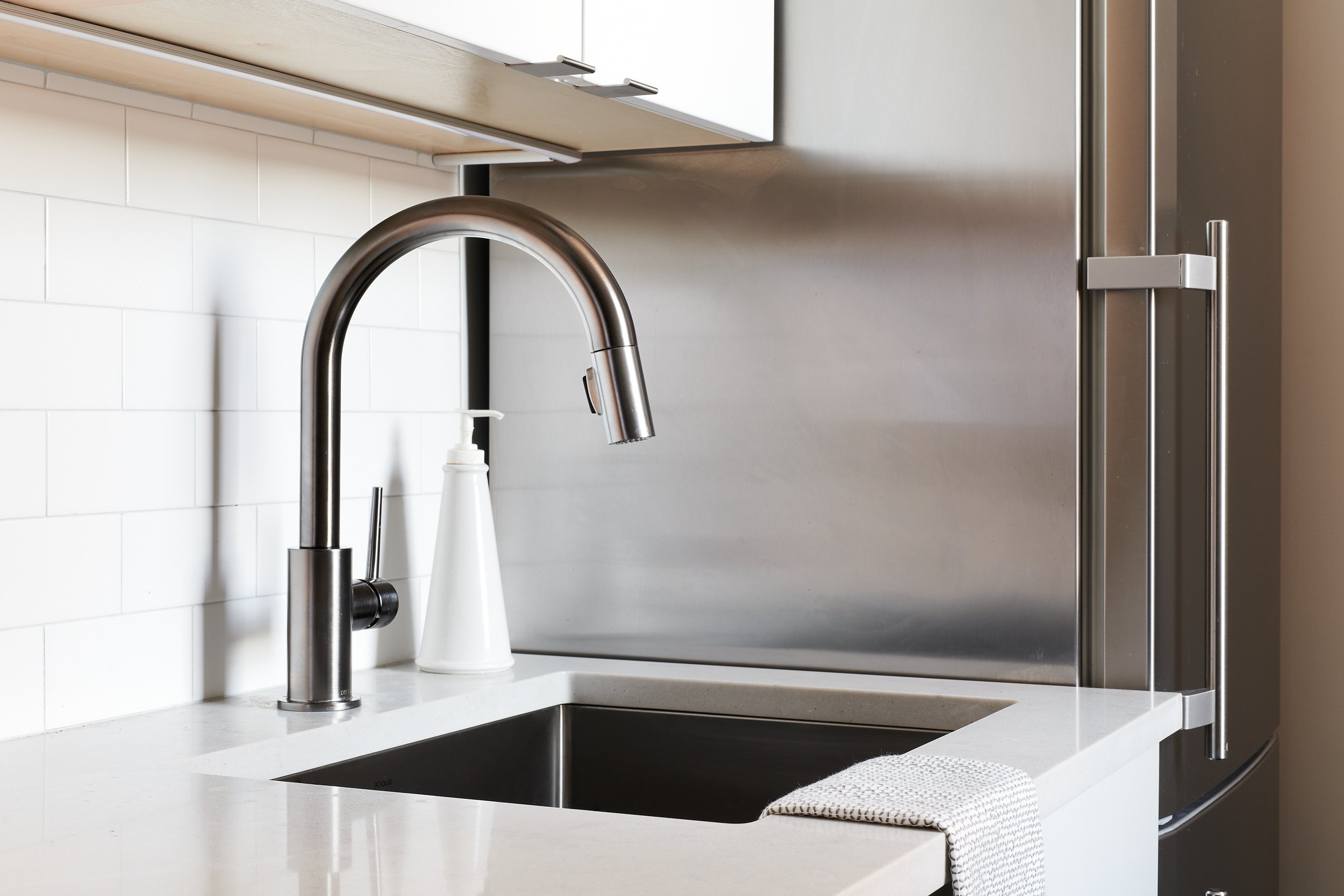
Stainless steel is the standard in professional kitchens for practical reasons: it is nonporous, hygienic, completely heat-proof, and easy to sanitize. In homes it sets a clean, modern tone, especially paired with wood cabinets that soften the industrial effect.
Expect scratches. Stainless steel marks in normal use, and over the years those fine scratches blend into a soft, brushed patina.
- Pros: Steel tolerates any heat, never stains, and wipes truly clean. Custom fabrication allows integrated sinks and backsplashes with no joints to trap grime.
- Cons: It scratches and dents, shows fingerprints, and can feel cold in some kitchens. It is also among the pricier options once custom fabrication is included.
- Cost: $80 to $225 per square foot installed. Thicker gauges and integrated features raise the price.
- Maintenance: A daily wipe and an occasional polish for fingerprints. A brushed finish hides smudges better than a mirror finish.
- Best for: Serious home cooks and modern or industrial designs. It pairs especially well with a butcher block island.
- Avoid it if: You need the surface to stay pristine. A household that drops cast iron will dent steel eventually.
- Design tip: Order a brushed or matte finish rather than polished. The patina develops more evenly and fingerprints mostly disappear.
Tile countertops
Tile countertops fell out of fashion as slab materials got cheaper, but they still solve real problems. Ceramic and porcelain tile cost less than any slab except laminate, a cracked tile can be replaced individually, and handmade or patterned tile creates looks no slab can.
Grout is the weak point. The joints stain, collect grime, and need scrubbing and periodic resealing, and the surface is never perfectly flat.
- Pros: Tile is inexpensive, repairable one tile at a time, and available in endless colors and patterns. Porcelain tile also handles heat well.
- Cons: Grout lines stain and demand ongoing scrubbing and resealing. The uneven surface frustrates bakers and anyone wiping up flour or crumbs.
- Cost: $10 to $50 per square foot installed for ceramic and porcelain. Natural stone tile costs more but still undercuts the equivalent slab.
- Maintenance: Mostly grout care. Plan to reseal it yearly and scrub it more often than you would like.
- Best for: Budget remodels, vintage looks, and homeowners who value easy spot repairs. Large-format tile with thin grout lines reduces the maintenance burden.
- Avoid it if: Grout upkeep already sounds like a dealbreaker, because it usually becomes one.
- Design tip: Choose epoxy grout or a dark grout color. Both hide stains dramatically better than standard light grout.
Recycled glass countertops
Recycled glass countertops suspend crushed bottle and window glass in either a cement or resin binder. The look ranges from confetti-bright to subtle terrazzo, and the sustainability angle appeals to homeowners sourcing their remodel deliberately.
- Pros: Each counter diverts glass from landfills and produces a one-of-a-kind terrazzo look. Resin-based versions resist stains well.
- Cons: Edges and corners can chip, and cement-based versions absorb stains without regular sealing. Acidic spills can also etch cement binders, much like marble.
- Cost: $50 to $125 per square foot installed.
- Maintenance: Depends on the binder. Resin versions need only daily cleaning, while cement versions need sealing once or twice a year.
- Best for: Colorful, eclectic, or sustainability-focused remodels. It also fits midcentury designs where terrazzo belongs.
- Avoid it if: You want a quiet, uniform surface or worry about edge chips. High-traffic corners take the most damage.
- Design tip: Ask whether the binder is cement or resin before comparing prices. The two perform differently enough to count as separate materials.
Best kitchen countertop materials by priority
If you already know your top priority, start here:
- Best low-maintenance countertop: quartz or porcelain. Neither needs sealing, and both clean up with soap and water.
- Best budget countertop: laminate or tile. Laminate wins on smoothness, while tile wins on repairability.
- Best natural stone countertop: granite or quartzite. Both stand up to daily cooking, with quartzite taking the durability edge at a higher price.
- Best luxury countertop: marble or dramatic quartzite. Marble offers the classic patina, while bold-veined quartzite carries the statement look with less upkeep.
- Best countertop for serious cooks: granite, stainless steel, or soapstone. All three accept hot cookware directly, which quartz cannot.
- Best warm, natural look: butcher block. Pair it with stone perimeter counters to limit water exposure.
- Best modern look: concrete, stainless steel, porcelain, or quartz. Thin porcelain profiles and waterfall quartz edges define current modern kitchens.
- Best countertop for resale value: quartz, granite, or quartzite. Buyers recognize all three as upgrades, and quartz carries the broadest appeal right now.
How to choose a countertop material
Start with the budget
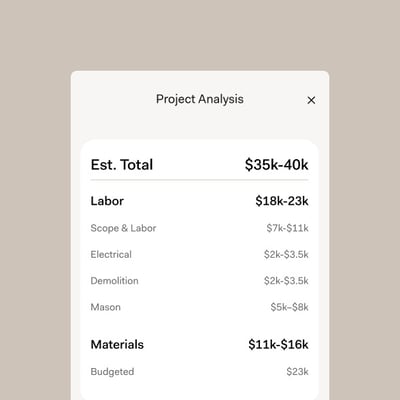
Countertops typically take up about 10% of a kitchen remodel budget, so set your number before you fall in love with a slab. Remember that the per-square-foot price is only a starting point: slab sizing, fabrication waste, edge profiles, sink cutouts, and removal of the old counter all move the total. Our kitchen remodel cost guide breaks down where the rest of the budget goes, and the kitchen remodel estimator can put a realistic number on your specific project.
Be honest about maintenance
Every material on this list is livable when its upkeep matches the owner. Sealing granite once a year takes 20 minutes, and oiling butcher block adds a few minutes a month. The trouble starts when a homeowner who will never reseal anything buys marble.
If your maintenance ceiling is zero, the realistic shortlist is quartz, porcelain, solid surface, stainless steel, and laminate.
Match the material to how you cook
Bakers benefit from marble's cool surface or wood's forgiving give, while households that sear in cast iron and set pans down hot should look at granite, soapstone, quartzite, porcelain, or steel. Think about heat, knives, acidic ingredients, and standing water, then check those habits against the cons listed for each material above.
Coordinate with the rest of the kitchen
The counter sits between the cabinets and the backsplash, so choose the three together. A busy granite pattern works best over quiet cabinet colors, and a dramatic veined island deserves simple surroundings. Lighting also changes stone more than homeowners expect, since warm undercabinet light can turn a cool gray quartz beige.
Our kitchen cabinet guide and kitchen backsplash guide cover the supporting choices, and the kitchen visualizer and cabinet visualizer let you test combinations before buying anything.
Decide between natural variation and engineered consistency
Natural stone guarantees that your counter matches no one else's, and engineered surfaces guarantee that the installed slab matches the sample. Neither answer is wrong. Homeowners who return to the stone yard three times to stare at one quartzite slab should buy the quartzite, while anyone who values predictability will be happier with quartz or porcelain.
Factor in installation
Slab materials require professional templating, fabrication, and installation, and heavy stones sometimes require cabinet reinforcement. Porcelain demands fabricators with specific experience, and concrete depends entirely on the individual maker. When you compare contractor quotes, confirm that templating, edge work, cutouts, old counter removal, and plumbing reconnection all appear as line items, because a missing line item usually becomes a change order.
Order samples before you commit
Bring samples home and abuse them. Set a hot mug on the laminate, leave lemon juice on the marble overnight, drag a key across the solid surface, and splash red wine on anything cement-based. If a sample fails one of those tests, it just saved you from the full-counter version of the same problem.
Plan your countertop installation with Block Renovation
A countertop is rarely a standalone decision. The same remodel usually involves cabinets, plumbing, and electrical work, plus a contractor who can coordinate the fabricator and keep the schedule intact. Block matches homeowners with vetted local contractors, collects competitive bids, and reviews every project scope to catch missing line items, like that old counter removal fee, before they turn into change orders. When you are ready to put a real price on your kitchen, start by getting matched with vetted contractors through Block and compare detailed quotes side by side.