



Cost
Attic Renovation Costs in 2026: Finish or Convert an Attic
07.20.2026
06.18.2026


.webp?width=640&name=bathroom%20custom%20shower%20remodeled%20small%20attic%20(1).webp)
In This Article
Stand in your unfinished attic and the space looks like easy square footage: a wide floor, a high peak, room for a bedroom or even a small apartment. Far less of it will count as legal living space than it looks, and that gap is the difference between adding a real bedroom and spending $50,000 on a room you still cannot call one. You can find out which one you have yourself, with a tape measure and a single question, before you call anyone: does enough headroom survive once the floor and roof are brought up to code?
Which rules apply depends on what you are building. A room for yourself, whether a bedroom, an office, or a playroom, only has to meet the code for habitable space. Rent it out and you add a second set of rules for a separate dwelling, which can mean thousands of dollars between two otherwise identical attics.
The good news is that you can settle the headroom question yourself, with a tape measure, before you spend a dollar.
The code sets one main number. The International Residential Code, what most of the country builds to, requires a 7-foot ceiling in any habitable room. Attics are where that rule gets strict, because the ceiling slopes: at least half the floor you plan to use has to sit under the 7-foot line, and anything under 5 feet does not count as living area at all.
So grab a tape measure and check three things from inside the attic.
The upgrades come with a catch. Bringing the floor and roof up to code adds depth to the framing, and that deeper lumber sits lower in the room and tighter against the slope, shrinking the very space that made the attic look convertible. So whatever the tape measure says today, plan to build with less than that.
A bedroom, a home office, or a quiet room for the kids is the simpler path, and many rafter-framed attics with real headroom can reach it. The room needs at least 70 square feet, with no dimension shorter than 7 feet, so a usable space starts around 7 feet by 10.
A sleeping room has one requirement an office does not: a way out in a fire. Every bedroom needs an emergency escape opening sized for a firefighter in gear, a net clear opening of 5.7 square feet, at least 20 inches wide and 24 inches tall, set low enough to climb through. In a finished attic that usually means a dormer window or a roof egress unit, which runs roughly $2,500 to $5,000 to cut in.
A pull-down ladder does not qualify for a habitable room, so you need a real, code-compliant attic staircase, and a typical one needs about 10 linear feet of floor to run its rise. That floor has to come from the level below, which usually means giving up a closet or the corner of a room downstairs to reach the new space upstairs, so plan for that lost square footage from the start.
An apartment is a bigger legal lift than a room. A personal room only has to satisfy the code for habitable space, but a rental adds the rules for an independent dwelling unit too, and that second set is longer and more local. Before you design anything, find out which category your town uses for the project: an accessory dwelling unit, an in-law suite, or a two-family conversion. Each comes with its own rules for parking, owner occupancy, and sometimes fire and sound separation between units.
Several other requirements apply to a legal rental that a finished room avoids, and they are worth confirming before the design is set: separate utility meters, fire and sound separation between the dwellings, an owner living on the property, and limits or bans on short-term rental. Any one of them can change the layout or the budget, so confirm them with your building and zoning departments early.
Skipping the permit to avoid that list usually backfires. An unpermitted unit can still bring in rent, but it can cost you later in three ways: a failed appraisal, a denied homeowners claim after something goes wrong, or a sale that stalls when a buyer's lender will not finance unpermitted space.
Once the attic clears the feasibility test, the job runs in a fairly fixed order. Knowing the sequence helps you read a contractor's schedule and catch a bid that leaves a step out.
The per-square-foot number every cost guide leads with is the least reliable thing about an attic. Two houses with identical attic square footage can differ by $40,000 on framing and stair location alone, because those two factors determine how much of the structure you rebuild versus simply finish.
Most of the cost falls into three buckets.
|
Cost driver |
Typical range |
What moves it |
|
Structure and framing |
$10,000 to $35,000 |
Truss roof, undersized joists, new dormers |
|
Stair and egress |
$5,000 to $15,000 |
Where the stair lands, cutting in a dormer |
|
Systems and finishes |
$15,000 to $45,000 |
Separate HVAC, plumbing for a bath, insulation |
A heating and cooling system sized for the floors below usually cannot keep an attic comfortable, since the attic sits directly under the roof and gets much hotter in summer, so plan for a separate zone or a ductless unit. Insulation and ventilation are not optional either, because energy codes require high attic insulation values and an air gap above them.
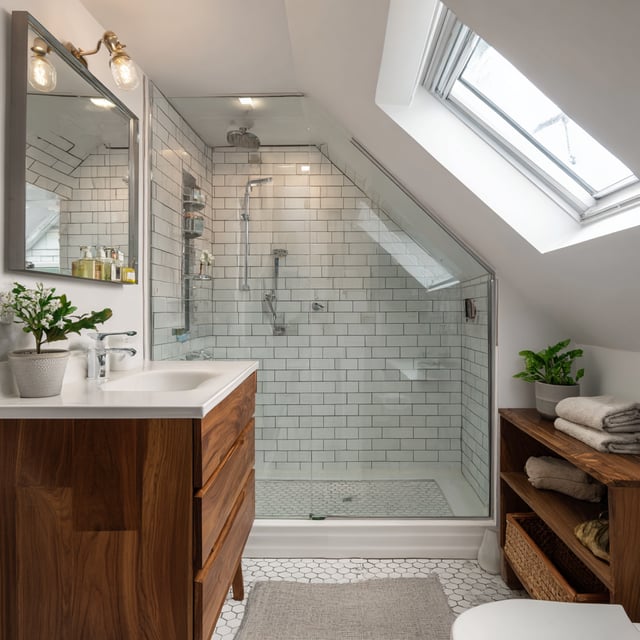
An attic bathroom adds the most to the budget, because it routes plumbing, a vent stack, and waste lines into a floor that may not be framed to carry them. For a personal room, that spend is usually a vanity purchase you will not recoup, and the staircase you resented for the first two weeks tends to feel normal by month two, so think hard before you commit to a full bath up there. A straightforward personal-room conversion often runs $30,000 to $80,000, and an apartment with its own kitchen, bath, and exterior stair runs higher.
That top end deserves a hard look. Once you price the structural reinforcement, the dormers, and a code-compliant stair, a steep but shallow attic can cost nearly as much as a modest second-story addition, and the addition gives you full-height walls instead of sloped ones, so which way your own project goes depends mostly on the framing you already have.
Spending real money to finish an attic does not guarantee the square footage shows up when you sell. Appraisers commonly measure homes by a national standard called ANSI Z765, and under it a finished attic counts toward your gross living area only if it clears the same ceiling math the building code uses and you reach it by a conventional, heated staircase. A pull-down stair, or a finished room where most of the floor sits under a low slope, can leave an appraiser unable to add a single official square foot, even after a $50,000 job.
The resale side is modest, too. Cost recovery on an attic-to-living-area conversion tends to run around two-thirds, one of the softer returns among interior projects and close to what a basement conversion recovers.
Two things follow from that:
A habitable conversion needs a permit in nearly every jurisdiction, and the inspection is where those requirements get verified instead of assumed. A plan reviewer will want to see the framing sizes, the stair geometry, the egress opening, the ceiling heights across the sloped sections, and the smoke and carbon monoxide alarms wired in.
Pulling the permit also puts the finished area on record with your assessor, which is the honest path and sometimes a costly one, because added finished square footage can trigger a property tax reassessment. That cost is small next to what an unpermitted room can cost you when you sell, so build it into the budget from the start.
The biggest variable in an attic project is whether your contractor reads the framing and headroom correctly before the first wall goes up. A misjudged truss roof or an undersized joist is the difference between a smooth job and a stalled one, which is why the contractor you pick matters more here than in almost any other room.
Every scope gets an expert review to catch missing line items and red flags early, so the bids you compare rest on the same facts. You pay through a secure system that releases money to the contractor only as the work gets done, and a Block project planner stays available for questions along the way.
Remodel with confidence through Block

Connect to vetted local contractors
We only work with top-tier, thoroughly vetted contractors

Get expert guidance
Our project planners offer expert advice, scope review, and ongoing support as needed
Enjoy peace of mind throughout your renovation
Secure payment system puts you in control and protects your remodel

Renovate confidently with Block
Easily compare quotes from top quality contractors, and get peace of mind with warranty & price protections.
Cost
Attic Renovation Costs in 2026: Finish or Convert an Attic
07.20.2026
Attic
Convert Attic to Living Space: Costs and Code
06.18.2026
Attic
Denver Attic Renovation: Making Your Attic Actually Livable
04.21.2026
Attic
Atlanta Attic Renovations: Older Homes, Structural Considerations & Design
04.13.2026
Attic
Finishing Your Seattle Attic: A Practical Guide | Block Renovation
04.06.2026